


























Views
Downloads

Printable Book Review Slips | Grade 2 ELA
Paste this activity's link or code into your existing LMS (Google Classroom, Canvas, Teams, Schoology, Moodle, etc.).
Students can open and work on the activity right away, with no student login required.
You'll still be able to track student progress and results from your teacher account.
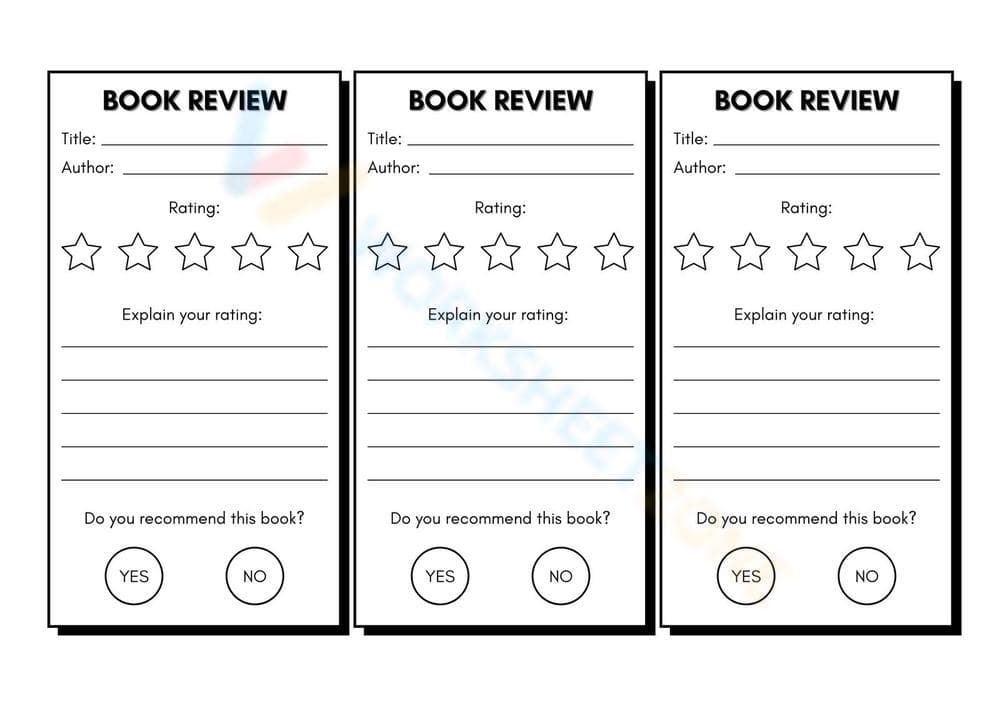
This printable book review slips worksheet helps second-grade students express their opinions about texts they have read. By filling out these simple, structured slips, young readers practice identifying basic book information, assigning a star rating, and writing a brief explanation to support their viewpoint.
At a Glance
- Grade: 2 · Subject: ELA
- Standard:
CCSS.ELA-LITERACY.W.2.1— Write opinion pieces about a book with supporting reasons.- Skill Focus: Opinion Writing & Book Reviews
- Format: 1 page · 3 slips · No answer key · PDF
- Best For: Independent reading centers
- Time: 10–15 minutes
What's Inside
This single-page resource includes three identical book review slips designed to be cut out and distributed. Each slip features dedicated spaces for the book's title and author, a five-star rating scale for students to color, four lined rows to explain their rating, and a simple yes-or-no bubble to indicate whether they recommend the book to a friend. The straightforward layout encourages concise writing without overwhelming early learners.
Zero-Prep Workflow
Implementing these review slips requires virtually zero teacher preparation.
- Print (1 minute): Generate as many copies as needed for your classroom library or reading center.
- Distribute (1 minute): Cut the page into thirds or hand the full sheet to students to cut themselves after finishing a book.
- Review (1 minute): Quickly scan the completed slips to check for comprehension and basic sentence structure.
With a total prep time of under two minutes, this resource is an excellent addition to any emergency sub plan or daily reading routine.
Standards Alignment
This activity is directly aligned with primary standard CCSS.ELA-LITERACY.W.2.1: Write opinion pieces in which they introduce the book they are writing about, state an opinion, supply reasons that support the opinion, use linking words, and provide a concluding statement. It also supports basic reading comprehension by asking students to recall the title and author. Both standard codes can be copied directly into lesson plans, IEP goals, or district curriculum mapping tools.
How to Use It
These slips are highly versatile for daily classroom routines. First, they serve as an excellent post-reading activity; students can complete a slip and drop it into a recommendation jar. Second, they work well as a quick exit ticket after a read-aloud to gauge engagement. As a formative assessment tip, observe whether students use specific details from the text when explaining their star rating, rather than generic phrases. Expected completion time is 10 to 15 minutes per slip.
Who It's For
This resource is primarily designed for second-grade students, though it easily adapts for first graders needing structured writing practice or third graders requiring a quick comprehension check. To differentiate for developing writers, teachers can provide sentence frames on the board. It pairs perfectly with a classroom library display where students can read each other's recommendations before selecting their next book.
Integrating regular opinion writing tasks like these book review slips significantly enhances early literacy development in the elementary classroom. Aligned with CCSS.ELA-LITERACY.W.2.1, this activity requires students to write opinion pieces about a book with supporting reasons. According to Fisher & Frey (2014), providing students with frequent, low-stakes opportunities to articulate their thoughts about texts builds both reading comprehension and writing fluency. When young learners evaluate a book and justify their rating, they move beyond passive decoding and engage in active critical thinking. These brief review slips offer a structured format that reduces cognitive load, allowing students to focus on formulating a clear opinion and supporting it with evidence from their reading. By making this a routine practice, educators foster a community of active readers who confidently share their literary perspectives.


