


























Views
Downloads
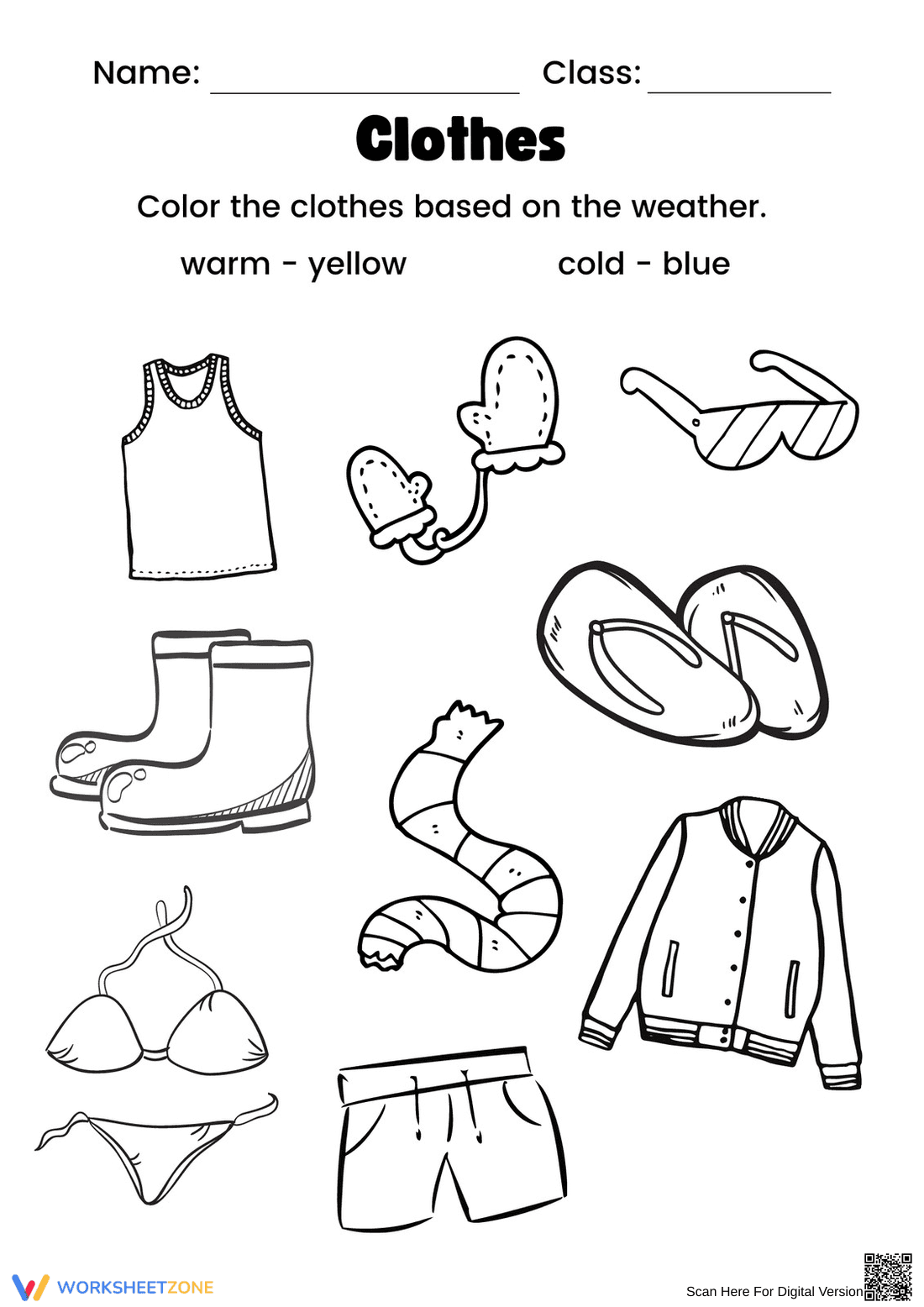

Essential Clothes & Weather Coloring Worksheet | Grade K
Paste this activity's link or code into your existing LMS (Google Classroom, Canvas, Teams, Schoology, Moodle, etc.).
Students can open and work on the activity right away, with no student login required.
You'll still be able to track student progress and results from your teacher account.
This Kindergarten science worksheet helps young learners connect clothing choices to weather patterns. By coloring 9 different items based on temperature cues, students develop critical categorization skills and vocabulary. It provides a clear, visual way to demonstrate understanding of how humans adapt to the environment, specifically focusing on warm and cold weather conditions.
At a Glance
- Grade: Kindergarten · Subject: Science
- Standard:
K-ESS2-1— Use observations to describe patterns in local weather and environment- Skill Focus: Weather-appropriate clothing categorization
- Format: 1 page · 9 problems · No-prep · PDF
- Best For: Morning work or weather unit introduction
- Time: 10–15 minutes
Inside this single-page PDF, you will find 9 distinct clothing illustrations including mittens, sunglasses, flip-flops, and a winter jacket. The worksheet features a simple two-color key: yellow for warm-weather items and blue for cold-weather gear. The large, clear line art is specifically designed for early childhood fine motor development and easy coloring.
This resource is designed for a zero-prep workflow. First, print the single-page PDF (30 seconds). Next, distribute the sheets and explain the yellow/blue color key (1 minute). Finally, review the completed pages as a whole-class check to ensure students correctly identified the 9 items (1 minute). Total teacher preparation time is under two minutes. It is an ideal resource for emergency sub plans.
This activity aligns with K-ESS2-1, focusing on observing weather patterns and how they influence daily life. It also supports ELA standard CCSS.ELA-LITERACY.L.K.5.A by requiring students to sort common objects into logical categories. Both standard codes can be copied directly into lesson plans, IEP goals, or district curriculum mapping tools.
Use this as a formative assessment after a lesson on seasons. As students color, circulate to observe if they distinguish between the scarf and the tank top. It also works well as a quiet transition task during morning arrival. Expect students to finish within 15 minutes. You can use the finished pages to create a classroom display about seasonal changes.
This worksheet is ideal for Kindergarten students or English Language Learners (ELLs) building basic vocabulary. It pairs naturally with a daily weather calendar or a classroom anchor chart showing seasonal changes. The simple instructions make it accessible for students still developing reading fluency and provides a low-stakes way to practice following multi-step directions.
According to the RAND AIRS 2024 report, visual categorization tasks in early childhood significantly improve long-term retention of environmental concepts. This worksheet addresses the K-ESS2-1 standard by requiring students to apply their observations of the environment to practical, everyday objects like clothing. By using a binary color-coding system (yellow for warm, blue for cold), the activity reduces cognitive load while reinforcing the relationship between temperature and human behavior. Research from Fisher & Frey (2014) emphasizes that such scaffolded tasks allow students to demonstrate mastery of complex scientific relationships through simple, non-verbal responses. This resource provides 9 specific opportunities for students to practice these skills, ensuring they can identify patterns in how weather dictates personal choices. It serves as a foundational tool for building the observational skills necessary for more advanced scientific inquiry in later elementary grades.


