


























Views
Downloads

Beginning Consonants Letter K Worksheet | Essential Phonics
Paste this activity's link or code into your existing LMS (Google Classroom, Canvas, Teams, Schoology, Moodle, etc.).
Students can open and work on the activity right away, with no student login required.
You'll still be able to track student progress and results from your teacher account.
This Preschool and Kindergarten phonics worksheet helps early learners master the letter K through multi-sensory engagement. Students identify beginning sounds, practice letter formation, and discriminate between similar characters. By the end of these three pages, children will confidently recognize both uppercase and lowercase K in various contexts.
At a Glance
- Grade: Preschool · Subject: ELA
- Standard:
CCSS.ELA-LITERACY.RF.K.1.D— Recognize and name all upper- and lowercase letters of the alphabet- Skill Focus: Letter K Recognition and Formation
- Format: 3 pages · 24 tasks · Answer key included · PDF
- Best For: Early literacy centers and morning work
- Time: 15–20 minutes
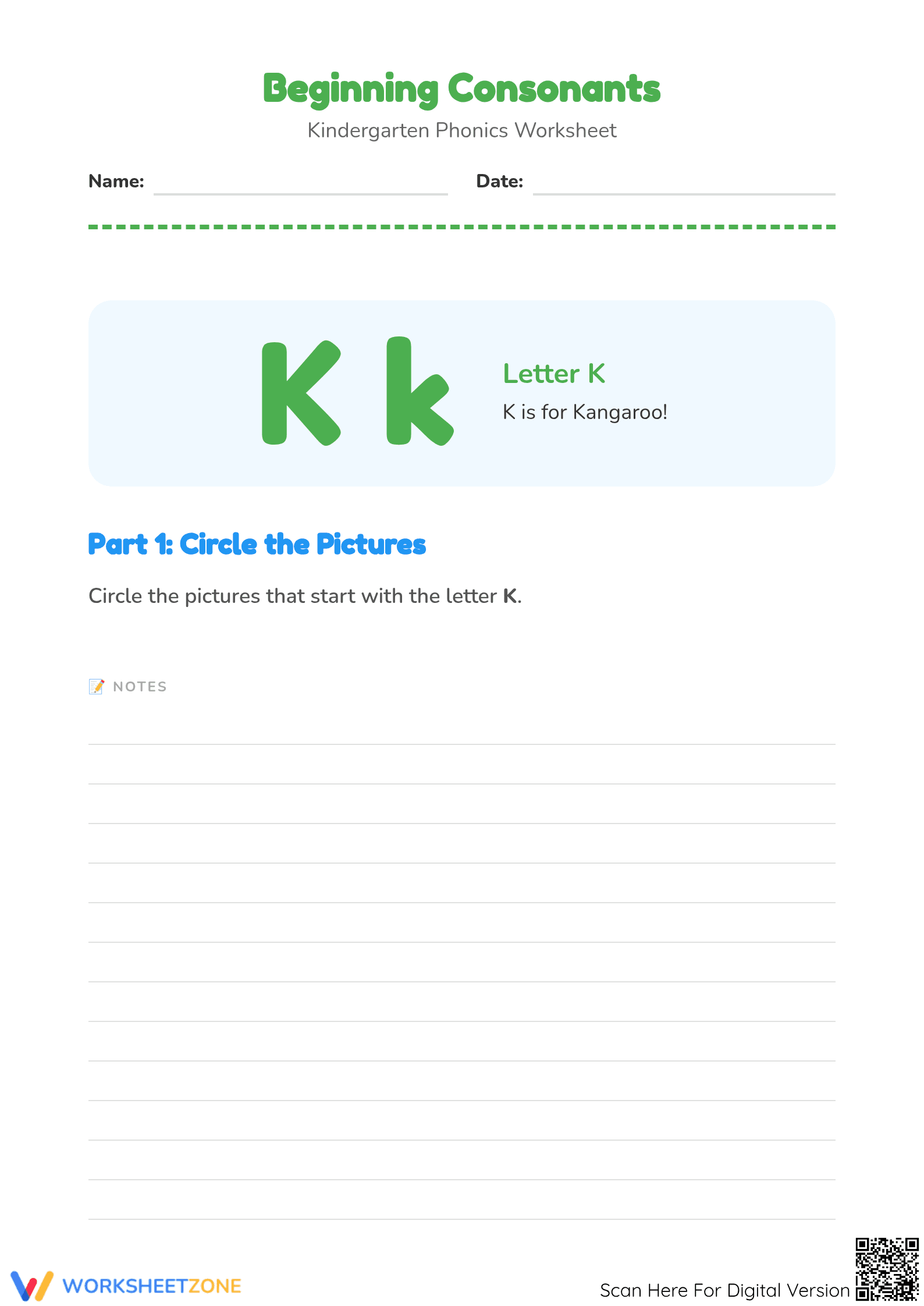
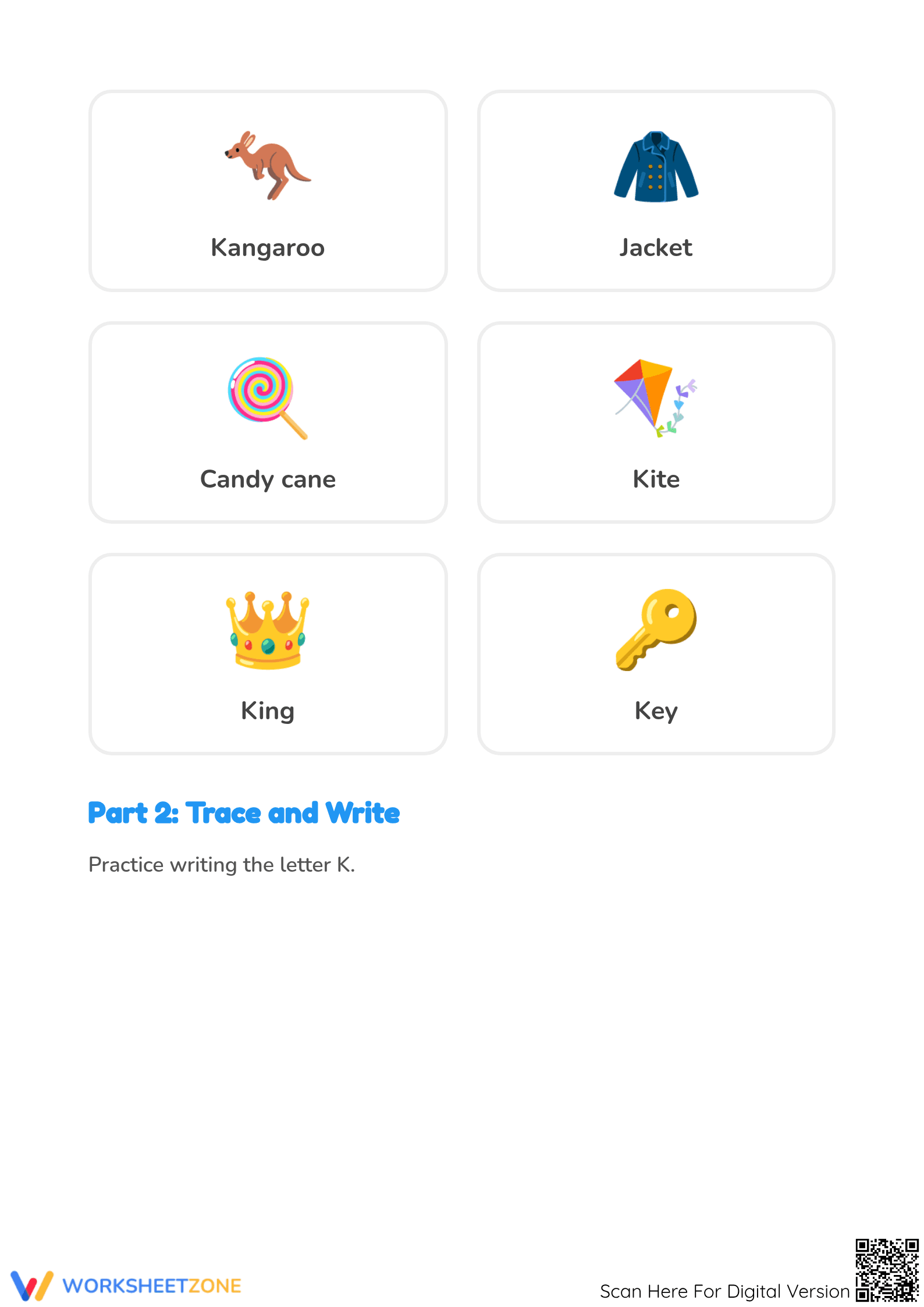
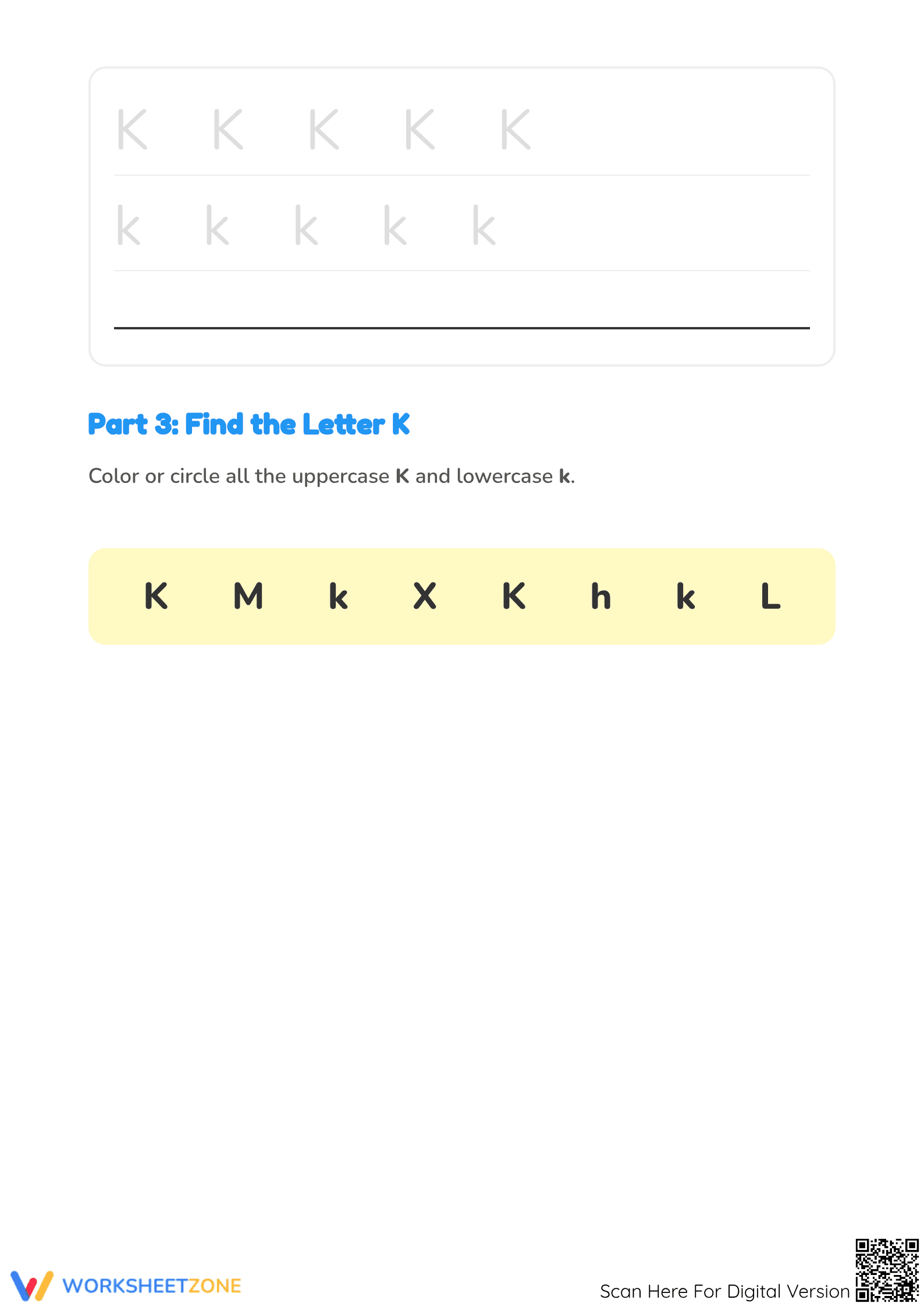
This comprehensive 3-page PDF includes three distinct sections. Page one introduces the letter with a visual anchor (Kangaroo). Page two features a picture-sorting task with six high-quality illustrations and a tracing guide for fine motor development. Page three concludes with a letter-search activity to build visual discrimination skills. A full answer key is provided for quick grading.
Skill Progression
- Guided Practice: Students begin by identifying the letter K in isolation and associating it with the "Kangaroo" anchor image.
- Supported Practice: Learners choose between six images (Kangaroo, Kite, King, Key vs. Jacket, Candy cane) to identify initial phonemes with visual cues.
- Independent Practice: Students demonstrate mastery by tracing 10 letter forms and scanning a letter bank to find specific characters.
This sequence follows the gradual-release model to ensure student confidence and independent success.
Standards Alignment
The primary standard addressed is `CCSS.ELA-LITERACY.RF.K.1.D`, which requires students to recognize and name all upper- and lowercase letters of the alphabet. Additionally, it supports `CCSS.ELA-LITERACY.RF.K.3.A` by linking the letter shape to its specific beginning sound. Both standard codes can be copied directly into lesson plans, IEP goals, or district curriculum mapping tools.
How to Use It
Use this during small-group rotations for students who need targeted phonics intervention. It also serves as an excellent formative assessment tool; observe how students handle the "Find the Letter K" section to check for confusion with similar letters like 'h' or 'L'. Expected completion time is 15 to 20 minutes for most early learners.
Who It's For
This resource is designed for preschool and kindergarten students beginning their phonics journey. It is particularly helpful for English Language Learners (ELL) who benefit from the clear picture-to-word associations. Pair this with a physical alphabet tray or a letter K anchor chart for maximum instructional impact.
According to the RAND AIRS 2024 report on early literacy, systematic phonics instruction that combines visual recognition with tactile tracing significantly improves long-term letter-sound retention in 4- and 5-year-old learners. This worksheet aligns with those findings by integrating three distinct modalities: visual identification, phonemic awareness through pictures, and fine motor tracing. By focusing specifically on CCSS.ELA-LITERACY.RF.K.1.D, the material ensures that students meet foundational benchmarks required for reading readiness. The inclusion of 24 discrete tasks across 3 pages provides the necessary repetition for mastery without overwhelming the learner. Educators can utilize this resource to bridge the gap between letter naming and phonemic blending, a critical step highlighted in the Fisher & Frey (2014) gradual release of responsibility framework.


