


























Views
Downloads
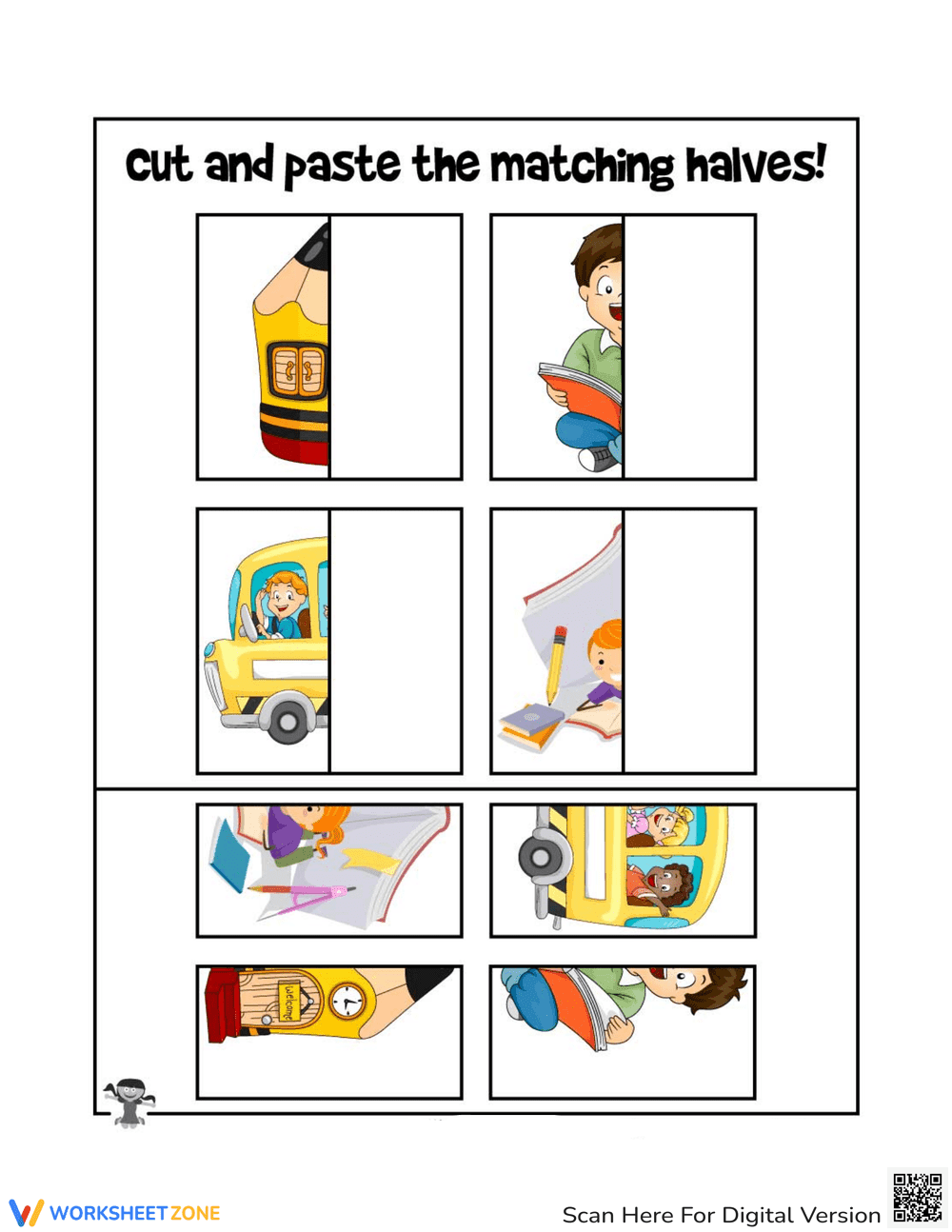

Printable Back to School Matching Half Puzzle Activity
Paste this activity's link or code into your existing LMS (Google Classroom, Canvas, Teams, Schoology, Moodle, etc.).
Students can open and work on the activity right away, with no student login required.
You'll still be able to track student progress and results from your teacher account.
Help early learners develop visual discrimination and fine motor skills with this cut and paste activity. Students practice identifying symmetry by matching the missing halves of four school-themed illustrations. This provides an immediate, hands-on way to assess baseline spatial awareness during the first weeks of school.
At a Glance
- Grade: Kindergarten · Subject: Math
- Standard:
CCSS.MATH.CONTENT.K.G.B.4— Analyze and compare shapes to observe spatial relationships.- Skill Focus: Visual discrimination and cutting
- Format: 1 page · 4 problems · PDF
- Best For: Morning work centers
- Time: 15–20 minutes
This printable PDF features a clean layout containing four school-themed puzzle blocks. The top section displays left halves of a pencil, a student, a bus, and books. The bottom section provides the corresponding right halves out of order. Students cut and paste to complete each image, reinforcing part-to-whole relationships.
Zero-Prep Classroom Workflow
Incorporate this activity into your daily routine with three simple steps:
- Print (1 minute): Run copies of the single-page PDF directly from your computer.
- Distribute (1 minute): Hand out sheets with child-safe scissors and glue sticks.
- Review (5 minutes): Observe spatial matching accuracy as students complete the puzzles.
With teacher preparation under two minutes, this resource serves as an excellent emergency sub plan.
Standards Alignment
This activity aligns with CCSS.MATH.CONTENT.K.G.B.4, which tasks students with analyzing and comparing two-dimensional shapes. By identifying matching halves, students analyze component parts to form a cohesive whole. Both standard codes can be copied directly into lesson plans, IEP goals, or district curriculum mapping tools.
How to Use It in the Classroom
Deploy this worksheet during the first week of school as a welcoming morning work assignment. It functions perfectly during independent center rotations focused on fine motor development. For a formative assessment observation, note which students struggle to align edges. Expect a completion time range of 15 to 20 minutes.
Target Student Population
This resource is tailor-made for preschool and kindergarten students developing foundational spatial reasoning. It offers excellent scaffolding for English language learners by focusing entirely on visual patterns. Pair this worksheet naturally with a read-aloud book about going to school or a direct instruction lesson on symmetry.
Early childhood spatial reasoning and fine motor coordination are critical predictors of later academic success in STEM disciplines. According to a comprehensive EdReports 2024 analysis, tactile learning experiences that combine visual discrimination with physical manipulation help solidify abstract geometric concepts in young minds. This worksheet targets those exact developmental milestones by requiring students to analyze part-to-whole relationships under the CCSS.MATH.CONTENT.K.G.B.4 framework. By integrating scissor skills with visual matching, the activity reinforces bilateral coordination and spatial orientation simultaneously. Teachers can confidently utilize this structured layout to gather baseline data on incoming kindergarten students' visual-spatial processing speeds and fine motor control. This evidence-based approach ensures that early interventions or extensions can be planned effectively during the initial weeks of the school year, maximizing student learning outcomes.


