


























Views
Downloads



Art Pictographs Printable Practice | Grades 5-8
Paste this activity's link or code into your existing LMS (Google Classroom, Canvas, Teams, Schoology, Moodle, etc.).
Students can open and work on the activity right away, with no student login required.
You'll still be able to track student progress and results from your teacher account.
This printable Math worksheet provides a comprehensive review of data handling through four distinct pictograph scenarios. Students will master the skill of interpreting various keys—where one symbol represents multiple units—to calculate totals and compare data sets. This essential resource ensures middle-grade students build the data literacy required for complex statistical analysis and data visualization. Lead with the skill and the student outcome in this four-part practice set.
At a Glance
- Grade: 5-8 · Subject: Math
- Standard:
CCSS.MATH.CONTENT.6.SP.B.4— Display and interpret numerical data sets using various graphical representations- Skill Focus: Multi-step pictograph interpretation and calculation
- Format: 4 pages · 15 problems · Answer key included · PDF
- Best For: Independent practice or formative assessment
- Time: 30–45 minutes
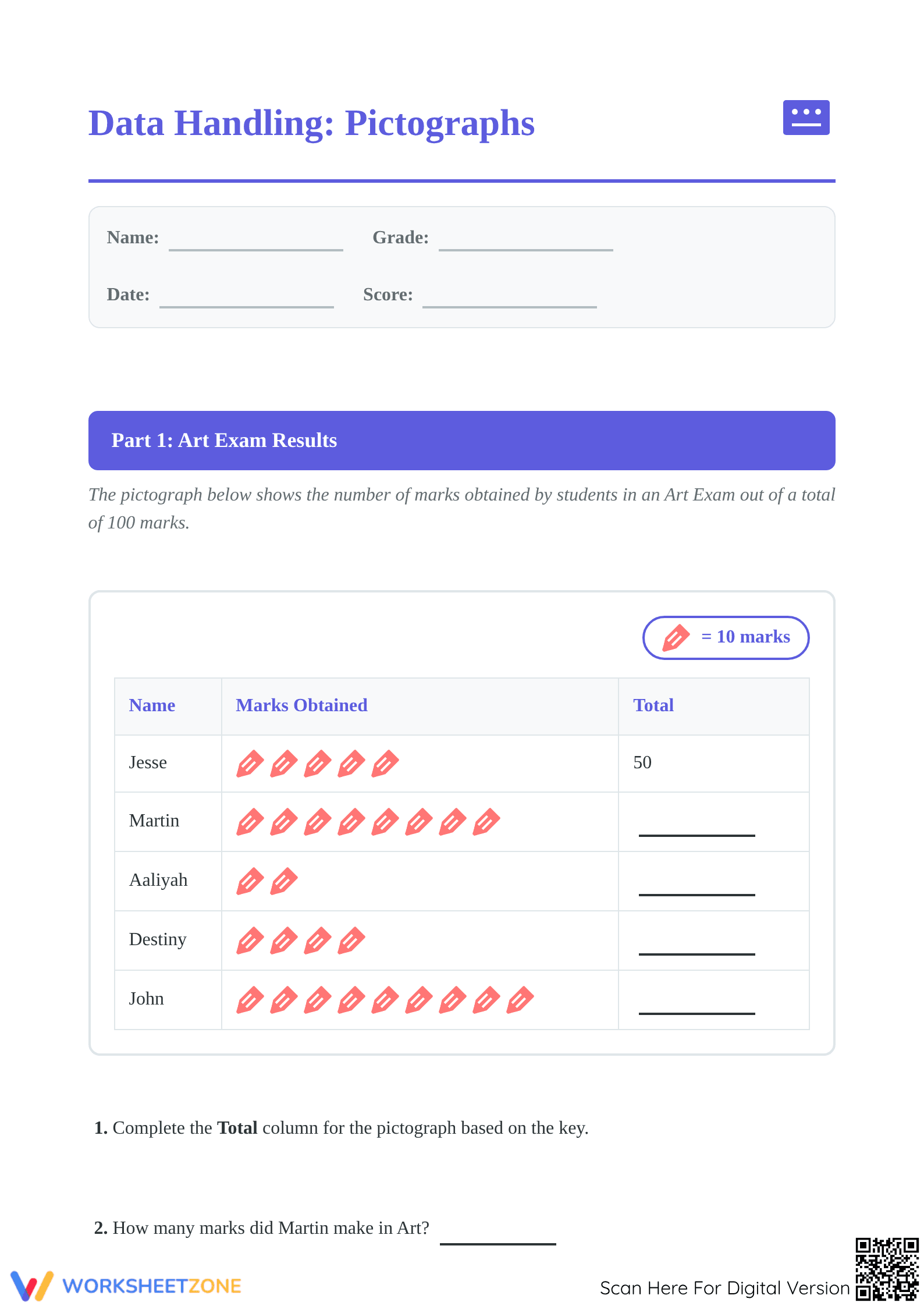
The worksheet is divided into four focused parts: Art Exam Results, Favorite School Clubs, Library Book Categories, and Weekly Fruit Sales. It spans 4 pages and includes 15 varied tasks, ranging from simple count-to-total operations to multi-step comparative questions. A full answer key is provided to facilitate quick grading or student self-correction during independent work sessions. Structural features include distinct keys for each section and clear table formatting.
Zero-Prep Workflow
The "Art Pictographs" resource is designed for immediate classroom integration. To implement, teachers simply print the 4-page PDF, distribute the copies to the class, and facilitate a brief review of the final results using the included key. Total teacher preparation time is less than two minutes, making this an ideal choice for substitute plans or emergency review days when zero setup is required.
Standards Alignment
This resource aligns primarily with CCSS.MATH.CONTENT.6.SP.B.4, focusing on displaying and summarizing numerical data. Students demonstrate mastery by translating symbolic data into numerical values across different scales, such as 5, 10, 12, or 20 units per icon. This standard code can be copied directly into lesson plans, IEP goals, or district curriculum mapping tools for easy tracking.
How to Use It
Use this worksheet as a mid-unit formative assessment to check student understanding of scaled intervals. It is best placed after initial instruction on basic bar graphs and dot plots. Teachers should observe students during Part 3 (Library Books) to ensure they are multiplying by the key of 20 correctly. The 45-minute completion window makes it a perfect standalone lesson for data processing skills.
Who It's For
This resource is tailored for upper elementary and middle school students in grades 5 through 8 who require reinforced practice with data visualization. It is particularly effective for visual learners who benefit from symbolic representations in mathematics. Pair this with a digital polling tool or a physical classroom survey to create a comprehensive direct instruction unit that connects theory to practice.
Statistical literacy, specifically the ability to decode and analyze graphical representations like pictographs, is a critical competency highlighted in the RAND AIRS 2024 report on mathematical readiness. This worksheet directly addresses CCSS.MATH.CONTENT.6.SP.B.4 by requiring students to synthesize information from various scaled keys. Research by Fisher & Frey (2014) emphasizes that "guided practice" with multiple data contexts—as seen in the transition from art exams to fruit sales in this packet—is essential for moving students toward independent mastery. By requiring 15 distinct calculations, the resource provides the necessary repetition to cement procedural fluency. Education researchers at EdReports 2024 note that materials focusing on interpreting data within real-world contexts increase student engagement and long-term retention of mathematical concepts. This resource serves as a robust bridge between basic counting and advanced statistical inference, ensuring students are prepared for secondary data analysis.


