


























Views
Downloads
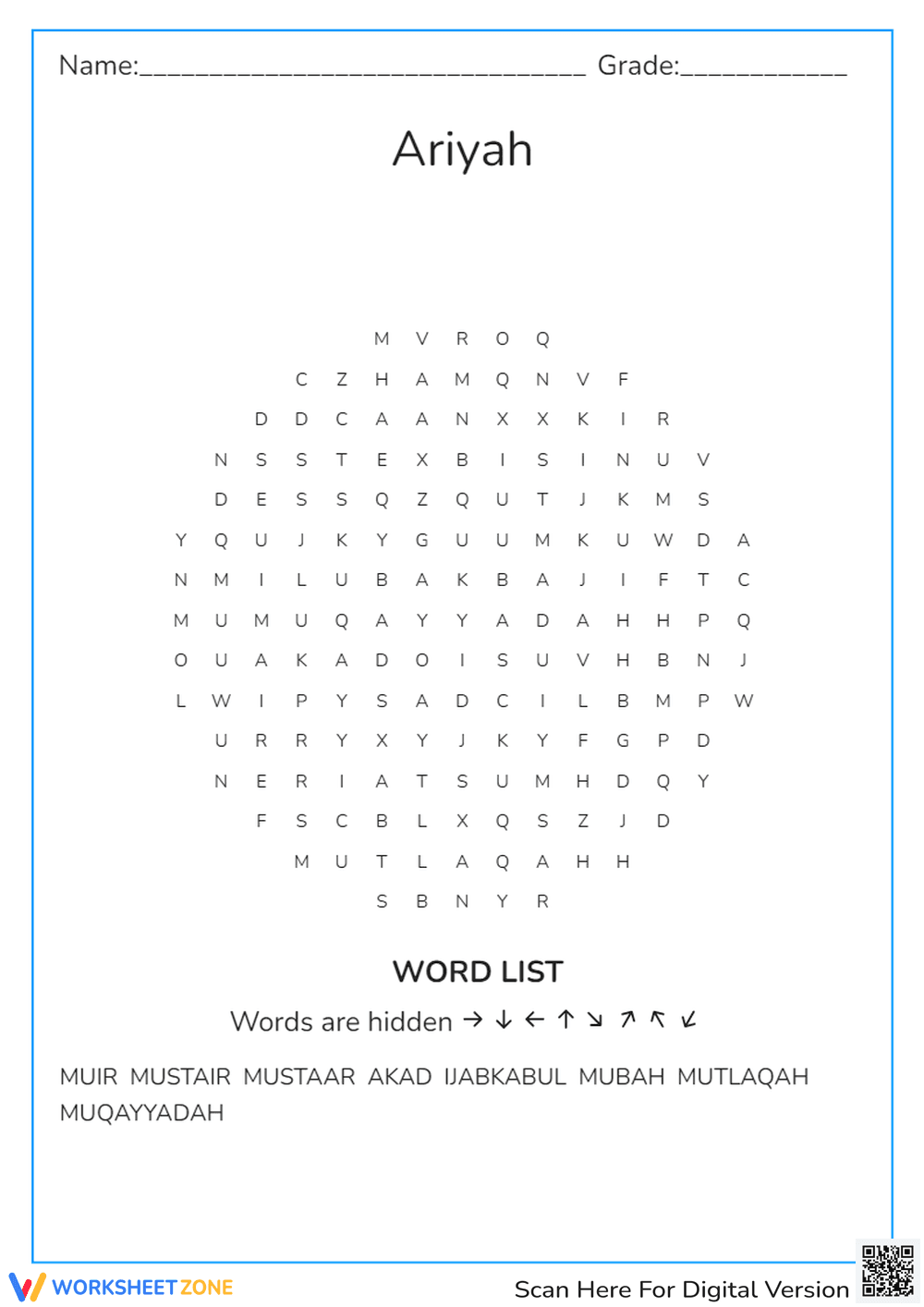

Grade 9 Ariyah Fikih Word Search | Essential Printable
Paste this activity's link or code into your existing LMS (Google Classroom, Canvas, Teams, Schoology, Moodle, etc.).
Students can open and work on the activity right away, with no student login required.
You'll still be able to track student progress and results from your teacher account.
This Grade 9 Fikih worksheet provides a focused word search activity to reinforce student understanding of Ariyah (lending) terminology. By identifying 8 domain-specific terms, students build familiarity with the legal and ethical framework of Islamic jurisprudence. This activity serves as an effective vocabulary bridge during introductory lessons on Islamic contracts and social obligations.
At a Glance
- Grade: 9 · Subject: Fikih
- Standard:
CCSS.ELA-LITERACY.L.9.6— Acquire and use accurately domain-specific words and phrases- Skill Focus: Fikih Vocabulary (Ariyah)
- Format: 1 page · 8 problems · Answer key included · PDF
- Best For: Vocabulary reinforcement and early finishers
- Time: 10–15 minutes
This single-page PDF features a circular word search grid containing 8 hidden terms related to the concept of Ariyah. The word list includes essential vocabulary such as Muir, Mustair, and Akad. The layout is clean and distraction-free, including a dedicated space for student names and grades. A full answer key is provided to facilitate quick grading or self-correction, ensuring students receive immediate feedback on their recognition skills.
This resource is designed for immediate classroom implementation with a total teacher prep time of under 2 minutes. Simply print the required number of copies (30 seconds), distribute them to students as a bell-ringer or transition activity (30 seconds), and use the included answer key for a rapid 1-minute review at the end of the session. It is an ideal sub-plan component or a quiet activity for students who complete primary assignments early.
The primary standard addressed is `CCSS.ELA-LITERACY.L.9.6`, which requires students to acquire and use accurately general academic and domain-specific words and phrases. By engaging with terms like Ijabkabul and Muqayyadah, students demonstrate mastery of specialized religious and legal vocabulary. This standard code can be copied directly into lesson plans, IEP goals, or district curriculum mapping tools to document alignment with literacy and content-area requirements.
Use this worksheet as a formative assessment after a direct instruction session on the pillars of Ariyah. It allows teachers to observe which students can quickly recognize the terms versus those who struggle with the spelling and structure of the vocabulary. Expected completion time is 10 to 15 minutes, making it perfect for the independent practice portion of a lesson or as a homework assignment to solidify term recognition.
This worksheet is tailored for Grade 9 students studying Islamic Studies or World Religions. It is particularly useful for English Language Learners (ELLs) who benefit from visual word recognition tasks to build confidence with new terminology. Pair this resource with a primary text on Fikih or an anchor chart detailing the rights and responsibilities of the lender and borrower to provide a comprehensive learning experience.
This Grade 9 Fikih word search focuses on the standard CCSS.ELA-LITERACY.L.9.6, emphasizing the acquisition of domain-specific vocabulary related to Ariyah. Research from Fisher & Frey (2014) highlights that word-level activities, when integrated into broader content instruction, significantly improve long-term retention of specialized terminology. By identifying 8 specific terms such as Mustaar and Mubah, students engage in active retrieval practice, which is a proven method for strengthening cognitive pathways. This resource provides a structured, low-stakes environment for students to interact with complex religious concepts. The inclusion of an answer key ensures that the feedback loop is immediate, supporting the gradual release of responsibility model. This worksheet is a reliable tool for educators seeking to bridge the gap between abstract legal concepts and concrete vocabulary mastery in a secondary classroom setting, ensuring all students have access to the core language of the subject matter.


