


























Views
Downloads


Essential Area of Rectangles and Squares Worksheet | Grade 4
Paste this activity's link or code into your existing LMS (Google Classroom, Canvas, Teams, Schoology, Moodle, etc.).
Students can open and work on the activity right away, with no student login required.
You'll still be able to track student progress and results from your teacher account.
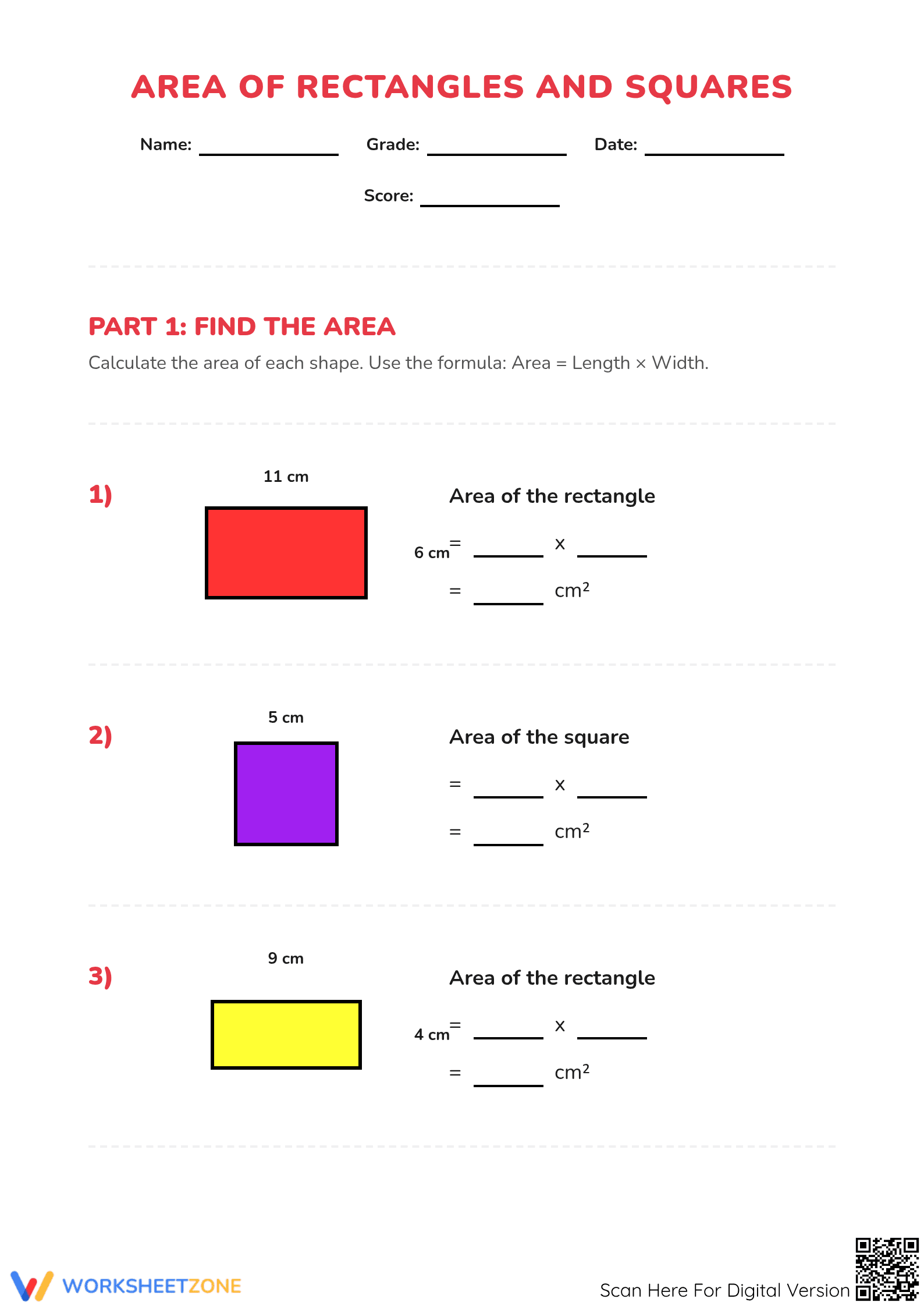
This Grade 4 math worksheet provides comprehensive practice for calculating the area of rectangles and squares using the standard formula. Students will master identifying dimensions and applying multiplication to find total square units across varied visual and text-based formats. This resource is designed to move students from conceptual understanding to procedural fluency.
At a Glance
- Grade: 4 · Subject: Math
- Standard:
CCSS.MATH.CONTENT.4.MD.A.3— Apply area and perimeter formulas for rectangles in real-world mathematical problems- Skill Focus: Area of rectangles and squares
- Format: 4 pages · 15 problems · Answer key included · PDF
- Best For: Independent geometry practice or homework
- Time: 25–35 minutes
This 4-page PDF contains 15 total problems divided into three logical sections. It includes 5 basic calculation tasks with visual aids, 5 bonus practice shapes for reinforcement, and 5 multi-sentence word problems. A complete 4-page answer key with step-by-step multiplication is provided for efficient grading and immediate student feedback.
The worksheet follows a gradual release of responsibility model to ensure student success. Guided practice (Problems 1-5) provides shape outlines and formula prompts to scaffold the calculation process for new learners. Supported practice (Problems 6-10) removes the labels and formula prompts, requiring students to extract data from the diagrams independently. Independent practice (Problems 11-15) shifts to word problems where students must visualize the shapes and determine dimensions without the aid of drawings.
This resource is strictly aligned to CCSS.MATH.CONTENT.4.MD.A.3, which requires students to apply the area formula for rectangles in real-world and mathematical contexts. By transitioning from visual representations to word-based scenarios, students demonstrate full mastery of the geometry domain. Both standard codes can be copied directly into lesson plans, IEP goals, or district curriculum mapping tools to streamline documentation.
To use this effectively, assign it during the independent practice phase of a geometry lesson to monitor individual student progress. Use the word problem section (Part 3) as a formative assessment to check if students can translate linguistic descriptions into mathematical operations. The expected completion time for the full set is approximately 30 minutes, making it suitable for a standard class period or a comprehensive homework assignment.
This worksheet is designed primarily for 4th-grade students learning basic area concepts, but it also serves as an excellent intervention tool for 5th-grade learners needing a refresher. It pairs naturally with an area anchor chart or a hands-on lesson using square tile manipulatives to bridge the gap between concrete and abstract math.
According to the RAND AIRS 2024 report on math instructional materials, the use of visual-to-abstract scaffolding significantly improves student retention of geometric formulas like CCSS.MATH.CONTENT.4.MD.A.3. By requiring students to interact with both diagrams and word problems, this resource builds a robust mental model of spatial measurement. This specific skill—finding the area of rectangles and squares—serves as the foundational prerequisite for 5th-grade volume calculations and more complex 6th-grade composite shape analysis. Standardized testing data suggests that students who practice formula application across multiple contexts (visual, numerical, and verbal) show higher proficiency in multi-step problem solving. This worksheet provides exactly that breadth of experience within a single, cohesive printable packet.


