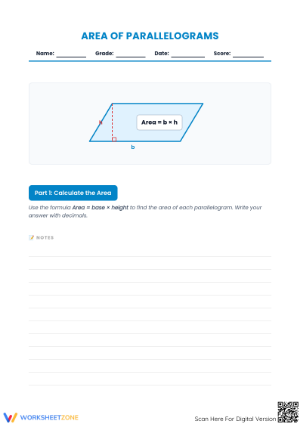
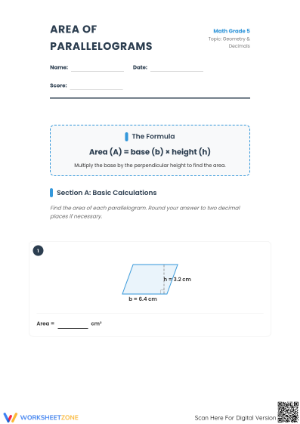
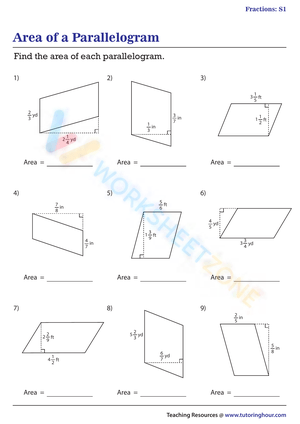
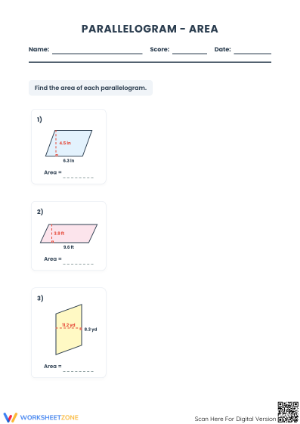
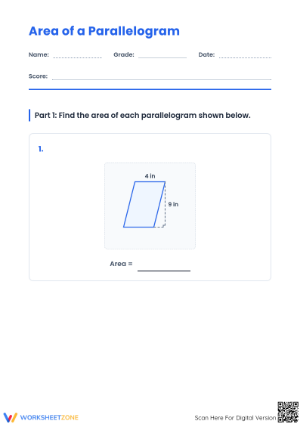
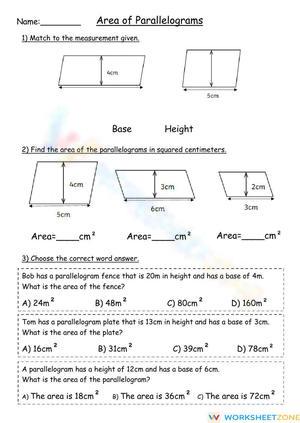
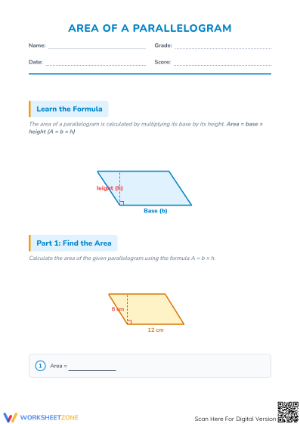
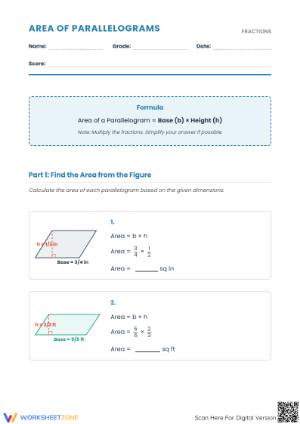
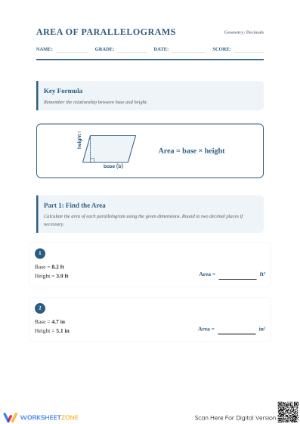
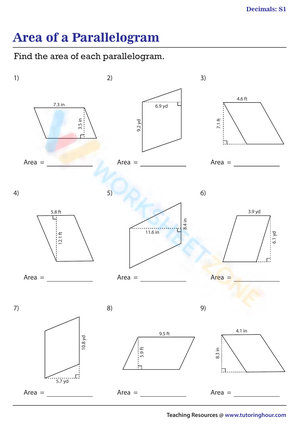
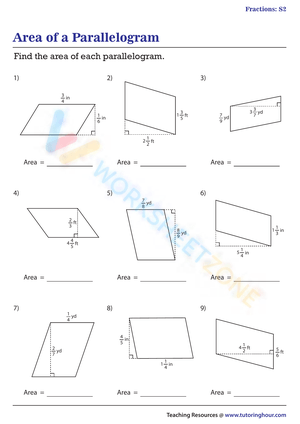
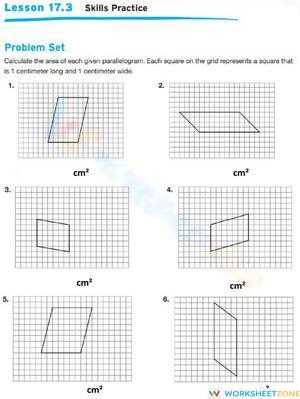
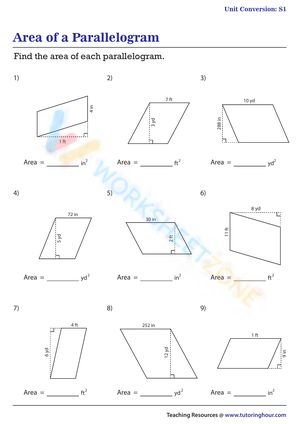
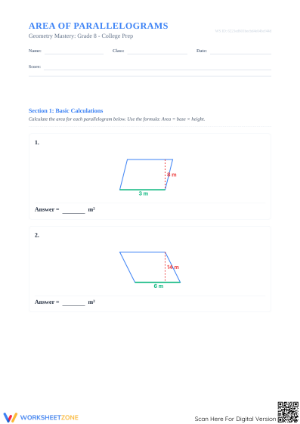
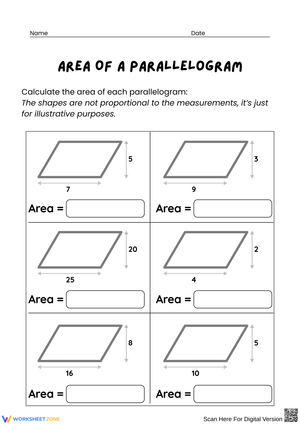
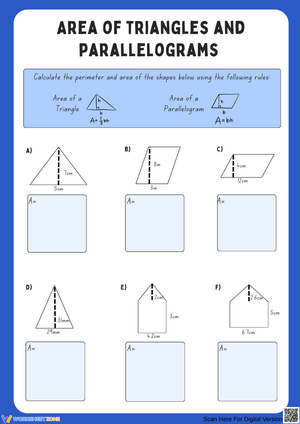
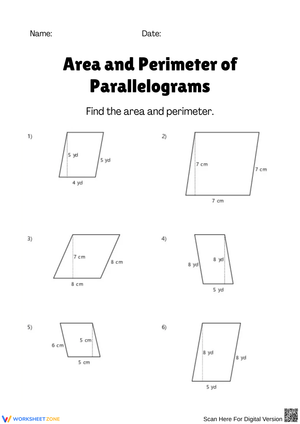
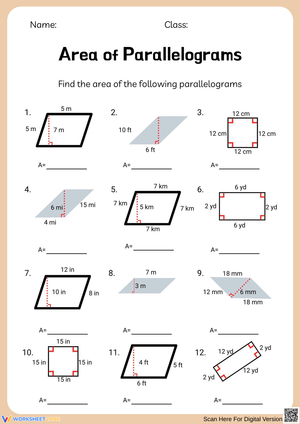
Area of parallelogram worksheets support a key cognitive milestone in geometry learning: the shift from recognizing shapes to calculating their properties. When students first encounter the formula A = base times height, they are bridging concrete visual understanding with abstract mathematical reasoning. This transition is one of the most important developmental steps in middle school math, and structured practice makes it far less intimidating. Well-designed worksheets guide learners through that bridge systematically, building confidence with each completed problem. Worksheetzone offers materials that meet students exactly at this developmental stage.
The scaffolding approach built into these area of parallelogram worksheets moves learners from guided examples to fully independent problem-solving. Early problems typically provide labeled diagrams, clear base and height measurements, and step-by-step solution models. As the worksheet progresses, diagrams become less annotated, encouraging students to identify measurements on their own. This gradual release of responsibility mirrors how skilled teachers differentiate instruction in the classroom. Parents working with children at home benefit from this same structure, because it reduces the need for constant explanations during homework sessions.
Consistent practice with area calculations also strengthens the mental stamina students need for longer math assessments. Working through a set of parallelogram problems requires sustained focus, pattern recognition, and careful arithmetic - three skills that transfer directly to other areas of the curriculum. Teachers report that students who regularly use structured geometry printables show fewer calculation errors over time and approach unfamiliar problems with greater composure. The printable format also allows for annotating, erasing, and retrying, which reinforces a growth mindset in young learners. Each completed page becomes visible proof of progress that students can point to with genuine pride.
Visual organization plays a central role in how students absorb and retain geometry concepts. These area of parallelogram worksheets present problems in clear grids with consistent spacing, reducing the cognitive load that comes from cluttered or confusing layouts. When a child can focus entirely on the math rather than deciphering a confusing page, comprehension improves measurably. For a fun extension during class breaks or home sessions, pairing these worksheets with a puzzle from our math riddles for kids collection keeps students engaged without losing the mathematical focus of the lesson.
For teachers planning a comprehensive geometry unit, these printables integrate naturally alongside resources that address broader parallelogram concepts. Exploring shape properties before diving into area calculations gives students a stronger conceptual foundation. You can find supporting materials in the properties of parallelograms section to complement your lesson sequence. Together, these resources create a coherent learning path from attribute recognition to area calculation, helping every student in your classroom develop durable geometry skills through area of parallelogram worksheets.
Frequently Asked Questions
Question 1: What grade level are these area of parallelogram worksheets designed for?
These worksheets are best suited for students in grades 5 through 8. Younger students who have a solid understanding of multiplication and basic geometry can also benefit. Teachers and parents can select problems at the appropriate difficulty level, since the worksheets range from simple labeled diagrams to more complex multi-step calculations that challenge advanced learners.
Question 2: How do I explain the area formula to a student who is struggling?
Start by connecting the parallelogram to a rectangle. Show the student that if you cut the triangular end off one side and attach it to the other, the shape becomes a rectangle. This visual transformation makes the formula A = base times height feel logical rather than arbitrary. Worksheetzone materials include diagram-based problems that reinforce this conceptual link through hands-on practice.
Question 3: Can parents use these worksheets for home practice without a teacher?
Yes, these printables are designed to be self-explanatory. Each worksheet includes worked examples or clear instructions at the top so parents can guide their child without needing advanced math knowledge. The step-by-step layout allows students to work semi-independently while parents check completed answers, making them an ideal tool for homework support or summer skill review sessions.
Question 4: How many problems should a student complete per session?
Most educators recommend 10 to 15 problems per sitting for optimal retention without fatigue. Shorter, consistent practice sessions - three to four times per week - tend to produce better long-term results than one lengthy session. Worksheetzone area of parallelogram worksheets are formatted to fit this approach, with enough variety per page to maintain student interest across multiple practice rounds.












 Interactive Worksheet Maker
 Quiz Maker
 Word Search Maker
 Crossword Puzzle Maker
 Word Scramble Generator
 Sentence Scramble Generator
 Handwriting Worksheet Generator
 Name Tracing Generator
 Fill In The Blank Generator