


























Views
Downloads

Area of Parallelogram Worksheet | Essential Grade 6 Math
Paste this activity's link or code into your existing LMS (Google Classroom, Canvas, Teams, Schoology, Moodle, etc.).
Students can open and work on the activity right away, with no student login required.
You'll still be able to track student progress and results from your teacher account.
This essential math worksheet provides comprehensive practice for students to master calculating the area of parallelograms. By working through visual models and real-world word problems, learners develop a deep understanding of geometric relationships and the formula for area. It is an ideal resource for reinforcing foundational geometry skills in middle school classrooms.
At a Glance
- Grade: 6 · Subject: Math
- Standard:
CCSS.MATH.CONTENT.6.G.A.1— Find the area of special quadrilaterals by decomposing into triangles and other shapes- Skill Focus: Area of Parallelograms
- Format: 5 pages · 16 problems · Answer key included · PDF
- Best For: Middle school geometry practice and assessment
- Time: 30–45 minutes
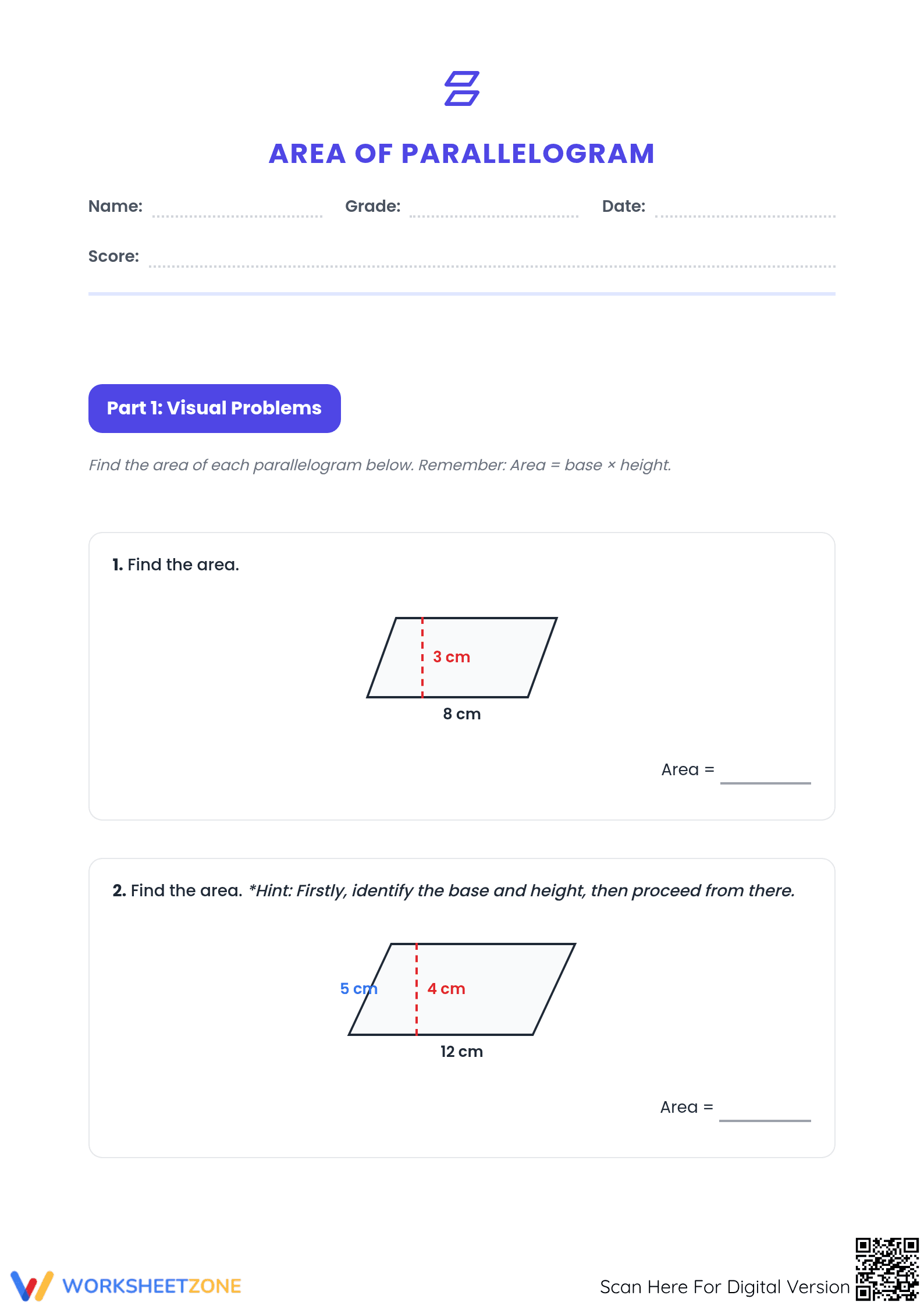
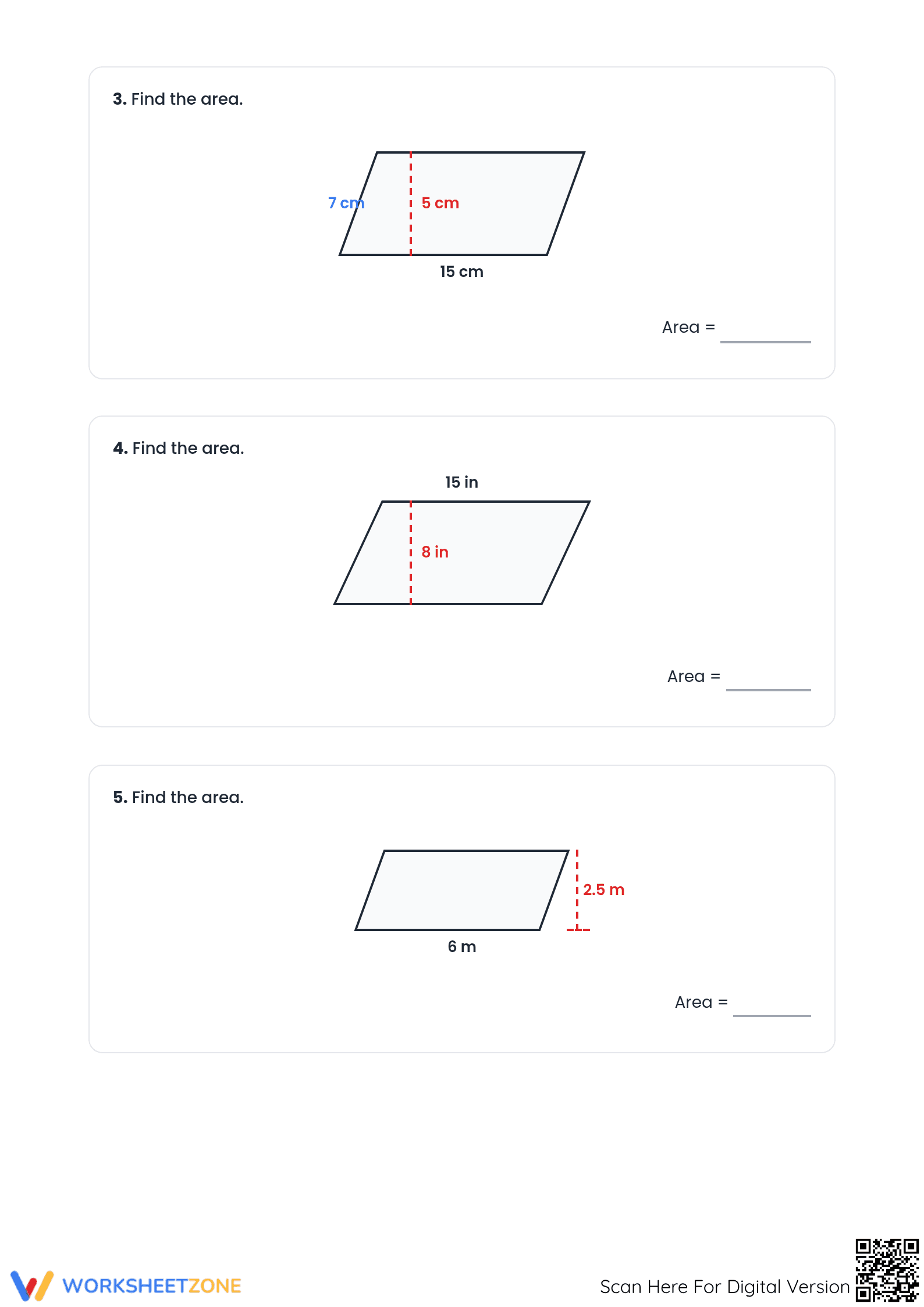
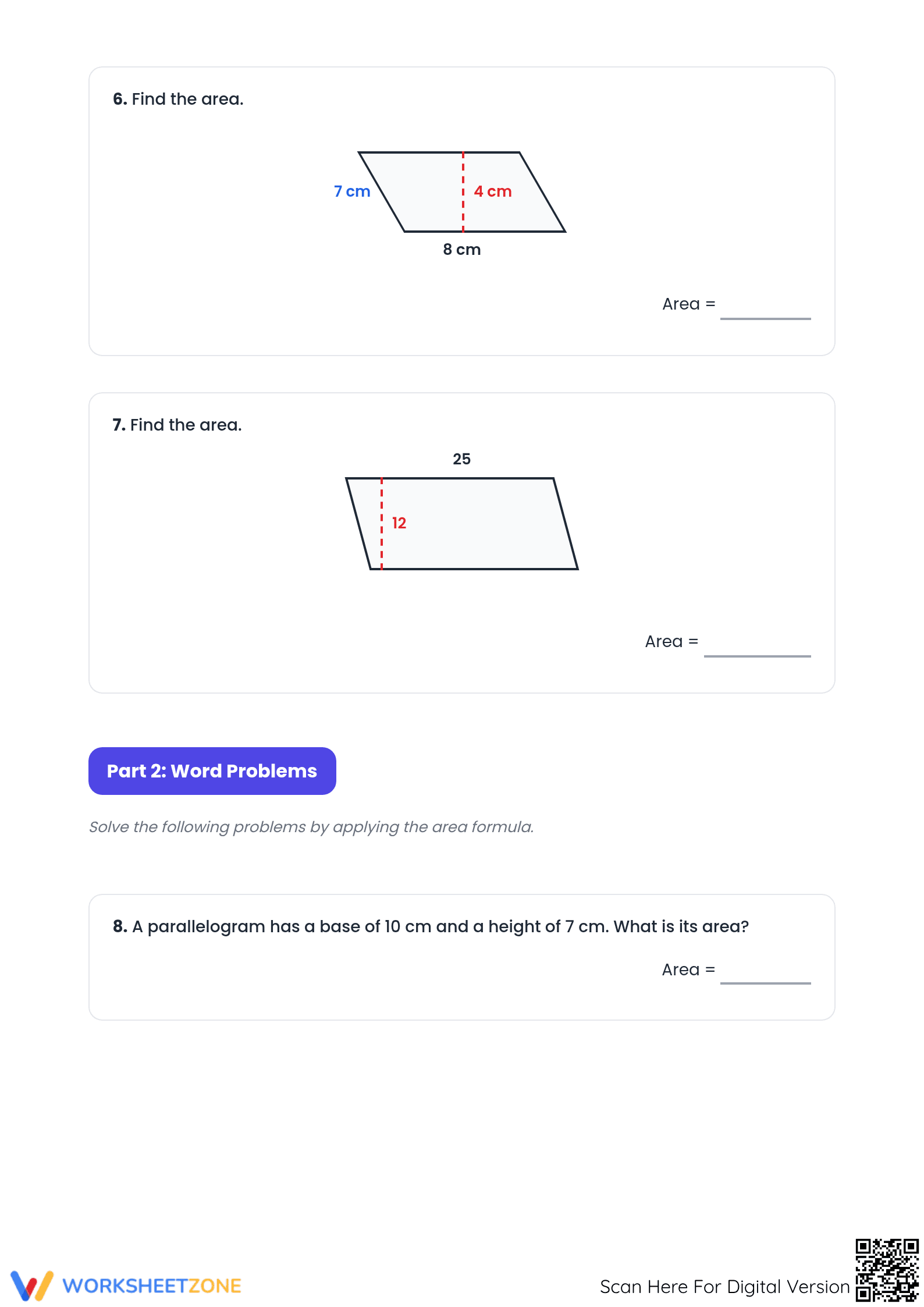
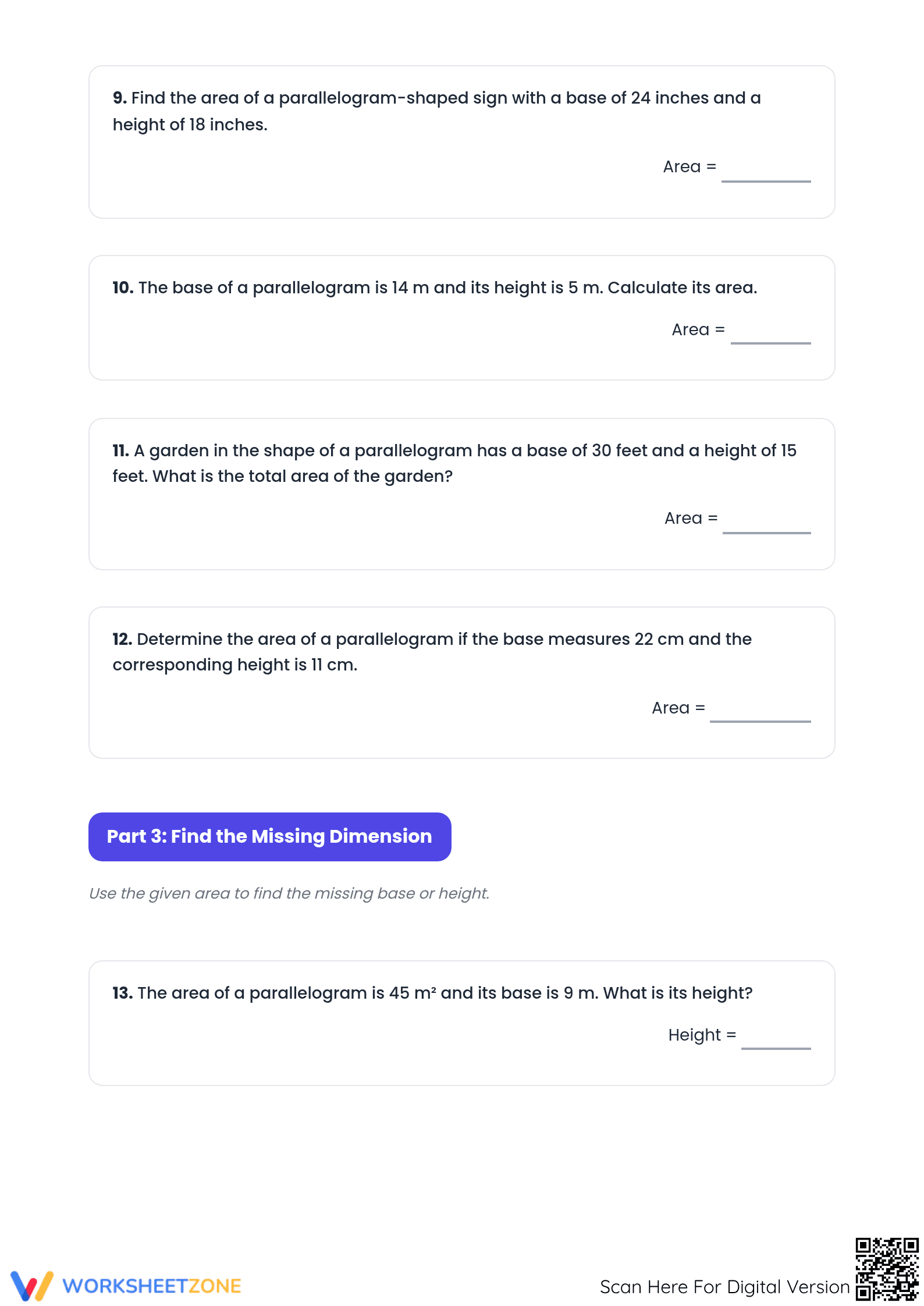
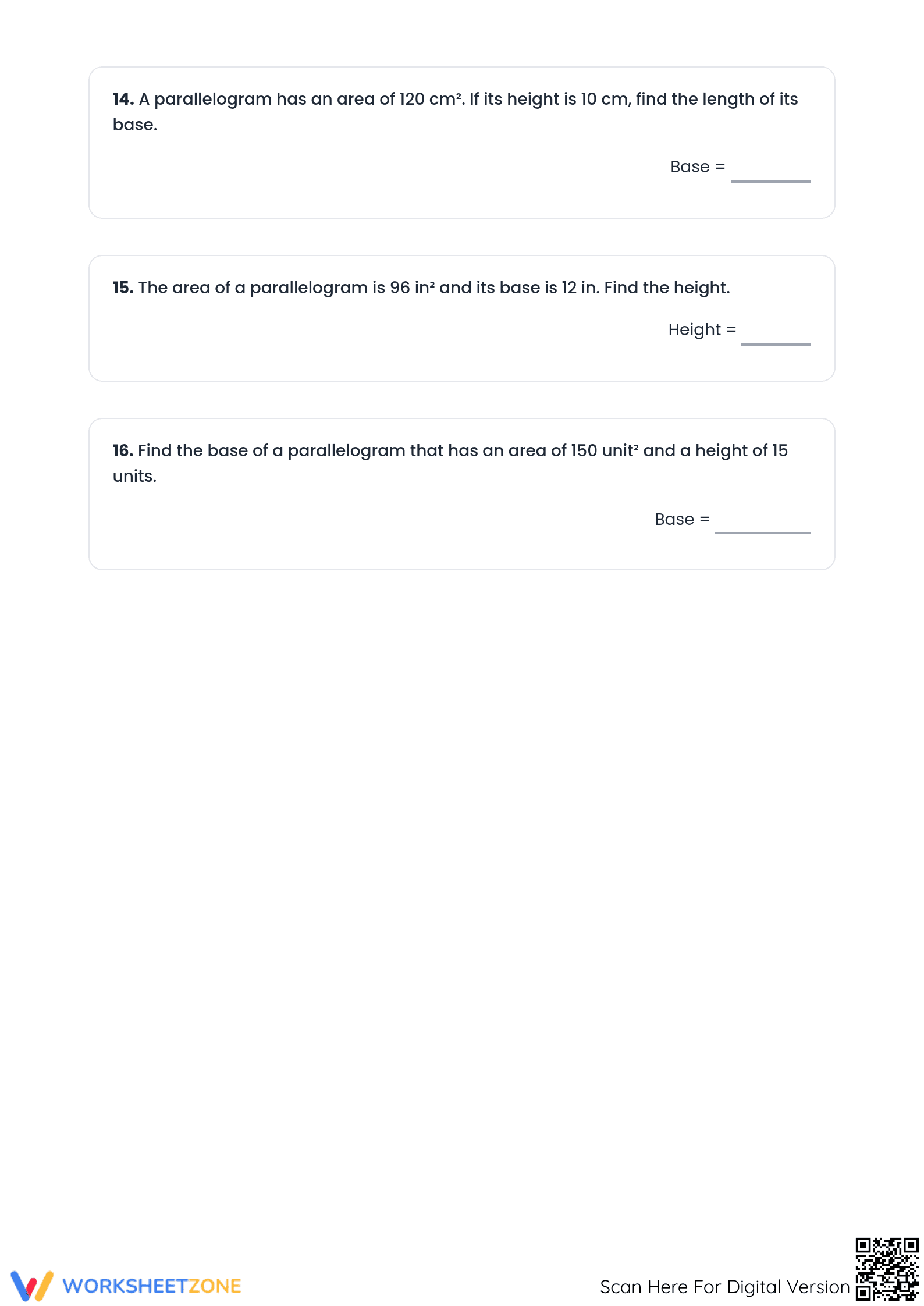
This five-page PDF packet features 16 diverse problems organized into three distinct sections. Students begin with visual representations where they must identify dimensions from diagrams. The complexity increases with word problems requiring conceptual application, and concludes with algebraic-style tasks where students solve for a missing base or height given the total area. A full answer key is included for rapid grading.
Skill Progression
- Guided Practice: The first two problems provide explicit hints and the area formula to scaffold initial success and build confidence.
- Supported Practice: Questions 3 through 12 offer seven visual and five word problems that require independent selection of base and height values.
- Independent Practice: The final four problems challenge students to manipulate the formula to find missing dimensions, ensuring a complete gradual-release mastery.
This worksheet is primary aligned to CCSS.MATH.CONTENT.6.G.A.1, which requires students to find the area of right triangles, special quadrilaterals, and polygons by composing into rectangles or decomposing into triangles and other shapes. It also supports 6.EE.B.7 by having students solve real-world and mathematical problems by writing and solving equations. Both standard codes can be copied directly into lesson plans, IEP goals, or district curriculum mapping tools.
Use this packet as a core independent practice session during your geometry unit after introducing the area formula. It works exceptionally well as a formative assessment; as students work, observe if they correctly identify the perpendicular height rather than the slant length in visual problems. Most Grade 6 students will complete the full set in 35 minutes.
Designed for sixth-grade students, this resource is also suitable for seventh and eighth-grade remediation or as a challenge for advanced fifth graders. It pairs naturally with an anchor chart displaying the derivation of the parallelogram area formula from a rectangle or a set of geometric manipulatives.
The ability to calculate the area of quadrilaterals like parallelograms is a critical milestone in middle school geometry, serving as a bridge between rectangle area and complex polygon decomposition. This worksheet targets CCSS.MATH.CONTENT.6.G.A.1 by requiring students to identify perpendicular heights and solve for missing variables. According to the RAND AIRS 2024 report on mathematics instructional materials, high-quality practice that transitions from visual scaffolds to word problems improves student retention of geometric formulas compared to rote memorization. By forcing students to distinguish between side lengths and altitudes in problems 1-7 and applying that knowledge to real-world scenarios, this resource addresses common misconceptions. This structured approach aligns with the gradual release of responsibility model, ensuring students are prepared for high-stakes assessments while building the conceptual foundation necessary for calculating the area of more complex composite figures in later grades.


