


























Views
Downloads




Essential Area and Perimeter Algebra Worksheet | Grade 6
Paste this activity's link or code into your existing LMS (Google Classroom, Canvas, Teams, Schoology, Moodle, etc.).
Students can open and work on the activity right away, with no student login required.
You'll still be able to track student progress and results from your teacher account.
This algebraic geometry worksheet bridges the gap between spatial reasoning and symbolic representation. Students learn to translate verbal geometric relationships into variables and solve for unknown dimensions in rectangles and squares. By the end of these exercises, learners will confidently apply algebraic equations to determine area and perimeter in complex problem-solving scenarios.
At a Glance
- Grade: 6 · Subject: Math
- Standard:
CCSS.MATH.CONTENT.6.EE.B.6— Use variables to represent numbers and write expressions when solving real-world problems- Skill Focus: Algebraic Area and Perimeter
- Format: 4 pages · 15 problems · Answer key included · PDF
- Best For: Independent practice after introductory algebra
- Time: 35–45 minutes
Inside this comprehensive four-page packet, you will find 15 structured tasks that move from simple translation to advanced critical thinking. The resource includes visual diagrams to support geometric visualization, a dedicated section for solving multi-step equations, and word problems that require students to derive dimensions from provided perimeter totals. A full answer key ensures quick checking.
- Guided practice: The first five tasks focus on translating verbal descriptions, such as "length is 3 times the width," into algebraic terms using 'w' as the width.
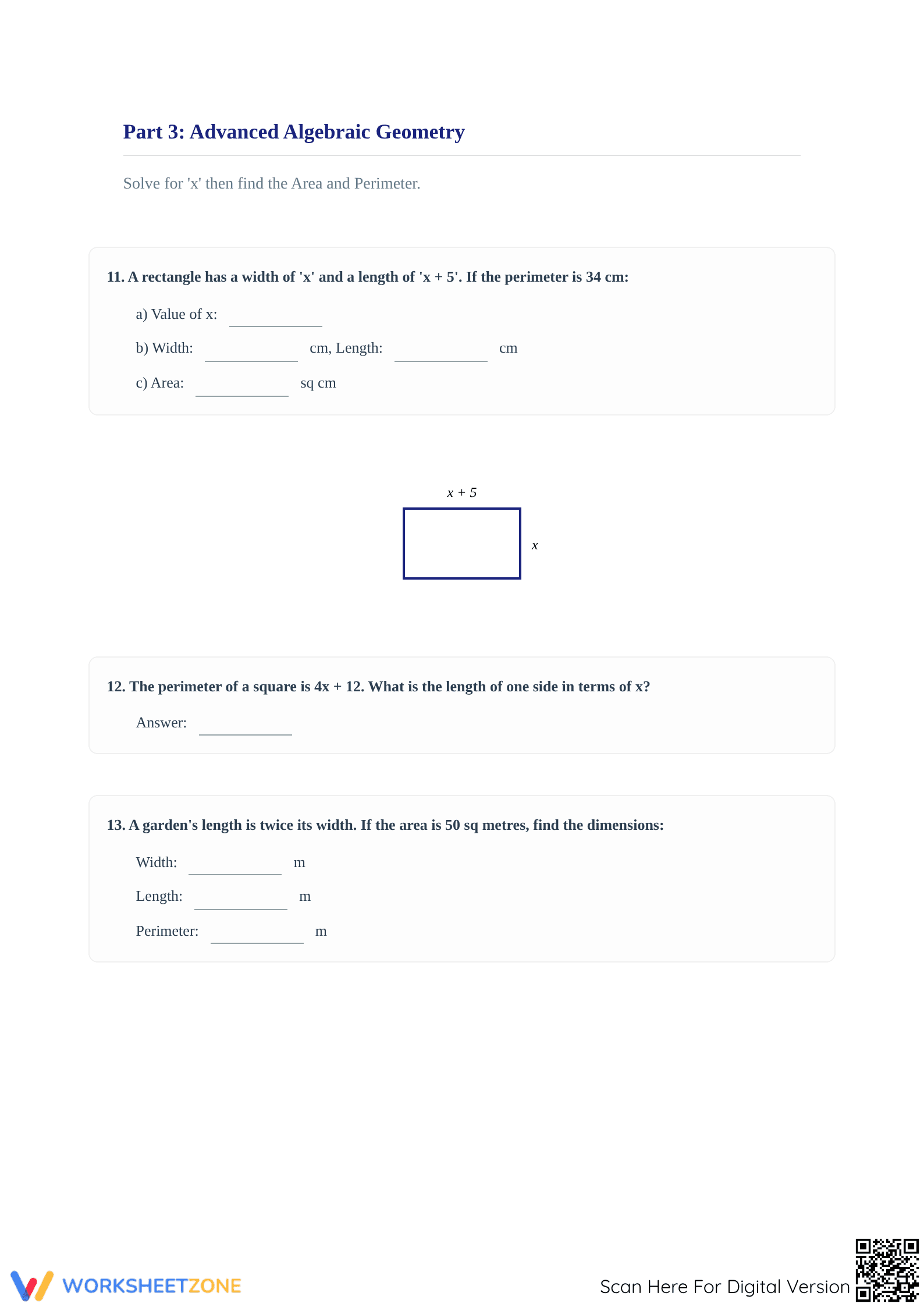
- Supported practice: Problems 6 through 10 provide diagrams and scaffolded steps to help students set up and solve perimeter equations for specific values.
- Independent practice: The final sections challenge students with advanced geometry and critical thinking questions, such as explaining how doubling a width affects dimensions.
This sequence follows the gradual-release model, moving from scaffolded identification to independent synthesis of algebraic concepts.
Aligned to CCSS.MATH.CONTENT.6.EE.B.6, this resource requires students to use variables to represent numbers and write expressions when solving a mathematical problem. It also supports CCSS.MATH.CONTENT.7.EE.B.4 by constructing simple equations to solve problems about quantities. Both standard codes can be copied directly into lesson plans, IEP goals, or district curriculum mapping tools.
Use this worksheet as a mid-unit assessment during your expressions and equations module. For a formative check, observe students during Part 2 to ensure they are correctly distributing the "2" in the perimeter formula (2l + 2w). Students typically require 40 minutes for full completion, making it an ideal choice for a complete lesson block or a detailed homework assignment.
This resource is designed for Grade 6 and 7 students who have mastered basic perimeter concepts but need to strengthen their algebraic fluency. It provides excellent differentiation for advanced Grade 5 learners or as a review for Grade 8 students. Pair this with a rectangle anchor chart or a short video lesson on combining like terms for maximum instructional impact.
Fisher & Frey (2014) emphasize that scaffolded tasks moving from translation to application are vital for mastering abstract concepts like algebra. This worksheet implements that model by requiring students to define variables before solving complex geometric equations. By connecting the physical properties of shapes—area and perimeter—to the abstract nature of algebraic variables, students develop a robust framework for higher-level mathematics. The standard CCSS.MATH.CONTENT.6.EE.B.6 focuses on using variables to represent numbers, a foundational skill for STEM coursework. Classroom data indicates that students practicing translating geometric relationships into symbolic language show gains in handling multi-step word problems on assessments. This resource provides the structured repetition necessary to move these skills into long-term memory. Furthermore, by integrating critical thinking questions at the end of the set, the worksheet ensures that students do not just memorize formulas but understand the underlying logic of variable manipulation in a real-world geometric context.


