


























Views
Downloads
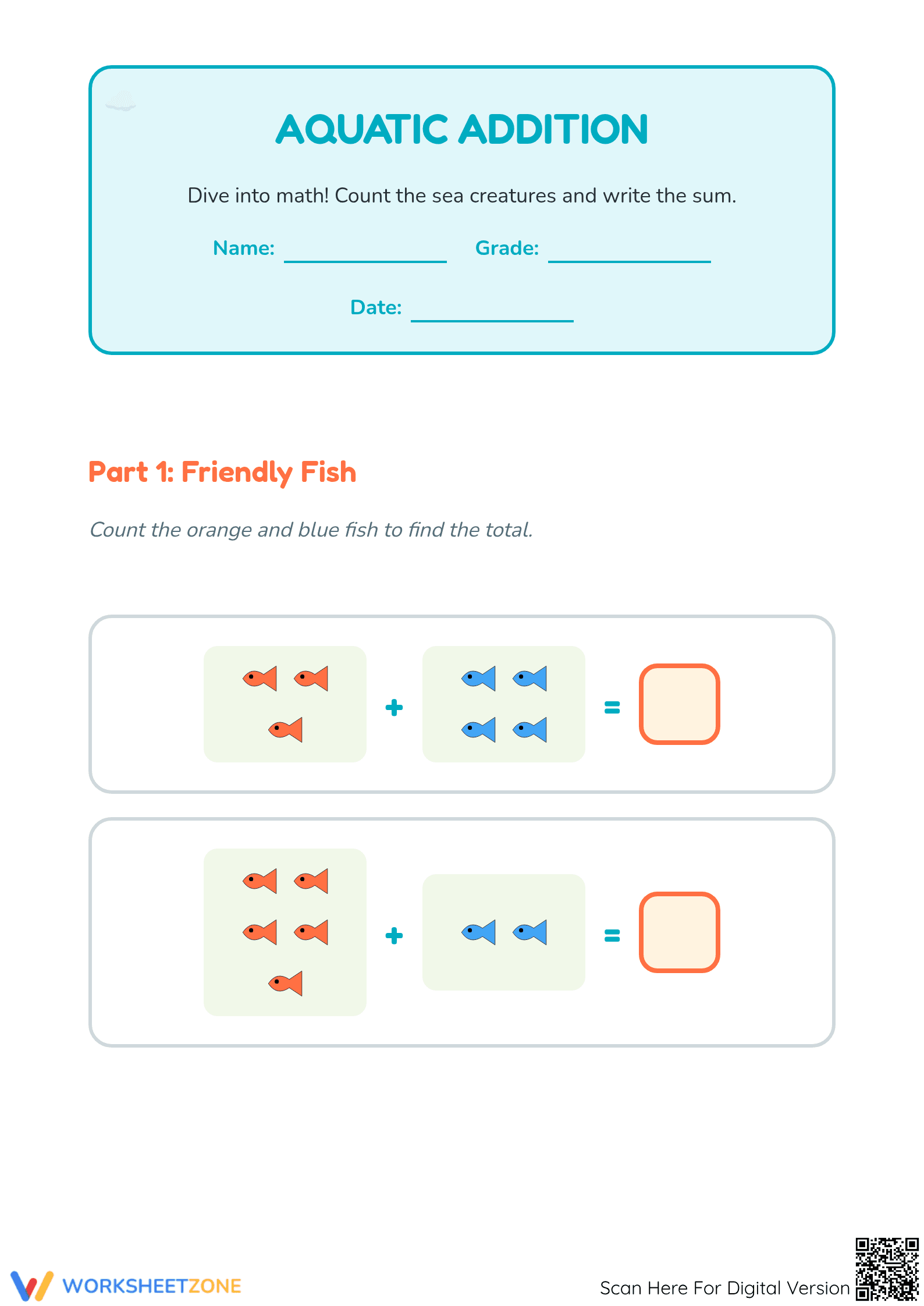
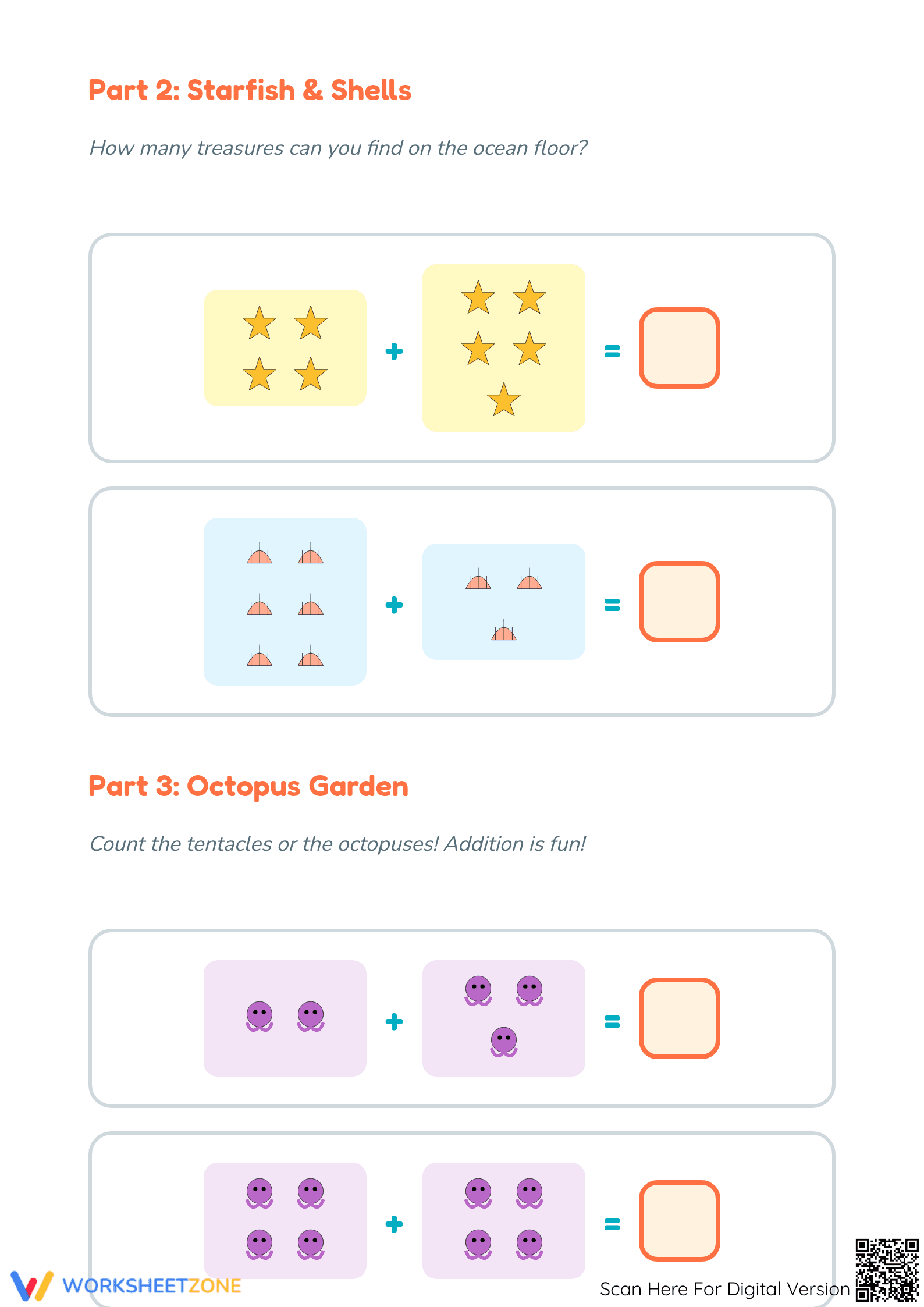

Printable Kindergarten Aquatic Addition Math Worksheet
Paste this activity's link or code into your existing LMS (Google Classroom, Canvas, Teams, Schoology, Moodle, etc.).
Students can open and work on the activity right away, with no student login required.
You'll still be able to track student progress and results from your teacher account.
This Kindergarten Aquatic Addition worksheet provides young learners with a vibrant, theme-based introduction to basic arithmetic. Students count charming sea creatures to solve simple addition problems within ten. By bridging visual representation with numerical values, the resource ensures children build a concrete understanding of how two sets of objects combine to form a new total.
At a Glance
- Grade: K · Subject: Mathematics
- Standard:
CCSS.MATH.CONTENT.K.OA.A.2— Solve addition problems within 10 using objects to represent the math- Skill Focus: Addition through counting objects
- Format: 2 pages · 6 problems · Answer key included · PDF
- Best For: Kindergarten math centers and introductory lessons
- Time: 15–20 minutes
What's Inside
This two-page PDF features six structured addition problems organized into three thematic sections: Friendly Fish, Starfish & Shells, and Octopus Garden. Each problem includes clear boxes for the final sum and uses distinct colors for different sets of objects. A complete two-page answer key is included, showing the numerical solutions for quick teacher verification or student self-correction.
Zero-Prep Workflow
- Print (30 Seconds): Select the two pages and print enough copies for your small group or entire class. No special paper is required.
- Distribute (1 Minute): Hand out the sheets along with crayons or pencils. The instructions are self-explanatory, allowing for immediate student engagement.
- Review (2 Minutes): Use the provided answer key to check student work. The total teacher preparation time for this activity is consistently under two minutes.
Standards Alignment
This resource is specifically aligned with CCSS.MATH.CONTENT.K.OA.A.2, which requires students to solve addition and subtraction word problems, and add and subtract within 10, e.g., by using objects or drawings to represent the problem. Both standard codes can be copied directly into lesson plans, IEP goals, or district curriculum mapping tools.
How to Use It
Use this worksheet as a formative assessment during your introductory unit on operations. While students are counting, walk around the room to observe if they are using one-to-one correspondence or if they are beginning to subitize smaller groups. It also serves as an excellent emergency sub plan for early elementary math blocks. Students should typically complete both pages within 15 to 20 minutes.
Who It's For
This resource is designed for Kindergarten students who are transitioning from basic counting to conceptual addition. It is particularly effective for visual learners and can be paired with an ocean-themed anchor chart or a read-aloud about sea life to create a cohesive thematic lesson.
The Aquatic Addition worksheet aligns with the instructional shifts identified in EdReports 2024, which emphasizes the necessity of using concrete representations to build early mathematical fluency. Research from the NAEP highlights that Kindergarten students who master addition through counting objects are significantly better prepared for the abstract symbolic logic required in first grade. By providing six structured problems with distinct visual cues, this resource supports the standard CCSS.MATH.CONTENT.K.OA.A.2, ensuring students can solve addition problems within ten. The plain-English focus on counting sea creatures helps bridge the gap between perceptual subitizing and conceptual addition. This approach is consistent with findings from ScienceDirect TpT Analysis, which suggests that high-engagement, themed visuals reduce cognitive load during initial skill acquisition. Teachers can rely on this documented methodology to provide effective, evidence-based practice that leads to lasting mastery of foundational operations and algebraic thinking skills.


