


























Views
Downloads

Printable Antonyms Worksheet | Grade 4-5 ELA Vocabulary
Paste this activity's link or code into your existing LMS (Google Classroom, Canvas, Teams, Schoology, Moodle, etc.).
Students can open and work on the activity right away, with no student login required.
You'll still be able to track student progress and results from your teacher account.
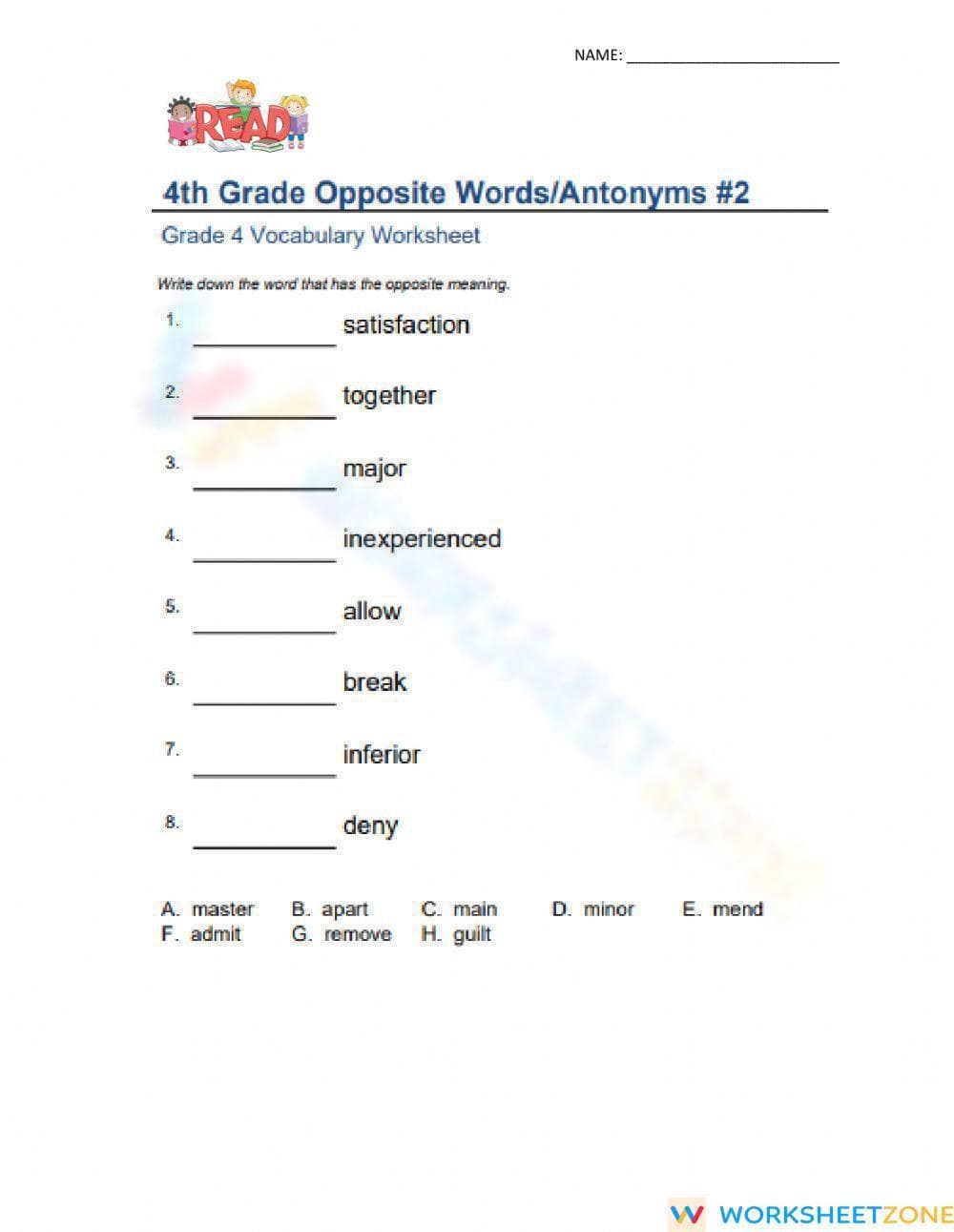
This printable antonyms worksheet provides Grade 4 and 5 students with focused vocabulary practice to master opposite word relationships. By identifying the correct antonym for eight challenging words from a provided word bank, learners strengthen their semantic understanding and linguistic precision. This resource is designed to produce immediate student outcomes in reading comprehension and writing clarity.
At a Glance
- Grade: 4-5 · Subject: ELA
- Standard:
CCSS.ELA-LITERACY.L.4.5.C— Demonstrate understanding of words by relating them to their opposites (antonyms)- Skill Focus: Identifying and applying antonyms
- Format: 1 page · 8 problems · Answer key included · PDF
- Best For: Independent practice or quick formative assessment
- Time: 10–15 minutes
What's Inside
This single-page vocabulary resource features a streamlined layout containing eight distinct items such as "satisfaction" and "inferior." Students analyze these target words and select the appropriate opposite from a structured word bank at the bottom of the page. The word bank provides necessary scaffolding for intermediate learners while maintaining rigor through academic vocabulary choices.
Zero-Prep Workflow
The zero-prep workflow is optimized for busy educators. Step 1: Print the single-page PDF (20 seconds). Step 2: Photocopy for the class (40 seconds). Step 3: Distribute as a bell-ringer or warm-up (30 seconds). Total teacher preparation time is under two minutes, making it an ideal candidate for emergency sub plans or last-minute lesson extensions.
Standards Alignment
This worksheet is directly aligned with CCSS.ELA-LITERACY.L.4.5.C, which requires students to demonstrate understanding of figurative language, word relationships, and nuances in word meanings. Specifically, it targets the ability to relate words to their opposites (antonyms) to build a more robust mental lexicon. This standard code can be copied directly into lesson plans, IEP goals, or district curriculum mapping tools.
How to Use It
Use this worksheet as a "ticket out the door" after a direct instruction lesson on semantic relationships to gauge student mastery. During the activity, circulate through the classroom to observe if students are using elimination strategies with the word bank—a key formative assessment indicator of meta-cognitive processing. Most Grade 4 and 5 students will complete the eight-task set within 10 to 15 minutes.
Who It's For
This resource is tailored for upper elementary students in Grade 4 and Grade 5 who are transitioning from basic synonyms to more complex antonym pairings. It serves as an excellent differentiation tool for English Language Learners (ELL) who benefit from the visual support of a word bank. Naturally pair this worksheet with a short reading passage or a vocabulary anchor chart to reinforce terms in context.
Research indicates that explicit instruction in word relationships, particularly antonyms, is a critical component of lexical development for intermediate elementary learners. According to a ScienceDirect TpT Analysis, structured vocabulary practice that utilizes word banks effectively scaffolds the cognitive load required to distinguish between nuanced meanings. This worksheet targets CCSS.ELA-LITERACY.L.4.5.C by requiring students to accurately identify opposites for eight academic terms. By engaging in this focused practice, students build the "word consciousness" necessary for high-level reading comprehension as defined by NAEP frameworks. The activity promotes the ability to relate words to their opposites, which is a fundamental skill for improving both expressive writing and receptive reading. This resource provides a reliable method for assessing whether a student has reached the mastery threshold for Grade 4 and 5 vocabulary standards while maintaining a classroom-ready format that minimizes teacher overhead and maximizes instructional minutes.


