


























Views
Downloads
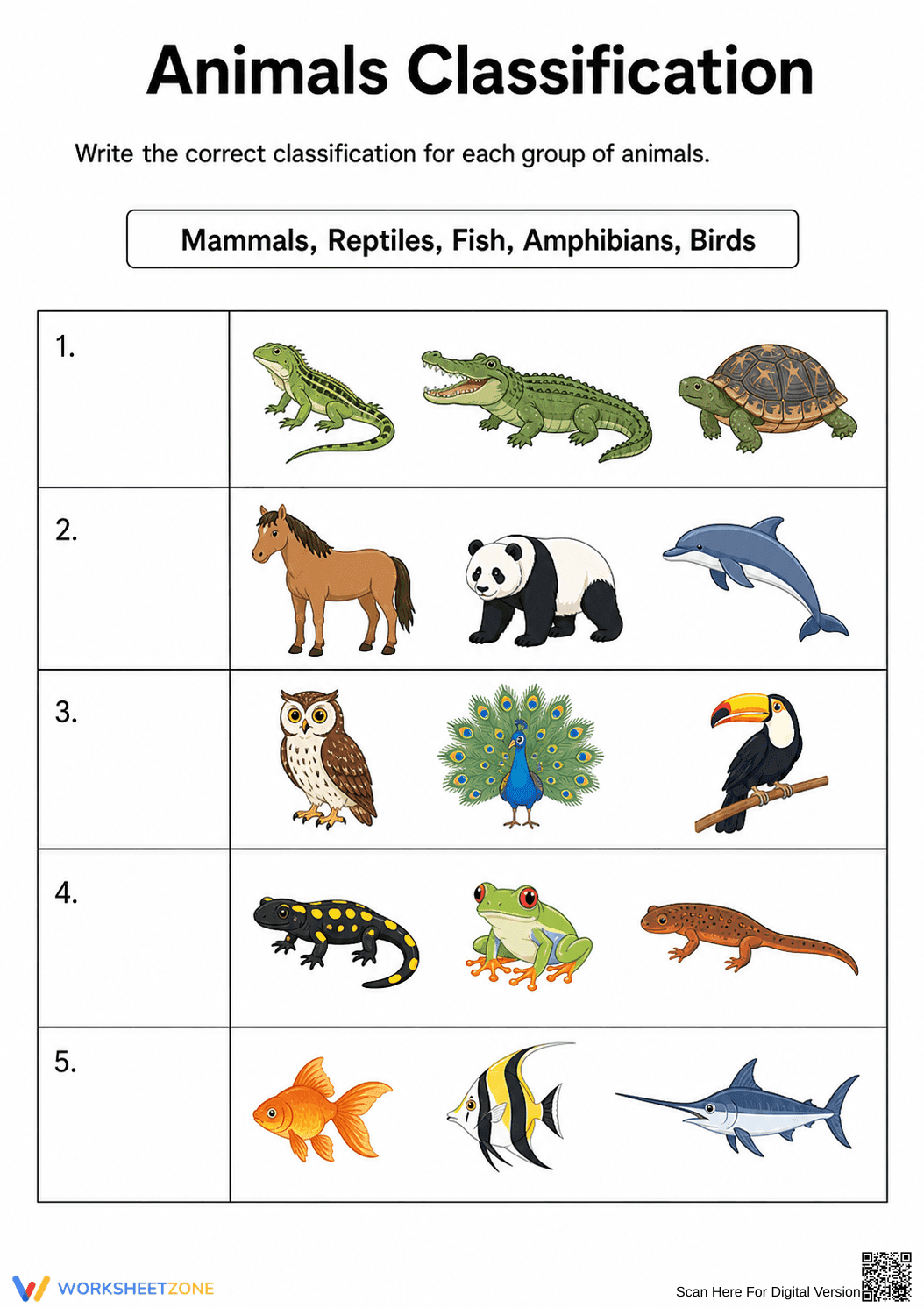

Animal Classification Worksheet | Grade 5 Essential
Paste this activity's link or code into your existing LMS (Google Classroom, Canvas, Teams, Schoology, Moodle, etc.).
Students can open and work on the activity right away, with no student login required.
You'll still be able to track student progress and results from your teacher account.
This Grade 5 animal classification worksheet helps students categorize living things into five biological groups. By observing physical traits of fifteen animals, learners distinguish between mammals, reptiles, fish, amphibians, and birds. This resource provides practice in scientific observation and taxonomy, ensuring students master foundational life science concepts.
At a Glance
- Grade: 5 · Subject: Science
- Standard:
3-LS1-1— Develop models to describe that organisms have unique and diverse life cycles- Skill Focus: Biological Classification
- Format: 1 page · 5 problems · Answer key included · PDF
- Best For: Quick formative assessment or science centers
- Time: 10–15 minutes
What's Inside
This single-page PDF features a clear, organized layout with five primary classification categories. Students are provided with a word bank containing the five major vertebrate groups. Below the instructions, fifteen high-quality illustrations are arranged in rows, challenging students to identify the common characteristics shared by the animals in each group. The worksheet includes a full answer key for rapid grading and feedback.
Zero-Prep Workflow
The zero-prep workflow for this resource is designed for maximum efficiency. First, print the PDF, taking thirty seconds. Second, distribute the sheets; the word bank and visual cues mean no introduction is required. Finally, review answers as a group. Total teacher preparation time is under two minutes, making it an ideal sub-plan.
Standards Alignment
This resource aligns with `3-LS1-1`, focusing on observable traits that define animal groups. It supports understanding of biological diversity and ecosystem roles. Standard codes can be copied directly into lesson plans, IEP goals, or curriculum mapping tools to ensure compliance with science frameworks.
How to Use It
Use this worksheet as a "bell-ringer" activity to activate prior knowledge before a lesson on vertebrate biology. It also serves as an excellent formative assessment tool after a lecture on animal traits. Teachers should observe if students can correctly identify the amphibians versus reptiles, as this often indicates a need for further clarification on skin texture and life cycles. The expected completion time is approximately 12 minutes.
Who It's For
This worksheet is ideal for Grade 5 students requiring a refresher on taxonomy or for English Language Learners (ELL) who benefit from the strong visual support provided by the animal illustrations. It pairs naturally with an anchor chart detailing the specific characteristics of mammals and birds or a direct instruction lesson on the Linnaean system. It is also suitable for inclusion in a science interactive notebook.
According to the RAND AIRS 2024 report on science literacy, visual-spatial categorization tasks are essential for developing schema in young learners. This worksheet utilizes the 3-LS1-1 standard to bridge the gap between simple observation and formal scientific classification. By requiring students to group fifteen distinct organisms into five vertebrate categories, the resource reinforces the concept that physical traits are indicators of evolutionary relationships. Research from Fisher & Frey (2014) suggests that scaffolded practice with word banks and visual aids significantly improves retention of technical vocabulary in the life sciences. This specific activity provides the necessary repetition for students to internalize the differences between ectothermic and endothermic groups. The structured format ensures that learners focus on the critical attributes of each class, such as the presence of feathers, scales, or fur, which is a prerequisite for more complex biological studies in middle school.


