


























Views
Downloads
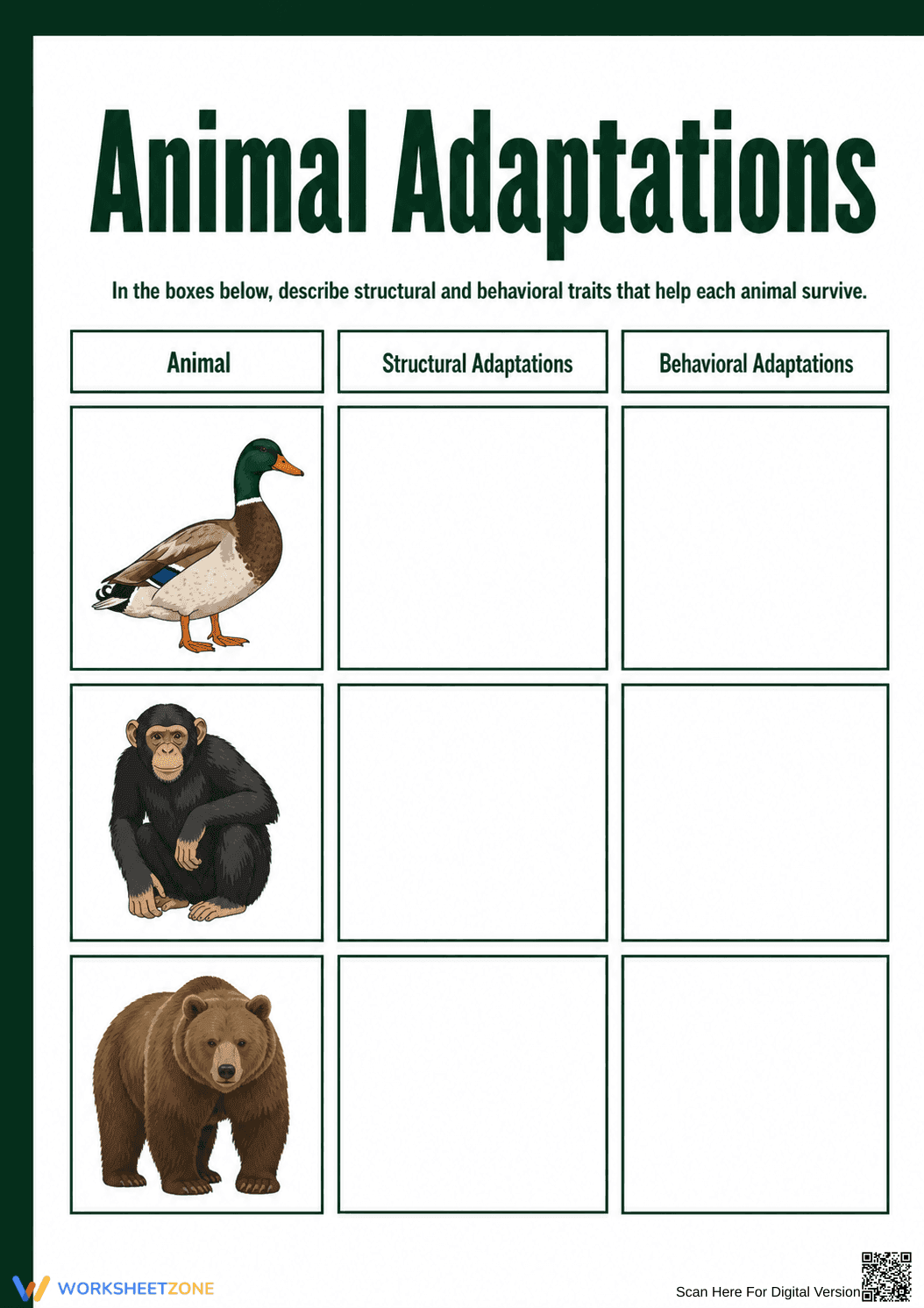
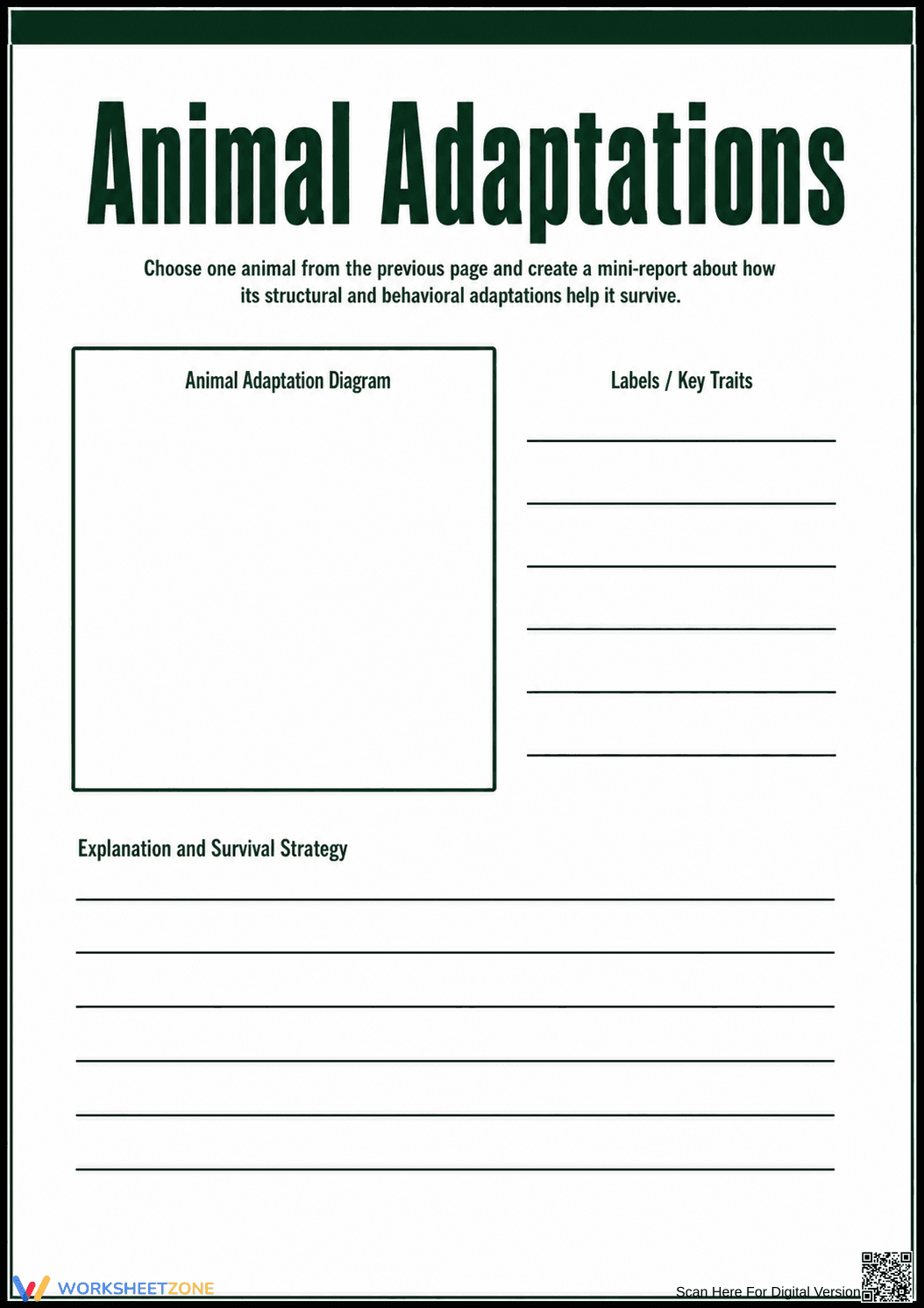

Grade 7 Animal Adaptations — Printable No-Prep Worksheet
Paste this activity's link or code into your existing LMS (Google Classroom, Canvas, Teams, Schoology, Moodle, etc.).
Students can open and work on the activity right away, with no student login required.
You'll still be able to track student progress and results from your teacher account.
This two-page animal adaptations worksheet helps students identify and explain structural and behavioral traits. By analyzing specific animals and drafting a mini-report, students connect physical characteristics to survival strategies, deepening their understanding of natural selection.
At a Glance
- Grade: 7 · Subject: Science
- Standard:
MS-LS4-4— Explain how traits increase the probability of surviving- Skill Focus: Structural and behavioral adaptations
- Format: 2 pages · 4 tasks · PDF
- Best For: Independent practice or mini-projects
- Time: 30–45 minutes
This resource features two sections to build scientific observation and writing skills. Page one includes a graphic organizer to categorize adaptations of a duck, chimpanzee, and bear. Page two provides a mini-report template with space for a labeled diagram, key traits, and a written explanation of survival strategies.
Designed for immediate classroom implementation, this zero-prep resource requires under two minutes of teacher setup. It is perfect for emergency sub plans or independent research days.
- Print (1 minute): Copy the two-page PDF for each student.
- Distribute (1 minute): Hand out worksheets and instruct students to choose one animal for their report.
- Review (5 minutes): Have students share their diagrams and explanations with a peer.
This worksheet is aligned to the Next Generation Science Standards, specifically focusing on MS-LS4-4: Construct an explanation based on evidence that describes how genetic variations of traits in a population increase some individuals' probability of surviving and reproducing in a specific environment. Both standard codes can be copied directly into lesson plans, IEP goals, or district curriculum mapping tools.
Integrate this worksheet during a unit on ecosystems, evolution, or biodiversity. It serves as an excellent formative assessment after direct instruction on the differences between structural and behavioral traits. Alternatively, use the second page as a standalone Claim-Evidence-Reasoning (CER) task where students must justify how a specific adaptation provides a survival advantage. While students work, teachers can observe their diagram labels to ensure they are accurately connecting physical features to environmental functions. Expect students to complete both pages in 30 to 45 minutes.
This resource is ideal for middle school life science students in grades 6 through 8, as well as ninth graders reviewing introductory biology concepts. The structured graphic organizer provides built-in scaffolding for students who need help organizing their thoughts before writing. Pair this worksheet with a nature documentary clip or a reading passage about extreme animal habitats to give students additional context before they begin their mini-reports.
Understanding how organisms adapt to their environments is a foundational concept in middle school life sciences. This worksheet aligns with MS-LS4-4, requiring students to explain how traits increase the probability of surviving. According to a ScienceDirect TpT Analysis, integrating graphic organizers with expository writing tasks significantly improves students' ability to accurately articulate complex biological relationships. By separating the identification of structural and behavioral adaptations from the synthesis required in the mini-report, this resource reduces cognitive load and allows young learners to process scientific information more effectively. The combination of visual diagramming and written explanation ensures that multiple learning modalities are engaged, reinforcing the core principles of natural selection and ecological fitness. This structured approach to scientific observation and reporting builds the critical thinking skills necessary for advanced STEM coursework.


