


























Views
Downloads

Essential Dodecahedron Angles Guide | Grade 8 Geometry
Paste this activity's link or code into your existing LMS (Google Classroom, Canvas, Teams, Schoology, Moodle, etc.).
Students can open and work on the activity right away, with no student login required.
You'll still be able to track student progress and results from your teacher account.
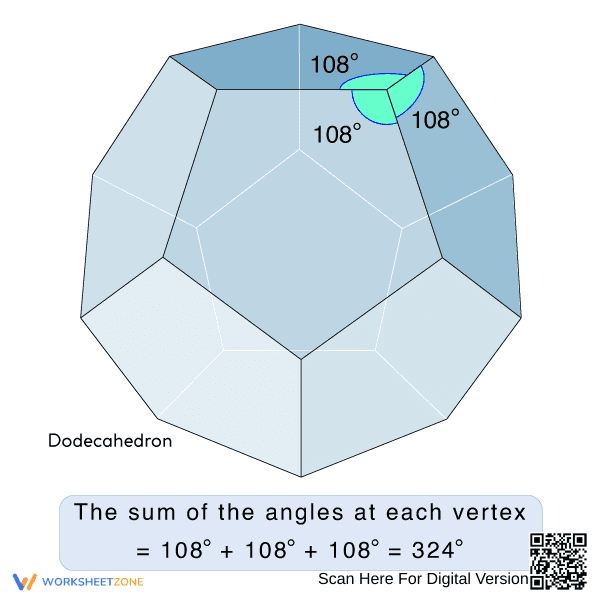
This Grade 8 geometry resource provides a clear visual breakdown of the interior angles within a regular dodecahedron. Students will identify the specific degree measurements at each vertex to understand the geometric properties of Platonic solids. This guide ensures learners can calculate angle sums and visualize complex 3D structures with precision.
At a Glance
- Grade: 8 · Subject: Geometry
- Standard:
HSG-MG.A.1— Use geometric shapes and their properties to describe objects- Skill Focus: Dodecahedron vertex angle calculation
- Format: 1 page · 1 reference task · Answer key included · PDF
- Best For: Visual learners and geometry reference
- Time: 5–10 minutes
Inside this resource, you will find a high-resolution diagram of a regular dodecahedron. It highlights the three pentagonal faces meeting at a single vertex, each contributing a 108-degree interior angle. The page includes a clear mathematical proof showing the sum of angles at each vertex equals 324 degrees, providing a concrete example of spatial geometry and polygon properties.
Skill Progression
- Guided practice: Students observe the labeled 108-degree angles on the primary diagram to identify the properties of a regular pentagon face.
- Supported practice: Learners follow the provided equation to verify the sum of angles at a single vertex using addition of three congruent angles.
- Independent practice: Students apply this logic to determine the total number of vertices and faces on the 3D solid in extended classroom activities.
This resource follows a gradual-release model by providing the visual evidence before requiring independent calculation of complex polyhedral properties.
Standards Alignment
This worksheet aligns with `HSG-MG.A.1`, which requires students to use geometric shapes, their measures, and their properties to describe objects. It also supports 7.G.B.6 by focusing on the attributes of two-dimensional shapes that compose three-dimensional figures. Both standard codes can be copied directly into lesson plans, IEP goals, or district curriculum mapping tools.
How to Use It
Use this as a supplemental reference during a unit on Platonic solids or as a visual anchor chart for geometry notebooks. It is particularly effective during the "explore" phase of a lesson to help students visualize why certain polygons can or cannot form a closed 3D shape. Expected completion for the associated calculation and observation is 5 to 10 minutes.
Who It's For
This guide is designed for middle and high school geometry students, particularly those who benefit from visual representations of abstract concepts. It pairs naturally with a lesson on Euler's formula or a hands-on activity involving 3D shape nets and physical manipulatives.
According to research from Fisher & Frey (2014), visual scaffolds are critical for students transitioning from 2D plane geometry to 3D spatial reasoning. This resource addresses the specific challenge of visualizing interior angles in a regular dodecahedron, a shape often omitted from basic curriculum but essential for advanced geometric modeling. By providing the 108-degree constant for pentagonal faces, the worksheet reduces cognitive load, allowing students to focus on the relationship between vertices and faces. The standard HSG-MG.A.1 emphasizes the application of these properties in real-world modeling. Data from NAEP suggests that students who engage with diverse polyhedra demonstrate higher proficiency in spatial visualization tasks. This printable guide serves as a foundational tool for mastering the properties of complex geometric solids through clear, evidence-based visual instruction and mathematical proof.


