


























Views
Downloads
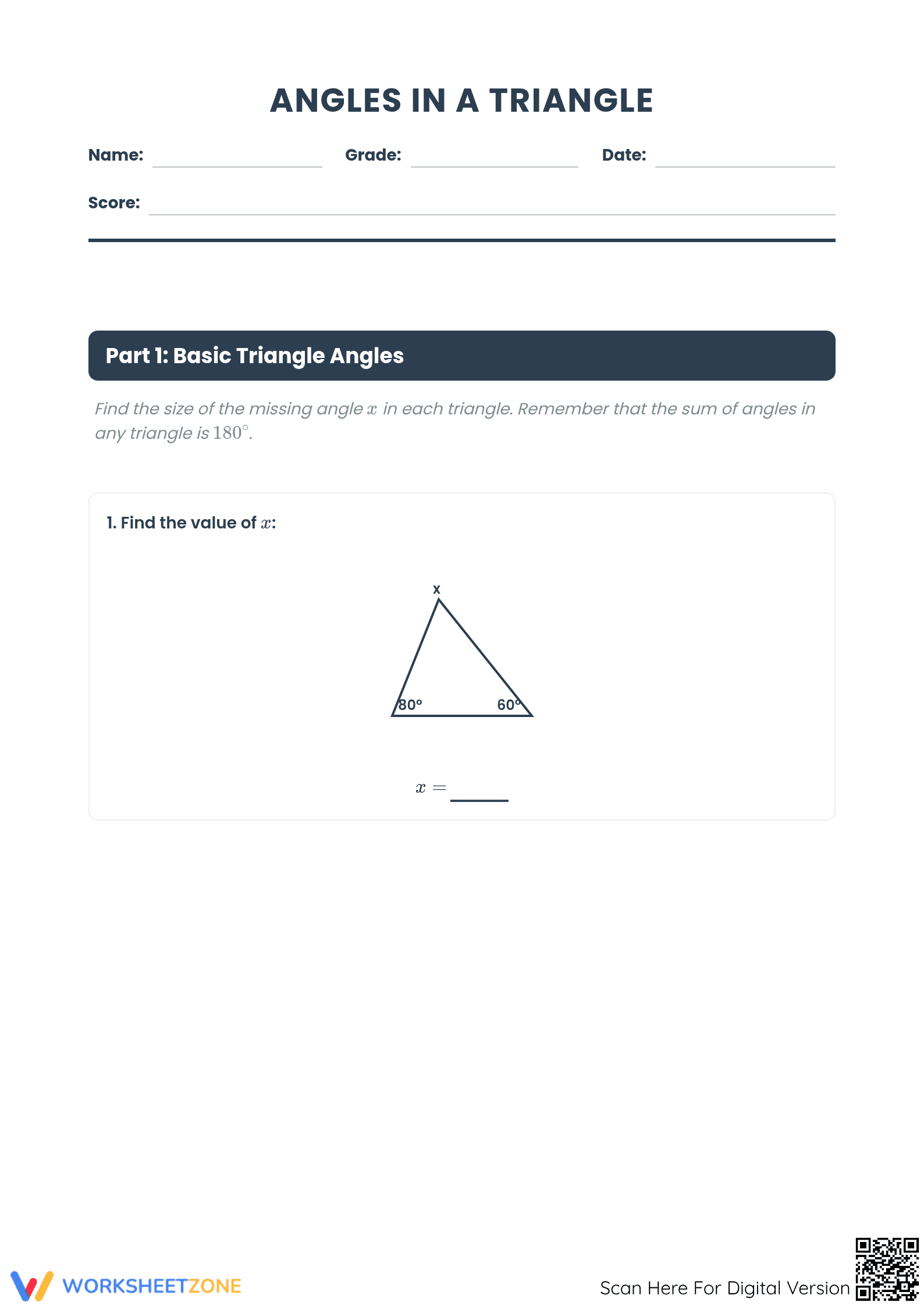
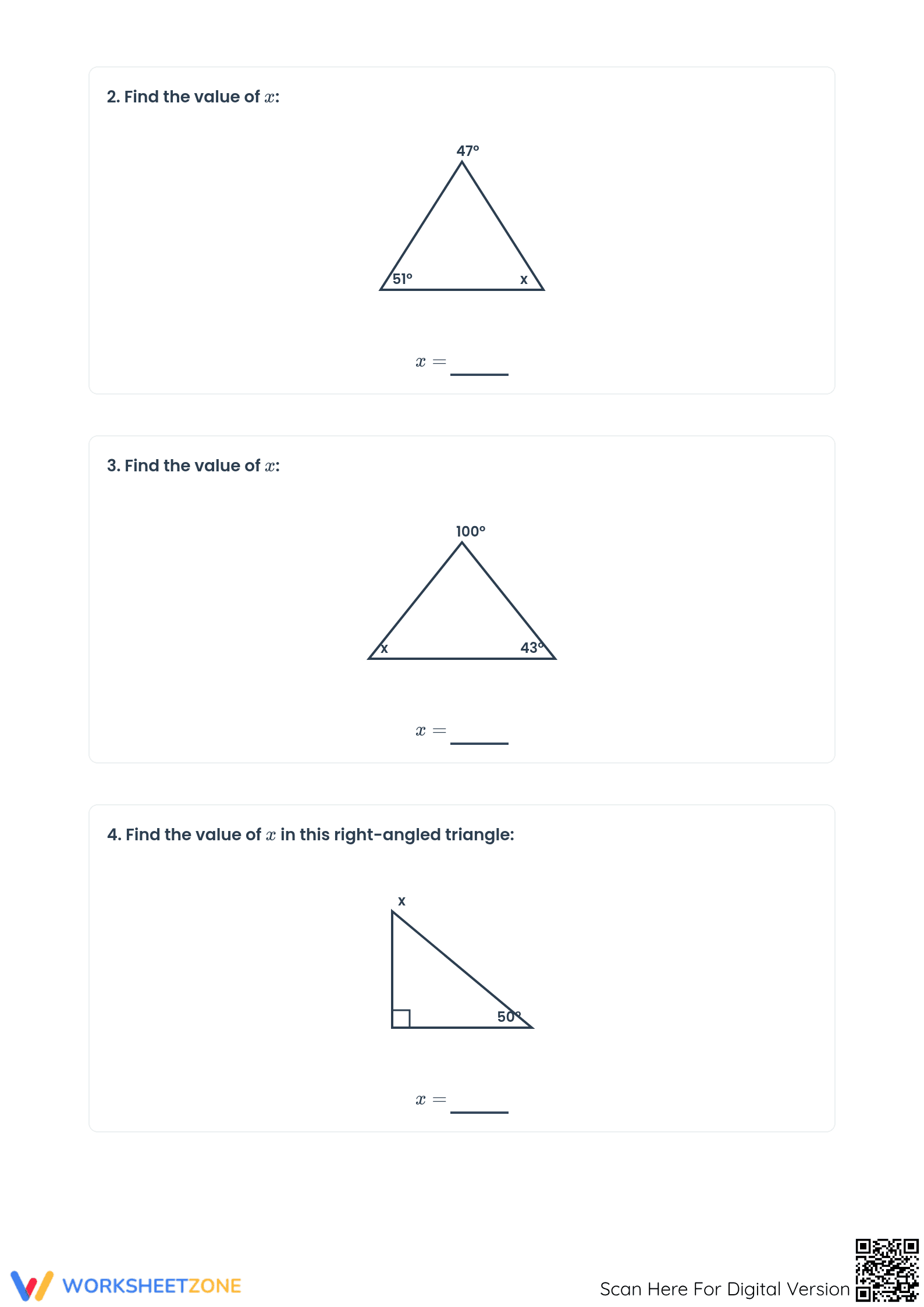
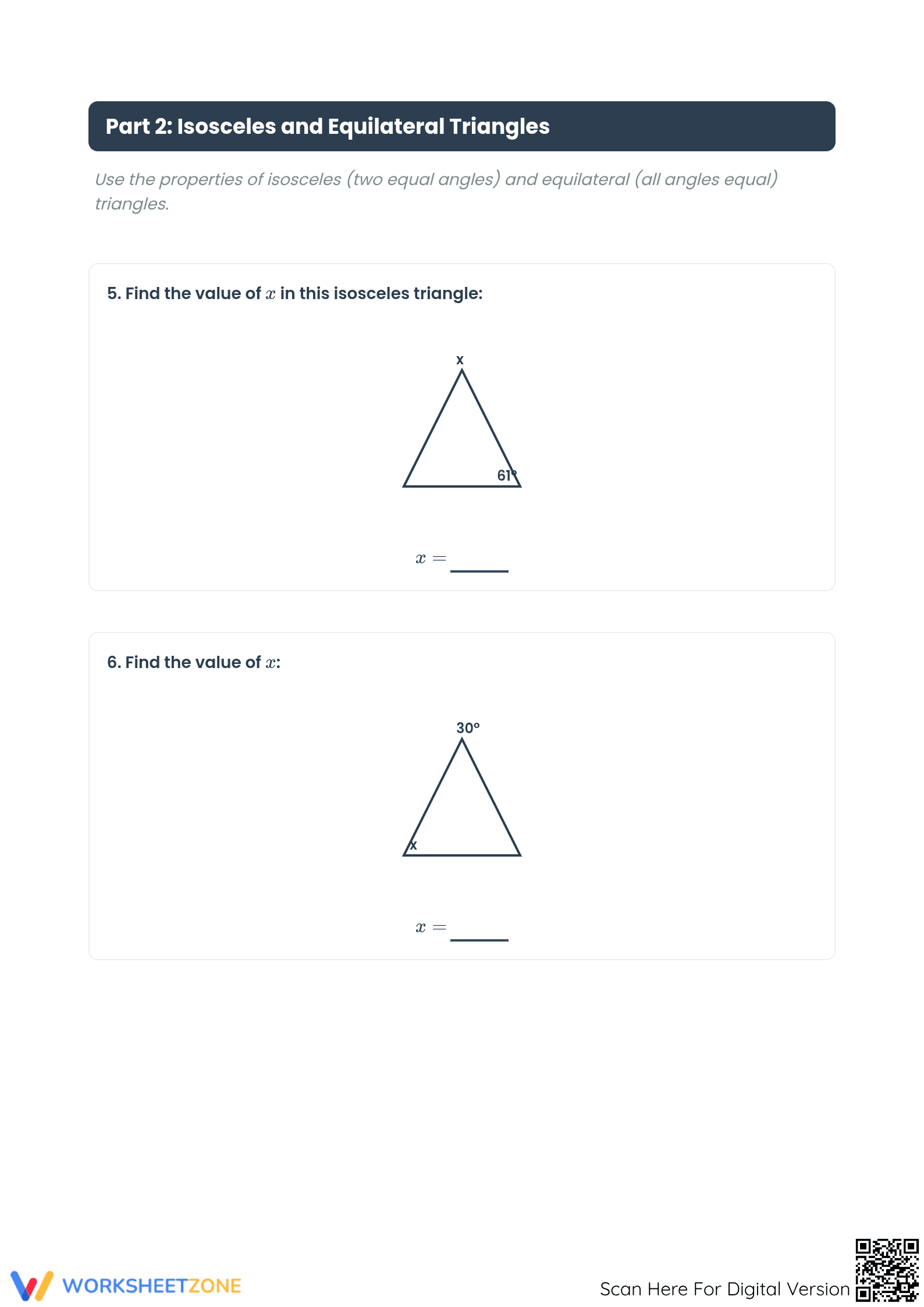
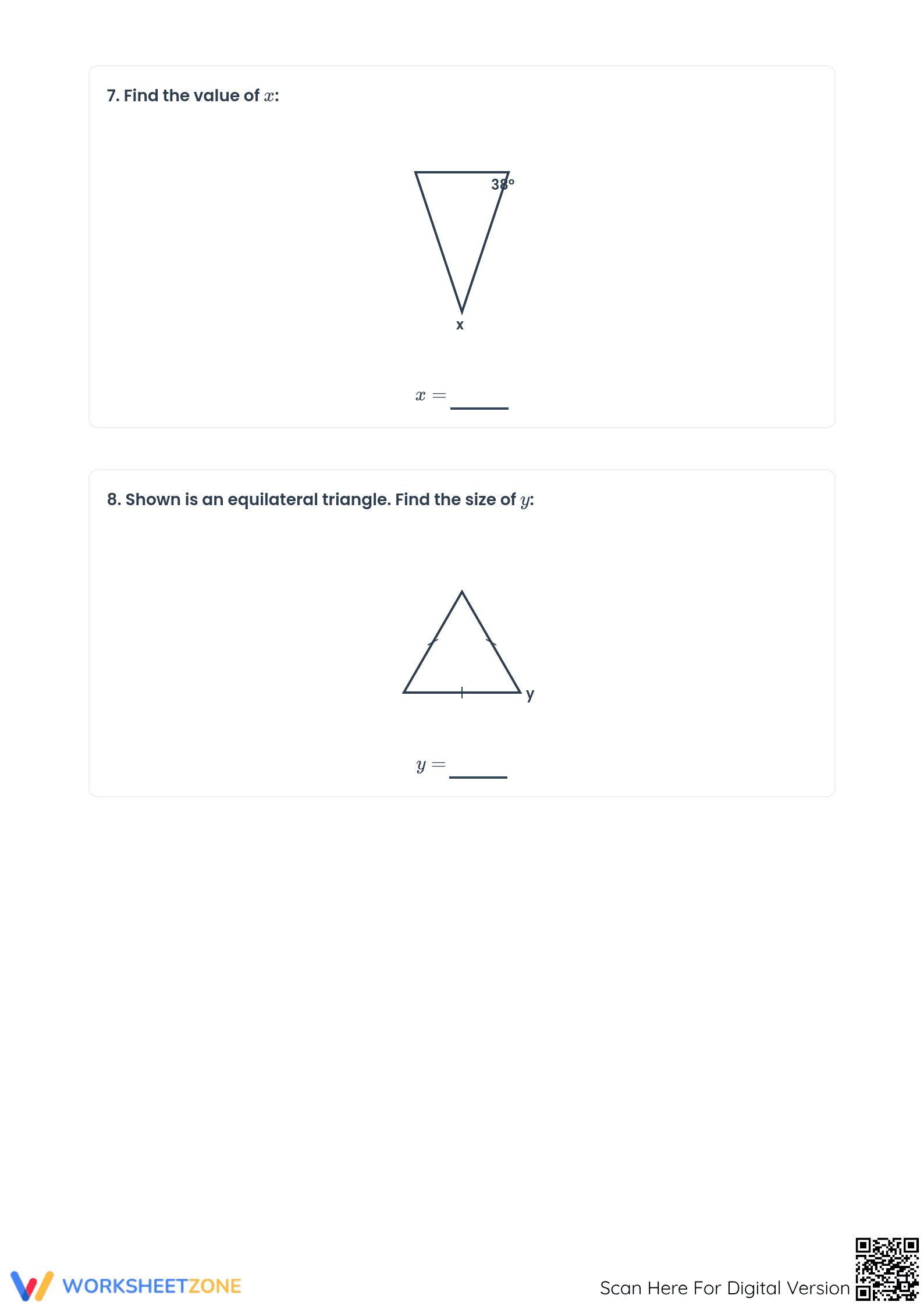

Angles in a Triangle Worksheet | Essential Grade 7 Math
Paste this activity's link or code into your existing LMS (Google Classroom, Canvas, Teams, Schoology, Moodle, etc.).
Students can open and work on the activity right away, with no student login required.
You'll still be able to track student progress and results from your teacher account.
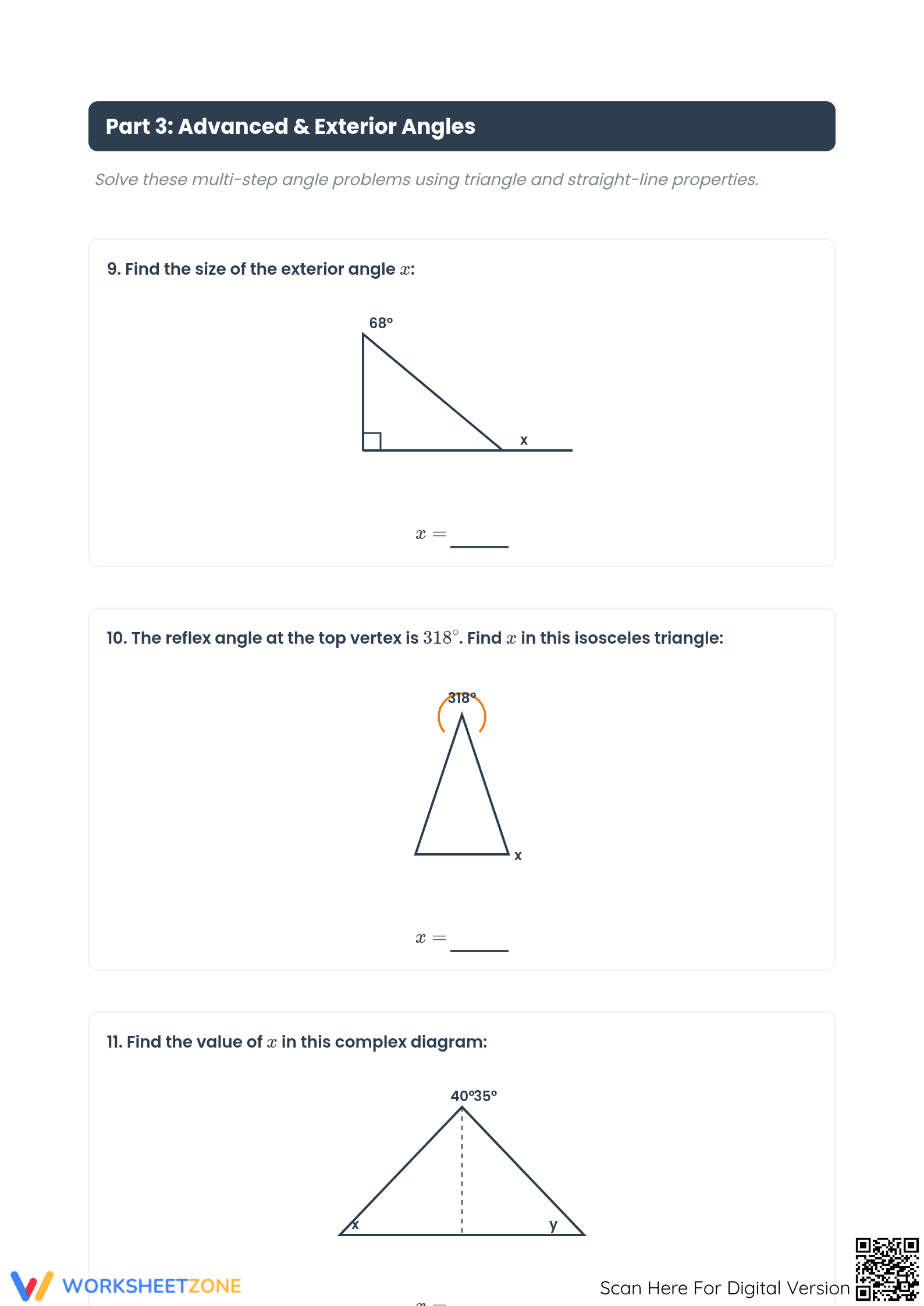
This comprehensive geometry resource enables students to master the fundamental properties of triangles through 11 targeted problems. By calculating missing interior and exterior angles, learners develop a concrete understanding of the 180-degree sum rule and the unique characteristics of isosceles, equilateral, and right-angled triangles.
At a Glance
- Grade: 7 · Subject: Math
- Standard:
CCSS.MATH.CONTENT.7.G.B.5— Use angle facts to write and solve equations for unknown angles in figures- Skill Focus: Triangle Angle Sum & Properties
- Format: 5 pages · 11 problems · Answer key included · PDF
- Best For: Independent practice and formative assessment
- Time: 30–45 minutes
The packet contains five distinct pages of student work, organized into three logical parts. Part 1 focuses on basic interior angle sums. Part 2 introduces the specific properties of isosceles and equilateral triangles, requiring students to identify equal angles before calculating. Part 3 challenges students with exterior angles and complex diagrams involving reflex angles. A full 5-page answer key is provided, showing the final values for x and y to facilitate rapid grading.
Zero-Prep Workflow
- Print: Select the specific pages needed for your lesson; the high-contrast PDF ensures clean copies in under 1 minute.
- Distribute: Hand out the 5-page packet as a complete unit or individual sheets for daily warm-ups.
- Review: Use the included answer key to provide instant feedback or allow students to self-correct their work during independent study.
Total teacher preparation time is less than 2 minutes, making this an ideal solution for emergency sub plans or last-minute curriculum gaps.
Standards Alignment
This worksheet is primarily aligned with CCSS.MATH.CONTENT.7.G.B.5, which requires students to use facts about supplementary, complementary, vertical, and adjacent angles in a multi-step problem to solve for an unknown angle. It also supports 5.G.B.3 by reinforcing the classification of two-dimensional figures based on properties. Both standard codes can be copied directly into lesson plans, IEP goals, or district curriculum mapping tools.
How to Use It
Assign Part 1 and 2 during the "We Do" phase of direct instruction to check for understanding of triangle sums. Use Part 3 as a high-leverage exit ticket or homework assignment to assess mastery of exterior angle theorems. Teachers should observe whether students are correctly identifying the "hidden" equal angles in isosceles triangles, as this is a common point of confusion. Completion typically takes 30 to 45 minutes depending on student proficiency.
Who It's For
This resource is designed for Grade 7 students but serves as excellent remediation for Grade 8 and 9 learners or enrichment for advanced Grade 5 and 6 students. It is particularly effective for students who benefit from visual geometry cues and structured problem-solving. Pair this worksheet with a protractor demonstration or a digital angle-sum interactive for a multi-modal learning experience.
The systematic approach to geometric reasoning presented in this worksheet aligns with the instructional shifts identified in the RAND AIRS 2024 report, which emphasizes the necessity of procedural fluency in middle school geometry. By requiring students to apply the 180-degree sum rule across varying triangle types—including right, isosceles, and equilateral—the resource builds the cognitive scaffolding required for high school trigonometry. Research from Fisher & Frey (2014) suggests that the gradual release of responsibility, mirrored here through the progression from basic interior sums to complex exterior angle problems, significantly improves long-term retention of mathematical properties. This 11-problem set provides the exact volume of practice needed to move students from conceptual awareness to computational mastery of CCSS.MATH.CONTENT.7.G.B.5. The inclusion of a comprehensive answer key further supports the NAEP recommendation for immediate feedback in mathematics instruction to prevent the reinforcement of procedural errors.


