


























Views
Downloads

Aligned Right Triangle Sides Worksheet | Grade 10 Geometry
Paste this activity's link or code into your existing LMS (Google Classroom, Canvas, Teams, Schoology, Moodle, etc.).
Students can open and work on the activity right away, with no student login required.
You'll still be able to track student progress and results from your teacher account.
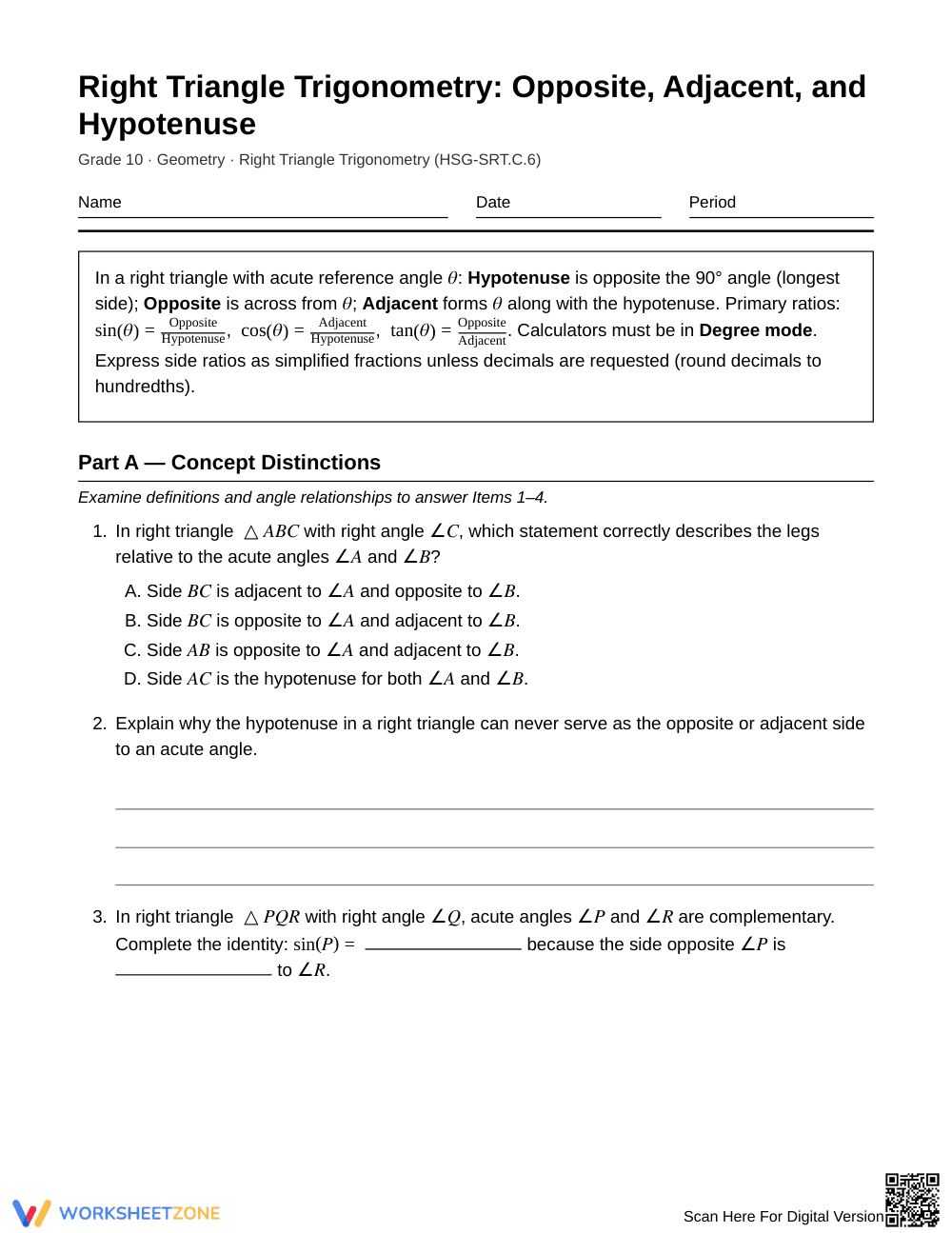
This Grade 10 geometry worksheet helps students master right triangle trigonometry by identifying opposite sides, adjacent sides, and the hypotenuse relative to acute reference angles. Learners build conceptual fluency, compute exact sine, cosine, and tangent ratios, and apply trigonometric equations to solve real-world geometry problems.
At a Glance
- Grade: 10 · Subject: Geometry
- Standard:
HSG-SRT.C.6— Define trigonometric ratios using right triangle side relationships- Skill Focus: Opposite, Adjacent, and Hypotenuse
- Format: 5 pages · 16 problems · Answer key included · PDF
- Best For: High school trigonometry skill practice
- Time: 40–50 minutes
What's Inside
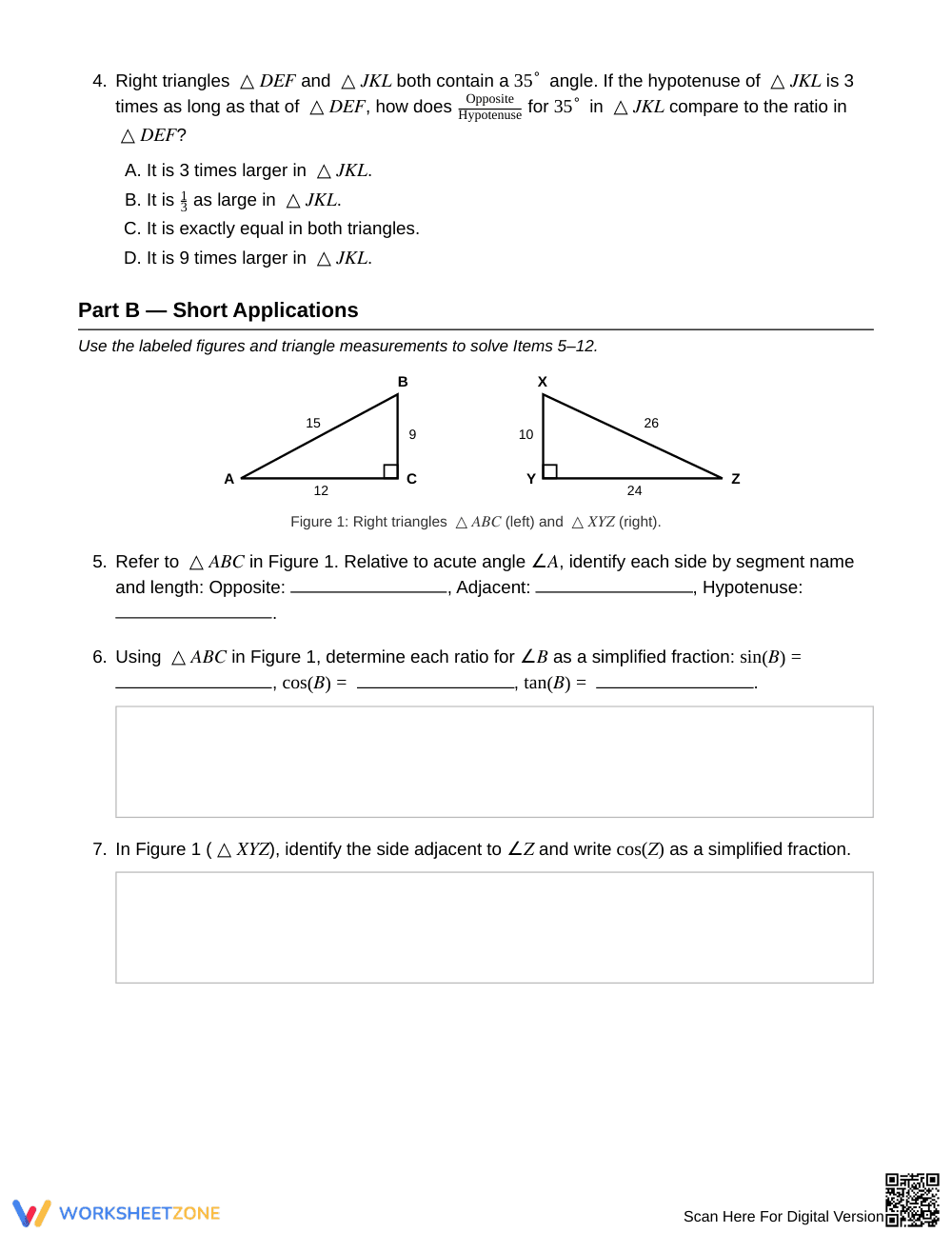
This 5-page printable PDF features 16 structured problems and a complete 3-page answer key. It includes a reference box with ratio formulas and degree mode reminders, labeled geometric diagrams, multiple-choice questions, fill-in-the-blank identities, multi-step application problems, similarity proofs, and an error analysis prompt.
Skill Progression
- Guided Practice (Part A, Items 1–4): Focuses on side definitions, explaining hypotenuse properties, complementary angle relationships, and scale invariance across similar triangles.
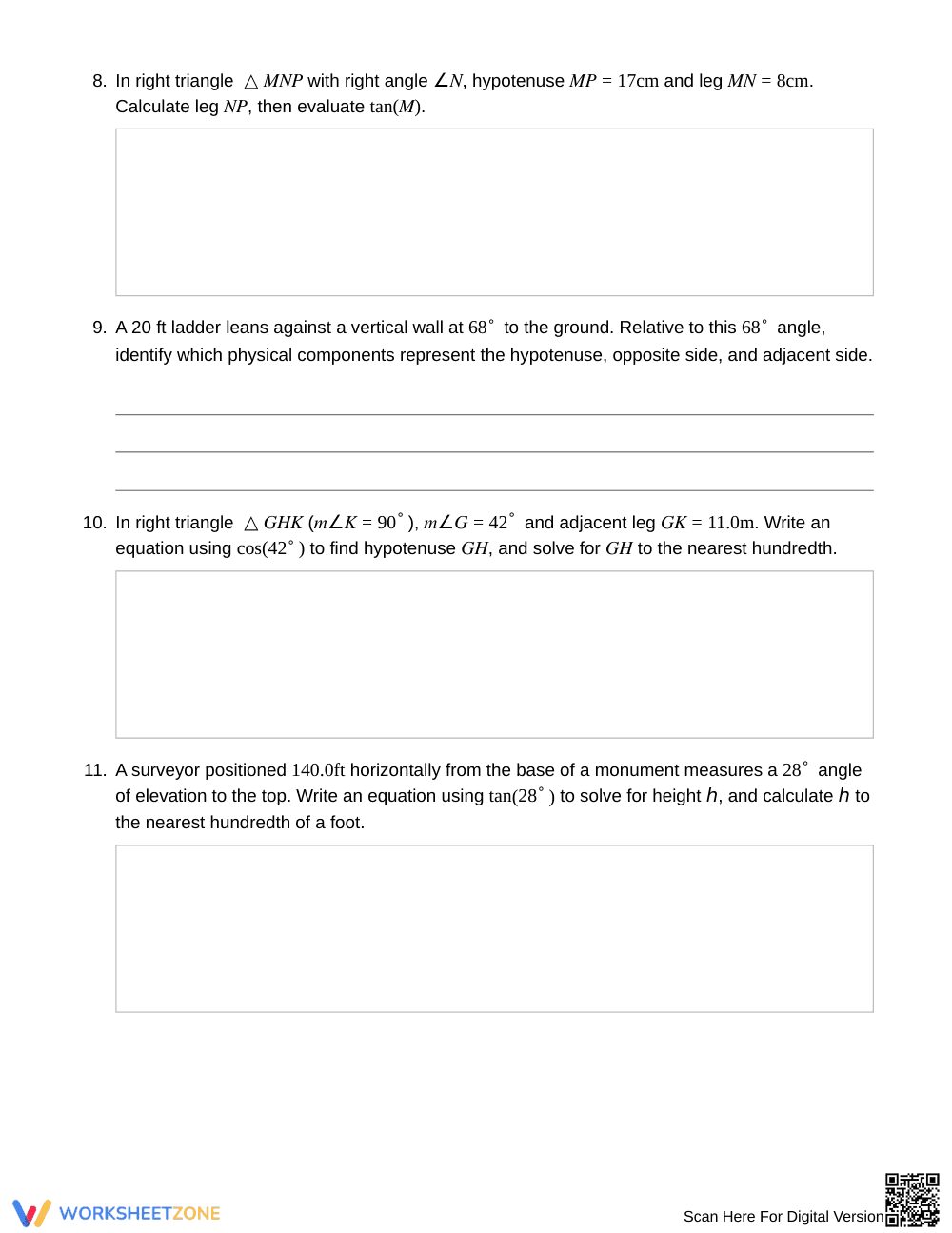
- Supported Practice (Part B, Items 5–12): Guides students to label sides from figures, calculate fractional trigonometric ratios, and solve elevation and distance word problems.
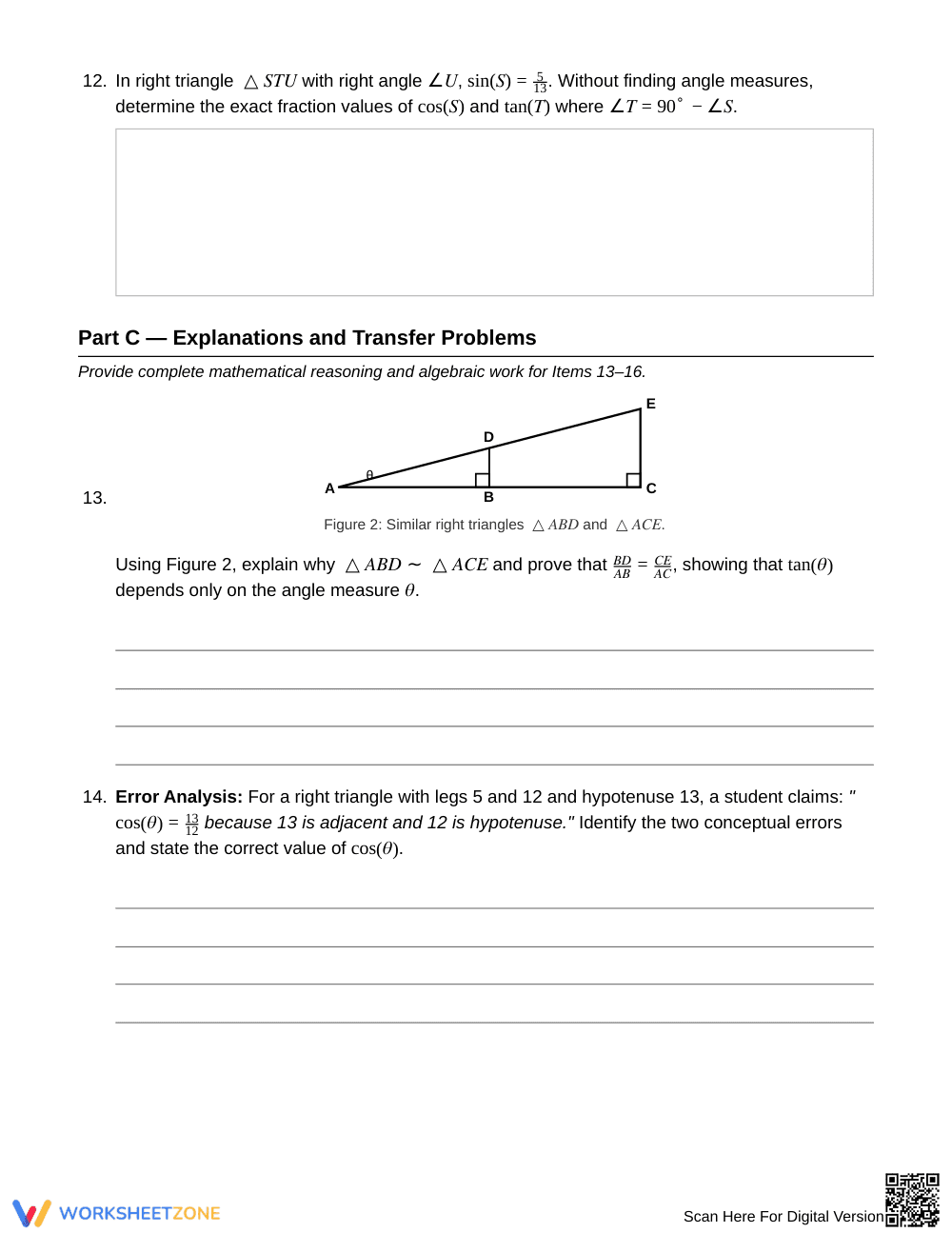
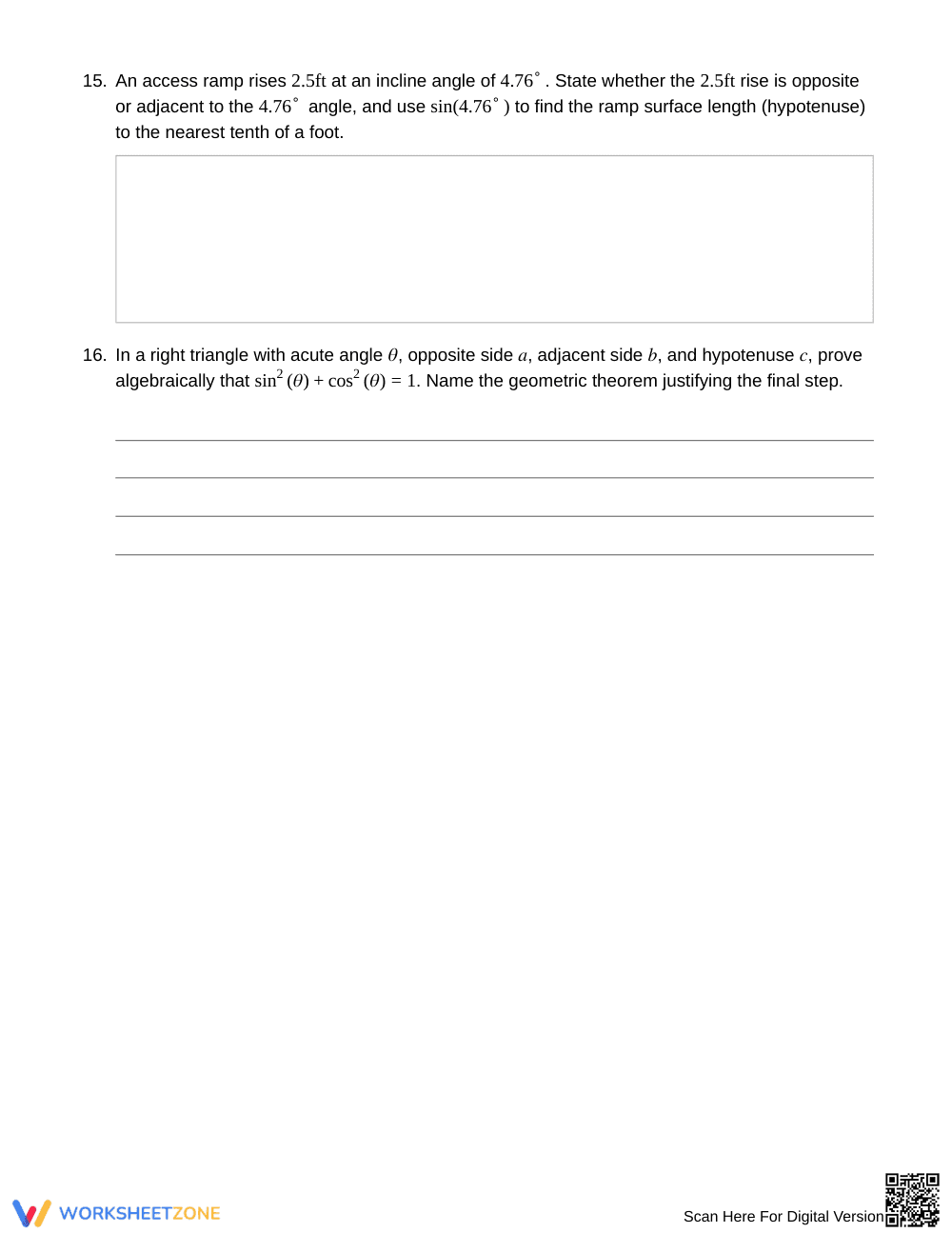
- Independent Practice (Part C, Items 13–16): Challenges students to prove ratio constancy, analyze conceptual calculation errors, model ramp inclines, and derive the Pythagorean trigonometric identity.
This structure utilizes the Gradual Release of Responsibility framework to transition learners from foundational concepts to independent proofs.
Standards Alignment
This resource aligns to `HSG-SRT.C.6`: Understand that by similarity, side ratios in right triangles are properties of the angles in the triangle, leading to definitions of trigonometric ratios for acute angles. It also supports `HSG-SRT.C.8`. Both standard codes can be copied directly into lesson plans, IEP goals, or district curriculum mapping tools.
How to Use It
Use this worksheet after introducing right triangle terminology or as a targeted review before assessing trigonometric ratios. Formatively observe whether students re-orient adjacent and opposite labels when switching reference angles. Students typically complete the 16 problems in 40 to 50 minutes of instructional time.
Who It's For
This worksheet is designed for Grade 10 geometry students learning trigonometry, as well as students needing focused remediation on side relationships. It provides clear visual scaffolds alongside rigorous extension proofs. Pair it with an angle-of-elevation classroom demonstration or reference anchor chart.
According to research by Fisher & Frey (2014) on scaffolded instructional design, student mastery of complex mathematical structures increases significantly when practice tasks systematically shift cognitive responsibility from conceptual orientation to autonomous reasoning. This Grade 10 Geometry worksheet operationalizes standard HSG-SRT.C.6 by guiding learners through a rigorous 16-problem sequence focused on defining opposite, adjacent, and hypotenuse sides in right triangles. By grounding trigonometric definitions in triangle similarity and angle-ratio constancy, the resource reinforces how side proportions function as invariant geometric properties. Students transition from identifying complementary angle relationships to executing multi-step applied equations and deriving foundational identities. When integrated into secondary geometry classrooms, this structured practice document provides educators with clear diagnostic insight into student comprehension while equipping high school learners with the prerequisite spatial and algebraic fluency required for advanced trigonometric modeling and real-world problem solving.


