




























Views
Downloads



Aligned Periodic Position Worksheet | Grade 12 Precalculus

Paste this activity's link or code into your existing LMS (Google Classroom, Canvas, Teams, Schoology, Moodle, etc.).
Students can open and work on the activity right away, with no student login required.
You'll still be able to track student progress and results from your teacher account.
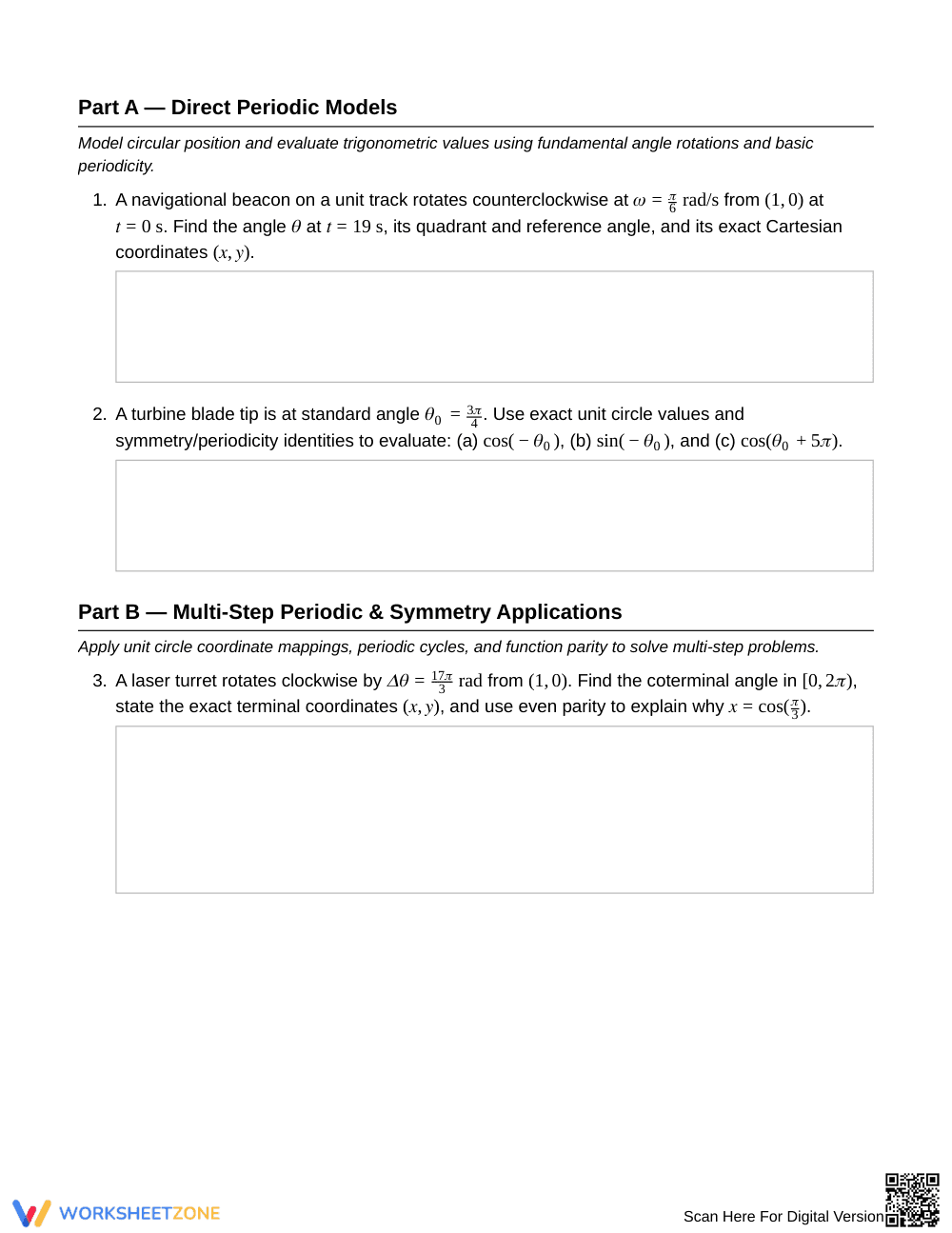
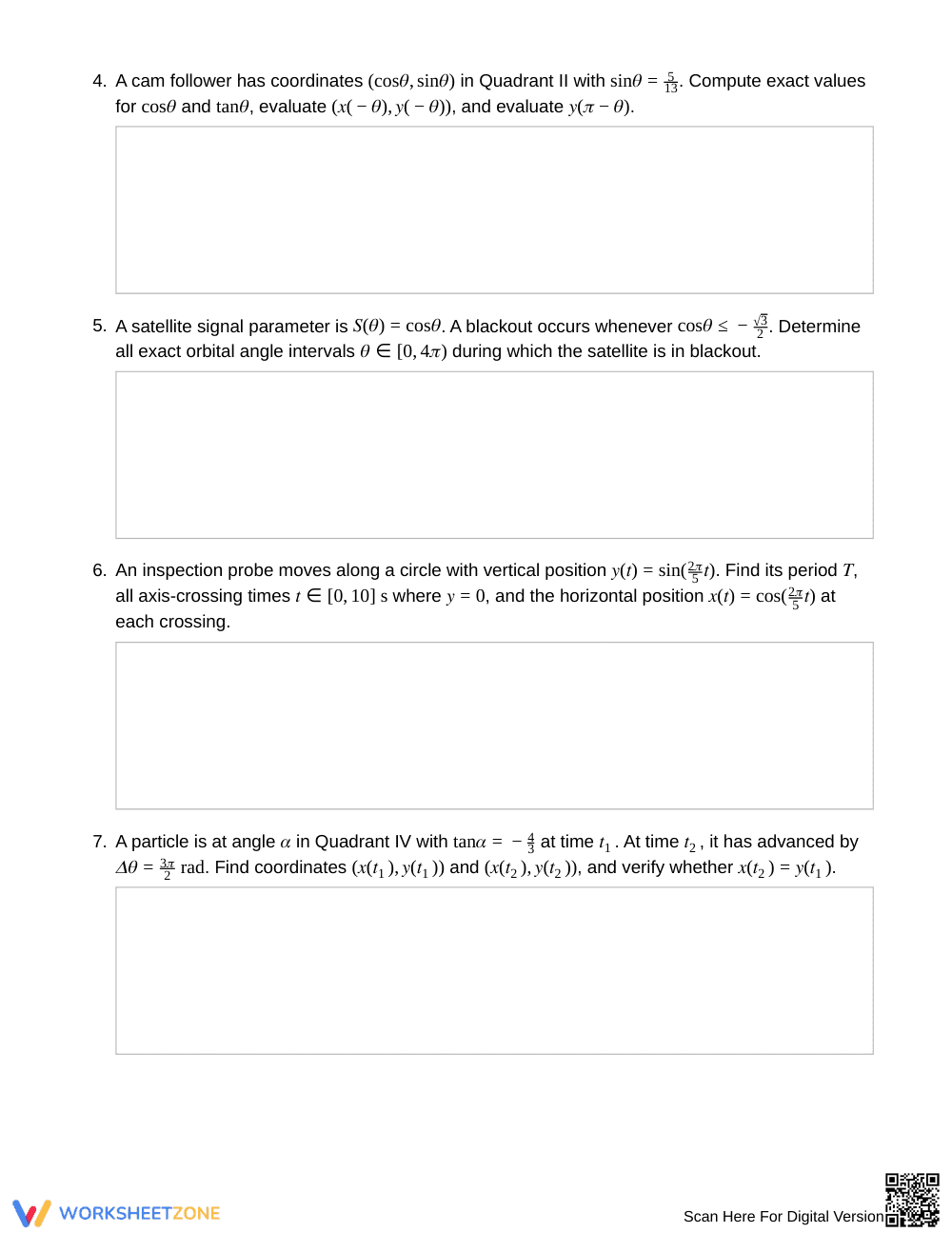
This Grade 12 Precalculus worksheet equips students to master circular periodicity, trigonometric function parity, and terminal coordinate tracking on the unit circle. Students determine exact positions, evaluate trigonometric expressions across multiple revolutions, and analyze periodic systems through structured analytical problems.
At a Glance
- Grade: 12 · Subject: Precalculus
- Standard:
HSF-TF.A.4— Use unit circle symmetry and periodicity to evaluate trigonometric functions and model position- Skill Focus: Interpret Periodic Position on a Circle
- Format: 5 pages · 10 problems · Answer key included · PDF
- Best For: Advanced trigonometry practice and review
- Time: 45–60 minutes
What's Inside
This 5-page PDF features a reference box summarizing periodicity and parity identities alongside a worked model problem with coordinate diagrams. The resource delivers 10 rigorous multi-part problems covering rotational kinematics, parity proofs, harmonic motion, and system optimization. A complete 2-page answer key provides step-by-step algebraic derivations and exact radical coordinates.
Skill Progression
- Guided practice (Part A, 2 tasks): Students calculate quadrant locations, reference angles, and exact coordinates for rotating beacons and turbine blades.
- Supported practice (Part B, 6 tasks): Learners apply even/odd parity, identify orbital blackout intervals, and solve multi-step tracking problems for probes and sensors.
- Independent practice (Part C, 2 tasks): Students evaluate spatial and temporal inequalities to compare welding programs and shutter logic systems.
This sequence implements a gradual-release model that builds proficiency from basic identities to complex engineering decisions.
Standards Alignment
The primary focus aligns with `HSF-TF.A.4`, requiring students to use the unit circle to express trigonometric symmetry and periodicity. Supporting work reinforces `HSF-TF.A.2` by connecting unit circle coordinates across extended real intervals. Both standard codes can be copied directly into lesson plans, IEP goals, or district curriculum mapping tools.
How to Use It
Use this worksheet following direct instruction on coterminal angles and parity, or as an intensive review before studying sinusoidal wave equations. During formative assessment, verify that students apply the even-function rule cos(−θ) = cos(θ) without erroneously changing coordinate signs. High school seniors typically complete the 10 problems in 45 to 60 minutes.
Who It's For
Designed for Grade 12 Precalculus and Trigonometry courses, this worksheet prepares students for calculus-level circular motion and rate problems. Teachers can use the introductory principles box to support developing students while assigning the Part C optimization tasks to challenge advanced learners. Pair this printable resource with an interactive unit circle visualizer.
Mastering trigonometric symmetry and circular periodicity under standard HSF-TF.A.4 establishes the critical mathematical foundation required for success in calculus, physics, and advanced STEM coursework. When students learn to interpret periodic position on the unit circle, they transition from static right-triangle geometry to dynamic coordinate functions capable of modeling continuous circular motion, orbital mechanics, and harmonic wave cycles. Research from Fisher & Frey (2014) demonstrates that structured gradual-release instructional frameworks—moving systematically from foundational coordinate identification to complex multi-step constraint modeling—significantly enhance mathematical retention and analytical problem-solving skills. By integrating exact radical calculations, parity proofs, and interval inequalities within applied engineering contexts, this comprehensive 5-page worksheet provides the deliberate practice needed for deep conceptual mastery. Educators can deploy these 10 targeted problems to ensure Grade 12 students develop rigorous analytical fluency in periodic modeling before entering college mathematics.


