




























Views
Downloads


Aligned Evaluating Exponents Worksheet | Grade 6 Math

Paste this activity's link or code into your existing LMS (Google Classroom, Canvas, Teams, Schoology, Moodle, etc.).
Students can open and work on the activity right away, with no student login required.
You'll still be able to track student progress and results from your teacher account.
This Grade 6 math worksheet strengthens students' ability to evaluate numerical expressions involving whole-number exponents and decimals using the standard order of operations. Through structured calculations and error analysis, learners master sequential operational rules, simplify complex multi-step expressions accurately, and build the foundational algebraic reasoning necessary for secondary mathematics.
At a Glance
- Grade: 6 · Subject: Middle School Math
- Standard:
6.EE.A.1— Write and evaluate multi-step numerical expressions involving whole-number exponents and parentheses- Skill Focus: Evaluating numerical expressions containing whole-number exponents
- Format: 5 pages · 12 problems · Comprehensive 4-page answer key included · PDF
- Best For: Intermediate order of operations review and targeted remediation
- Time: 35–45 minutes
What's Inside
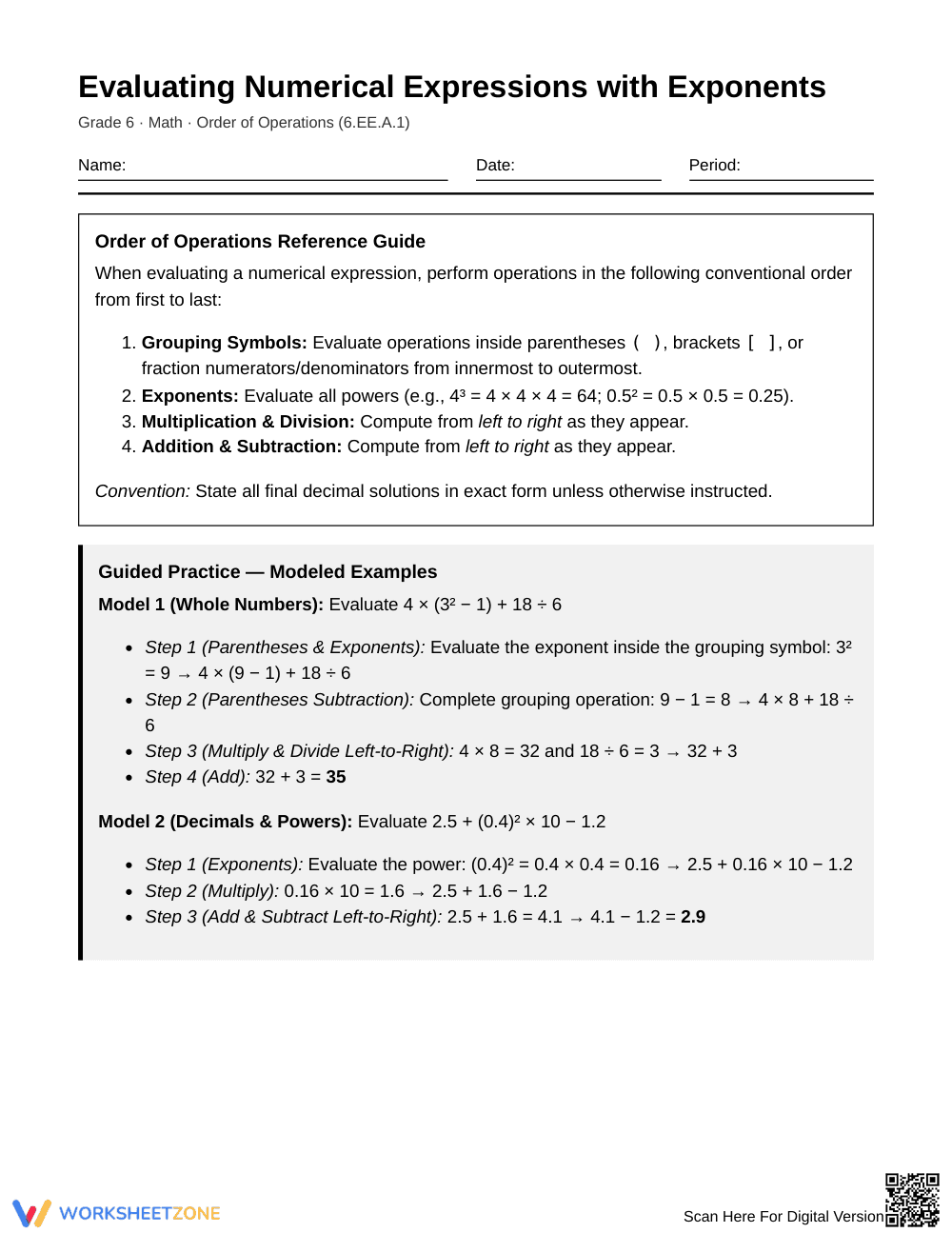
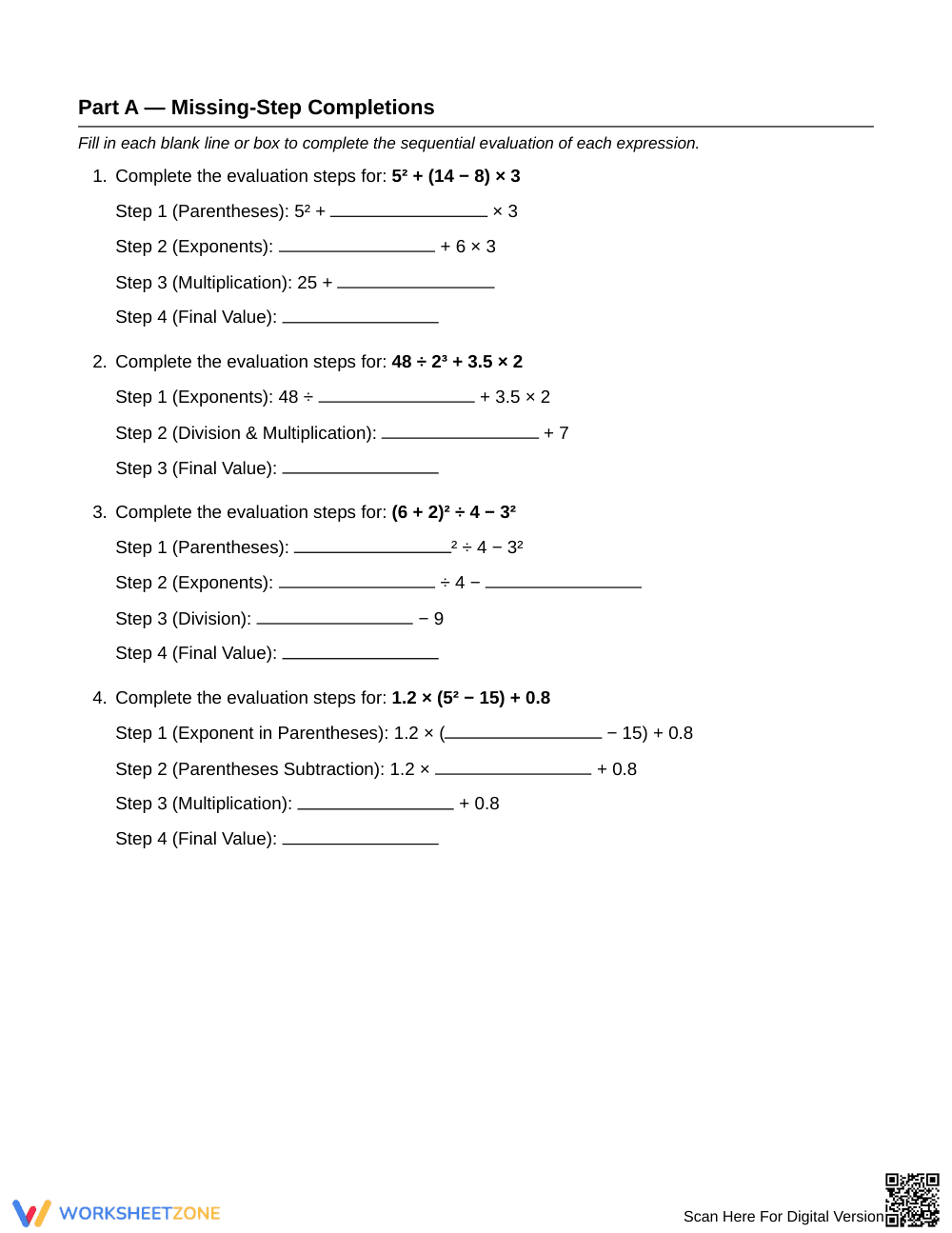
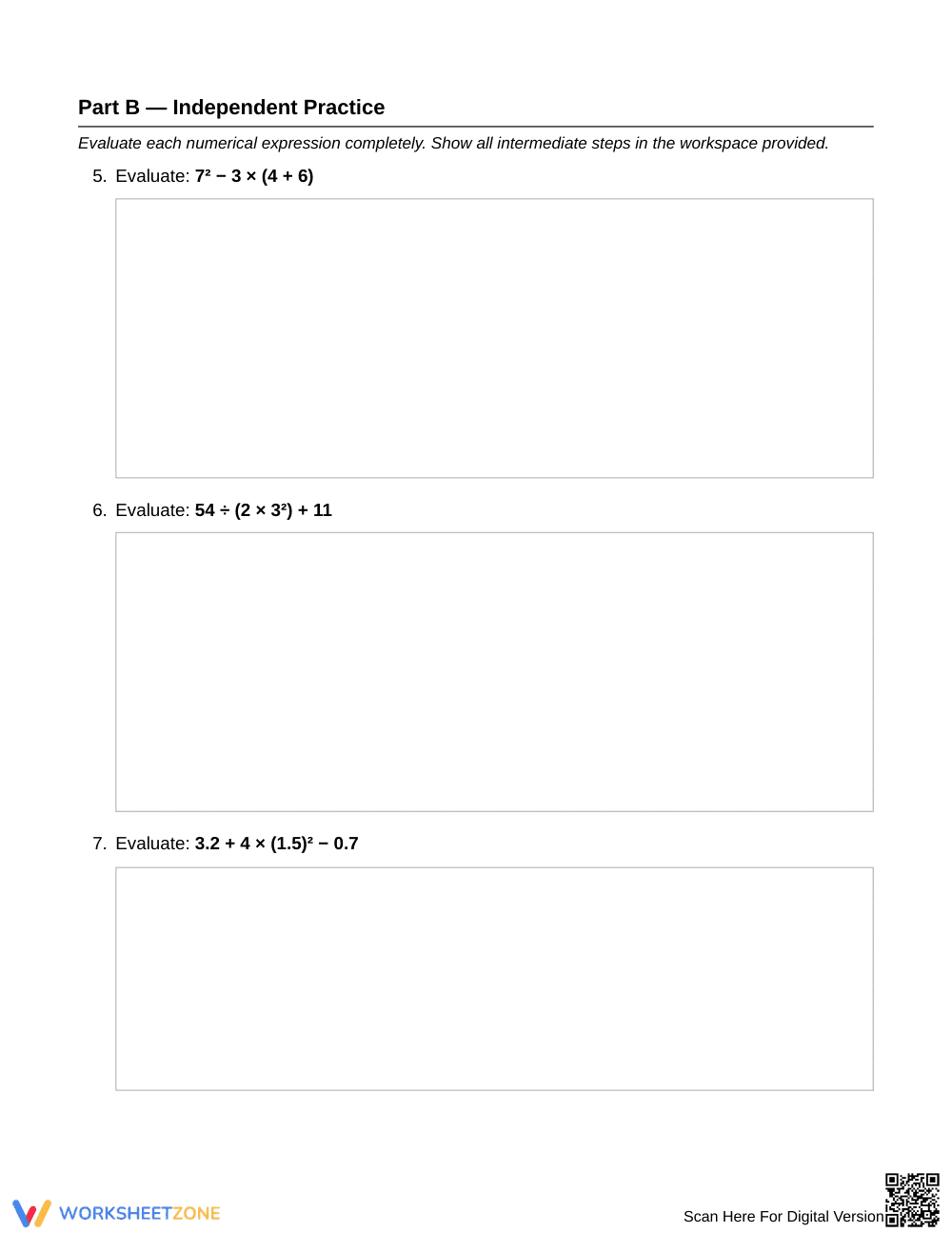
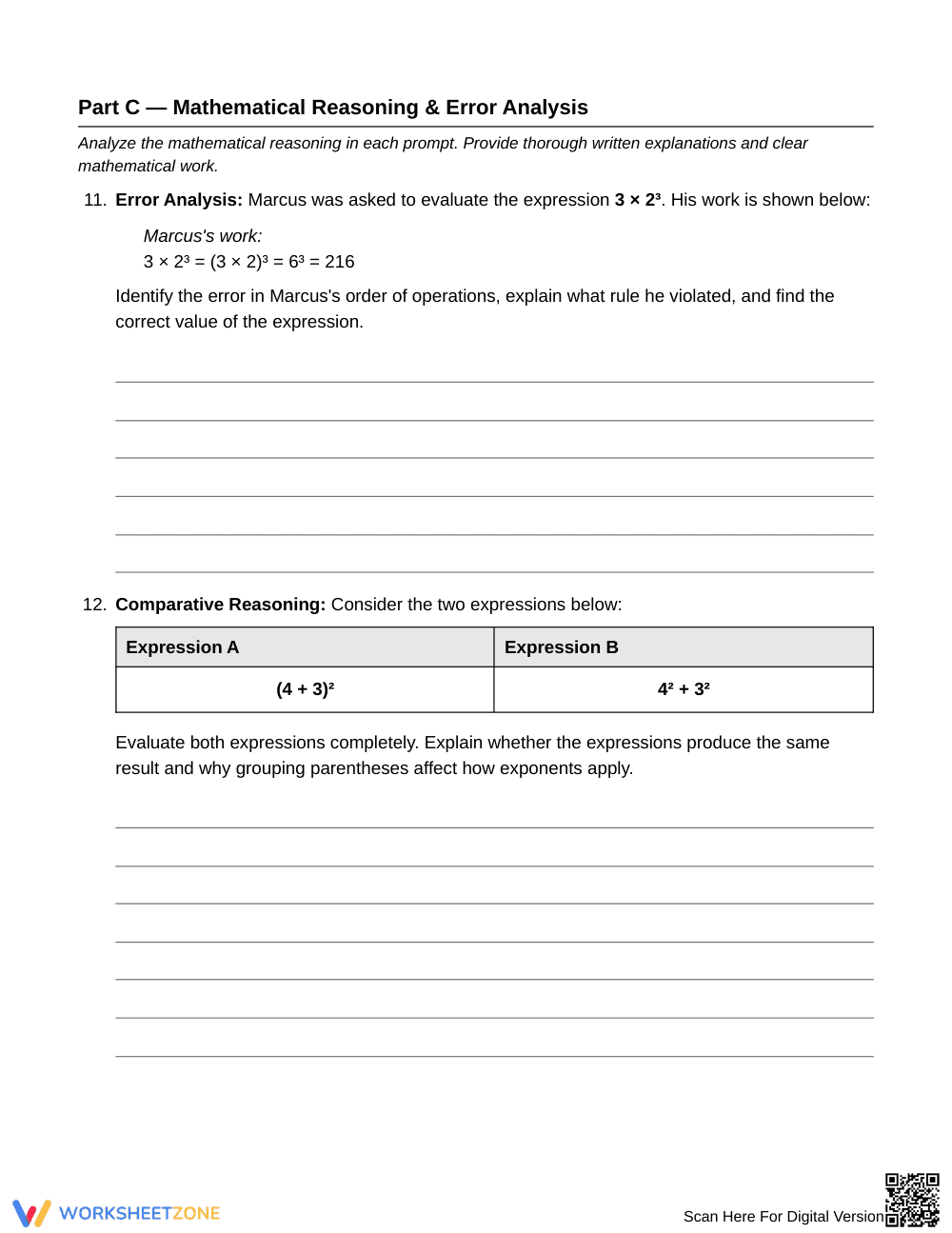
This 5-page instructional resource contains an introductory reference guide outlining the conventional hierarchy of operations, followed by 12 multi-step student tasks. The worksheet includes two fully annotated worked examples featuring whole numbers and decimals, four fill-in-the-blank scaffolding problems, six open-response calculation items, two rigorous mathematical reasoning prompts, and a comprehensive 4-page step-by-step answer key.
Skill Progression
- Guided practice: Four structured completion items in Part A provide intermediate prompt lines, guiding students through each operational phase from evaluating powers to applying multiplication and division.
- Supported practice: Six independent calculation items in Part B require learners to evaluate complex expressions containing brackets, decimal bases, and exponents without prompts while utilizing dedicated intermediate workspace.
- Independent practice: Two analytical reasoning tasks in Part C challenge students to diagnose common misconceptions through student error analysis and articulate why grouping symbols alter exponential outcomes.
This sequence embodies the gradual-release model, moving students purposefully from instructional modeling to completely independent conceptual and procedural mastery.
Standards Alignment
This resource aligns directly with `6.EE.A.1`: Write and evaluate numerical expressions involving whole-number exponents. Students also reinforce supporting standard `6.NS.B.3` by executing multi-digit decimal operations within multi-step arithmetic chains. Both standard codes can be copied directly into lesson plans, IEP goals, or district curriculum mapping tools.
How to Use It
Deploy this worksheet immediately after initial direct instruction on exponent rules and the order of operations hierarchy. During independent seatwork, observe whether students mistakenly multiply the base by the exponent or compute operations from right to left before grouping symbols resolve. Alternatively, assign the reasoning section as an exit ticket or collaborative partner task. The complete activity takes approximately 35 to 45 minutes to finish.
Who It's For
This worksheet is designed for general education Grade 6 math classrooms, advanced Grade 5 students, and Grade 7 intervention groups needing arithmetic reinforcement. Tier 2 support is facilitated by the visual reference box and structured scaffolding. Pair this worksheet naturally with a whole-group order of operations anchor chart or guided direct instruction lesson.
According to Fisher & Frey (2014), purposeful gradual-release architectures significantly accelerate mathematics comprehension by bridging teacher demonstration and unassisted student execution. This Grade 6 instructional resource operationalizes standard 6.EE.A.1, which requires learners to write and evaluate numerical expressions involving whole-number exponents. By sequencing practice from missing-step prompts to independent computations and rigorous error analysis, the worksheet directly targets frequent procedural breakdowns, such as confounding base-exponent multiplication with repeated factors. The embedded worked models establish explicit mental pathways for prioritizing operations within parentheses and managing decimal powers before completing addition or subtraction. Consequently, middle school students cultivate procedural fluency alongside durable metacognitive awareness when evaluating multi-step numerical statements. Teachers utilizing this resource obtain actionable diagnostic data on student arithmetic readiness, ensuring that emerging conceptual misconceptions are identified and corrected prior to entering secondary algebraic coursework.


