


























Views
Downloads



Aligned Algebraic Error Analysis Worksheet | Grade 6 Math
Paste this activity's link or code into your existing LMS (Google Classroom, Canvas, Teams, Schoology, Moodle, etc.).
Students can open and work on the activity right away, with no student login required.
You'll still be able to track student progress and results from your teacher account.
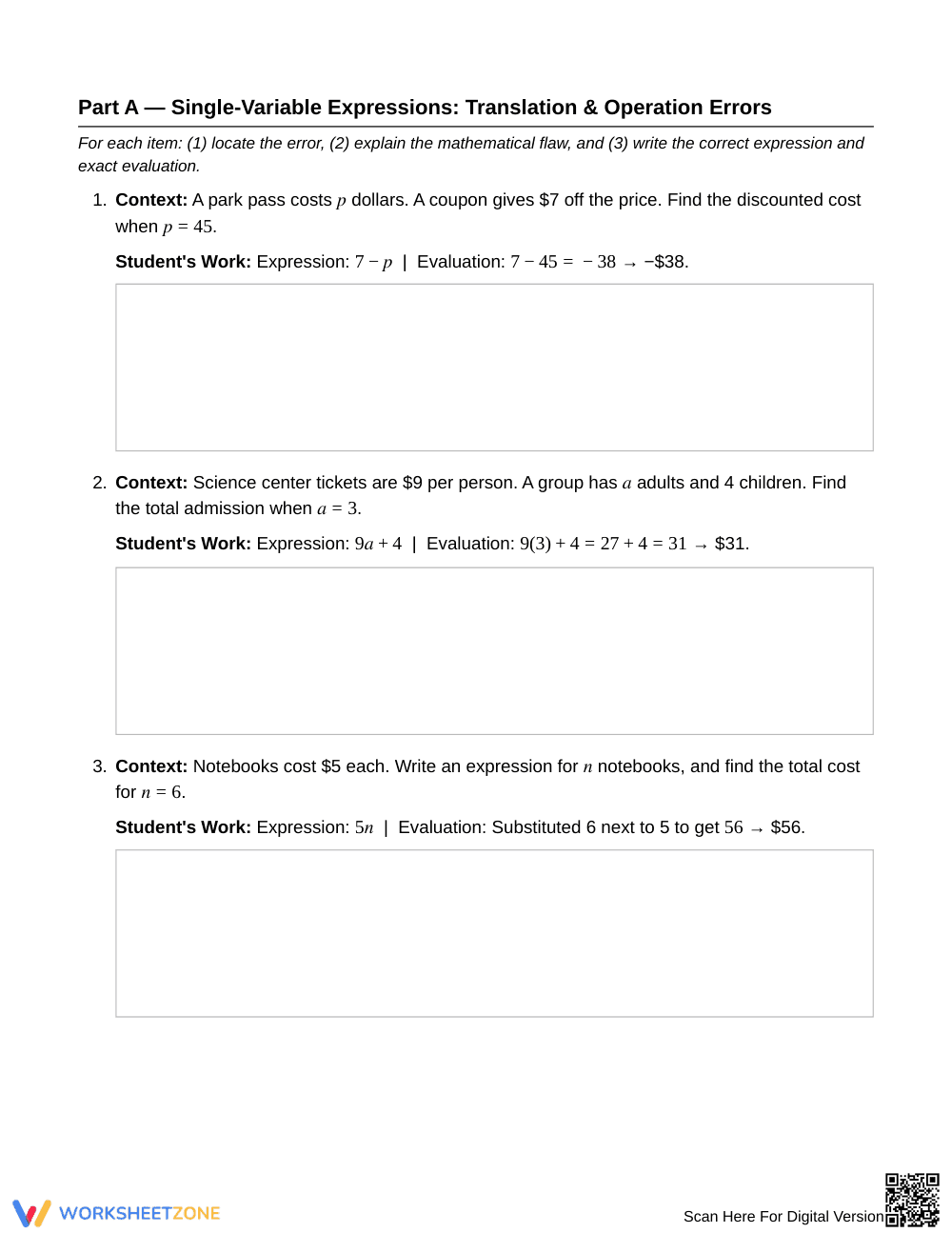
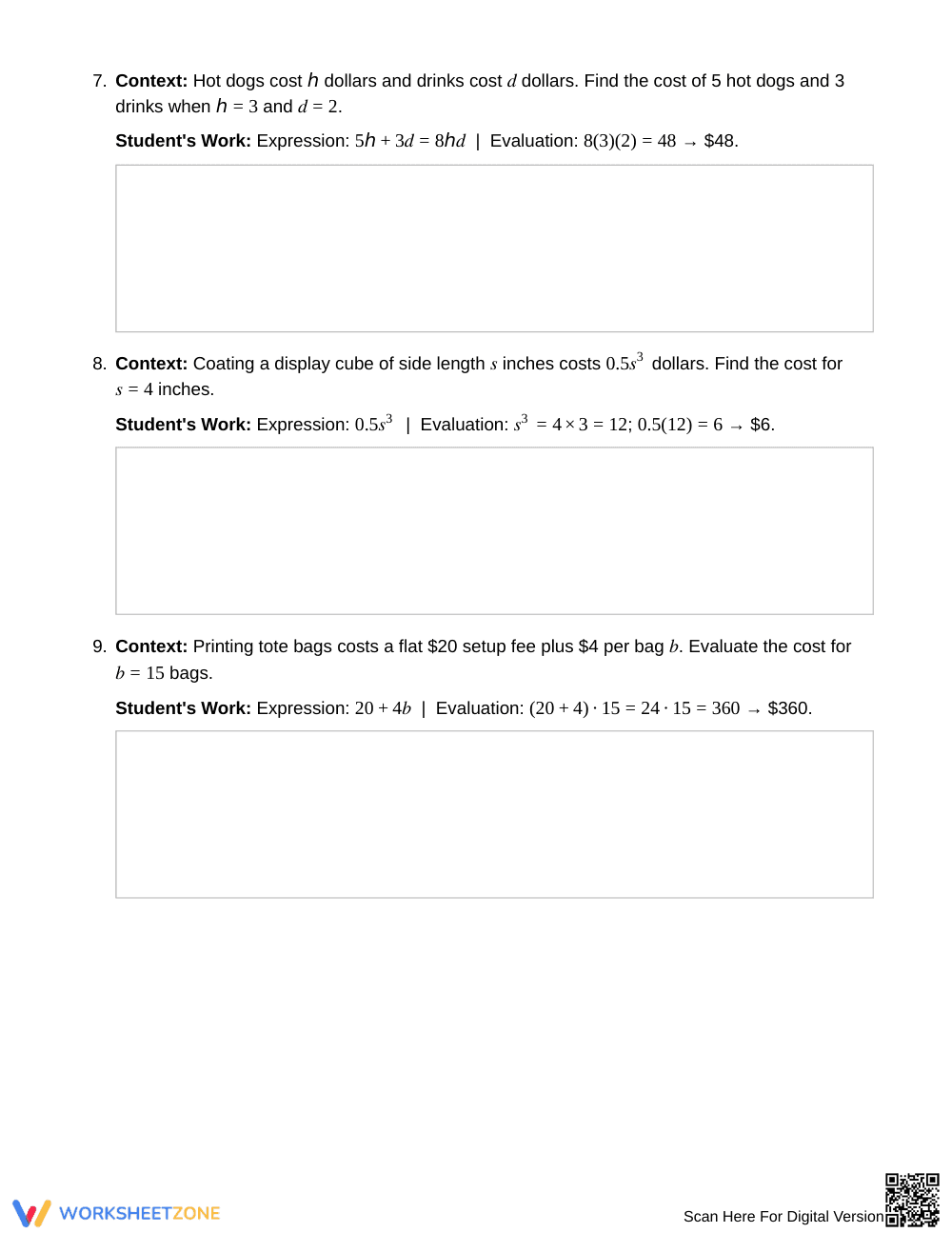
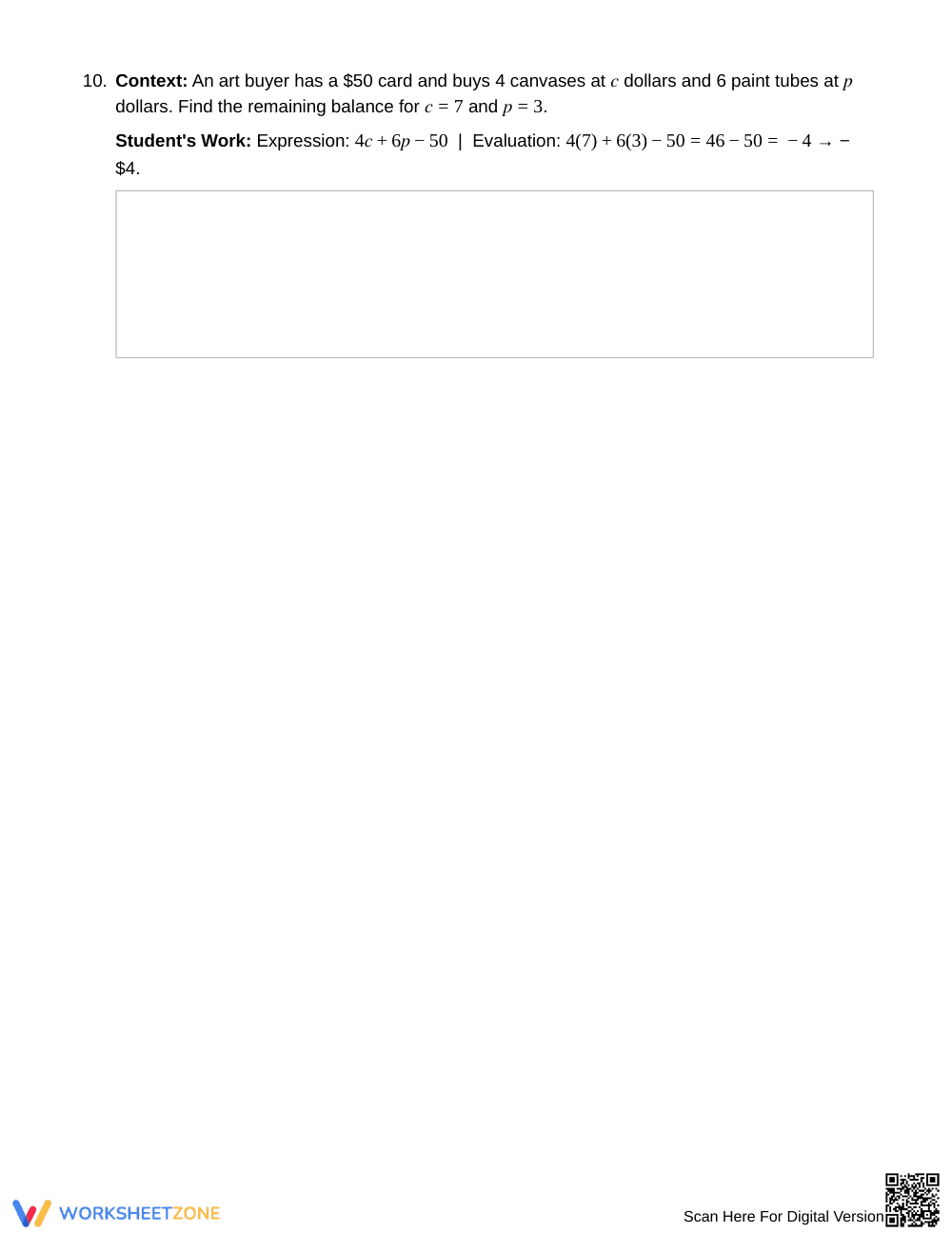
This Grade 6 math worksheet guides students through diagnosing and correcting algebraic translation and substitution errors. Learners evaluate 10 realistic student work samples, explain underlying mathematical misconceptions, and calculate exact numerical solutions across single-variable and multi-variable word problems.
At a Glance
- Grade: 6 · Subject: Math
- Standard:
6.EE.A.2— Write, read, and evaluate expressions in which letters represent numbers- Skill Focus: Correcting algebraic translation and substitution errors
- Format: 5 pages · 10 problems · Answer key included · PDF
- Best For: Error analysis and remediation
- Time: 30–45 minutes
What's Inside
This 5-page worksheet opens with a core algebraic principles table and a modeled error analysis scenario. Students complete 10 rigorous tasks where they identify errors, explain mathematical flaws, and provide corrected calculations. A full 3-page answer key provides complete line-by-line solutions.
Skill Progression
- Guided practice: A modeled scenario demonstrates the three-step error correction process using a real-world cost context.
- Supported practice (Part A — 5 problems): Single-variable tasks target foundational misconceptions like reversed subtraction order and exponent base errors.
- Independent practice (Part B — 5 problems): Multi-variable tasks challenge students to critique distributed discounts, exponent operations, and unlike terms.
This structured progression follows a gradual-release model, building conceptual confidence before students work independently.
Standards Alignment
This activity aligns with `6.EE.A.2`, which requires students to write, read, and evaluate expressions with variables, perform operations with whole-number exponents, and identify terms. The tasks also support `6.EE.A.3` by applying properties of operations to generate equivalent expressions. Both standard codes can be copied directly into lesson plans, IEP goals, or district curriculum mapping tools.
How to Use It
Use this worksheet after direct instruction on algebraic expressions. For formative practice, have student pairs complete Part A collaboratively to debate mathematical reasoning, then assign Part B independently. Watch for students confusing multiplication with exponentiation (such as treating 4 cubed as 12), and redirect them to the reference table. Completion time is 30 to 45 minutes.
Who It's For
This worksheet is ideal for Grade 6 math students, pre-algebra intervention groups, and learners needing non-examples to solidify algebraic rules. Pair this resource with an order of operations anchor chart or a guided translation lesson.
According to research synthesized by Fisher & Frey (2014), analyzing non-examples and correcting worked errors accelerates conceptual understanding more effectively than repetitive rote computation alone. Under standard 6.EE.A.2, sixth-grade students must write, read, and evaluate numerical expressions where letters represent numbers, requiring strong fluency with mathematical grammar and the order of operations. Common student errors frequently stem from treating substituted variables as place-value placeholders or reversing terms in subtraction phrases like 'seven off the price.' By asking learners to explicitly identify the mathematical flaw, articulate the underlying rule, and construct the correct algebraic expression across 10 targeted tasks, this worksheet prompts metacognitive reflection and prevents persistent procedural misconceptions. Structured error analysis builds durable algebraic reasoning, ensuring students evaluate multi-step expressions accurately before advancing to linear equations and inequalities in later middle school grades.


