


























Views
Downloads
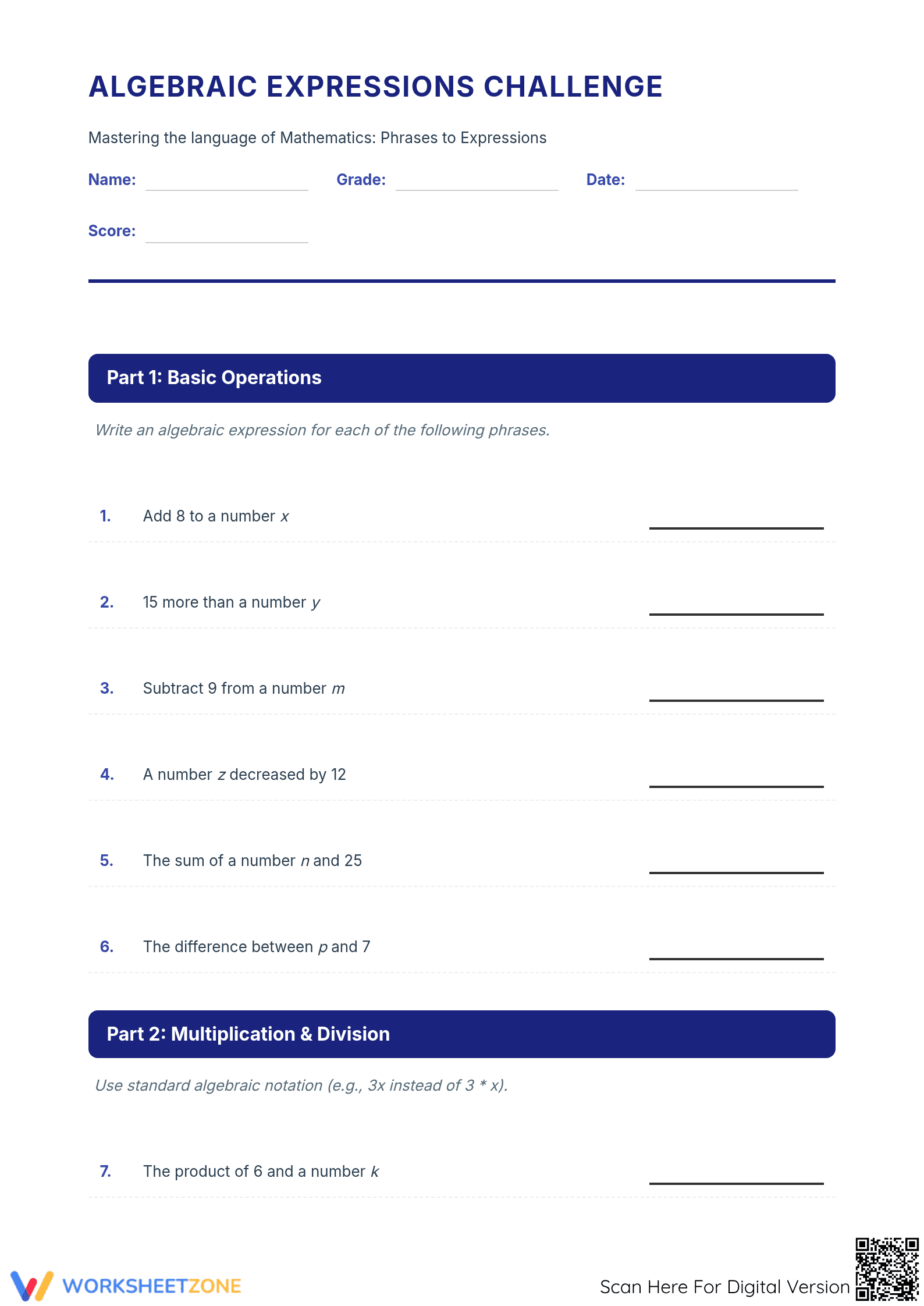
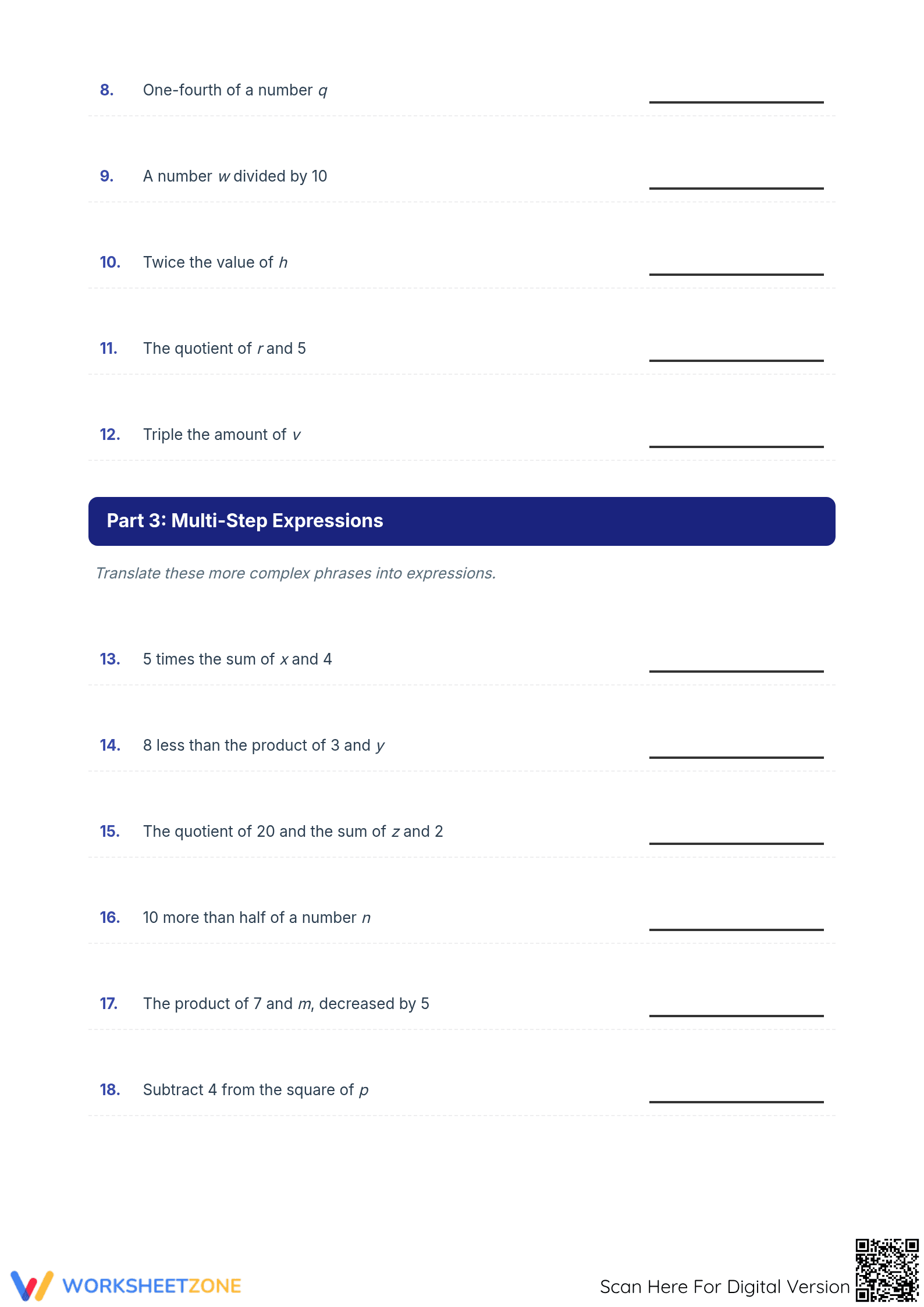
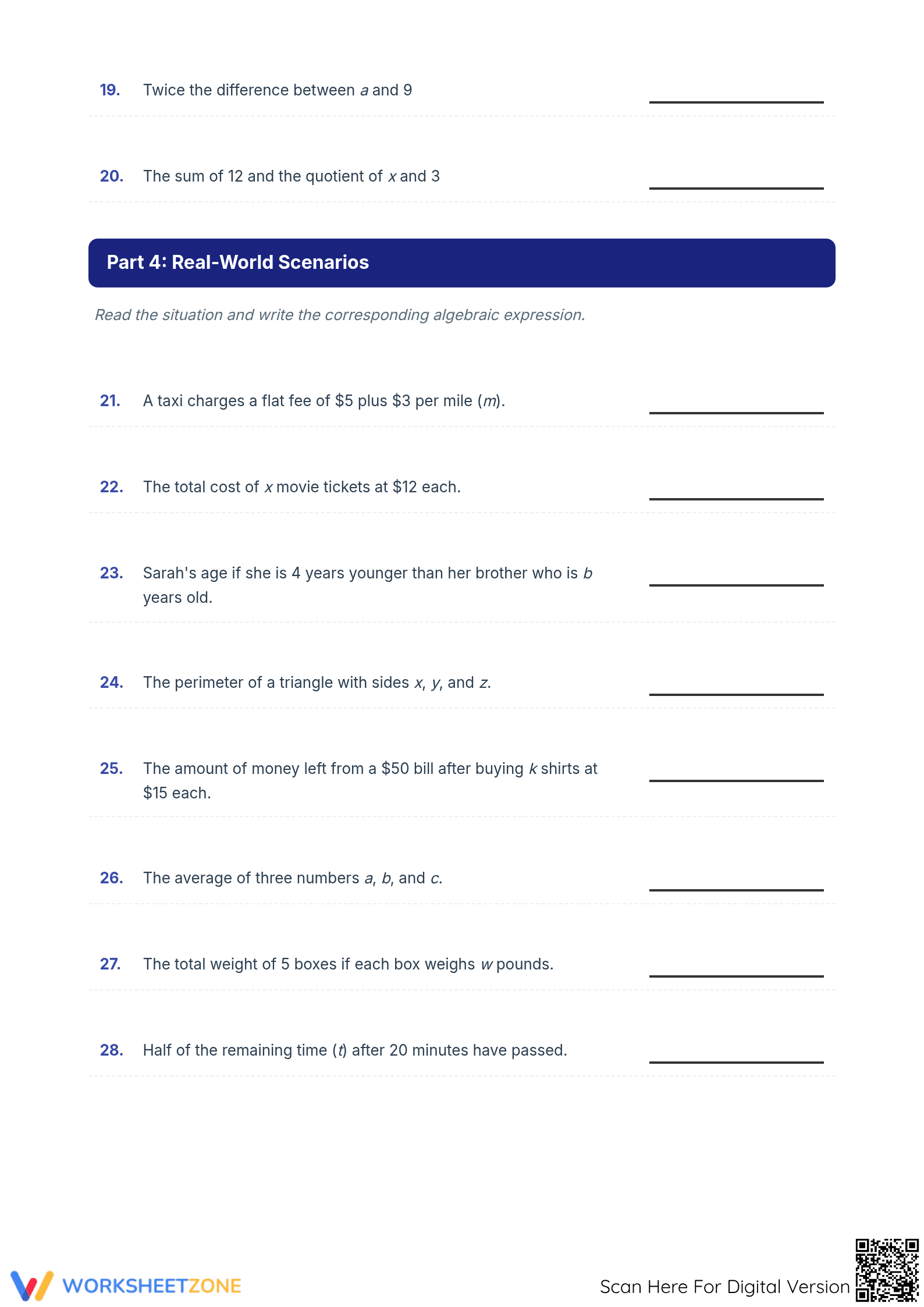
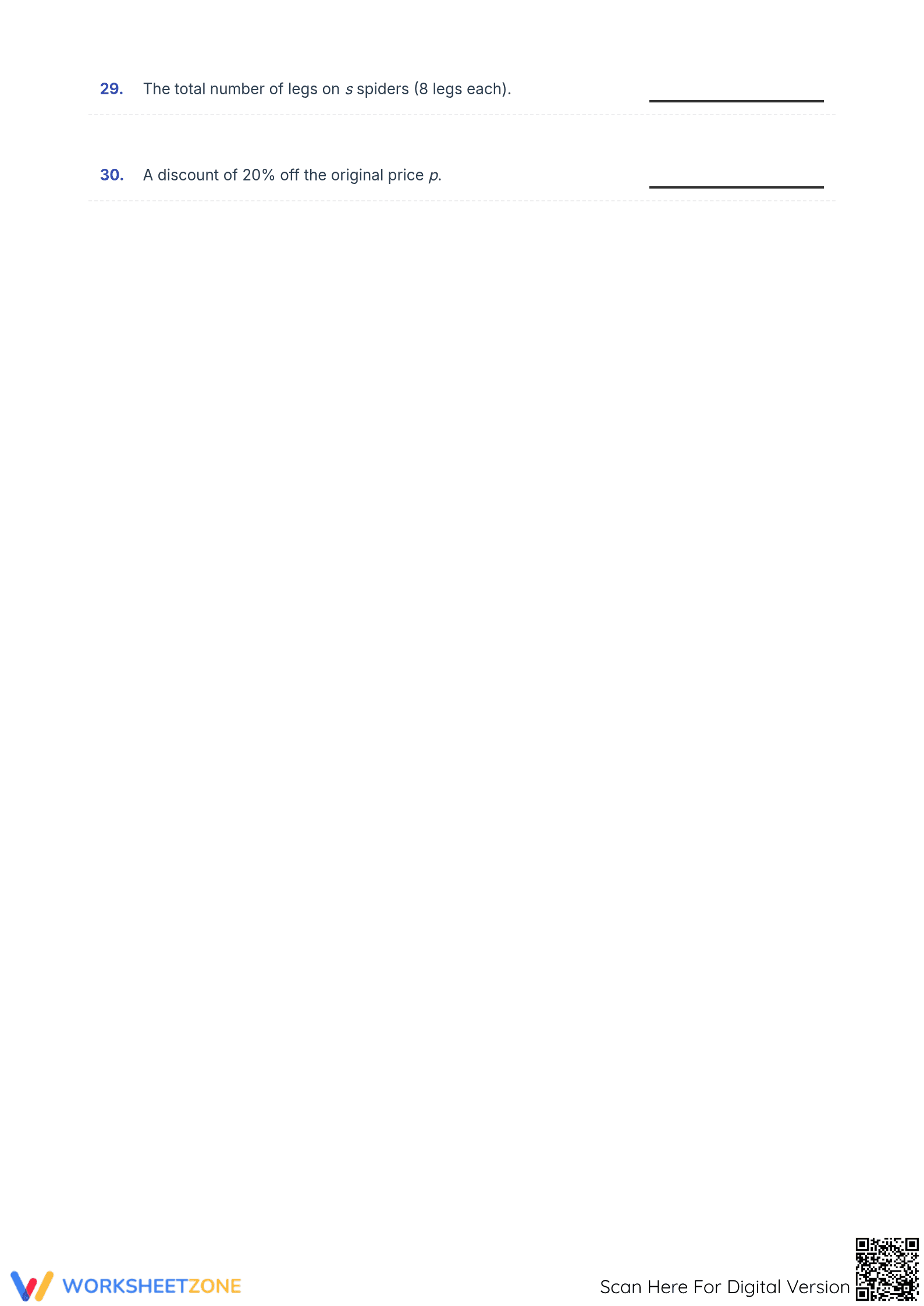

Printable Algebra Word Problems to Expressions Worksheet
Paste this activity's link or code into your existing LMS (Google Classroom, Canvas, Teams, Schoology, Moodle, etc.).
Students can open and work on the activity right away, with no student login required.
You'll still be able to track student progress and results from your teacher account.
Bridge the gap between literacy and numeracy with this comprehensive algebraic expressions practice set. Students learn to translate verbal phrases into precise mathematical notation, a foundational skill for pre-algebra. This resource provides a structured environment for mastering variables and operations through diverse, scaffolded exercises that build confidence.
At a Glance
- Grade: 7–8 · Subject: Algebra
- Standard:
CCSS.MATH.CONTENT.7.EE.B.4— Use variables to represent quantities and construct simple expressions to solve problems- Skill Focus: Translating word phrases into algebraic expressions
- Format: 4 pages · 30 problems · Answer key included · PDF
- Best For: Individual practice and real-world scenario application
- Time: 40–50 minutes
What's Inside
This extensive four-page packet features 30 unique problems organized into four logical segments. Parts 1 and 2 cover basic operations and notation requirements. Part 3 challenges students with multi-step expressions involving grouping. Part 4 presents eight real-world scenarios, such as taxi fares and age comparisons, requiring students to extract variables from context. A complete four-page answer key is included for rapid grading and immediate feedback during classroom or home use.
Zero-Prep Workflow
- Print: Select the desired pages and print copies for your cohort (1 minute).
- Distribute: Hand out the worksheets as a transition activity or independent practice block (1 minute).
- Review: Use the provided answer keys for student self-correction or quick teacher-led verification.
This workflow requires less than two minutes of teacher preparation, making it an excellent candidate for emergency sub plans or last-minute reinforcement sessions.
Standards Alignment
This resource is primarily aligned to CCSS.MATH.CONTENT.7.EE.B.4, requiring students to use variables to represent quantities in real-world problems and construct simple expressions. It also supports CCSS.MATH.CONTENT.6.EE.A.2.A by focusing on the literal translation of mathematical phrases. Both standard codes can be copied directly into lesson plans, IEP goals, or district curriculum mapping tools for administrative tracking.
How to Use It
Assign this worksheet during independent practice following a lesson on translating expressions. For a formative assessment, observe students during Part 3 to see if they correctly place parentheses in multi-step problems involving sums and quotients. Expected completion time is approximately 45 minutes for the full set, though it can be easily split into two shorter sessions focusing on specific operation types.
Who It's For
This packet is designed for middle school students in Grade 7 or 8 developing algebraic reasoning. It is particularly effective for English Language Learners (ELLs) who need explicit practice connecting vocabulary cues like "quotient" to mathematical symbols. Pair this with a vocabulary anchor chart for maximum support during the transition from concrete arithmetic to abstract algebraic thinking.
Proficiency in translating between verbal and symbolic representations is a critical predictor of later success in high school mathematics. According to research from EdReports 2024, high-quality instructional materials that provide repeated, varied practice in mathematical modeling help students move beyond rote computation toward conceptual understanding. This worksheet addresses that need by providing 30 distinct opportunities to practice the CCSS.MATH.CONTENT.7.EE.B.4 standard across basic and complex contexts. By moving from simple operations to multi-step scenarios, the resource aligns with the gradual release of responsibility model. Students who master these linguistic-to-symbolic translations are better equipped to handle the rigorous demands of standardized testing. The inclusion of real-world scenarios ensures that students see the practical utility of algebra in daily life, reinforcing the engagement strategies identified in recent NAEP performance analyses and supporting long-term retention of algebraic concepts.


