


























Views
Downloads


Essential Algebra Rules & Properties Worksheet | Grades 5-7
Paste this activity's link or code into your existing LMS (Google Classroom, Canvas, Teams, Schoology, Moodle, etc.).
Students can open and work on the activity right away, with no student login required.
You'll still be able to track student progress and results from your teacher account.
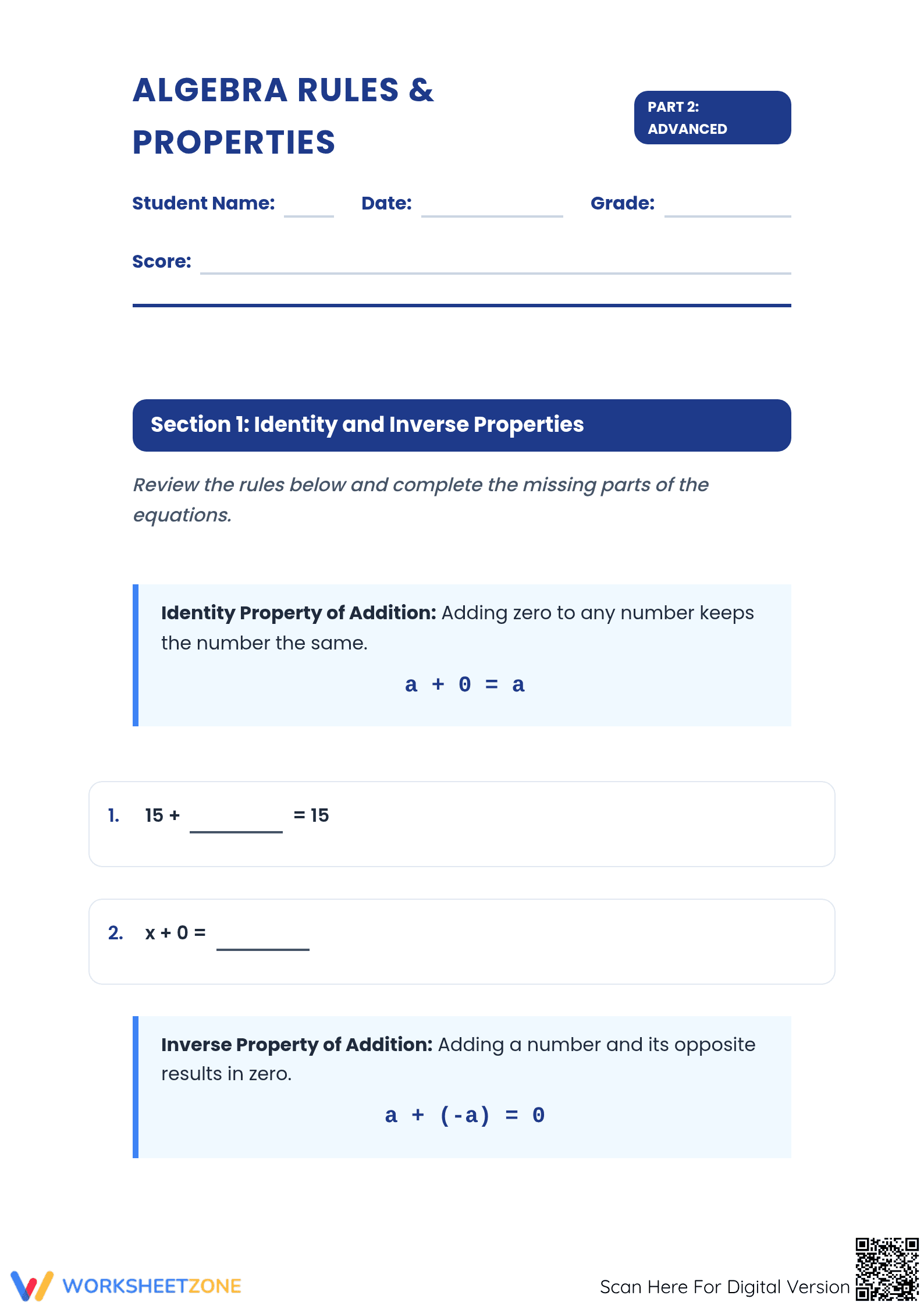
This comprehensive algebra properties worksheet provides middle school students with rigorous practice in identifying and applying fundamental mathematical rules. By working through identity, inverse, and distributive properties, learners develop the algebraic fluency necessary for simplifying complex expressions. Students transition from conceptual understanding to advanced application across twenty-five structured problems.
At a Glance
- Grade: 6 · Subject: Math / Algebra
- Standard:
6.EE.A.3— Apply properties of operations to generate equivalent expressions and simplify expressions- Skill Focus: Algebraic Properties (Identity, Inverse, Distributive)
- Format: 5 pages · 25 problems · Answer key included · PDF
- Best For: Middle school algebra unit reinforcement
- Time: 35–50 minutes
What's Inside
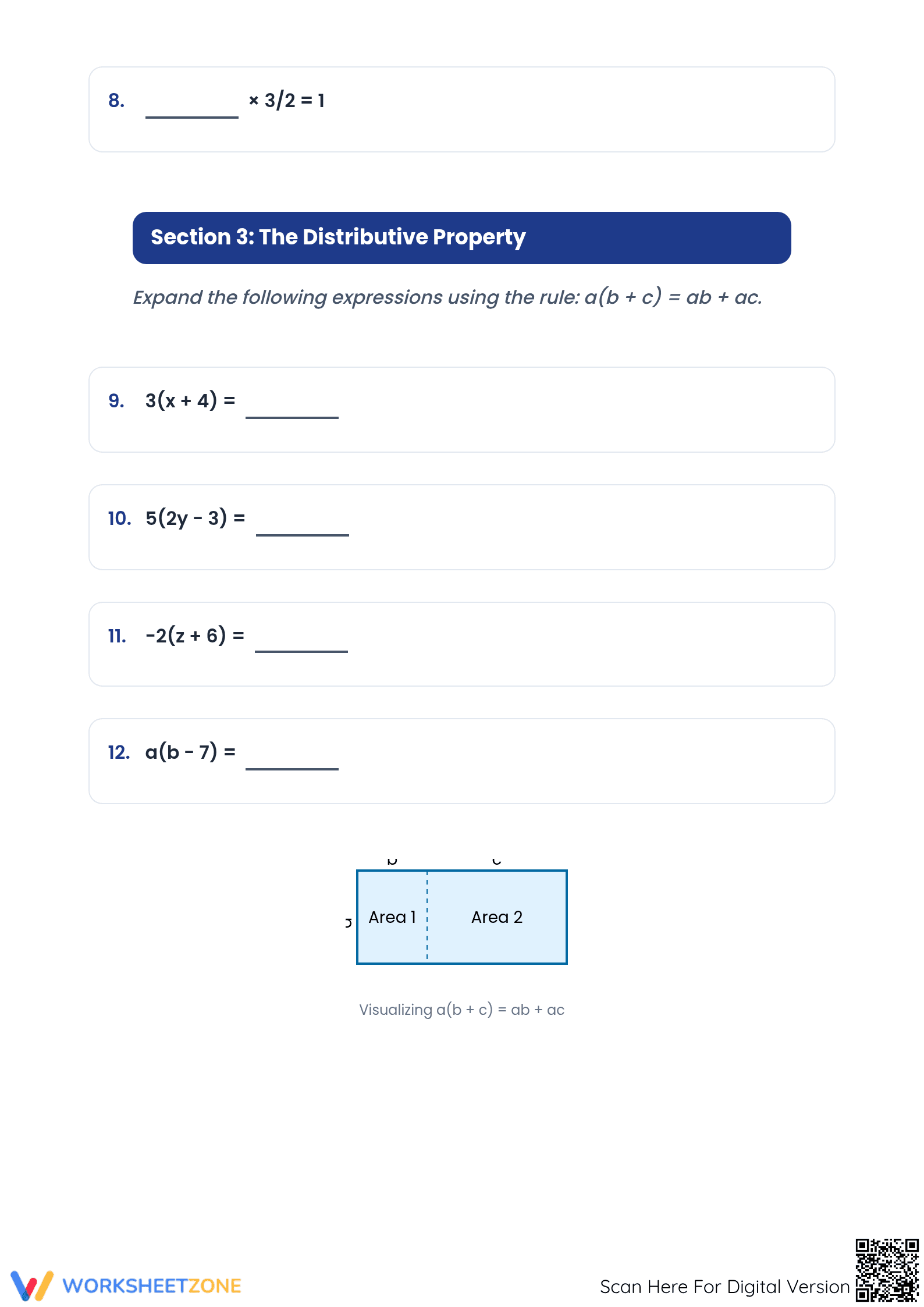
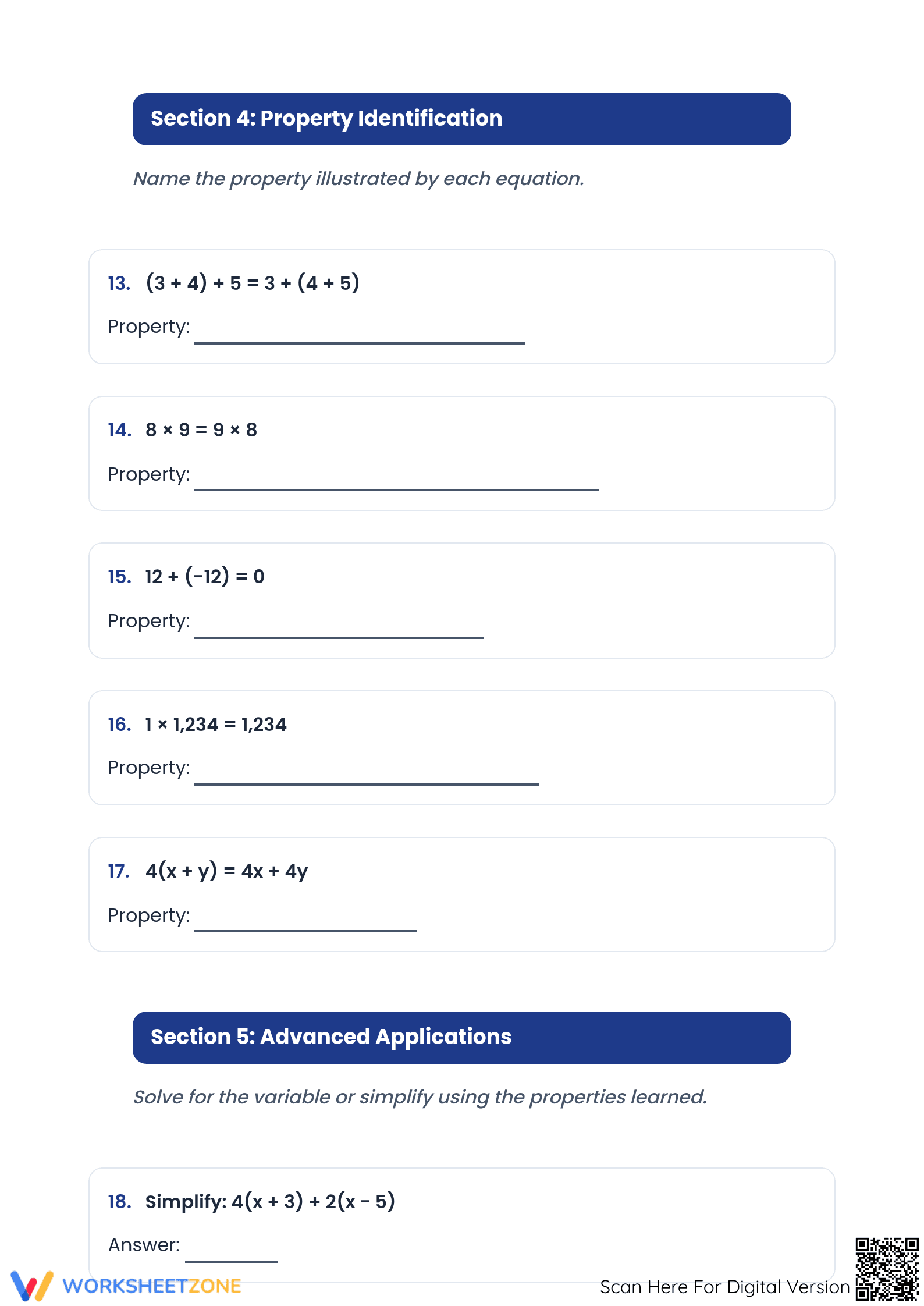
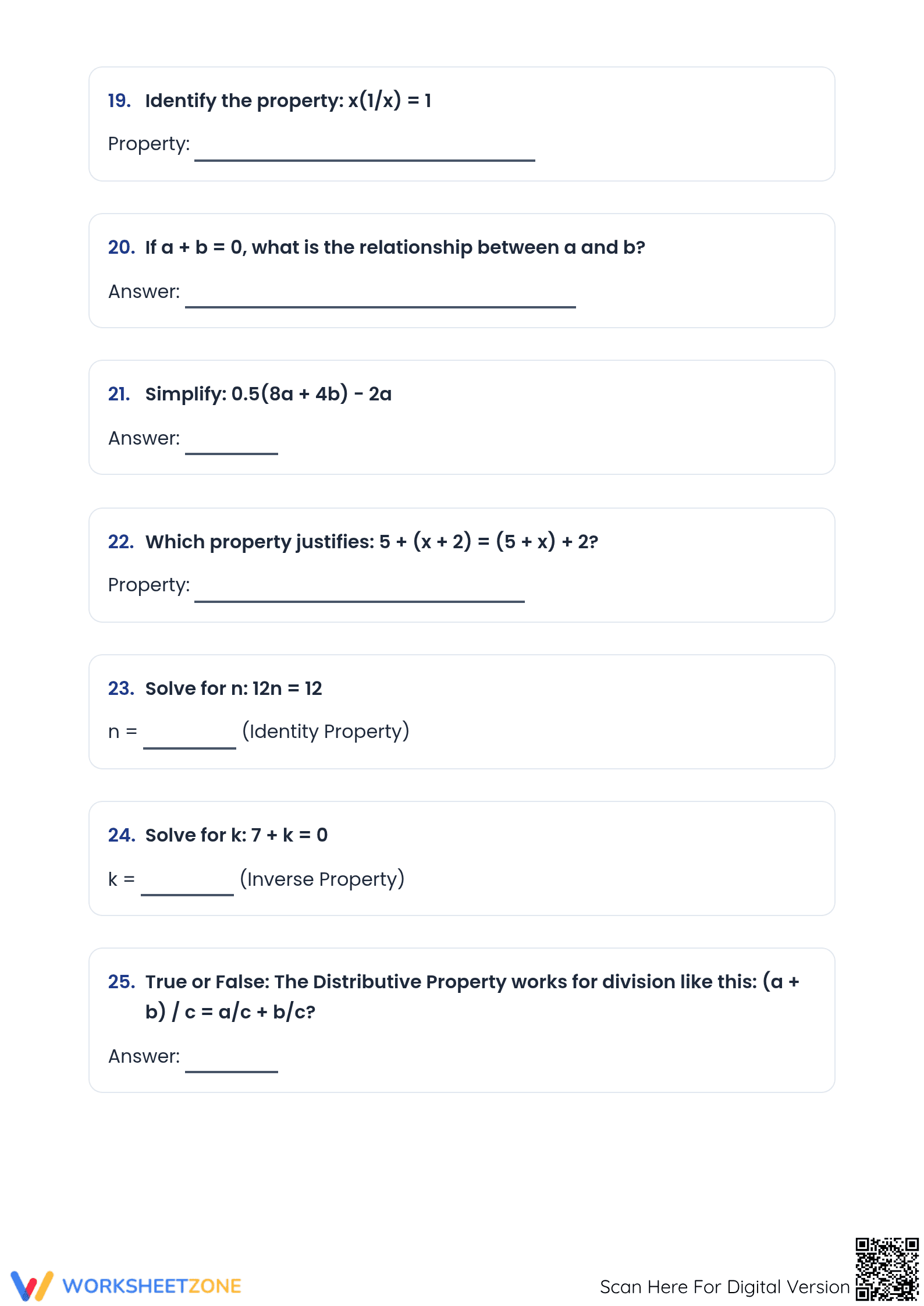
This five-page PDF resource is organized into five distinct sections for student mastery. It includes detailed portions for addition and multiplication properties, a visual area model for the distributive property, and a section for property identification. The final section challenges students with advanced applications, such as simplifying expressions like 4(x+3) + 2(x-5). A complete answer key is provided for immediate feedback.
Skill Progression
- Guided Practice: Introduces definitions and basic examples of Identity and Inverse properties, requiring students to complete 8 foundational equations with low-level scaffolding.
- Supported Practice: Moves into the Distributive Property using visual area models to bridge arithmetic and variables across 4 targeted exercises.
- Independent Practice: Requires students to identify properties in 10 unique equations and apply rules to simplify 3 advanced expressions without support.
This gradual-release model builds student confidence before reaching high-complexity application tasks using the "I Do, We Do, You Do" instructional framework.
Standards Alignment
This resource is directly aligned to the Common Core State Standard 6.EE.A.3, which requires students to "apply properties of operations to generate equivalent expressions." Specifically, it addresses the use of the distributive law and the application of identity and inverse properties. Both standard codes can be copied directly into lesson plans or IEP goals.
How to Use It
Use this worksheet as a summative assessment following a direct instruction unit. Alternatively, assign sections as warm-up "bell-ringers" to maintain skill retention. Observe how students transition from visual area models to abstract simplification. A common formative checkpoint is the correct application of the inverse property when solving for variables.
Who It's For
This resource is designed for middle school students, specifically Grades 6 and 7. It is beneficial for learners who require structured scaffolding before moving into complex equation solving. It pairs naturally with a classroom anchor chart displaying the associative and commutative laws for quick reference during independent practice.
Algebraic fluency is the "gatekeeper" to higher mathematics. Manipulating expressions using formal properties is a central requirement of middle school curricula. According to the NAEP assessment framework, student performance in algebra relies on the transition from arithmetic to systematic application of properties. Research from Fisher & Frey (2014) emphasizes that the gradual release of responsibility—moving from worked examples in Section 1 to independent simplification tasks in Section 5—is critical for retention of abstract mathematical concepts. By providing 25 targeted tasks bridging visual models and symbolic logic, this worksheet ensures students move beyond rote memorization toward a functional understanding of standard 6.EE.A.3 and equivalent expressions. This alignment with evidence-based instructional design supports classroom teachers in delivering high-quality, rigorous algebra instruction.


