


























Views
Downloads

Addition with Objects Worksheet | Grade K Printable
Paste this activity's link or code into your existing LMS (Google Classroom, Canvas, Teams, Schoology, Moodle, etc.).
Students can open and work on the activity right away, with no student login required.
You'll still be able to track student progress and results from your teacher account.
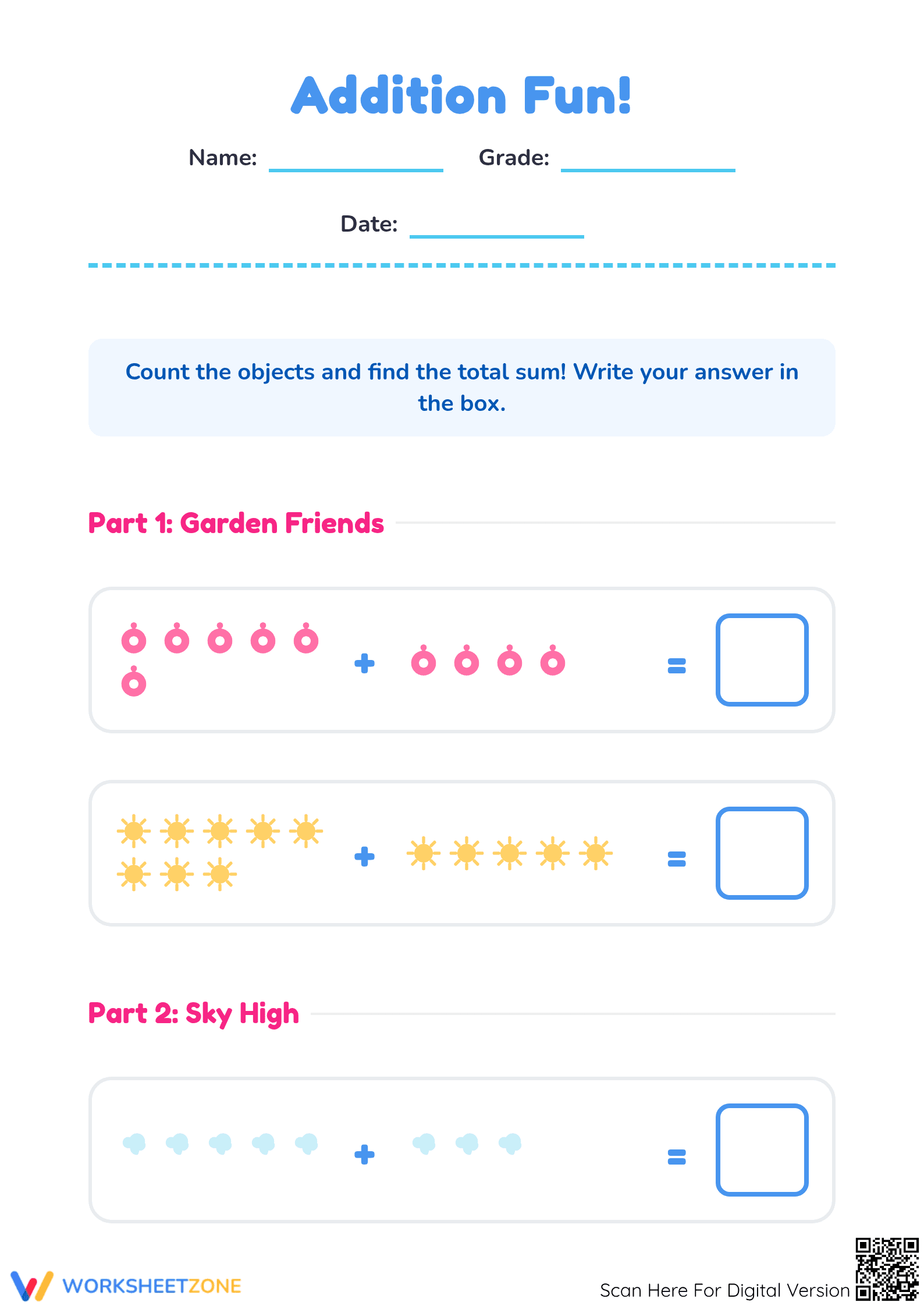
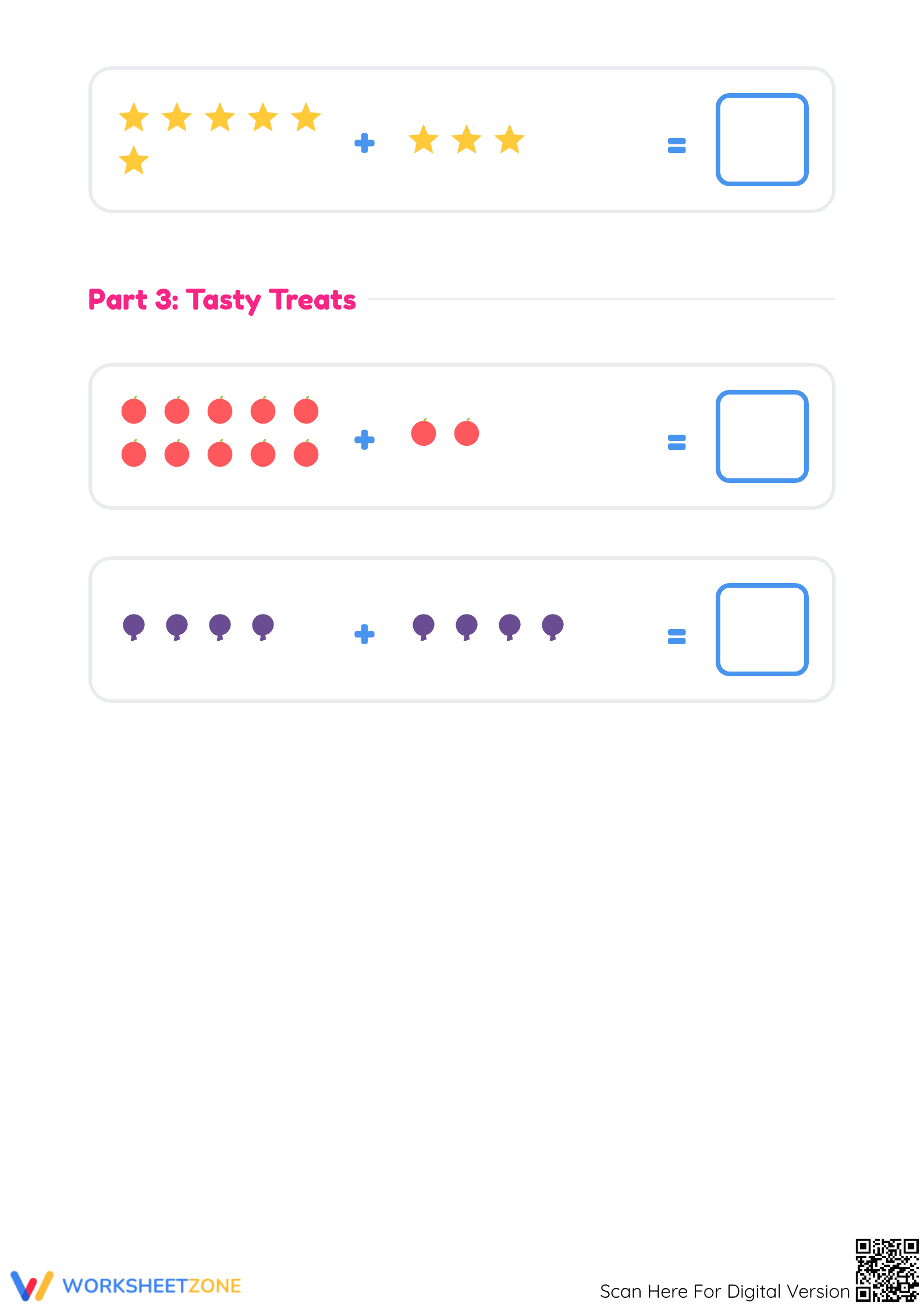
This Kindergarten visual addition worksheet helps young learners build foundational math skills by counting colorful objects to find the total sum. By connecting concrete visual representations to mathematical equations, students develop a strong conceptual understanding of basic addition before moving on to abstract numbers.
At a Glance
- Grade: Kindergarten · Subject: Math
- Standard:
CCSS.MATH.CONTENT.K.OA.A.1— Represent addition with objects or drawings.- Skill Focus: Visual Addition
- Format: 2 pages · 6 problems · Answer key included · PDF
- Best For: Independent practice or math centers
- Time: 10–15 minutes
This resource features two pages of themed addition problems divided into categories like "Garden Friends" and "Tasty Treats." Students solve six visual addition equations by counting groups of familiar shapes, such as suns and apples. A complete answer key is provided to make grading quick and accurate.
- Print (1 minute): Download the PDF and print the two-page sheet. The clean layout requires no special formatting.
- Distribute (1 minute): Hand out during math block or place in center folders. Instructions are self-explanatory for early readers.
- Review (2 minutes): Use the included answer key to quickly check work or project it for whole-class review.
Total teacher preparation time is under two minutes, making this ideal for busy mornings or substitute plans.
This worksheet is directly aligned to CCSS.MATH.CONTENT.K.OA.A.1, which requires students to represent addition and subtraction with objects, fingers, mental images, drawings, sounds, acting out situations, verbal explanations, expressions, or equations. By counting the illustrated items to complete the equation, students practice this exact standard. Both standard codes can be copied directly into lesson plans, IEP goals, or district curriculum mapping tools.
This fits perfectly into a morning work routine or a dedicated math center. Teachers can use it after direct instruction to reinforce combining two groups. As a formative assessment tip, observe how students count the objects—note whether they recount the first group or "count on" to find the total. Expected completion time is 10 to 15 minutes.
This resource is designed primarily for Kindergarten students who are just beginning to explore addition. It is also an excellent intervention tool for first graders who need additional concrete visual support before tackling abstract numerical equations. For a complete lesson, pair this worksheet with physical manipulatives like counting blocks or a whole-group anchor chart demonstrating how to combine two sets.
Developing early algebraic thinking requires strong foundational experiences with concrete and pictorial representations. According to a recent EdReports 2024 analysis of early childhood mathematics curricula, students who consistently practice representing mathematical operations with visual models demonstrate significantly higher retention of core concepts compared to those who move too quickly to abstract numbers. This worksheet directly supports CCSS.MATH.CONTENT.K.OA.A.1 by having students represent addition with objects or drawings. When young learners physically count illustrated items—such as the suns and apples featured in these exercises—to solve an equation, they bridge the critical gap between concrete counting and abstract arithmetic. Providing structured, visual tasks like these ensures that foundational math skills are firmly established. This deliberate practice sets the stage for future success in more complex mathematical reasoning, ensuring students build the confidence needed for first-grade math standards.


