


























Views
Downloads

Printable Addition Symbols Math Lab | Grade 1 Math
Paste this activity's link or code into your existing LMS (Google Classroom, Canvas, Teams, Schoology, Moodle, etc.).
Students can open and work on the activity right away, with no student login required.
You'll still be able to track student progress and results from your teacher account.
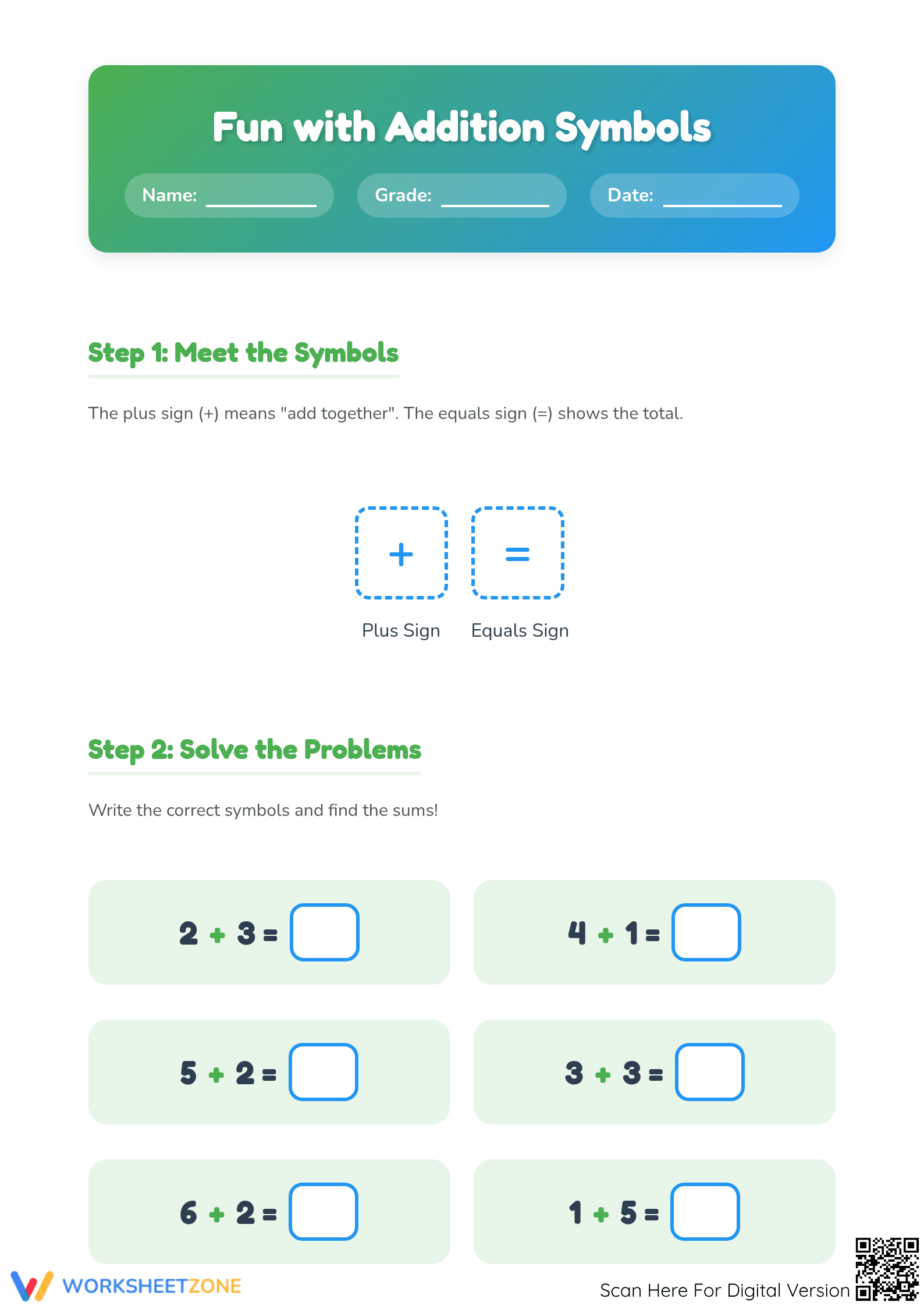
This Grade 1 math worksheet provides a structured environment for students to master the plus and equals signs through hands-on practice. By focusing on addition within 20, learners build the foundational fluency required for complex arithmetic. This resource ensures students understand the mathematical meaning behind symbols before advancing to more abstract calculations.
At a Glance
- Grade: 1 · Subject: Math
- Standard:
1.OA.D.7— Understand the meaning of the equal sign in equations- Skill Focus: Addition Symbols & Equation Balancing
- Format: 2 pages · 13 problems · Answer key included · PDF
- Best For: Introduction to formal addition equations
- Time: 15–20 minutes
What's Inside
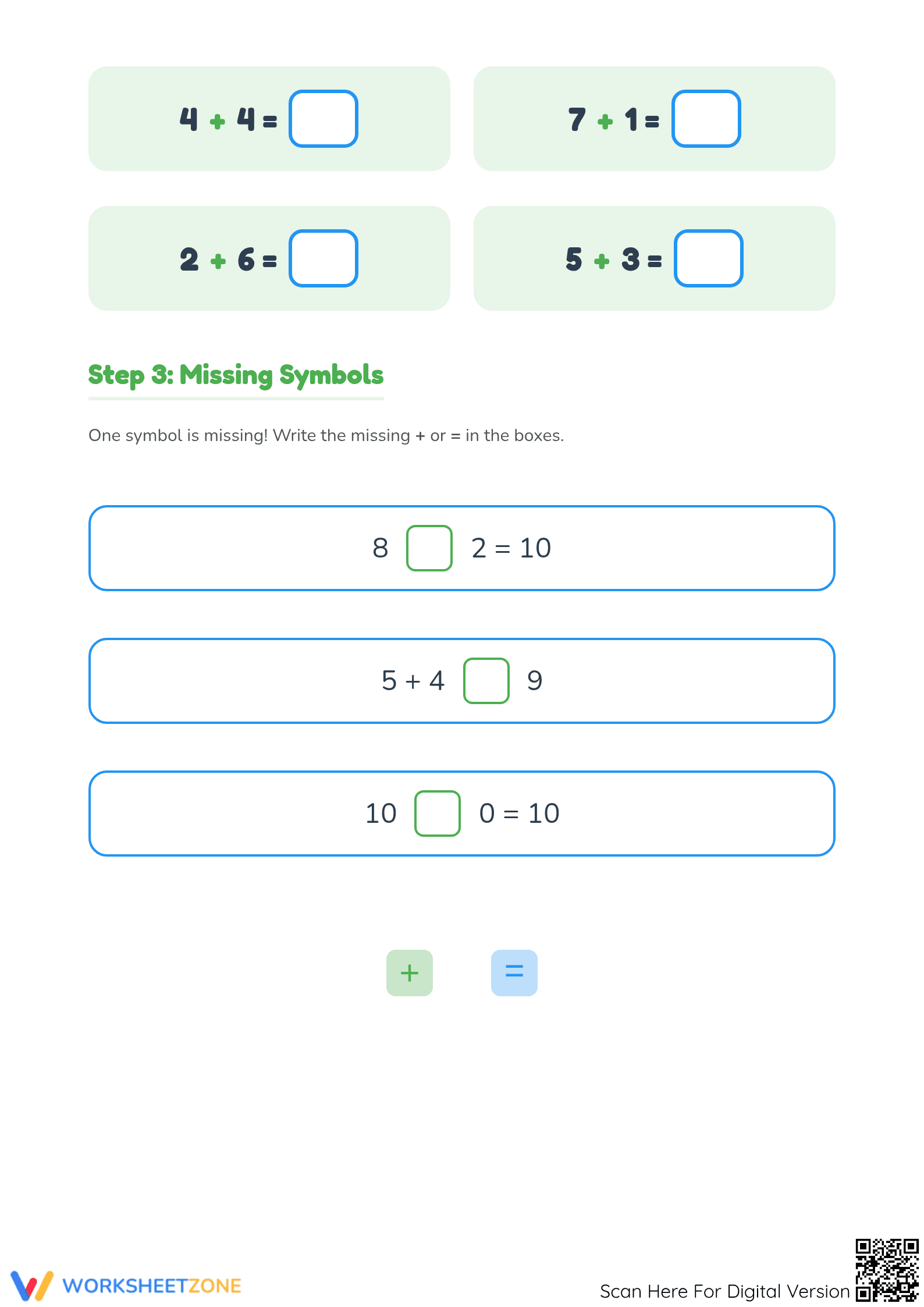
The package contains two comprehensive pages designed for clarity and engagement. The first page introduces the symbols with a visual "Meet the Symbols" section, followed by six computation problems where students calculate sums. The second page continues with four additional sums and a "Missing Symbols" lab where students identify whether a plus or equals sign is required to make the math statement true.
Zero-Prep Workflow
- Step 1: Print. Open the PDF and print the two-page document for your entire class in under 30 seconds.
- Step 2: Distribute. Hand out the worksheets as a ready-to-go morning activity or a focused math center task.
- Step 3: Review. Use the included answer key for immediate feedback, allowing for self-checking or rapid teacher assessment.
Total preparation time is under two minutes, making this an ideal resource for substitute plans or emergency teaching folders.
Standards Alignment
The primary focus aligns with `1.OA.D.7`, which requires students to understand the meaning of the equal sign and determine if equations involving addition are true. Additionally, the worksheet supports `1.OA.D.8` by asking students to determine unknown symbols that relate three whole numbers. Both standard codes can be copied directly into lesson plans, IEP goals, or district curriculum mapping tools.
How to Use It
Use this worksheet during the "Guided Practice" phase of a lesson. After introducing symbols on an anchor chart, transition students to these pages. Observe students during Step 3 to see if they identify the relationship between numbers and the total; this serves as a formative assessment of algebraic thinking. Completion typically takes 15 to 20 minutes.
Who It's For
This resource is tailored for first-grade students or kindergarteners ready for extension work. It provides sentence frames and visual cues to support English Language Learners (ELL) and students with IEP accommodations. For a comprehensive lesson, pair this with a physical math manipulative activity using counters or a number line to bridge the gap between concrete objects and symbolic representation.
The Addition Symbols Math Lab is an essential tool for early elementary numeracy, specifically targeting the conceptual understanding of mathematical symbols as defined by standard `1.OA.D.7`. Research by Fisher & Frey (2014) emphasizes that the gradual release of responsibility—moving from "Meeting the Symbols" to "Missing Symbols"—is critical for students to internalize the logic of equations. By requiring learners to find the missing equals sign, the worksheet prevents the common misconception that the equal sign merely signals an operation, instead framing it as a symbol of balance. A 2024 ScienceDirect TpT Analysis of educational resources indicates that worksheets combining computation with symbol identification significantly improve long-term retention of algebraic concepts. This Grade 1 resource provides the repetition necessary for mastery while maintaining high engagement through its lab-themed structure, making it a proven asset for any math curriculum seeking to build durable arithmetic foundations.


