


























Views
Downloads


Printable Adding Hundreds & Thousands Worksheet | Grade 4
Paste this activity's link or code into your existing LMS (Google Classroom, Canvas, Teams, Schoology, Moodle, etc.).
Students can open and work on the activity right away, with no student login required.
You'll still be able to track student progress and results from your teacher account.
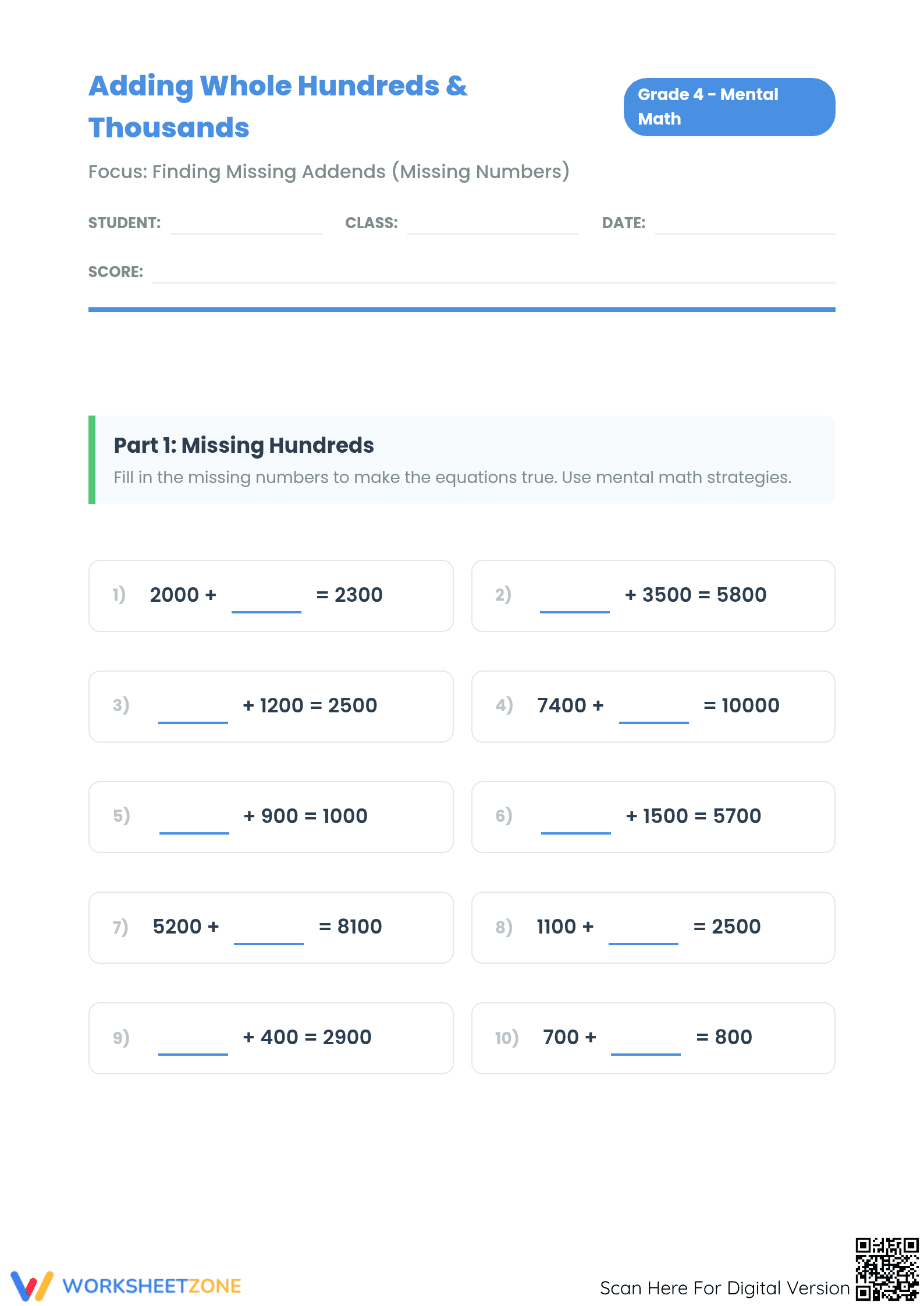
This Grade 4 addition worksheet helps students master mental math by solving 30 missing addend problems involving whole hundreds and thousands. By applying place value strategies, learners develop computational fluency and logical reasoning skills. This resource bridges the gap between basic arithmetic and algebraic thinking through structured practice and real-world word problem application.
At a Glance
- Grade: 4 · Subject: Math
- Standard:
CCSS.MATH.CONTENT.4.NBT.B.4— Fluently add multi-digit whole numbers using strategies based on place value- Skill Focus: Mental math missing addends
- Format: 4 pages · 30 problems · Answer key included · PDF
- Best For: Daily warm-ups and math centers
- Time: 20–30 minutes
What's Inside
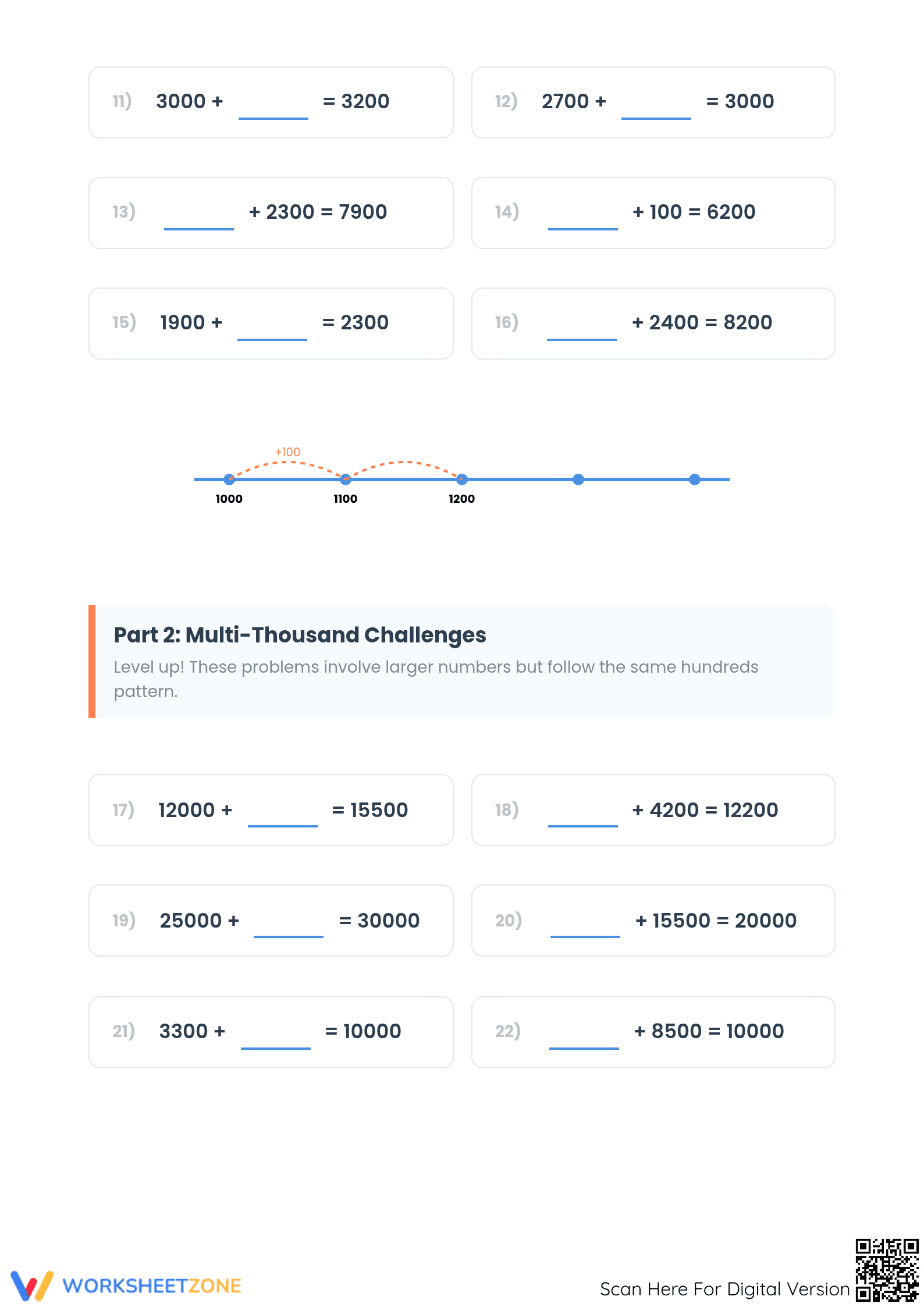
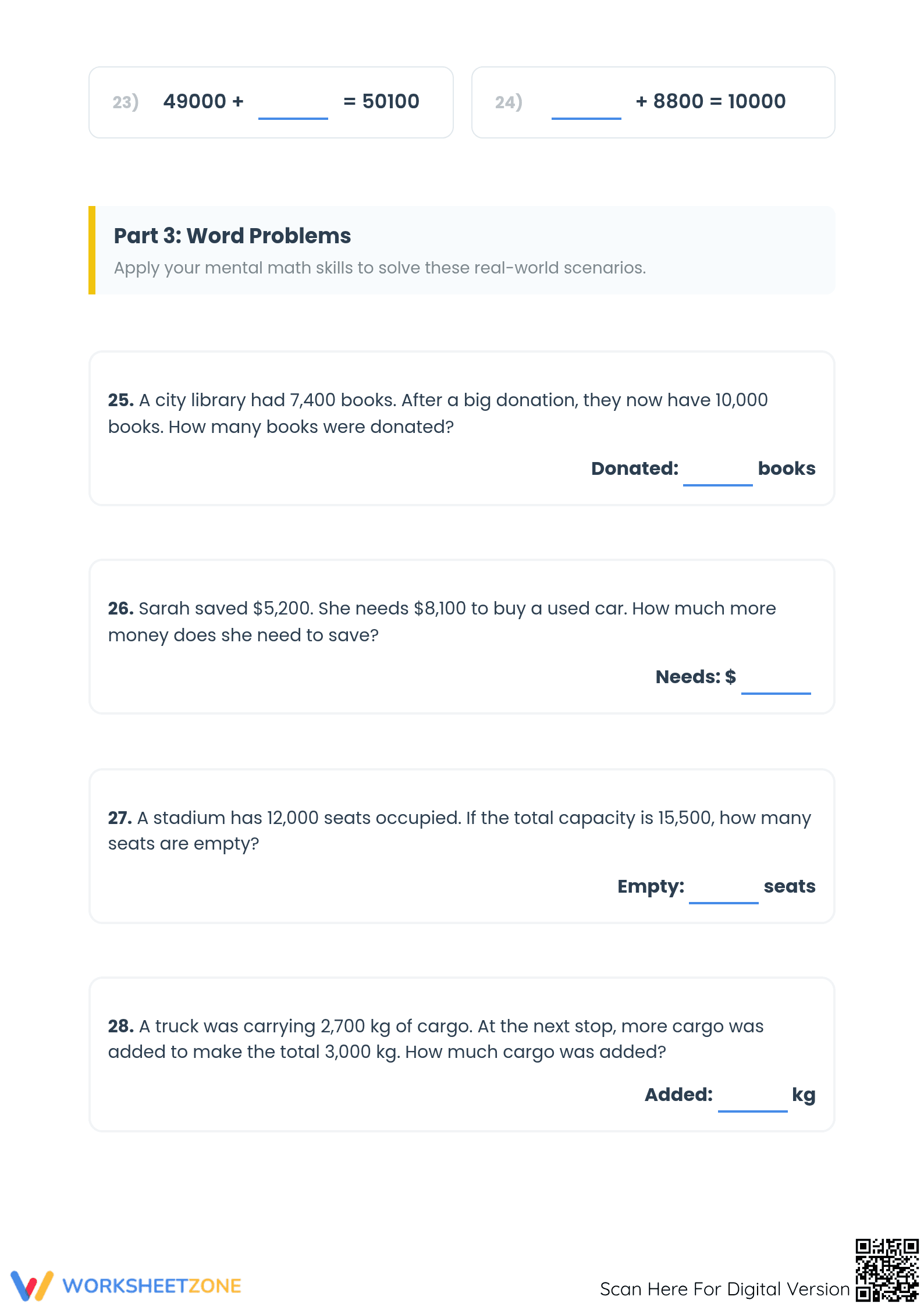
This four-page PDF includes 30 diverse problems divided into three scaffolded sections. Part 1 features 16 equations focusing on missing hundreds, providing students with immediate success. Part 2 levels up with eight multi-thousand challenges that expand place value understanding. Part 3 concludes with six real-world word problems that require students to translate narrative scenarios into mathematical operations. A complete answer key is provided to facilitate rapid grading.
Zero-Prep Workflow
- Print (1 minute): Select the four-page PDF and print enough copies for your class or small group.
- Distribute (1 minute): Hand out the sheets during your Number Talk or as a dedicated independent practice task.
- Review (5 minutes): Use the provided answer key for student self-correction or a quick teacher-led check.
Total teacher preparation time is under two minutes, making this an ideal resource for busy classrooms or unexpected substitute teacher plans.
Standards Alignment
The primary standard addressed is CCSS.MATH.CONTENT.4.NBT.B.4, which requires students to fluently add and subtract multi-digit whole numbers using place value strategies. By focusing on whole hundreds and thousands, students develop the number sense necessary for more complex algorithmic calculations. This worksheet also supports standards related to operations and algebraic thinking by introducing the concept of an unknown variable in addition equations. Both standard codes can be copied directly into lesson plans, IEP goals, or district curriculum mapping tools.
How to Use It
Use this worksheet as a high-impact warm-up activity to activate prior knowledge before a lesson on multi-digit addition. Alternatively, assign it as a math center rotation where students work in pairs to verbalize their mental math strategies. To observe formative growth, watch how students handle the Multi-Thousand Challenges to see if they apply the hundred-based patterns consistently. Most students will complete all 30 problems within a 25-minute instructional block.
Who It's For
This resource is designed for fourth-grade students developing fluency with larger numbers, but it also serves as an excellent intervention tool for fifth graders or an enrichment task for advanced third graders. It pairs naturally with place value anchor charts or a base-ten block demonstration. The clean, distraction-free layout is especially beneficial for students who require visual clarity during independent work sessions.
Grounded in research by Fisher & Frey (2014) on gradual release of responsibility, this worksheet scaffolds learning from structured equations to real-world problems. It promotes algebraic reasoning and computational fluency. NAEP research highlights that mastering mental math with place value benchmarks, like whole hundreds, leads to higher success in standard addition algorithms. This resource provides targeted practice for neural encoding of these patterns, allowing teachers to identify misconceptions.


