Students will learn how to take ten from off-decade two-digit numbers and add it back. They are going to:
- Employ skip-counting patterns in both directions, going forward by 10 to 100 of the decade and backward by 10 on the decade.
- Add and subtract from decade and off-decade numbers by alternating between ones and tens.
- How are mathematical representations of relationships made?
- How can the study of mathematics aid in clear communication?
- How can identifying regularity or repetition help with problem-solving efficiency?
- How do we represent, compare, quantify, and model numbers using mathematics?
- What does it mean to analyze or estimate a numerical quantity?
- What qualifies a tool or approach as suitable for a particular task?
- Sum: The result of addition.
-base-ten blocks
- numeral cards 11–99 (If you don’t have cards, you can cut apart a Hundreds Chart)
- number cube with –10 and +10 (A standard six-sided number cube can also be used. Cover the even numbers with a green sticker to indicate +10, and the odd numbers with a red sticker to indicate -10.)
- Lesson 3 Exit Ticket (M-1-2-3_Lesson 3 Exit Ticket and KEY)
- Observations made during small-group work, student interaction, and whole-class discussion will be used to evaluate student progress.
- Students will review the strategies they were introduced to in Lesson 3 and can use the Lesson 3 Exit Ticket (M-1-2-3_Lesson 3 Exit Ticket and KEY) as a formative assessment.
Explicit instruction, modeling, scaffolding, and active engagement
W: Give the students access to base-10 blocks so they can start adding and subtracting 10.
H: Give students a set of base-ten blocks and ask them to determine what happens when you add and subtract 10.
E: Based on the roll of a number cube, students will use their comprehension to add and subtract 10 from a decade number in a game.
R: During the whole-group discussion and the number-cube rolling exercise, let the students work in pairs.
E: Keep an eye on class discussions as a kind of unofficial evaluation. Ask partners to talk about the different approaches they took to reach the target number.
T: Assign students a similar task to mentally solve +10 and –10 problems on a daily or frequent basis. In small groups, students can use base-ten blocks to practice problem-solving and discuss potential strategies for reaching goals. Ask students to start deducting 10 from off-decade numbers if they're ready.
O: The purpose of this lesson is to teach students how to add and subtract from decades as well as recognize place value.
Display the number 30 to the students using base-ten blocks. Add one ten to the number. Ask, "How many do I have right now? How are you aware?" After assigning pairs of students to discuss, ask one or two of them to share.
Anticipate responses such as "There are four 10s or 40." Seek out students who claim that there are now four. Ensure that they are focusing intently on vocabulary with place value.
After adding ten and asking, "How many do I have now?" Repeat the procedure with the number 36. "How are you aware?"
Expect answers like "four 10s and 6 ones or 46." Look out for students who have lost track of the ones and switched to the 40.
Adding 10 each time, repeat this process with multiple numbers on and off the decade.
Remind the students of the number 30 in base-ten blocks. This time, take out a 10. Ask "Now, how many blocks do I have? How are you aware?" Students should talk with a partner and then share.
Answers like "2 tens or 20" are to be expected. Look out for students who report that there are only two left. Ensure that they employ language with place value.
Show the 50 in base-ten blocks to your students. Take out a ten. Question: "Now, how many blocks do I have? How are you aware of this?" Pupils should talk with their partners before sharing.
Students will apply their knowledge by playing a game with their partners in which they add or subtract 10 from a decade number using a number cube roll. Each partner selects a decade (10, 20, 30, 40, 50, 60, 70, 80, 90, or 100) from a range of 10. Depending on the result of the roll, the other partner either adds or subtracts ten. The partners then reverse roles and repeat.
Extension:
To fulfill your students' needs throughout the year, employ the techniques and activities provided below.
Routine: A way to begin the day, period, or activity: Just write the date and practice taking 10 off and adding to the number.
Small Group: More practice and small-group instruction will be helpful for students who require chances for extra learning. Students can use base-ten towers as manipulatives in the number-cube game described above.
Expansion: When the students are ready, they can play the number cube game again, with the first partner selecting ANY number from 1 to 100. When they're ready, they can start working on tensing up hundreds of numbers.

Adding and Subtracting Within 10 Worksheet
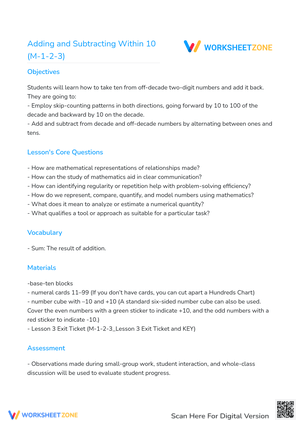
This is an educational worksheet focused on adding and subtracting within 10, specifically targeting taking ten from off-decade two-digit numbers and adding it back. It includes objectives, lesson core questions, vocabulary (sum), materials needed (base-ten blocks, numeral cards 11-99, a number cube with -10 and +10), and mentions an assessment using observations. The worksheet also mentions skip-counting patterns going forward and backward by 10.
Grade Level Suitability:
This worksheet is suitable for 1st grade and possibly early 2nd grade. The focus on adding and subtracting within 10, along with the use of base-ten blocks, suggests it's designed for students who are beginning to learn these concepts. The mention of two-digit numbers suggests a slightly more advanced first-grade level or a review for second grade.
Why Use It:
This worksheet helps students develop a strong foundation in number sense, specifically relating to addition and subtraction within 10. It encourages skip-counting, understanding place value, and using manipulatives to visualize math problems. The lesson's core questions promote critical thinking about mathematical concepts.
How to Use It:
Begin by reviewing the vocabulary (sum). Gather the required materials: base-ten blocks, numeral cards (or a hundreds chart), and a number cube with -10 and +10. Use the base-ten blocks and numeral cards to model taking ten from off-decade two-digit numbers and adding it back. Practice skip-counting by 10s forward and backward. Use the exit ticket to assess understanding.
Target Users:
This worksheet is best suited for 1st and early 2nd grade students who are learning to add and subtract within 10, and are beginning to work with two-digit numbers. It can also be helpful for students who need extra support in developing number sense and place value understanding.