


























Views
Downloads
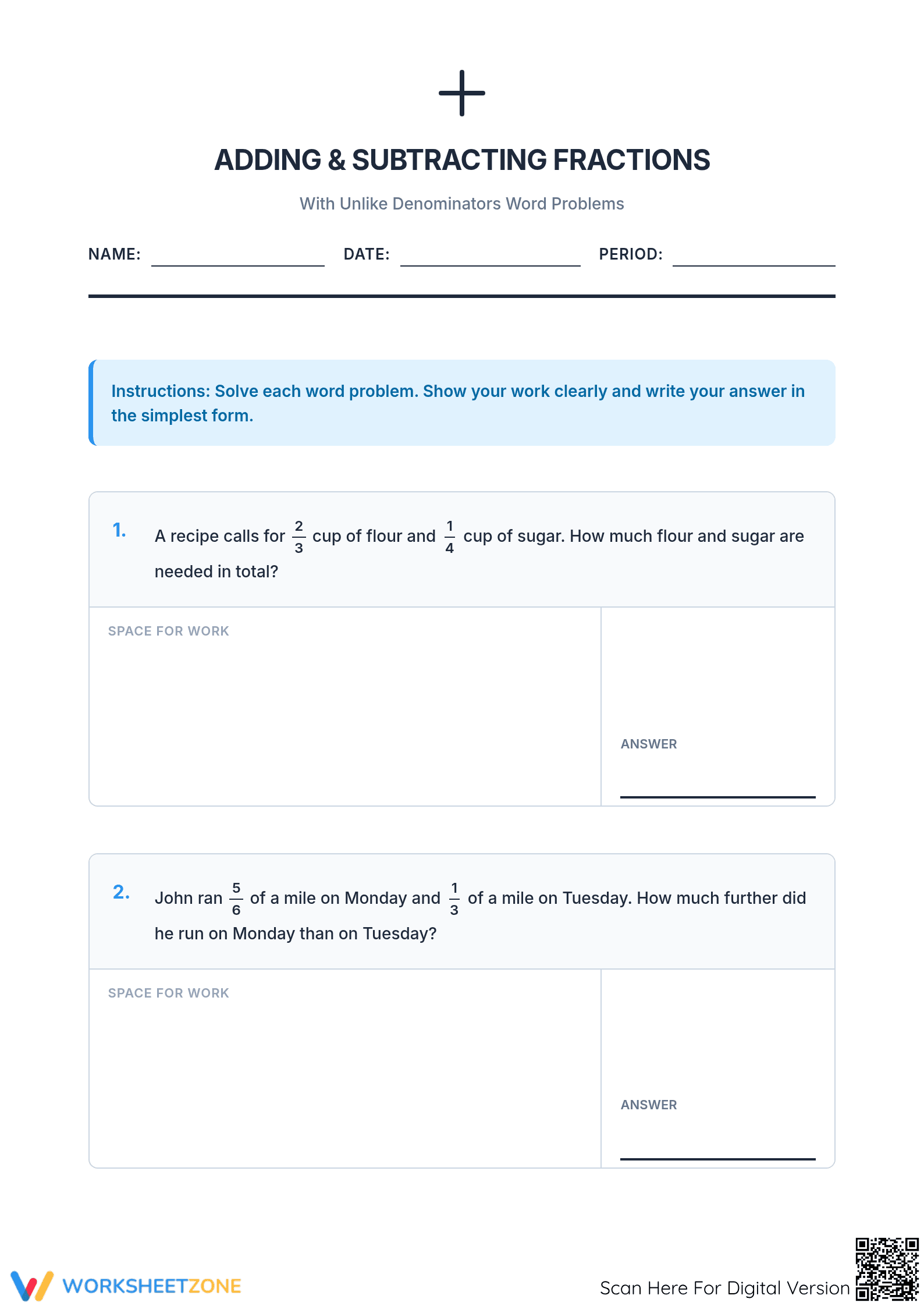



Essential Fraction Word Problems Worksheet | Grade 6 Math
Paste this activity's link or code into your existing LMS (Google Classroom, Canvas, Teams, Schoology, Moodle, etc.).
Students can open and work on the activity right away, with no student login required.
You'll still be able to track student progress and results from your teacher account.
This worksheet provides focused practice for Grade 6 students on the essential skill of adding and subtracting fractions with unlike denominators within real-world contexts. Through a series of six carefully constructed word problems, learners will apply their understanding of fraction operations to find common denominators and calculate solutions, strengthening both their procedural fluency and problem-solving abilities.
At a Glance
- Grade: 6 · Subject: Math
- Standard:
CCSS.MATH.CONTENT.5.NF.A.2— Solve word problems with addition and subtraction of fractions.- Skill Focus: Adding & Subtracting Fractions (Unlike Denominators, Word Problems)
- Format: 3 pages · 6 problems · Answer key included · PDF
- Best For: Skill practice, homework, formative assessment
- Time: 20–30 minutes
What's Inside
This resource is a three-page PDF with six word problems. Each problem involves adding or subtracting fractions with unlike denominators. Space is provided for students to show work and write their answer in simplest form. A full answer key is included for easy grading.
Skill Progression
- Guided Practice: The problems progress in difficulty. The first two use common fractions (halves, thirds) for a warm-up.
- Supported Practice: Problems three and four introduce more complex fractions (eighths, fifths) to build confidence.
- Independent Practice: The final two problems require students to work independently with varied denominators (tenths, sixths), demonstrating mastery. This follows a gradual release model to build student independence.
Standards Alignment
This worksheet aligns with CCSS.MATH.CONTENT.5.NF.A.2, which requires students to solve word problems involving fraction addition and subtraction with unlike denominators. While a 5th-grade standard, it provides essential review for 6th graders before they tackle more advanced ratio work. The standard code can be copied directly into lesson plans or curriculum maps.
How to Use It
Use this worksheet for independent practice after a lesson on common denominators, as a homework assignment, or as a quick formative assessment. To assess, note if students correctly identify the operation and find a proper common denominator. Most students will complete the worksheet in 20-30 minutes.
Who It's For
Designed for 6th-grade math students, this also suits advanced 5th graders or as review for 7th graders. To support learners, pair with a fraction bars anchor chart. For an extension, have early finishers write their own fraction word problem.
Applying procedural skills to contextualized word problems is a critical step toward mathematical proficiency. This worksheet supports CCSS.MATH.CONTENT.5.NF.A.2, which bridges the gap between computation and application for fraction operations. Research emphasizes that students need repeated, structured opportunities to practice skills in varied contexts to achieve fluency and long-term retention. As noted in the RAND AIRS 2024 analysis of effective math interventions, practice materials that isolate a specific skill while still presenting it within a problem-solving framework are highly effective. This resource provides that focused practice, asking students to solve six unique word problems involving adding and subtracting fractions with unlike denominators. This approach ensures students not only practice finding common denominators but also learn to interpret contextual clues to determine the correct operation, a key component of mathematical reasoning.


