


























Views
Downloads



A Tiny Feast Analysis Worksheet | Essential Grade 6-8 ELA
Paste this activity's link or code into your existing LMS (Google Classroom, Canvas, Teams, Schoology, Moodle, etc.).
Students can open and work on the activity right away, with no student login required.
You'll still be able to track student progress and results from your teacher account.
This comprehensive literary analysis worksheet guides middle school students through Chris Adrian's "A Tiny Feast." Students examine critical narrative components, from character motivations to complex themes, ensuring a thorough understanding of the text's structure. It is designed to foster critical thinking and evidence-based responses in any Grade 6-8 ELA classroom.
At a Glance
- Grade: 6–8 · Subject: ELA Literature
- Standard:
CCSS.ELA-LITERACY.RL.6.3— Analyze how a story's plot unfolds and how characters respond to challenges.- Skill Focus: Narrative Analysis & Story Elements
- Format: 3 pages · 10 problems · Answer key included · PDF
- Best For: Independent practice or formative assessment
- Time: 20–30 minutes
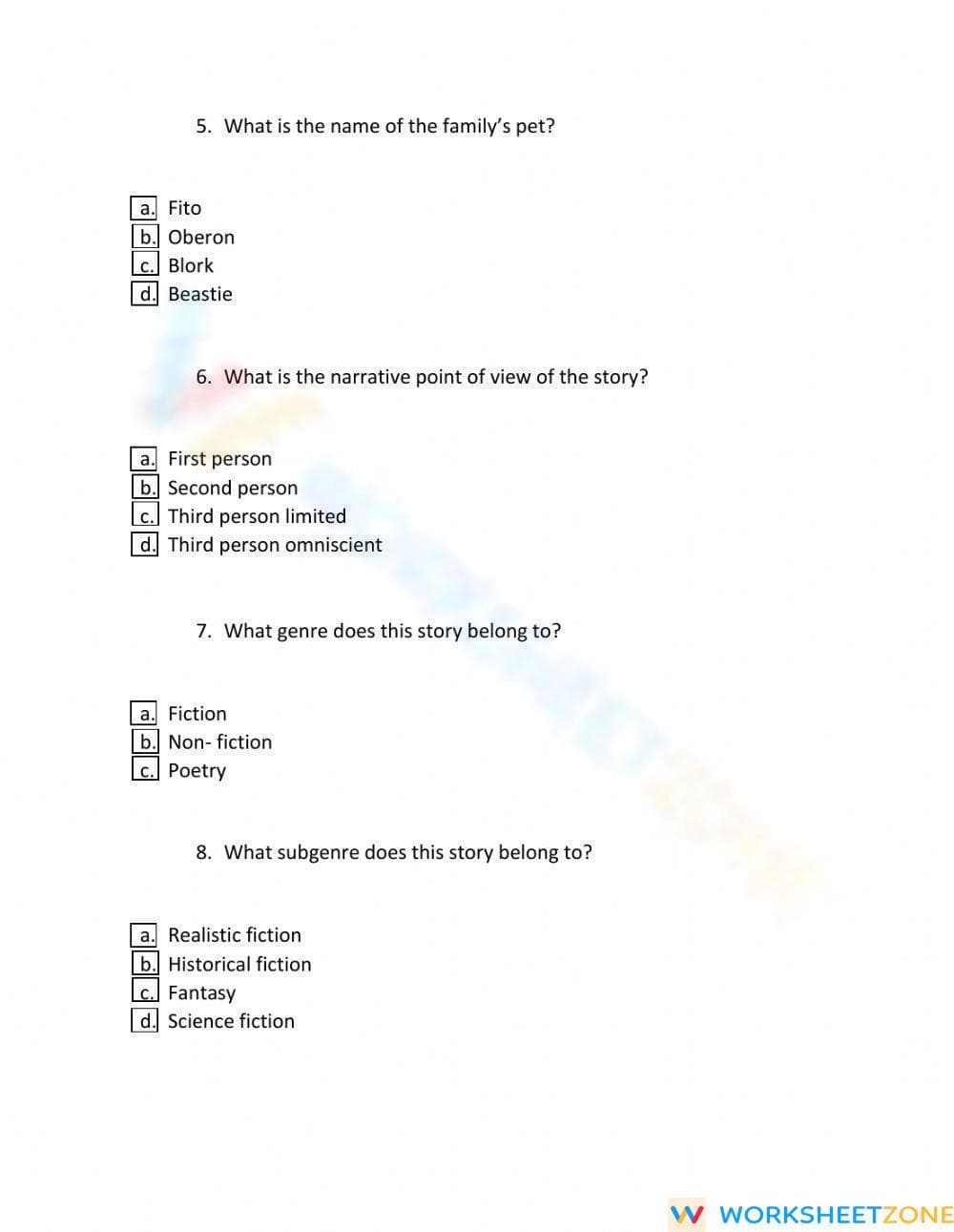
This 3-page printable contains ten strategically designed tasks. The first nine questions are multiple-choice, focusing on essential literary elements such as setting, character identification (Titania and Oberon), theme, and point of view. The final task transitions students to independent writing, requiring a concise five-line plot summary demonstrating their ability to synthesize complex narrative arcs.
- Guided practice: Initial questions establish the literal foundation, asking students to identify the specific setting and main characters.
- Supported practice: Students move to conceptual analysis, selecting the correct narrative point of view and identifying the subgenre from provided options.
- Independent practice: The worksheet concludes with a synthesis task, constructing a brief plot summary.
This structured approach follows the gradual release model, moving from identification to high-level summarization.
Primary alignment is to CCSS.ELA-LITERACY.RL.6.3, requiring students to describe how a story's plot unfolds and how characters respond to episodes. Additionally, it supports CCSS.ELA-LITERACY.RL.6.5 by asking students to identify the story arc structure. Both standard codes can be copied directly into lesson plans, IEP goals, or district curriculum mapping tools.
Use this worksheet as a summative assessment after reading "A Tiny Feast" to gauge mastery of literary elements. Alternatively, assign it as homework to prepare students for a classroom discussion. Teachers should observe responses to the theme and POV questions to identify misconceptions regarding narrative perspective. Total completion time is approximately 25 minutes.
This resource is tailored for Grade 6-8 students studying modern literature. It provides sufficient scaffolding for general education while offering a writing extension for advanced learners. It pairs naturally with an anchor chart detailing the components of the Freytag's Pyramid plot structure or a direct instruction lesson on character development.
This Grade 6-8 ELA resource facilitates rigorous engagement with Chris Adrian’s "A Tiny Feast," specifically targeting the narrative analysis skills outlined in CCSS.ELA-LITERACY.RL.6.3. By requiring students to identify characters, evaluate themes, and synthesize plot arcs, the worksheet mirrors the evidence-based inquiry methods emphasized in the RAND AIRS 2024 report on effective reading comprehension strategies. The progression from multiple-choice identification to short-form summary writing ensures that students not only recognize literary devices but can also apply them to construct meaningful interpretations of complex texts. Such structured practice is vital for developing the high-level literacy skills required by modern state standards and national assessments. This standalone module provides educators with a reliable tool for measuring student growth in literary analysis, ensuring that learners can accurately navigate the intersections of character development, setting, and plot resolution within the context of contemporary fiction.


