


























Views
Downloads
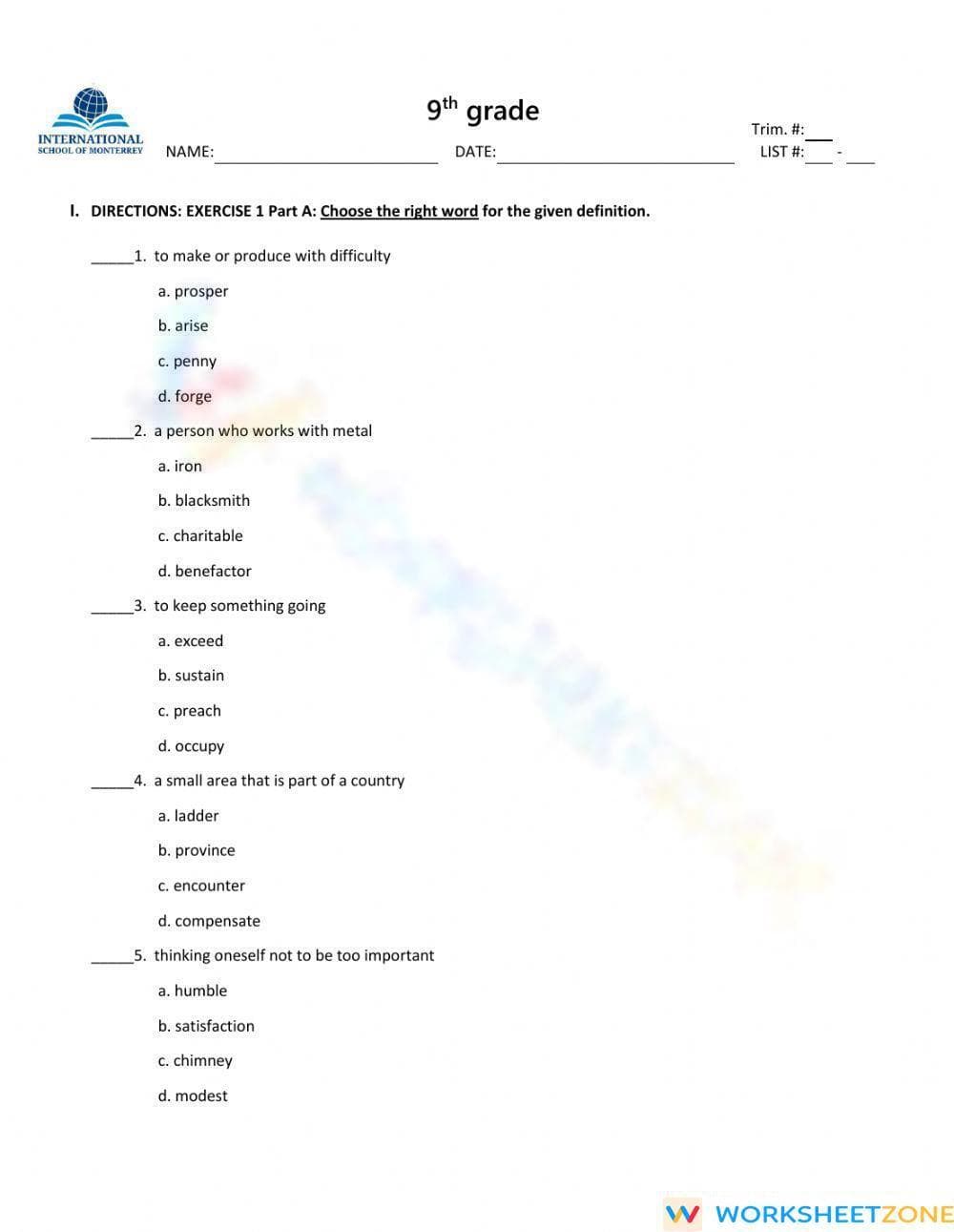



Printable Academic Vocabulary Worksheet | Grade 9-10 ELA
Paste this activity's link or code into your existing LMS (Google Classroom, Canvas, Teams, Schoology, Moodle, etc.).
Students can open and work on the activity right away, with no student login required.
You'll still be able to track student progress and results from your teacher account.
This ELA worksheet provides targeted practice for Grade 9 and 10 students on deciphering academic vocabulary in context. Through a series of multiple-choice questions, learners will strengthen their ability to use definitions, contextual clues, and word relationships to determine the precise meaning of grade-level words, a foundational skill for reading comprehension.
At a Glance
- Grade: 9-10 · Subject: ELA
- Standard:
CCSS.ELA-LITERACY.L.9-10.4— Determine the meaning of words and phrases as they are used in a text.- Skill Focus: Academic Vocabulary, Context Clues
- Format: 4 pages · 20 problems · Answer key included · PDF
- Best For: Vocabulary practice, bell-ringer, independent work
- Time: 20–25 minutes
What's Inside
This four-page resource offers a 20-problem vocabulary exercise divided into three parts: matching words to definitions, definitions to words, and using words in context. A complete answer key is included for easy grading or self-check, making the PDF packet entirely self-contained.
Skill Progression
The worksheet uses a gradual-release model to build skill.
- Guided Start: The first 5 problems pair definitions with words for maximum support.
- Supported Practice: The next 5 problems ask students to select the correct definition for a given word.
- Independent Use: The final 10 questions require students to use words in context, demonstrating full comprehension. This mirrors the classic 'I Do, We Do, You Do' teaching method.
Standards Alignment
This worksheet aligns with CCSS.ELA-LITERACY.L.9-10.4, which requires students to determine the meaning of unknown words using various strategies. The exercises specifically provide practice in using context and reference-style thinking to clarify a word's precise meaning. This standard code can be copied directly into lesson plans, IEP goals, or district curriculum maps.
How to Use It
This resource is highly flexible. Use it as a pre-assessment before a unit, or as independent practice after a direct instruction lesson on context clues. For a quick formative check, have students complete the first ten problems and review answers with a partner. The entire worksheet should take students about 20-25 minutes to complete.
Who It's For
Designed for 9th and 10th-grade ELA students, this resource is great for reinforcing vocabulary skills. Its clear structure makes it accessible for most learners. To provide extra support, pair this worksheet with an anchor chart of context clue strategies or pre-teach the vocabulary with visuals for English Language Learners.
This vocabulary exercise directly supports CCSS.ELA-LITERACY.L.9-10.4, which focuses on determining word meanings through context. Acquiring and using academic vocabulary is a critical component of adolescent literacy and a strong predictor of academic success. Research has consistently shown a robust correlation between a student's vocabulary size and their reading comprehension ability. The RAND AIRS (2024) report emphasizes that instruction must go beyond simple definitions to include rich, contextualized practice, as provided in this worksheet's 20 problems. By engaging with words through multiple formats—matching, definition selection, and sentence application—students build the flexible knowledge needed to navigate complex grade-level texts. This approach ensures that vocabulary acquisition is not just memorization but a functional skill applied to authentic reading and writing, a key finding highlighted in numerous literacy studies.


