


























Views
Downloads
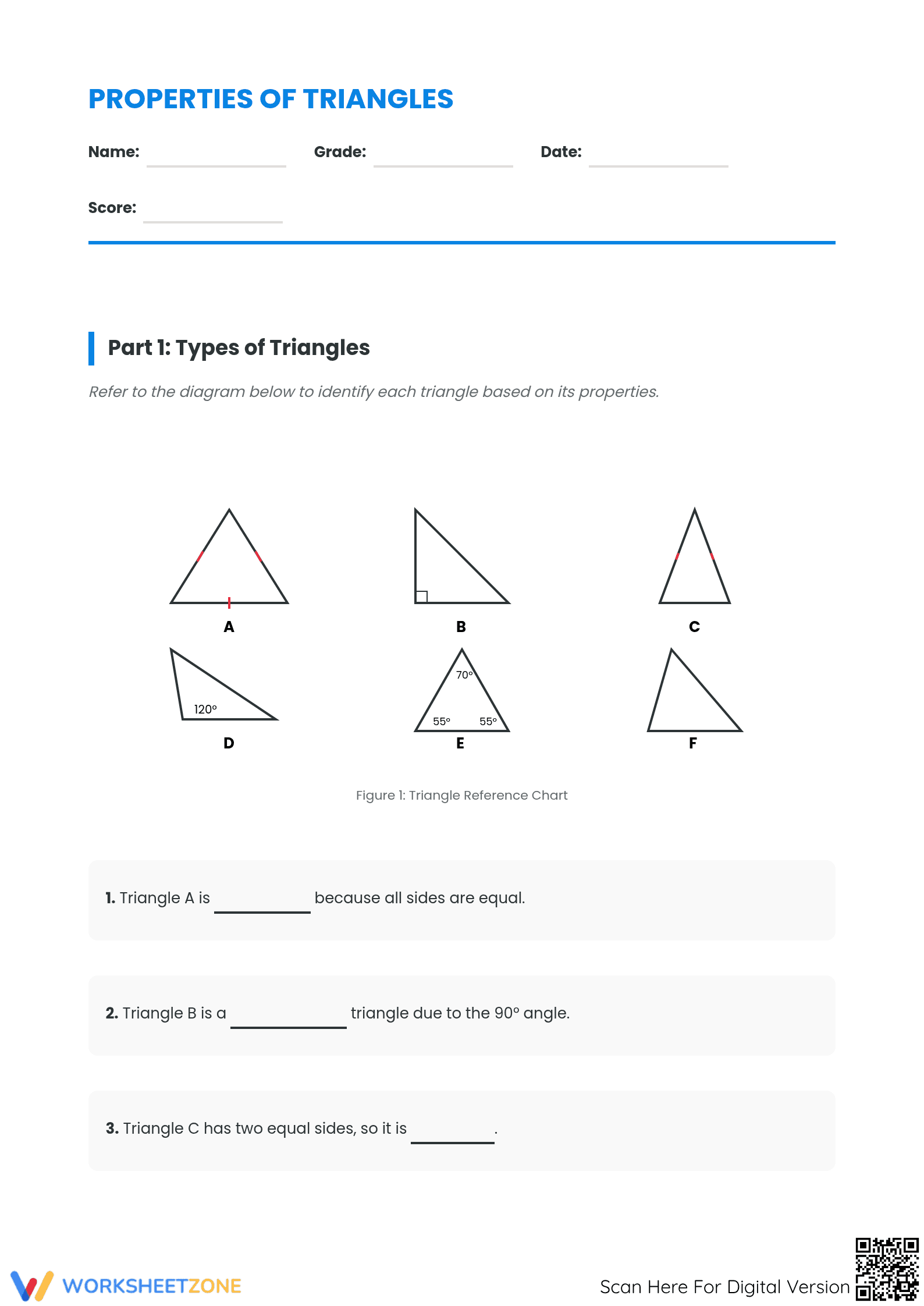
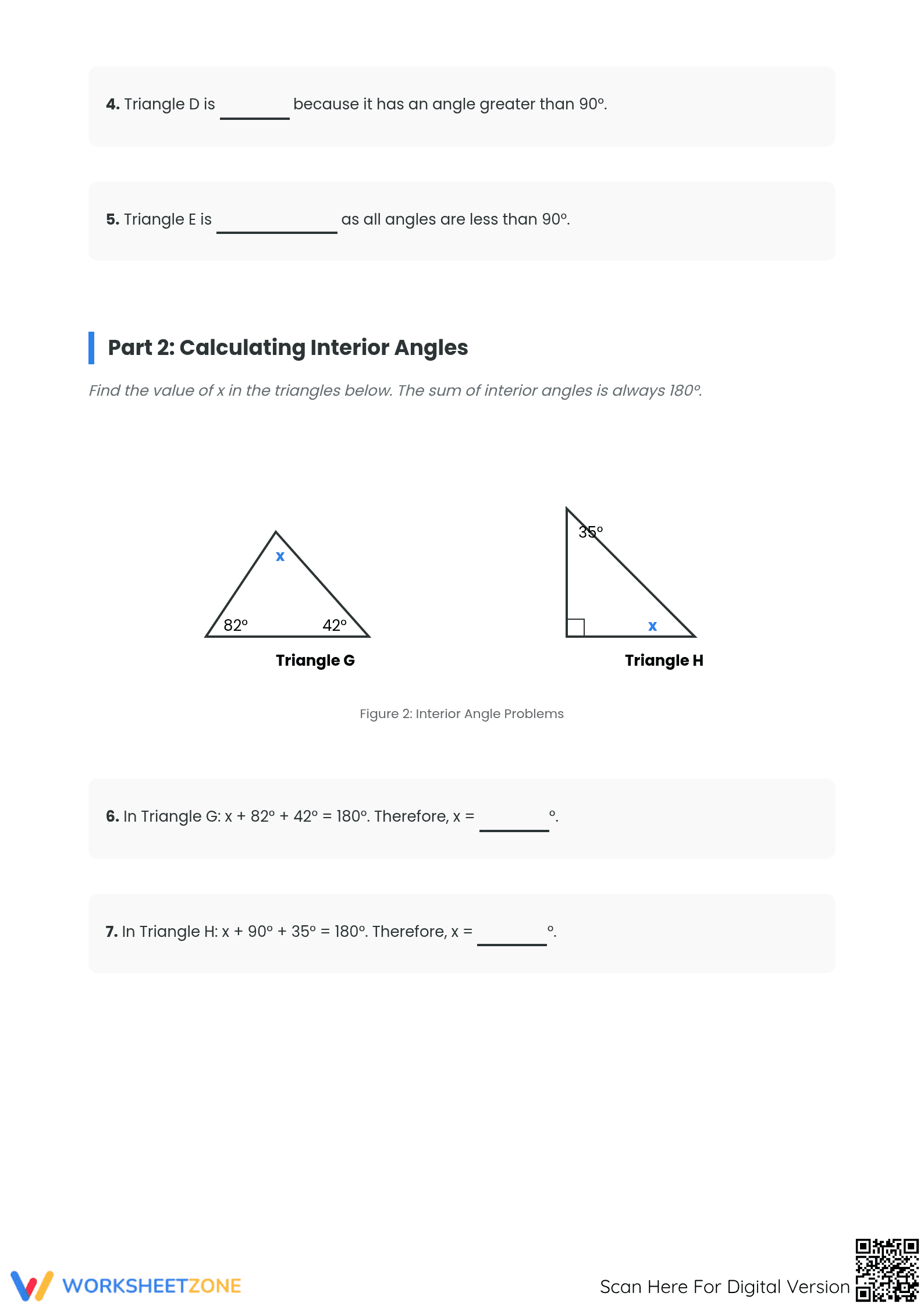
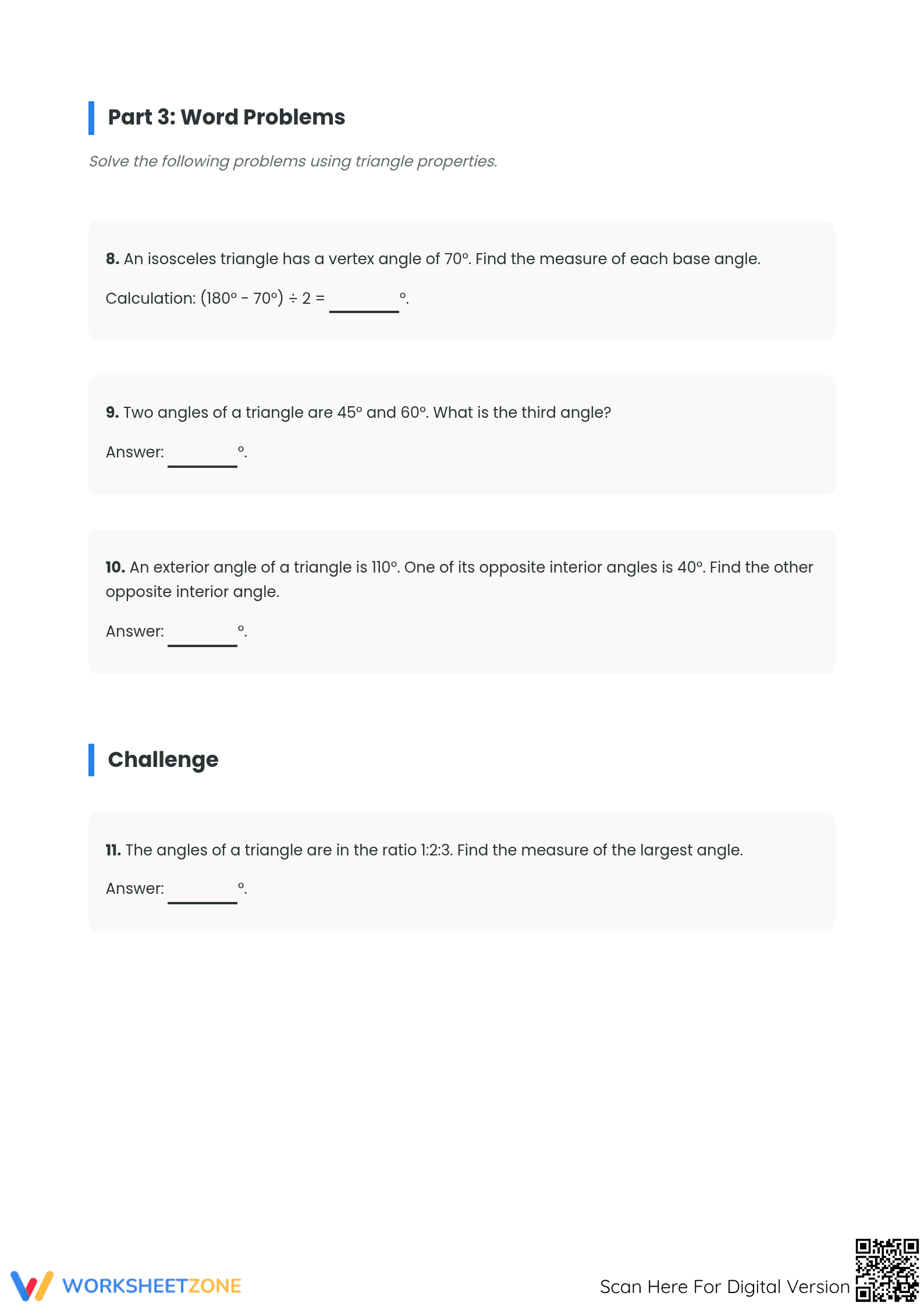

Essential Properties of Triangles Worksheet | Grade 8-10
Paste this activity's link or code into your existing LMS (Google Classroom, Canvas, Teams, Schoology, Moodle, etc.).
Students can open and work on the activity right away, with no student login required.
You'll still be able to track student progress and results from your teacher account.
This comprehensive geometry resource facilitates a deep understanding of triangle classification and angle relationships. Students engage with visual models and word problems to master the properties that define these fundamental shapes. By calculating missing interior and exterior angles, learners build the geometric reasoning necessary for advanced mathematics. The worksheet ensures students can fluently identify triangles by their unique side and angle characteristics.
At a Glance
- Grade: 8-10 · Subject: Geometry
- Standard:
CCSS.MATH.CONTENT.8.G.A.5— Use arguments to establish facts about triangle angle sums and exterior angles- Skill Focus: Triangle Properties and Angle Calculations
- Format: 3 pages · 11 problems · Answer key included · PDF
- Best For: Independent practice or homework
- Time: 20–30 minutes
What's Inside
This three-page PDF includes a specialized Triangle Reference Chart to support visual learners during the initial identification phase. The document features eleven structured tasks ranging from identifying equilateral and obtuse triangles to solving complex word problems involving interior angle ratios. A full answer key is provided, ensuring that teachers can quickly verify student work or facilitate self-directed grading in a classroom setting.
Zero-Prep Workflow
This resource is designed for immediate classroom implementation. First, print the three-page PDF or upload it to your digital learning platform (30 seconds). Second, distribute the worksheets; students can immediately begin using the Reference Chart on page one to support their identification of triangle types (1 minute). Finally, use the included answer key for rapid grading or student self-correction (1 minute). Total preparation time is under three minutes, making it ideal for substitute plans.
Standards Alignment
This worksheet is aligned with CCSS.MATH.CONTENT.8.G.A.5, which requires students to use informal arguments to establish facts about the angle sum and exterior angle of triangles. The tasks specifically target the 180-degree interior sum and the relationship between interior and exterior angles. This standard code can be copied directly into lesson plans, IEP goals, or district curriculum mapping tools to ensure instructional compliance.
How to Use It
This worksheet is best used during the guided practice phase of a geometry unit or as a formative assessment after teaching the triangle sum theorem. One effective use case is to assign it as a collaborative activity where students justify their classification choices to a partner. Teachers should observe students during Part 2 to ensure they are correctly setting up the algebraic equations for the interior angle calculations.
Who It's For
This material is tailored for Grade 8 through Grade 10 students who are solidifying their understanding of Euclidean geometry. It is particularly effective for students requiring visual scaffolds, as the reference chart provides clear cues for side and angle properties. It pairs naturally with instructional videos on the triangle inequality theorem or interactive geometry software explorations.
According to the ScienceDirect TpT Analysis, structured geometry practice that integrates visual classification with computational problem-solving significantly enhances long-term retention of spatial properties. This worksheet is meticulously aligned to CCSS.MATH.CONTENT.8.G.A.5, ensuring students develop the informal arguments necessary to establish foundational facts about the angle sum and exterior angle of triangles. By progressing from identification to complex word problems involving ratios, students move beyond rote memorization into applied geometric reasoning. The challenge problem encourages higher-order thinking, while the immediate feedback from the answer key supports self-directed learning. Educators can utilize these tasks to identify misconceptions regarding the sum of interior angles (180 degrees) before transitioning to advanced trigonometry. This resource provides a reliable bridge between initial instruction and mastery, supporting diverse classroom environments with clear, actionable content.


