


























Views
Downloads

Essential Algebraic Expressions Practice | Grade 6 Math
Paste this activity's link or code into your existing LMS (Google Classroom, Canvas, Teams, Schoology, Moodle, etc.).
Students can open and work on the activity right away, with no student login required.
You'll still be able to track student progress and results from your teacher account.
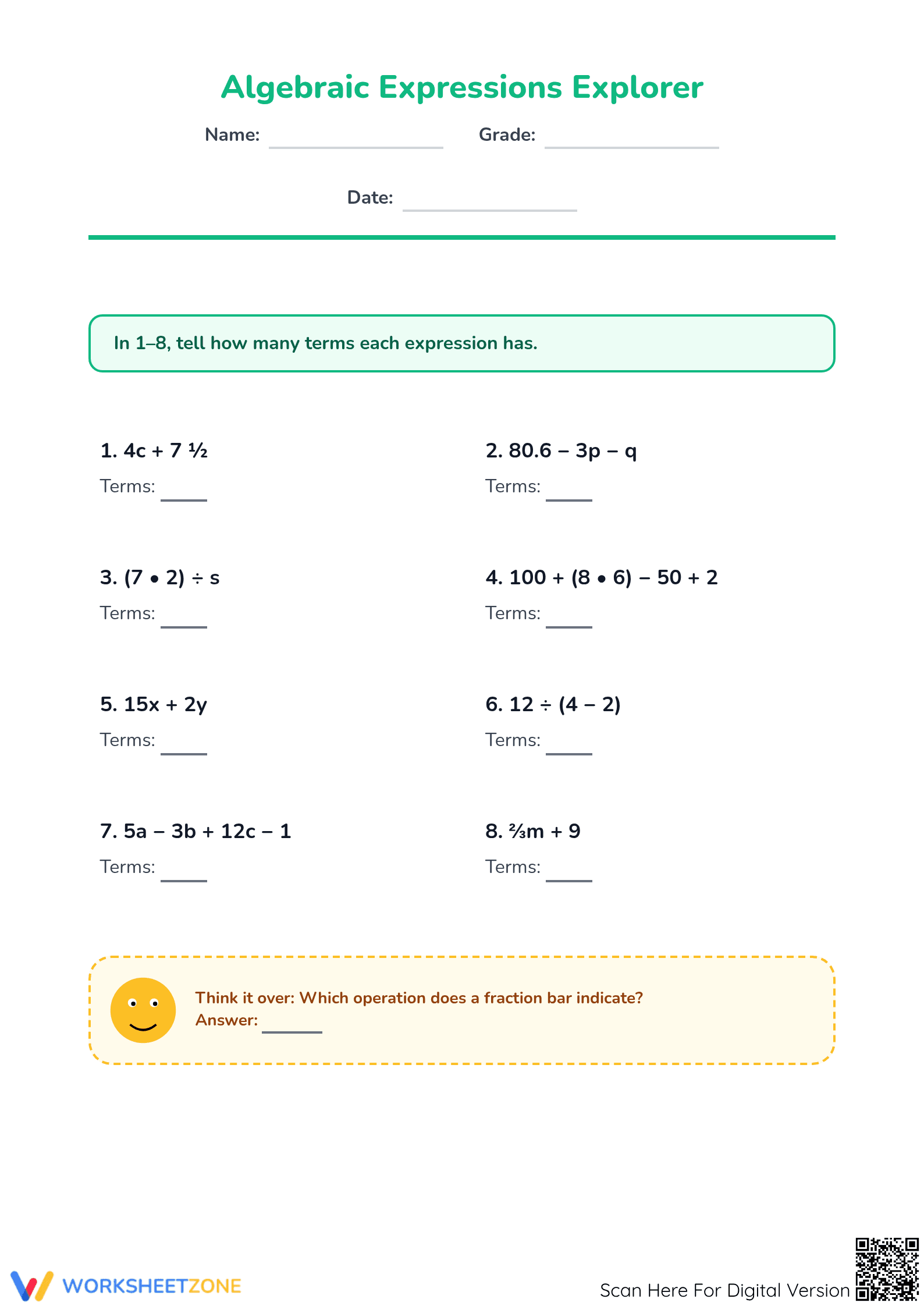
This comprehensive Grade 6 worksheet helps students master the language of algebra by identifying the specific parts of mathematical expressions. Students will practice distinguishing between terms, coefficients, constants, factors, products, and quotients. By translating word problems into variables, learners build the foundational skills necessary for solving complex equations and advancing in middle school mathematics.
At a Glance
- Grade: 6 · Subject: Math
- Standard:
6.EE.A.2.B— Identify parts of an expression using mathematical terms like sum, term, and product- Skill Focus: Algebraic vocabulary and expression analysis
- Format: 4 pages · 20 problems · Answer key included · PDF
- Best For: Individual practice or guided math centers
- Time: 25–40 minutes
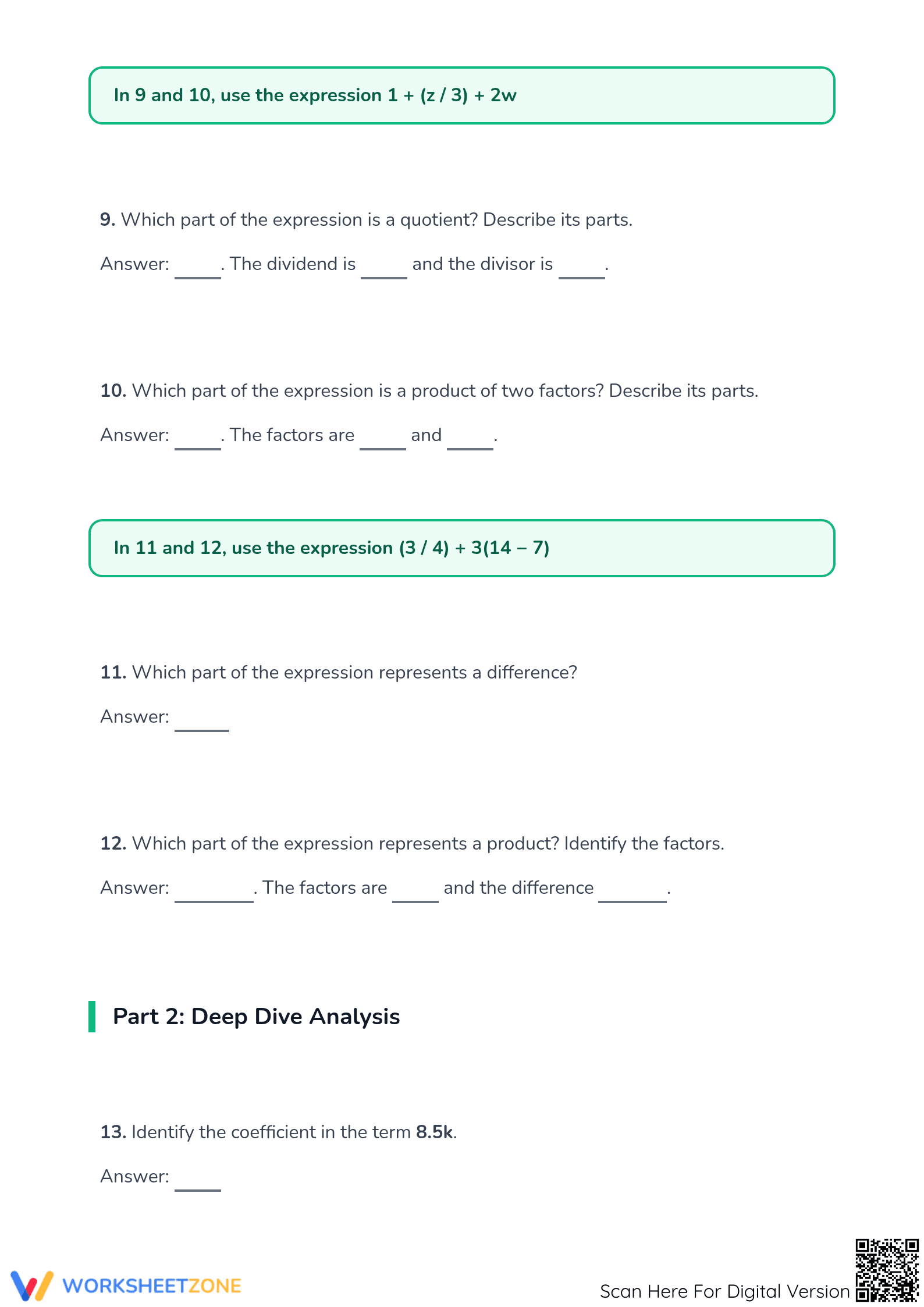
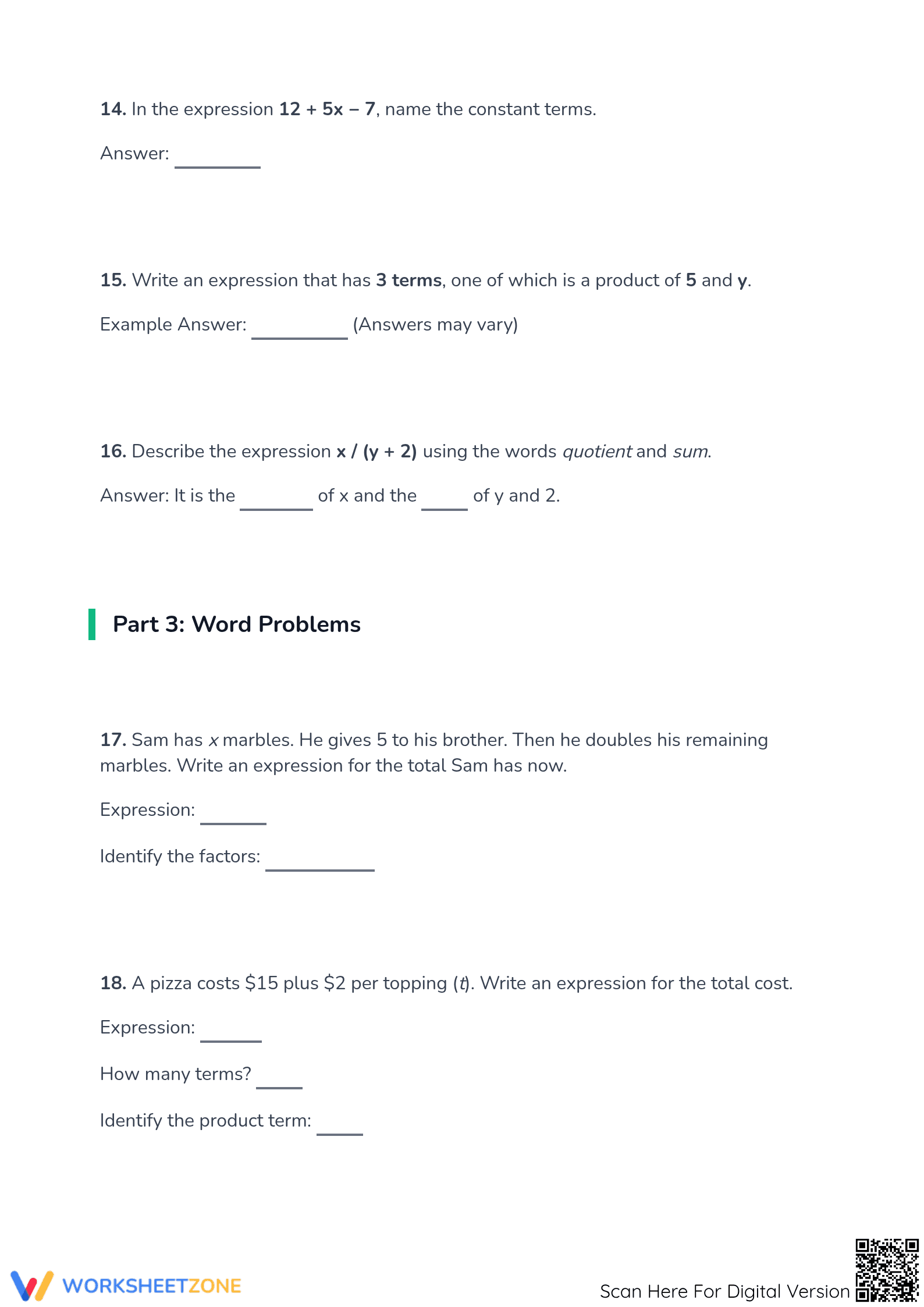
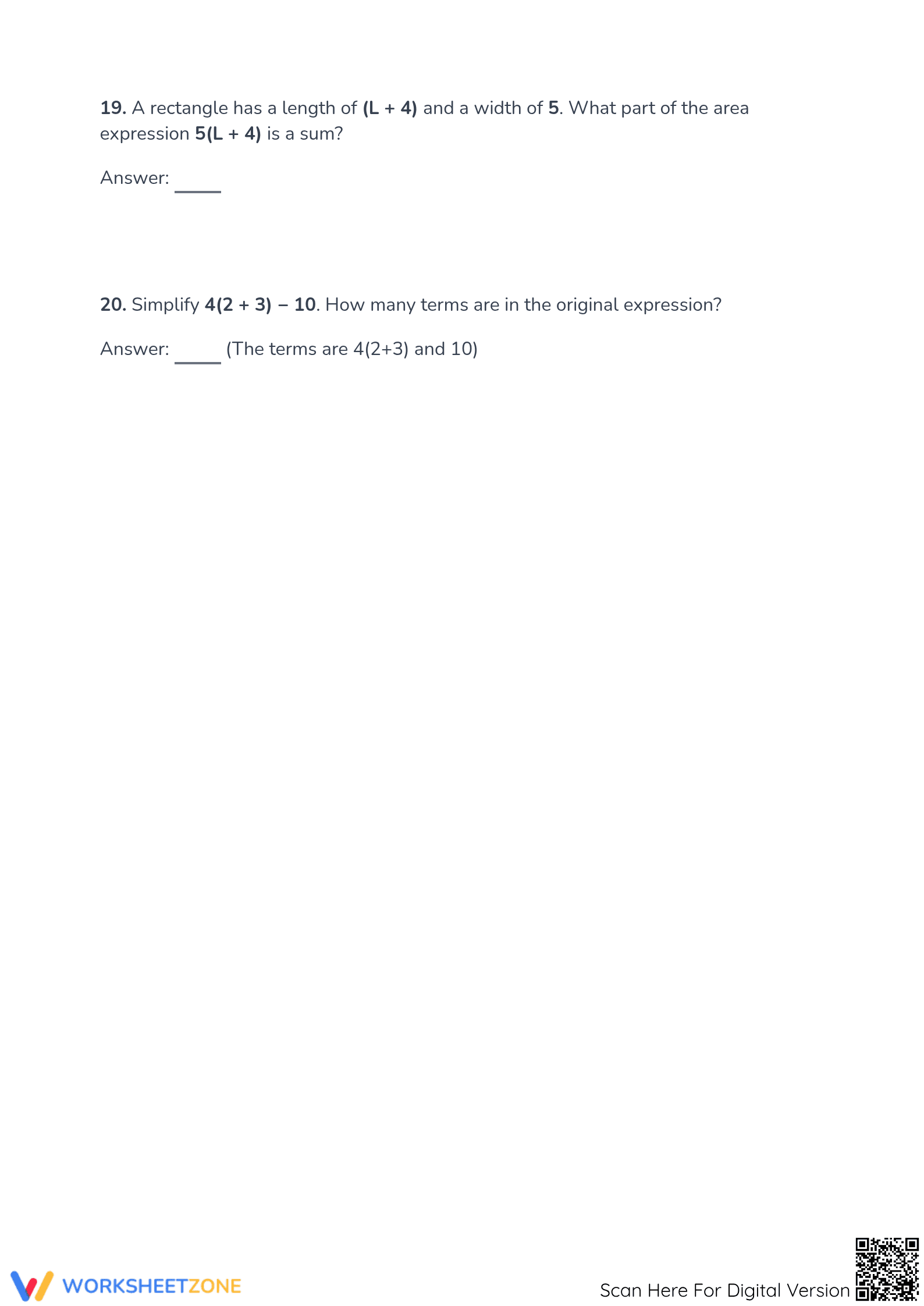
This 4-page "Algebraic Expressions Explorer" includes 20 tasks designed to deepen conceptual understanding. The resource begins with term-counting before moving into "Deep Dive Analysis" where students identify coefficients and factors. Finally, the "Word Problems" section challenges students to construct expressions from real-world scenarios, ensuring they apply vocabulary in context.
- Guided Practice: Problems 1–12 focus on basic term identification and the structural analysis of complex quotients and products within given expressions.
- Deep Dive Analysis: Questions 13–16 require students to isolate coefficients, constants, and write unique expressions according to specific mathematical constraints.
- Word Problems: The final section presents 4 high-level real-world scenarios where students must translate language into algebraic structures independently.
This progression follows a gradual-release model, moving from basic recognition to sophisticated application.
This worksheet is aligned to CCSS 6.EE.A.2.B, requiring students to identify expression parts using terms like term, product, factor, and coefficient. The problems also support standard 6.EE.A.2.A through expression writing. Both standard codes can be copied directly into lesson plans, IEP goals, or district curriculum mapping tools.
Use this worksheet as a primary practice tool during your unit on algebraic thinking. It is particularly effective during the "We Do" phase of a lesson or as a station activity in a guided math rotation. Teachers should observe students during Part 2 to ensure they aren't confusing coefficients with constants. Expect completion in approximately 30 minutes.
This resource is designed for Grade 6 students who are transitioning from basic arithmetic to abstract algebraic concepts. It offers necessary scaffolding for English Language Learners who need to master technical academic vocabulary. The worksheet pairs naturally with a "Parts of an Expression" anchor chart or a short introductory video on variables to reinforce visual cues.
According to the EdReports 2024 analysis of middle school curriculum, high-quality instructional materials must explicitly bridge the gap between procedural fluency and conceptual vocabulary. This Grade 6 worksheet addresses that critical need by requiring students to articulate the structural components of algebraic expressions rather than simply performing calculations. Research from Fisher & Frey (2014) emphasizes that the gradual release of responsibility—moving from basic term identification to independent word problem construction—is the most effective way to ensure long-term retention of abstract mathematical structures. By requiring students to identify specific factors, constants, and quotients within complex groupings, this practice set builds the essential cognitive schema required for success in high school Algebra I courses. The 20-task volume provides the deliberate practice necessary to move technical mathematical terminology into functional fluency, effectively preparing students for standardized assessments that demand precise identification of algebraic parts.


