


























Views
Downloads

Linear Equations Worksheet | Grade 6 Math Printable
Paste this activity's link or code into your existing LMS (Google Classroom, Canvas, Teams, Schoology, Moodle, etc.).
Students can open and work on the activity right away, with no student login required.
You'll still be able to track student progress and results from your teacher account.
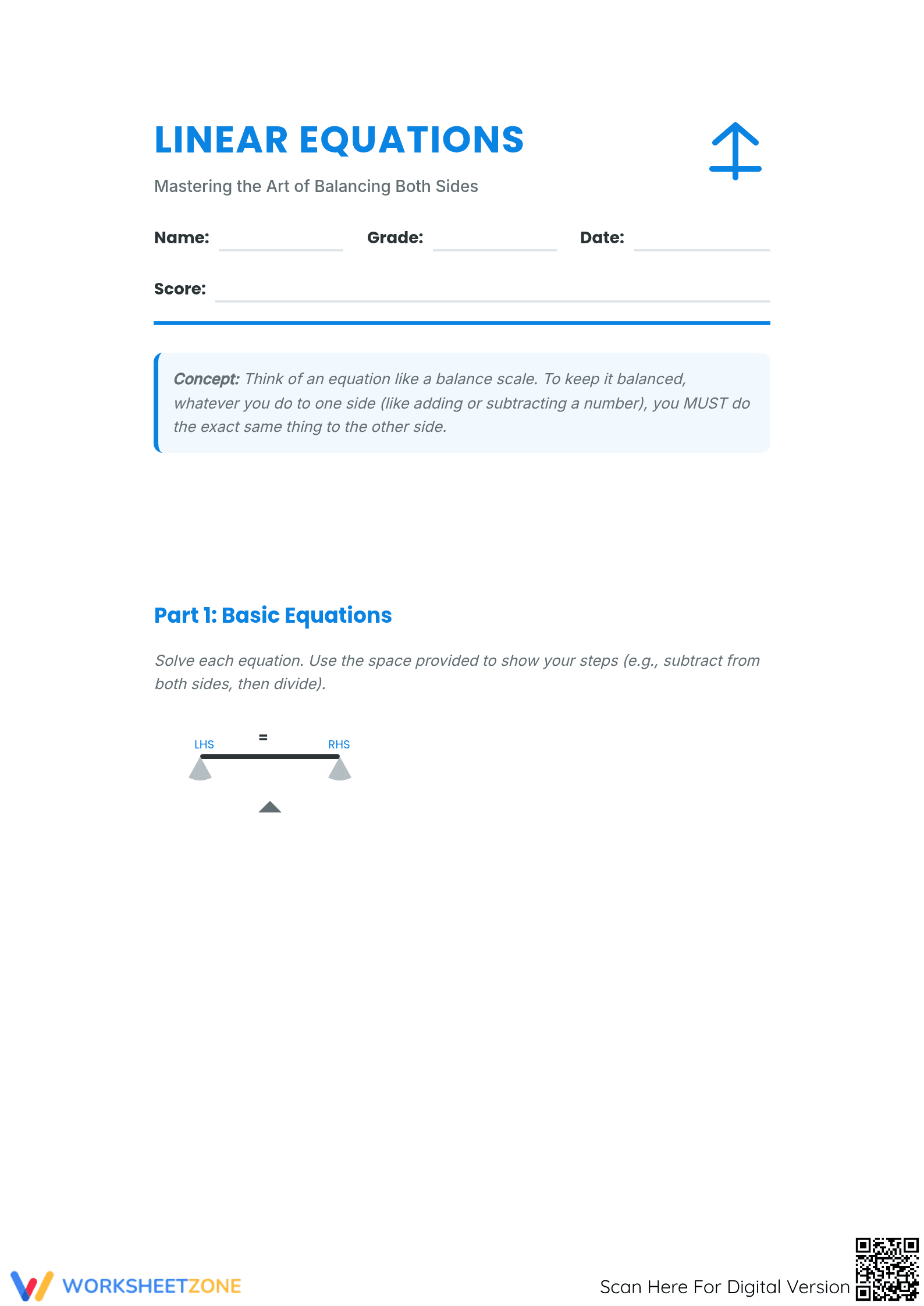
This Grade 6 math worksheet provides focused practice on solving linear equations. Students learn to balance both sides of an equation to isolate the variable. Working through these structured problems helps learners build the foundational algebraic skills necessary for higher-level math and real-world problem-solving.
At a Glance
- Grade: 6 · Subject: Math
- Standard:
CCSS.MATH.CONTENT.6.EE.B.7— Solve real-world and mathematical problems using equations- Skill Focus: Solving Linear Equations
- Format: 5 pages · 14 problems · Answer key included · PDF
- Best For: Independent practice and homework
- Time: 25–35 minutes
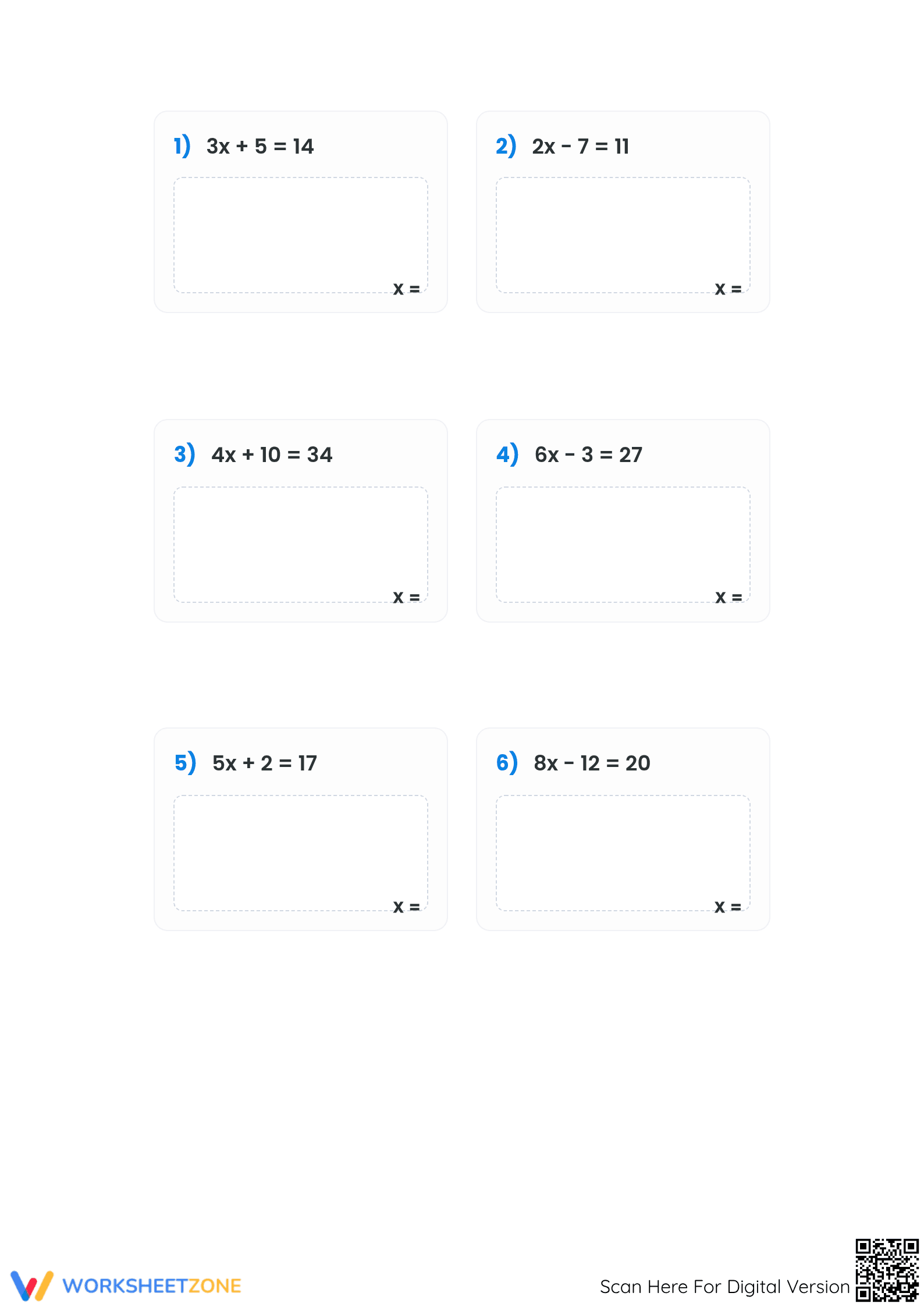
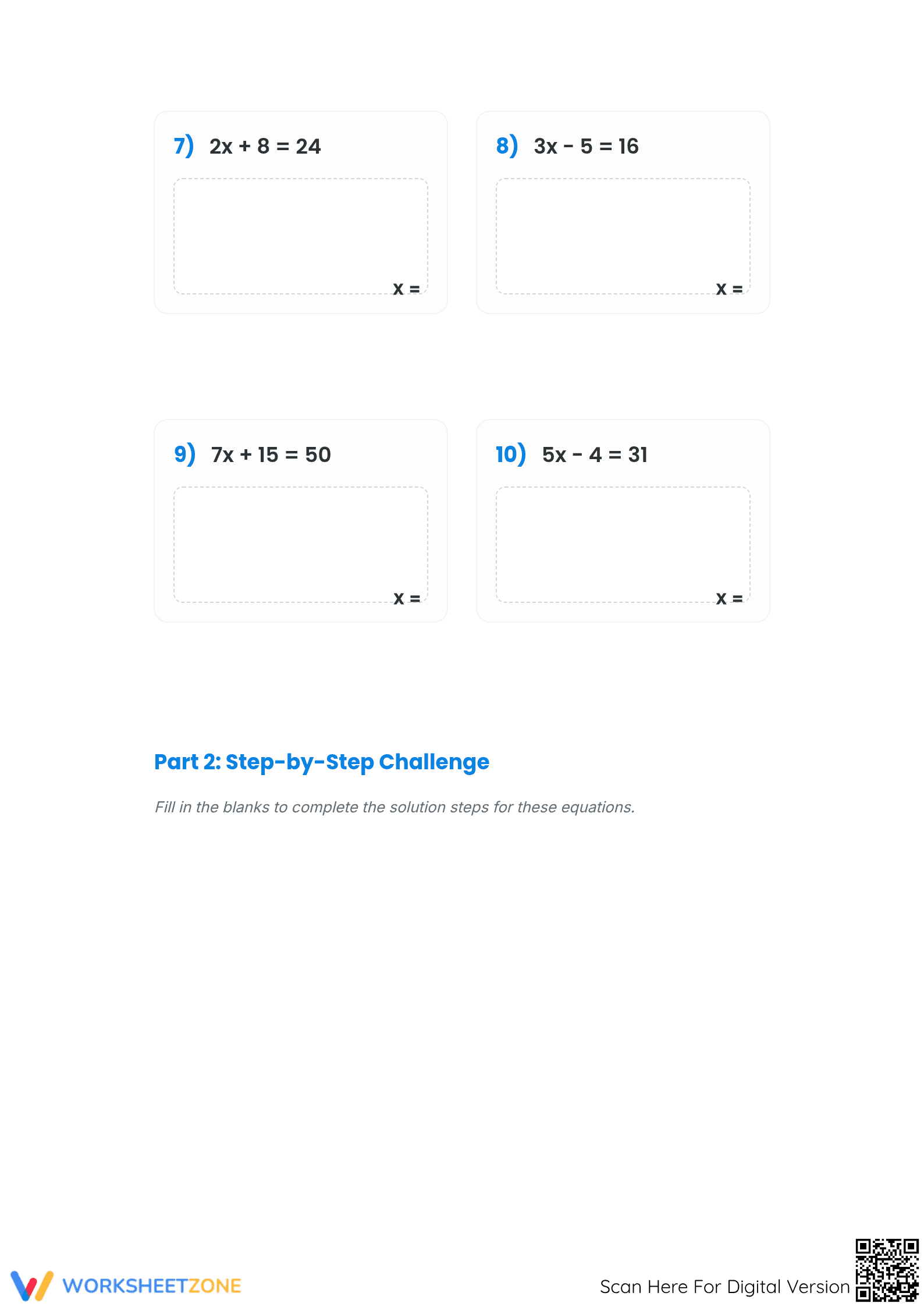
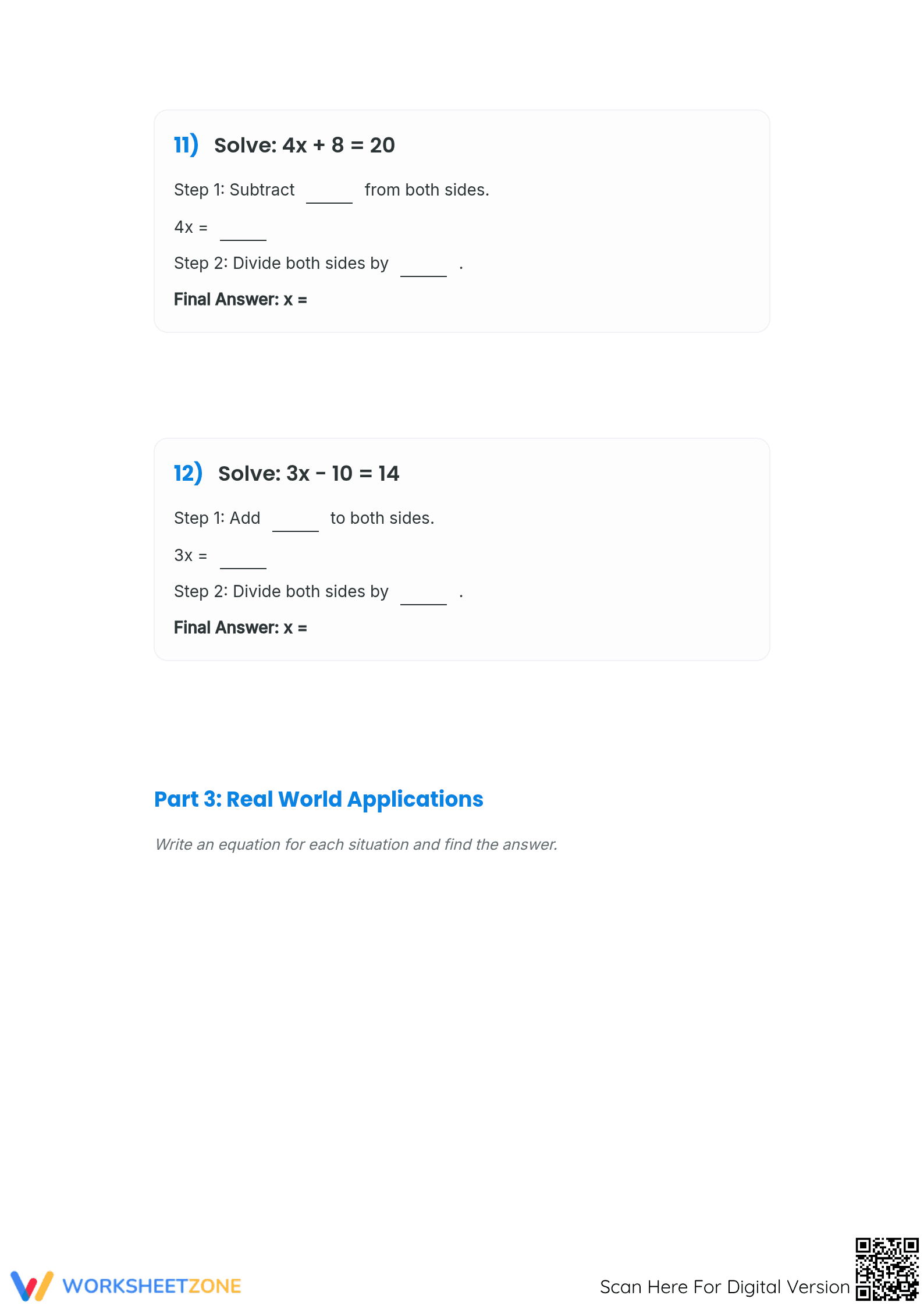
This comprehensive resource includes 14 carefully sequenced problems across five pages. The worksheet is divided into three sections: basic equations, step-by-step challenge problems with fill-in-the-blank scaffolds, and real-world application word problems. A complete answer key is provided, allowing for quick grading or self-assessment. The layout features ample workspace for students to show their mathematical reasoning.
Skill Progression
- Guided practice: The worksheet begins with a conceptual reminder about balancing scales, followed by 10 standard two-step equations where students practice isolating the variable.
- Supported practice: The second section features 2 step-by-step challenge problems. These include sentence frames and fill-in-the-blank steps to scaffold the process of subtracting and dividing.
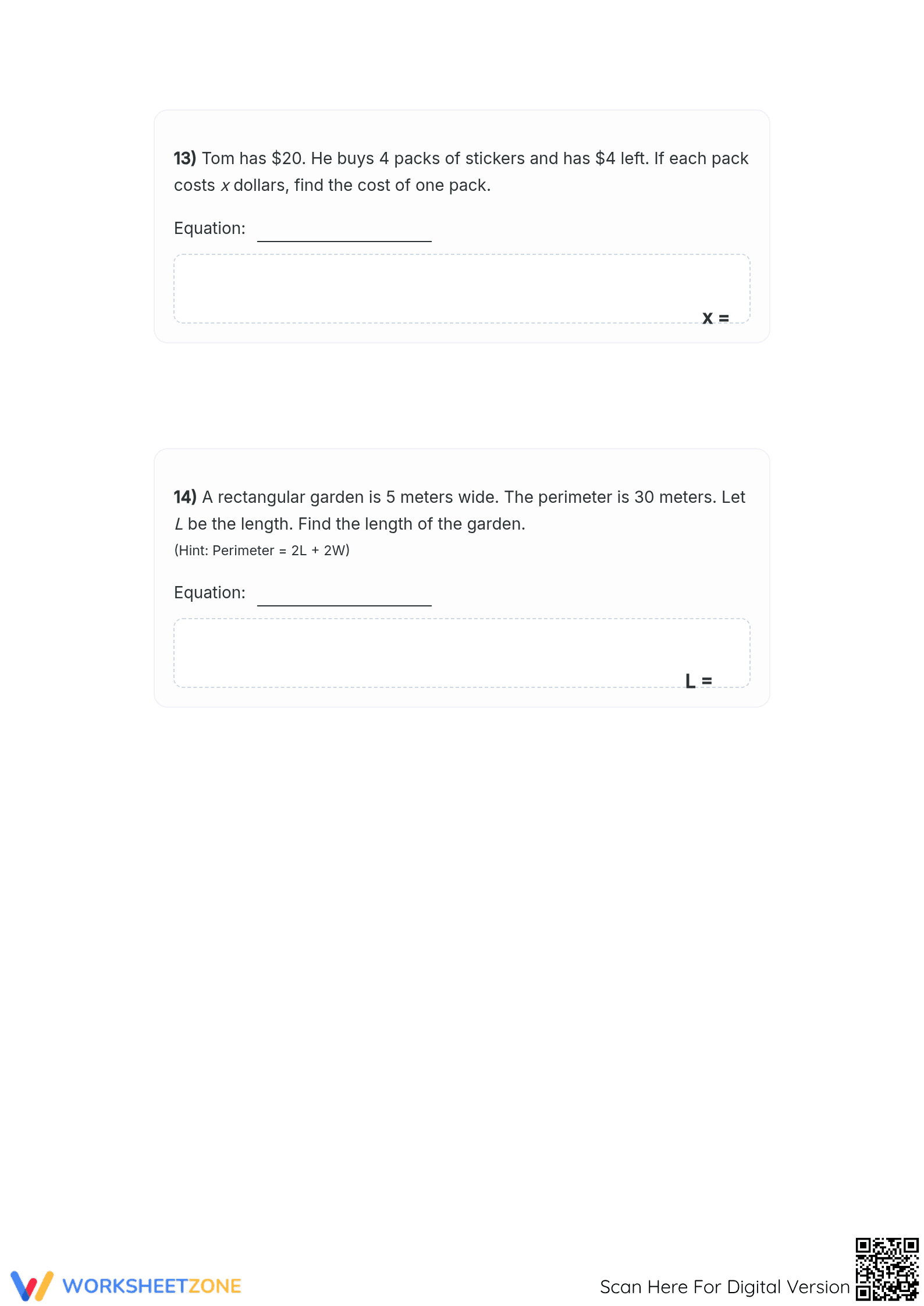
- Independent practice: The final section challenges students with 2 real-world word problems, requiring them to write their own equations before solving for the unknown value.
This gradual-release approach ensures students build confidence through the "I Do, We Do, You Do" instructional model.
Standards Alignment
This resource is aligned to CCSS.MATH.CONTENT.6.EE.B.7: Solve real-world and mathematical problems by writing and solving equations of the form x + p = q and px = q for cases in which p, q and x are all nonnegative rational numbers. It also supports early exposure to two-step equations typically mastered in later grades. Both standard codes can be copied directly into lesson plans, IEP goals, or district curriculum mapping tools.
How to Use It
Deploy this worksheet during the independent practice portion of your algebra unit, following direct instruction on balancing equations. It also serves as an excellent homework assignment or review activity. As a formative assessment tip, observe whether students consistently show their work on both sides of the equal sign during the first 10 problems. Expect most sixth graders to complete this assignment in 25 to 35 minutes.
Who It's For
This worksheet is designed for sixth-grade math students who are being introduced to algebraic concepts. The built-in scaffolds in part two make it highly accessible for students who need additional support with multi-step procedures. For a complete lesson experience, pair this printable with a visual anchor chart demonstrating the balance scale concept or a hands-on activity using algebra tiles.
Mastering algebraic thinking requires consistent, structured practice. This resource aligns with CCSS.MATH.CONTENT.6.EE.B.7, helping students solve real-world and mathematical problems using equations. According to a RAND AIRS 2024 report, students who engage with scaffolded problem sets that explicitly connect abstract equations to concrete models—such as the balance scale concept introduced in this worksheet—demonstrate significantly higher retention of algebraic procedures. The progression from basic computation to real-world application ensures that learners do not just memorize steps, but actually understand the underlying logic of equality. By providing clear workspaces and step-by-step challenges, this material reduces cognitive overload and allows students to focus entirely on mathematical reasoning. Educators can rely on this structured approach to build a strong foundation for future success in advanced mathematics courses.


