




























Views
Downloads
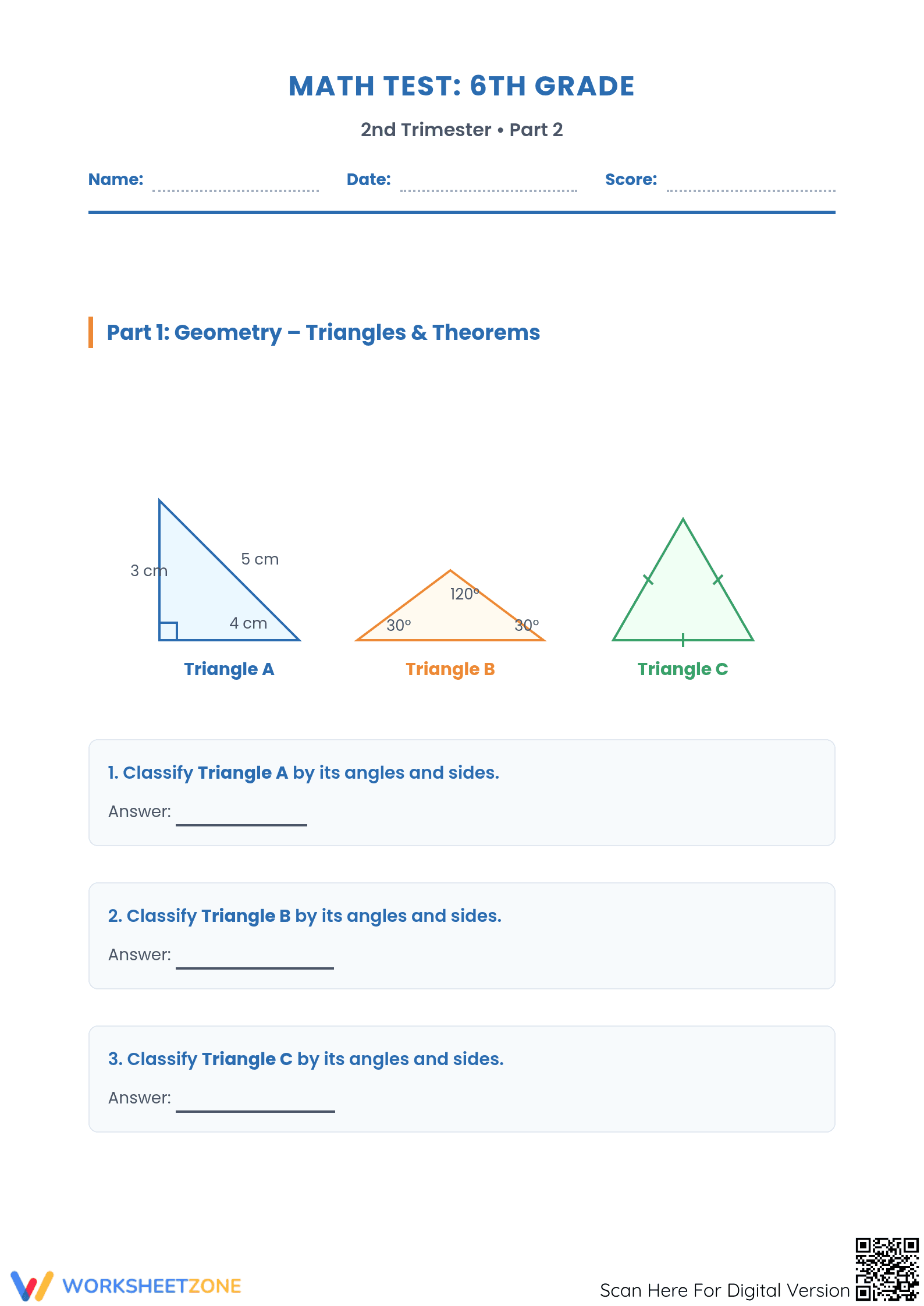



Essential 6th Grade Math Test: CCSS.MATH.CONTENT.6.G.A.1

Paste this activity's link or code into your existing LMS (Google Classroom, Canvas, Teams, Schoology, Moodle, etc.).
Students can open and work on the activity right away, with no student login required.
You'll still be able to track student progress and results from your teacher account.
This Grade 6 math assessment provides a comprehensive evaluation of geometry and number sense skills. Students demonstrate mastery by classifying triangles, applying geometric theorems, and converting between decimals and fractions. It serves as a rigorous tool to measure progress during the second trimester, ensuring students meet core middle school mathematical expectations.
At a Glance
- Grade: 6 · Subject: Math
- Standard:
CCSS.MATH.CONTENT.6.G.A.1— Solve mathematical problems involving properties of triangles and rational numbers.- Skill Focus: Triangle Classification & Decimal Conversion
- Format: 4 pages · 18 problems · Answer key included · PDF
- Best For: Trimester assessment and standards mastery tracking
- Time: 40–50 minutes
What's Inside
This four-page document contains 18 structured problems divided into two distinct parts. Part one focuses on geometry, requiring students to classify triangles by sides and angles while identifying key theorems like the Triangle Sum Theorem. Part two transitions to number sense, utilizing visual grids to bridge the gap between decimals and fractions, followed by computational tasks involving simplest form and Least Common Multiple (LCM) calculations.
Mastery Evidence
The assessment is structured to provide clear evidence of student proficiency across multiple cognitive levels. Tasks 1 through 8 evaluate foundational geometric knowledge, mapping directly to "Approaching" and "Meeting" tiers of standard mastery. Tasks 9 through 18 provide quantifiable data on rational number fluency. Scores can be entered directly into gradebooks or used to update IEP progress notes regarding specific computational goals.
Standards Alignment
The primary focus is CCSS.MATH.CONTENT.6.G.A.1, which involves understanding geometric properties and solving mathematical problems. Additionally, the worksheet supports CCSS.MATH.CONTENT.6.NS.B.3 by requiring students to fluently add and manipulate rational numbers. Both standard codes can be copied directly into lesson plans, IEP goals, or district curriculum mapping tools.
How to Use It
Use this worksheet as a formal summative assessment at the conclusion of a geometry or number system unit. It is also effective as a diagnostic tool before state testing to identify specific gaps in triangle classification or fraction operations. Expect completion within 40 to 50 minutes.
Who It's For
This resource is designed for general education sixth-grade students, but the visual scaffolds in the decimal section make it highly accessible for English Language Learners and students receiving Tier 2 interventions. It pairs naturally with a geometry anchor chart or a direct instruction lesson on the Triangle Sum Theorem.
This assessment aligns with the CCSS.MATH.CONTENT.6.G.A.1 standard, focusing on the plain-English skill of identifying and using properties of triangles to solve mathematical problems. Research from the RAND AIRS 2024 report emphasizes that high-quality, standards-aligned assessments are critical for identifying student learning gaps and informing instructional adjustments in middle school mathematics. By integrating both geometry and number sense, this worksheet reflects the integrated nature of the 6th-grade curriculum. The inclusion of visual models for decimal-fraction conversion supports the "concrete-representational-abstract" sequence advocated by Fisher & Frey (2014), ensuring that students develop a deep conceptual understanding rather than just rote procedural fluency. This dual-focus approach ensures that 18 distinct data points are collected to provide a valid snapshot of student performance relative to year-end mastery goals.


