


























Views
Downloads


Essential Order of Operations with Integers | Grade 6 Math
Paste this activity's link or code into your existing LMS (Google Classroom, Canvas, Teams, Schoology, Moodle, etc.).
Students can open and work on the activity right away, with no student login required.
You'll still be able to track student progress and results from your teacher account.
Mastering the order of operations with integers is a foundational middle school skill. This comprehensive worksheet guides students through the PEMDAS hierarchy, starting with basic warm-ups and progressing to complex challenges with nested parentheses and exponents. Students build computational fluency as they apply integer rules to evaluate diverse numerical expressions.
At a Glance
- Grade: 6 · Subject: Math
- Standard:
CCSS.MATH.CONTENT.6.EE.A.2.C— Evaluate expressions at specific values of their variables including those involving whole-number exponents.- Skill Focus: Order of Operations with Integers (PEMDAS)
- Format: 4 pages · 16 problems · Answer key included · PDF
- Best For: Middle school independent practice and review
- Time: 25–40 minutes
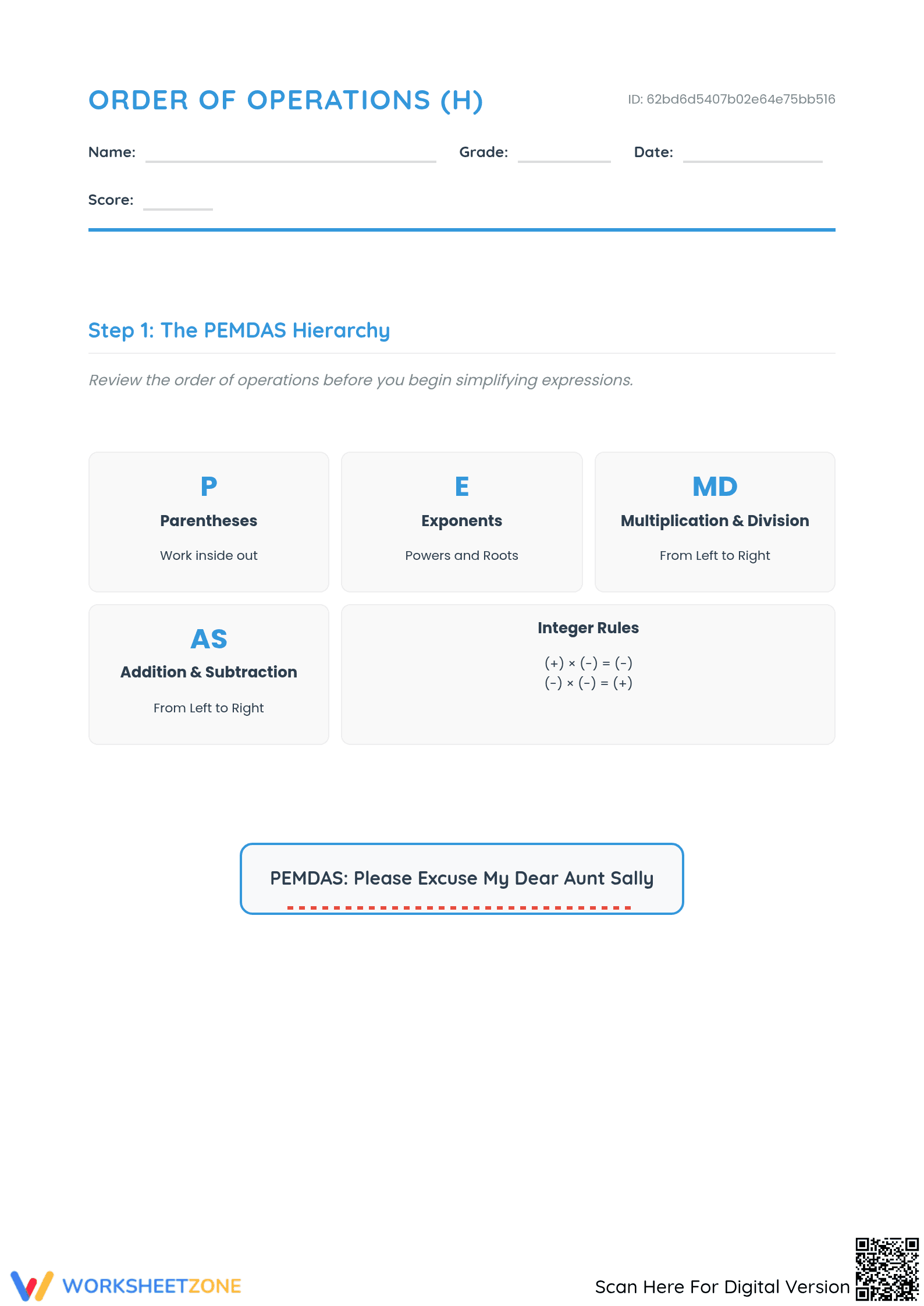
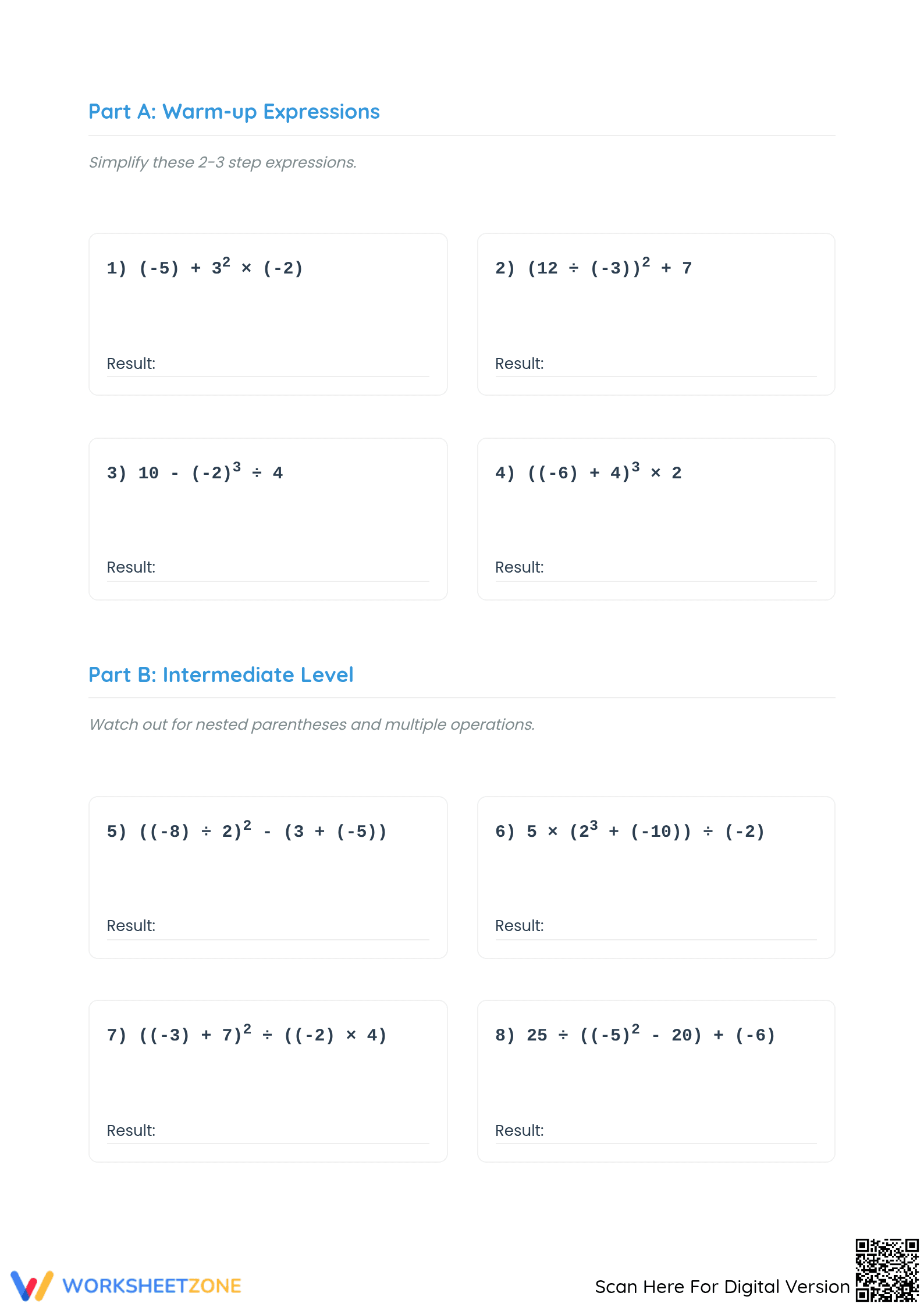
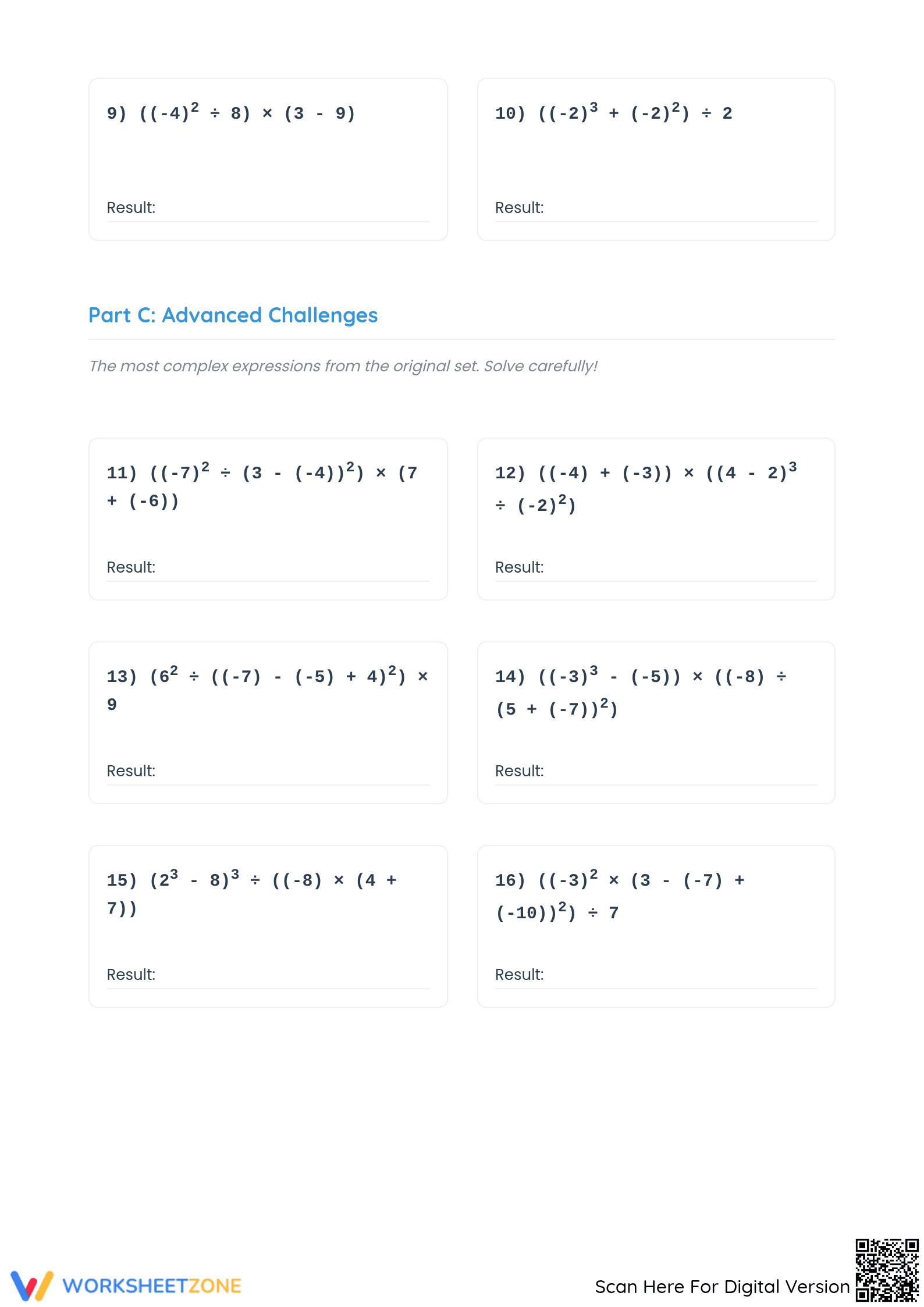
This packet begins with a visual anchor chart explaining PEMDAS and integer multiplication rules. The exercises include Part A (4 warm-up expressions), Part B (6 intermediate problems with nested parentheses), and Part C (6 advanced challenges). A complete, step-by-step answer key is provided for immediate grading and student feedback.
This resource follows a strategic gradual-release model:
- Guided Practice: The first page serves as a reference, outlining the hierarchy and integer sign rules to prevent common errors.
- Supported Practice: Ten problems in Part A and B transition students from basic steps to expressions involving exponents and negative numbers.
- Independent Practice: Part C provides six high-rigor challenges testing mastery of multiple grouping symbols and operations.
This scaffolded approach builds a clear bridge toward mathematical independence.
The primary focus is `CCSS.MATH.CONTENT.6.EE.A.2.c`, requiring students to evaluate expressions in the conventional order. It also supports `CCSS.MATH.CONTENT.7.NS.A.3` by applying operations to solve mathematical problems involving rational numbers. Both standard codes can be copied directly into lesson plans, IEP goals, or district curriculum mapping tools.
Use this worksheet during the "You Do" phase of a lesson. Distribute it after direct instruction on PEMDAS. During practice, observe students at Part B to ensure they apply exponents before multiplication. The resource takes approximately 30 minutes, making it an ideal exit ticket or homework assignment for middle school math.
This resource is tailored for Grade 6-8 students developing fluency with negative numbers and grouping symbols. It is effective for learners requiring visual reminders of integer rules. Teachers can pair this with an anchor chart or video tutorial to provide a multi-modal experience for diverse learners in the classroom.
Research by Fisher & Frey (2014) emphasizes that scaffolded practice is essential for internalizing complex mathematical procedures like the order of operations. By providing a clear hierarchy and progressing from low-complexity to high-rigor tasks, this worksheet minimizes the cognitive load associated with multi-step integer arithmetic. Current NAEP data consistently highlights that students often struggle with the "order" component of PEMDAS, particularly when exponents and negative numbers are integrated. This resource addresses that gap by isolating the hierarchy required by CCSS.MATH.CONTENT.6.EE.A.2.c and providing repetitive, focused practice that reinforces the conventional rules of calculation. The inclusion of an answer key further supports self-regulated learning, allowing students to identify and correct procedural errors in real-time. This alignment with evidence-based instructional design ensures that the material is not only standards-aligned but also pedagogically sound for middle school learners seeking to master integer operations and numerical expression evaluation.


