


























Views
Downloads

Order of Operations Integers Worksheet | Grade 7 Essential
Paste this activity's link or code into your existing LMS (Google Classroom, Canvas, Teams, Schoology, Moodle, etc.).
Students can open and work on the activity right away, with no student login required.
You'll still be able to track student progress and results from your teacher account.
Strengthen your students' computational fluency with this comprehensive order of operations worksheet. This resource focuses on evaluating multi-step numerical expressions involving integers, exponents, and complex grouping symbols. By working through these problems, students build the persistence and precision required to solve advanced mathematical equations while mastering the fundamental PEMDAS and BODMAS rules.
At a Glance
- Grade: 7 · Subject: Math
- Standard:
CCSS.MATH.CONTENT.7.NS.A.3— Solve mathematical problems involving the four operations with rational numbers- Skill Focus: Order of Operations (PEMDAS)
- Format: 5 pages · 24 problems · Answer key included · PDF
- Best For: Independent practice and skills review
- Time: 45–60 minutes
What's Inside
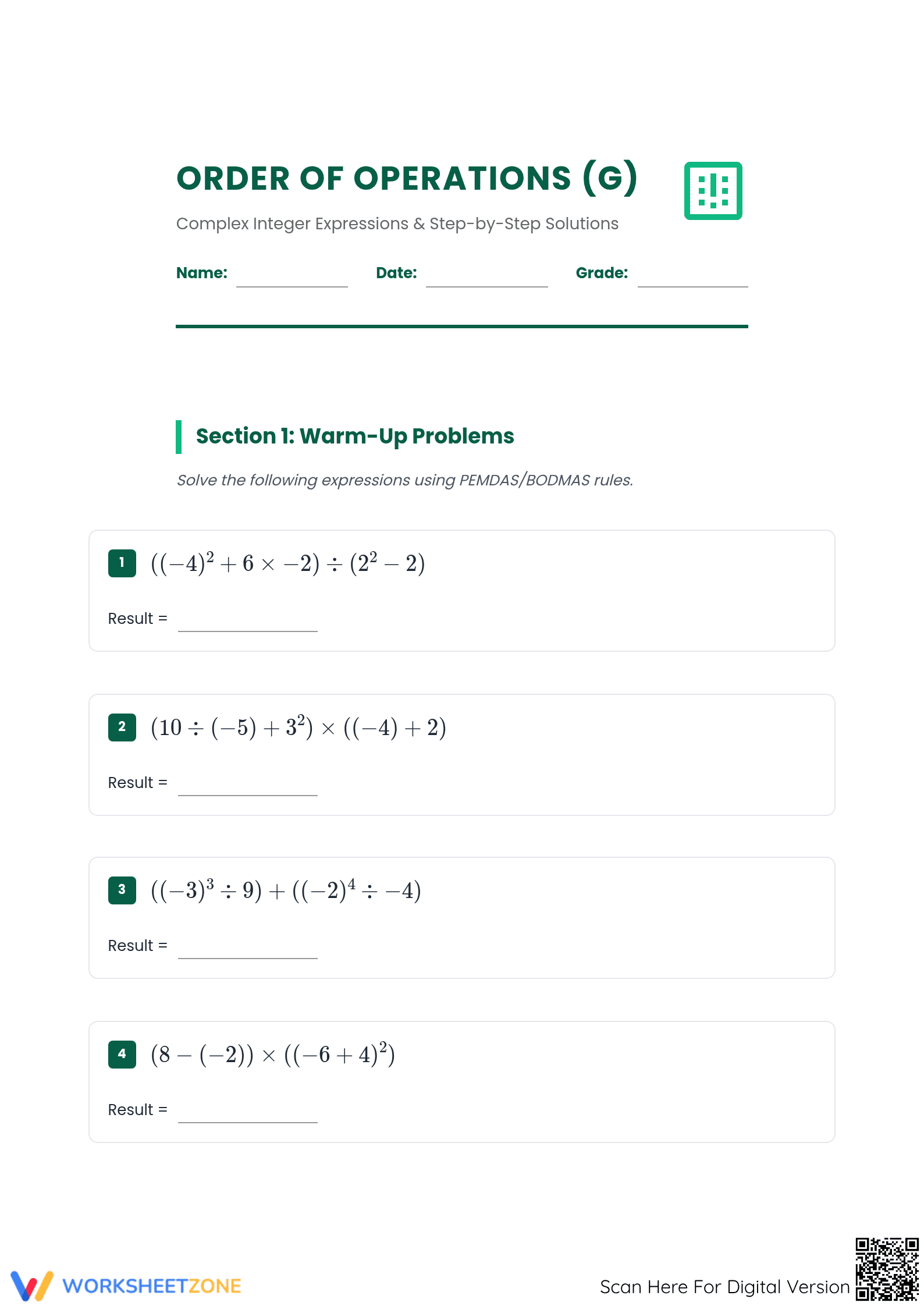
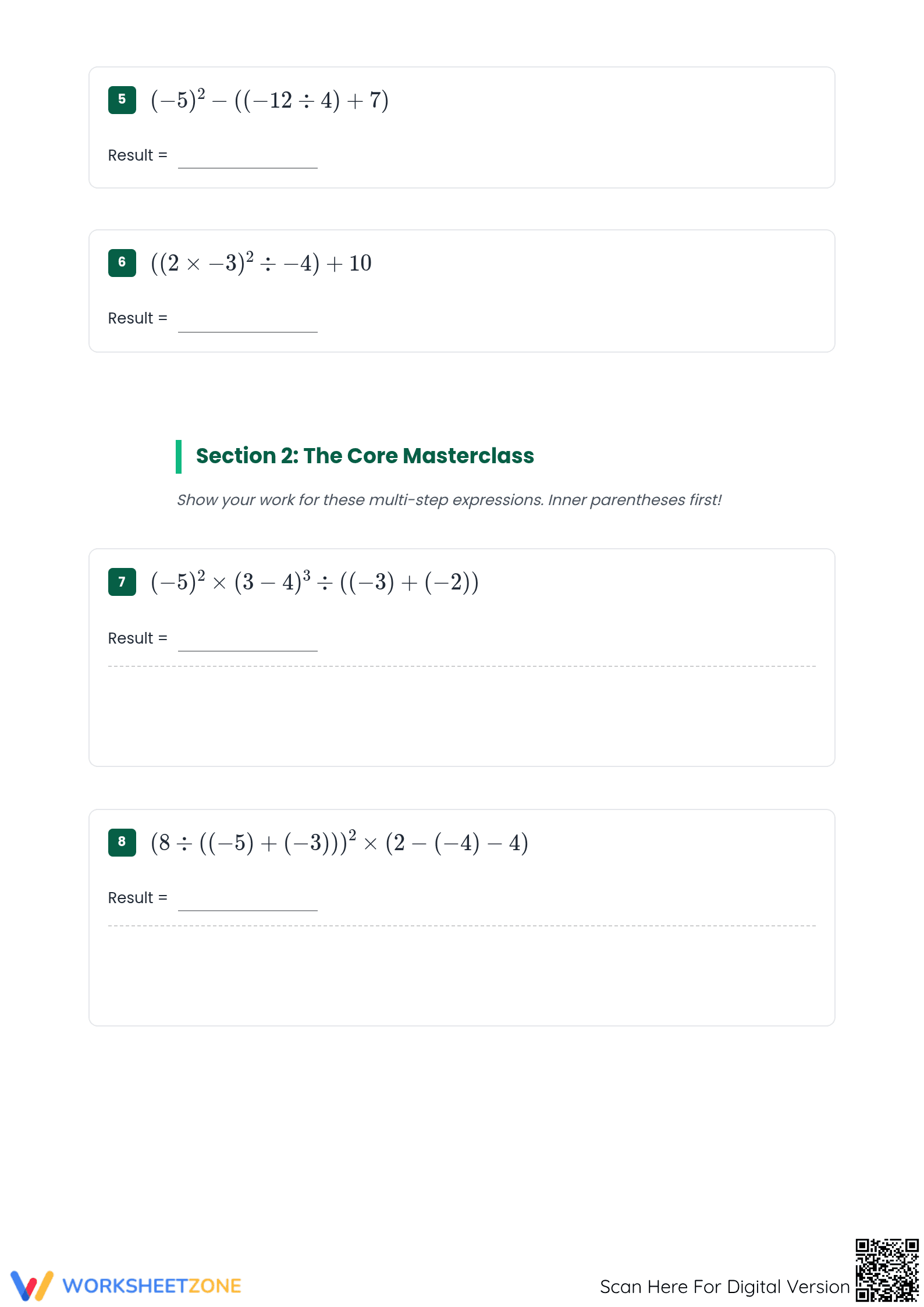
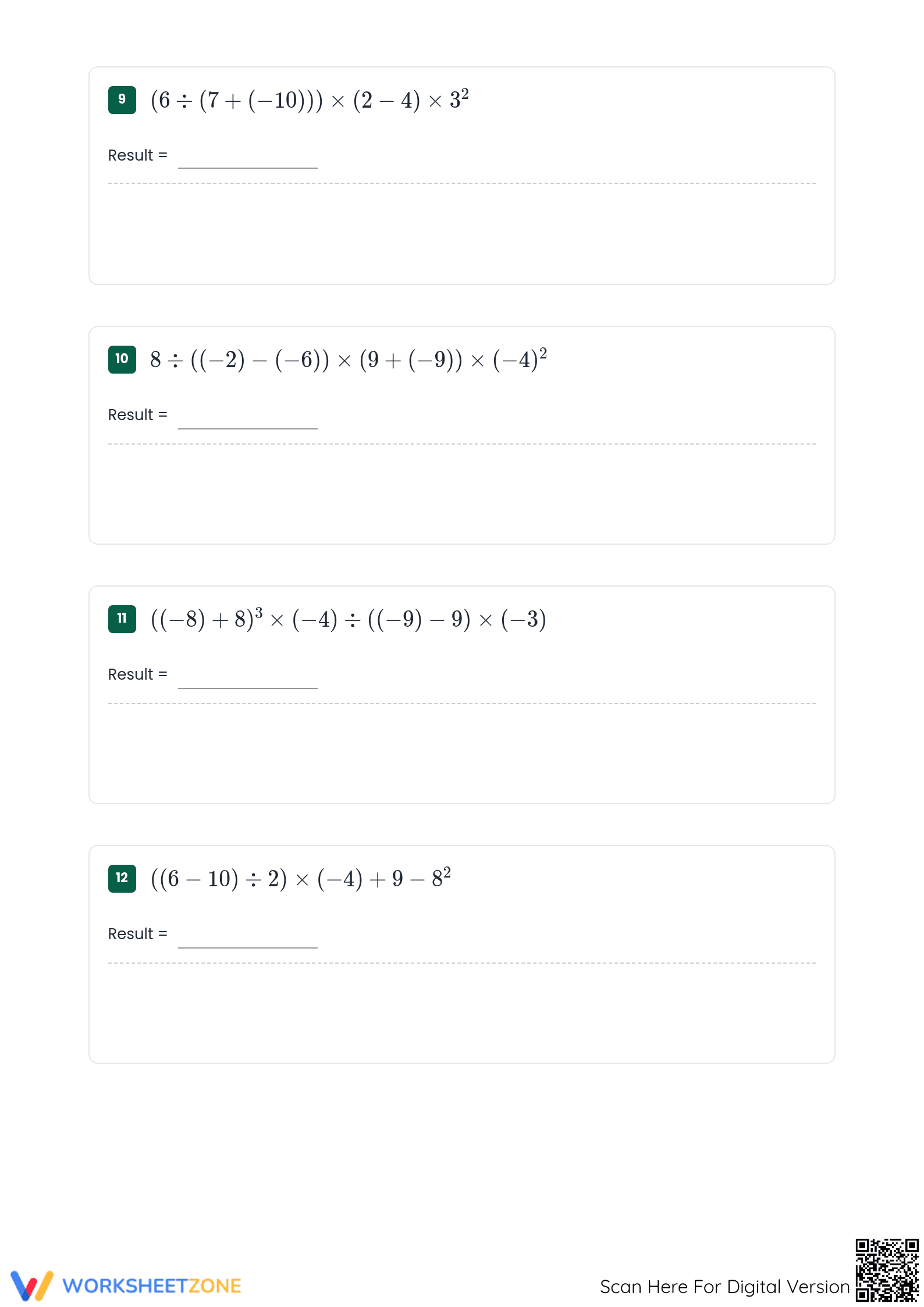
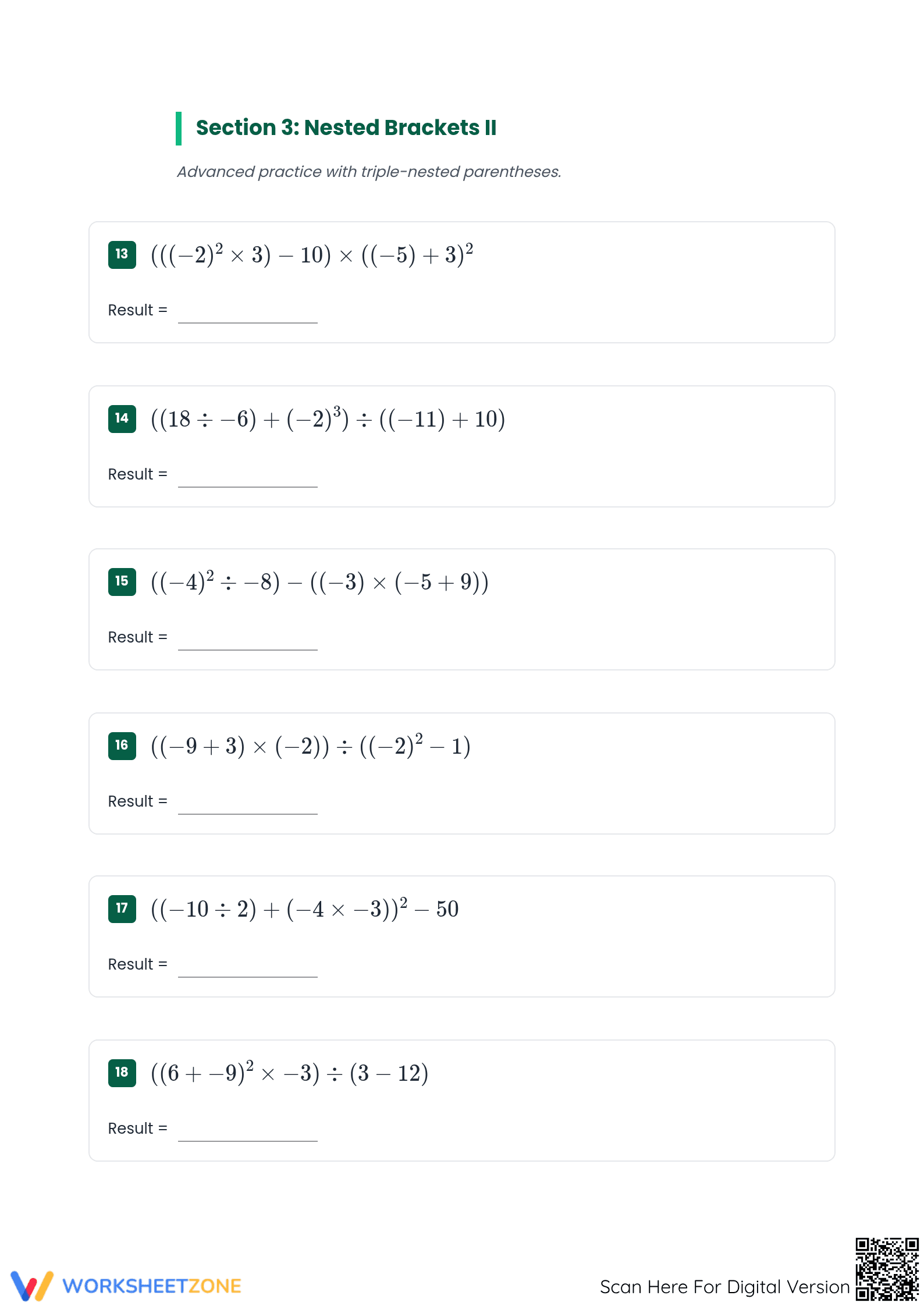
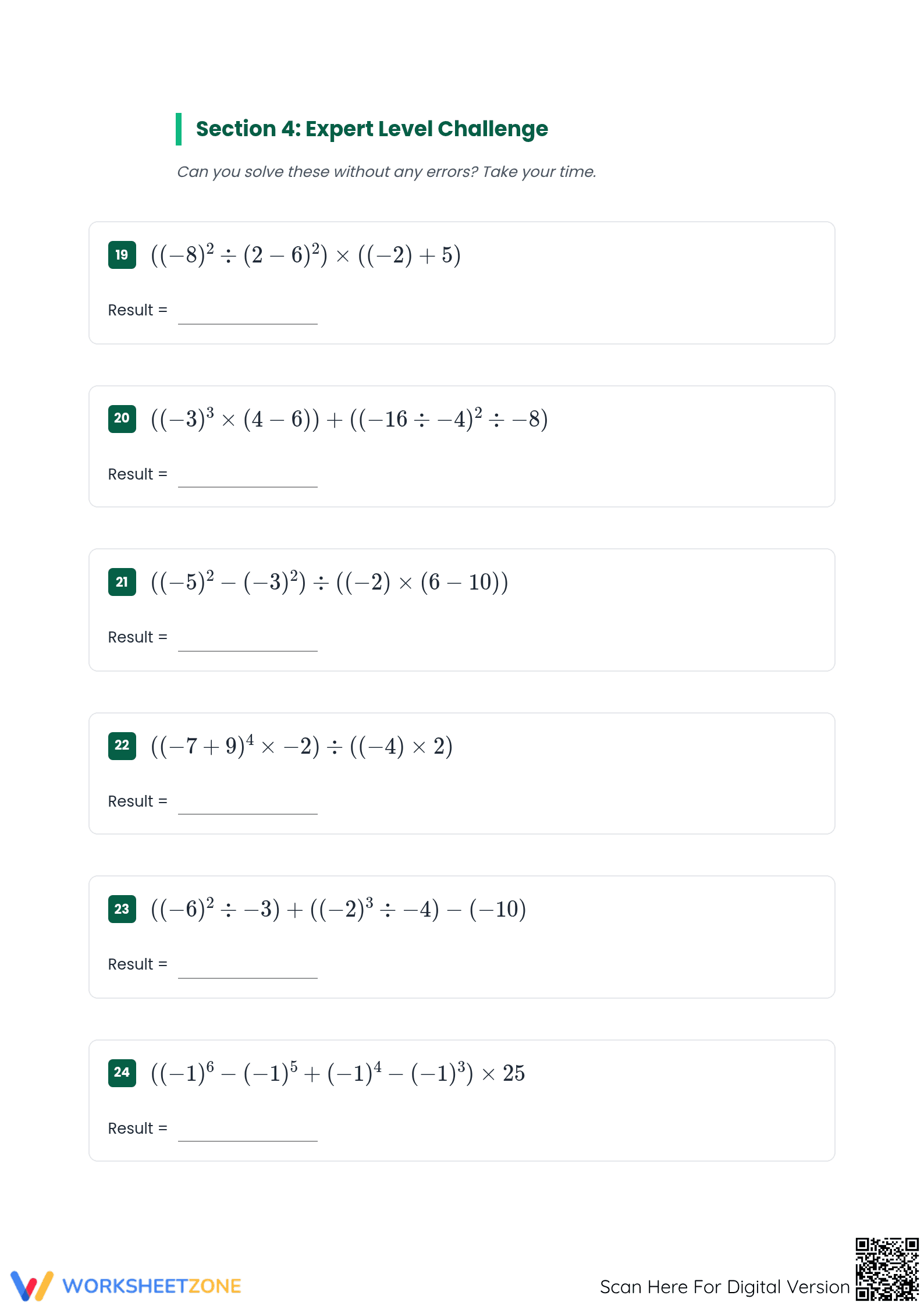
This 5-page PDF document contains twenty-four unique mathematical expressions divided into four specialized sections. Each task is presented in a clear, spacious box to allow for organized scratch work. The set includes a full answer key featuring final results for every problem, enabling quick grading and immediate student feedback on their computational accuracy.
Skill Progression
- Guided Practice: The first section provides six warm-up problems that introduce basic integer operations and simple exponents to build initial confidence.
- Supported Practice: The middle sections transition into the Core Masterclass, featuring twelve multi-step problems with inner parentheses and negative bases.
- Independent Practice: The final section presents expert-level challenges with triple-nested brackets and high-order exponents to test procedural mastery.
This structure follows the gradual release model, moving students from basic recall to complex application of mathematical properties.
Standards Alignment
This worksheet is primarily aligned with CCSS.MATH.CONTENT.7.NS.A.3: "Solve real-world and mathematical problems involving the four operations with rational numbers." It also supports CCSS.MATH.CONTENT.6.EE.A.1 by requiring students to write and evaluate numerical expressions involving whole-number exponents. Both standard codes can be copied directly into lesson plans, IEP goals, or district curriculum mapping tools.
How to Use It
This resource is ideal for use during the independent practice portion of a lesson after direct instruction on integer rules and PEMDAS. Teachers can also assign the sections over multiple days to serve as warm-up "bell-ringers." During use, observe students to see if they are correctly prioritizing inner parentheses before exponents; this formative assessment identifies common misconceptions early. Expect completion in 45 to 60 minutes.
Who It's For
This practice set is designed for seventh and eighth-grade students who have mastered basic arithmetic and are moving toward algebraic readiness. It provides excellent remediation for high school students struggling with sign errors or operational priority. For best results, pair this worksheet with a direct instruction lesson or a visual anchor chart detailing the order of operations.
This order of operations with integers resource is anchored in CCSS.MATH.CONTENT.7.NS.A.3, focusing on solving mathematical problems involving the four operations with rational numbers. Mastery of PEMDAS and BODMAS conventions is critical for algebraic readiness, as students must learn to prioritize operations within nested grouping symbols and handle integer signs simultaneously. According to research by Fisher & Frey (2014), a gradual release of responsibility—moving from warm-up tasks to expert-level challenges—facilitates deeper conceptual understanding and procedural fluency. This worksheet implements that framework by providing twenty-four problems that scale in complexity, requiring students to evaluate exponents and nested brackets in a structured sequence. By isolating these computational hurdles, the worksheet ensures that seventh-grade students build the cognitive endurance needed for higher-level mathematics. Educational institutions can utilize these problems to assess student proficiency in integer arithmetic, ensuring they are prepared for the rigor of multi-step algebraic equations and complex numerical analysis in real-world contexts.


