


























Views
Downloads


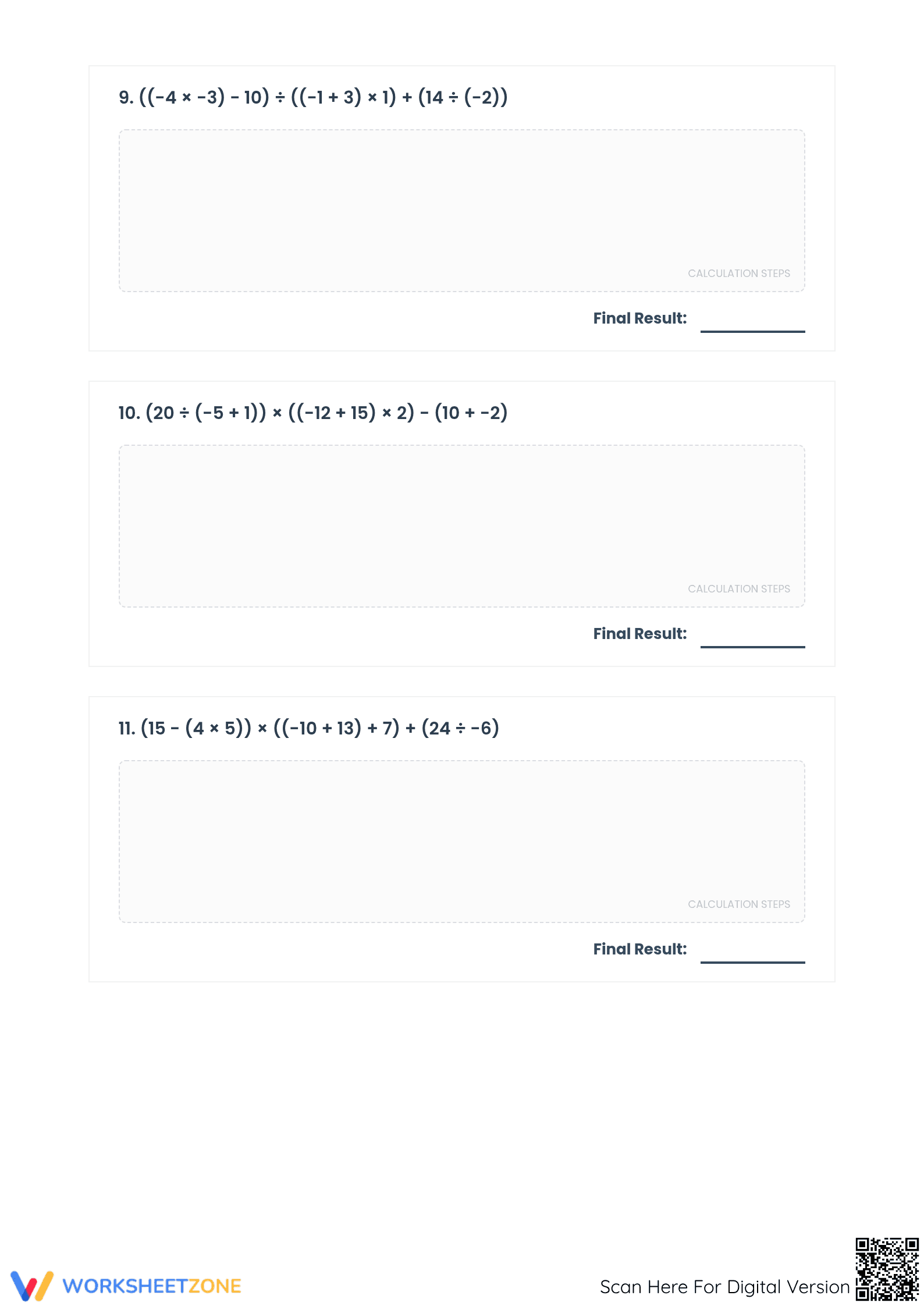


Printable Order of Operations with Integers | 6-Step Grade 6
Paste this activity's link or code into your existing LMS (Google Classroom, Canvas, Teams, Schoology, Moodle, etc.).
Students can open and work on the activity right away, with no student login required.
You'll still be able to track student progress and results from your teacher account.
This comprehensive Grade 6 math worksheet empowers students to master the order of operations with integers through rigorous 14-problem practice. By navigating complex 6-step expressions involving parentheses and all four operations, learners develop the computational fluency needed for advanced algebra. Students will gain confidence in applying PEMDAS rules to signed numbers in a structured, supported environment.
At a Glance
- Grade: 6 · Subject: Math
- Standard:
CCSS.MATH.CONTENT.6.EE.A.1— Write and evaluate numerical expressions involving whole-number exponents and order of operations- Skill Focus: Order of Operations with Integers
- Format: 5 pages · 14 problems · Answer key included · PDF
- Best For: Middle school algebra readiness and integer fluency
- Time: 35–50 minutes
What's Inside
This 5-page resource provides ample space for students to document their mathematical thinking. Each of the 14 problems features a dedicated "Calculation Steps" box, encouraging learners to show their work and identify errors in their logic. The worksheet is divided into two logical sections: "Core Operations" for foundational practice and "Advanced Step Mastery" for higher-order application, ensuring a thorough review of PEMDAS principles.
Skill Progression
- Core Operations: Problems 1-6 focus on identifying the initial operation within nested parentheses, providing 6 tasks with moderate complexity.
- Advanced Step Mastery: Problems 7-14 introduce 8 tasks with increased negative integer density and multi-layer grouping symbols.
- Independent Synthesis: The final set of problems requires students to manage multiple operations simultaneously without additional scaffolding.
This gradual-release model ensures students move from guided recognition to independent mastery of multi-step integer evaluation using the I Do, We Do, You Do approach.
Standards Alignment
The primary alignment for this resource is CCSS.MATH.CONTENT.6.EE.A.1, which requires students to evaluate numerical expressions. Additionally, it supports CCSS.MATH.CONTENT.7.NS.A.3 by challenging students to solve mathematical problems involving the four operations with rational numbers. Both standard codes can be copied directly into lesson plans, IEP goals, or district curriculum mapping tools.
How to Use It
This worksheet is ideal for use during the independent practice phase of a lesson or as a comprehensive homework assignment. Teachers can use the "Calculation Steps" boxes as a formative assessment tool; if a student consistently misses the second step in a 6-step problem, it indicates a specific misunderstanding of the priority of operations. Expect students to spend approximately 40 minutes for full completion.
Who It's For
Designed for Grade 6 students, this resource is also highly effective for Grade 7 and 8 learners requiring remediation in integer operations. Teachers may assign only the "Core Operations" section to students currently struggling with negative numbers. This worksheet pairs naturally with a number line anchor chart or a "PEMDAS" interactive notebook entry to provide visual support during problem-solving.
Order of operations mastery is a critical gateway to algebraic success, yet research indicates it remains a common area of struggle for middle school students. This worksheet addresses these challenges by providing 14 high-quality problems aligned to CCSS.MATH.CONTENT.6.EE.A.1, focusing on the plain-English skill of evaluating complex expressions with integers. By utilizing a "Calculation Steps" workspace, the resource promotes metacognitive awareness, a strategy highlighted in the RAND AIRS 2024 report as essential for improving mathematical outcomes in diverse classrooms. The structured layout reduces cognitive load, allowing students to focus on the specific sequence of PEMDAS rather than struggling with formatting. This resource serves as a reliable tool for building the computational stamina required for high-school-level mathematics, ensuring that every student has a clear pathway toward mastering signed number operations in multi-step contexts. This approach ensures that learners develop a durable understanding of numerical hierarchies before transitioning to variable-based algebraic equations.


