


























Views
Downloads

Essential Order of Operations with Integers | Grade 7 Math
Paste this activity's link or code into your existing LMS (Google Classroom, Canvas, Teams, Schoology, Moodle, etc.).
Students can open and work on the activity right away, with no student login required.
You'll still be able to track student progress and results from your teacher account.
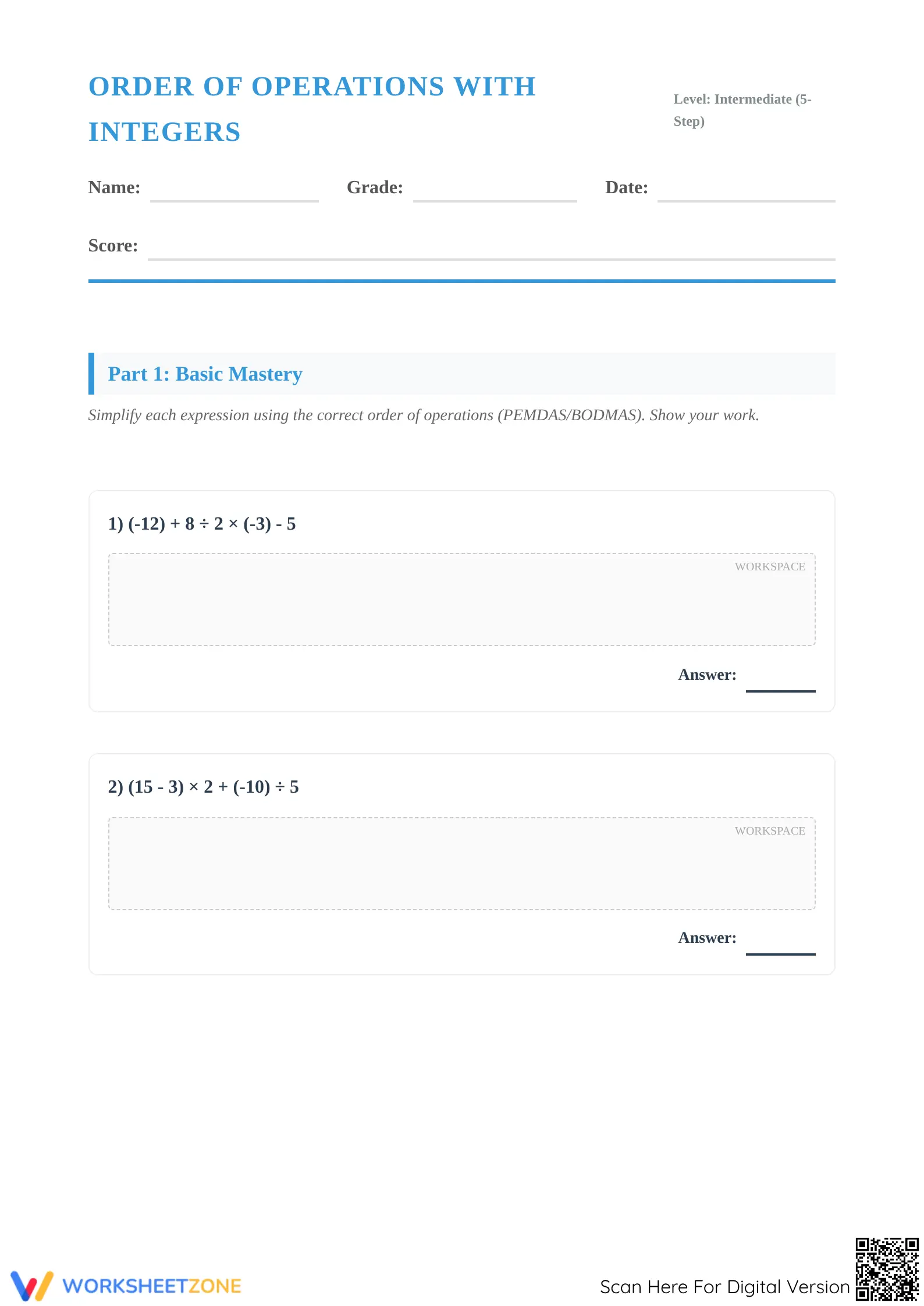
Equip your students with the critical ability to solve multi-step expressions involving positive and negative numbers. This comprehensive resource provides structured practice for evaluating complex expressions using the correct order of operations, including exponents and parentheses. Students will develop the procedural fluency necessary for success in higher-level algebra by mastering these foundational integer skills.
At a Glance
- Grade: 7 · Subject: Math
- Standard:
CCSS.MATH.CONTENT.7.NS.A.3— Solve multi-step problems with rational numbers including integers and exponents- Skill Focus: 5-step order of operations (PEMDAS)
- Format: 5 pages · 16 problems · Answer key included · PDF
- Best For: Middle school independent practice or homework
- Time: 30–45 minutes
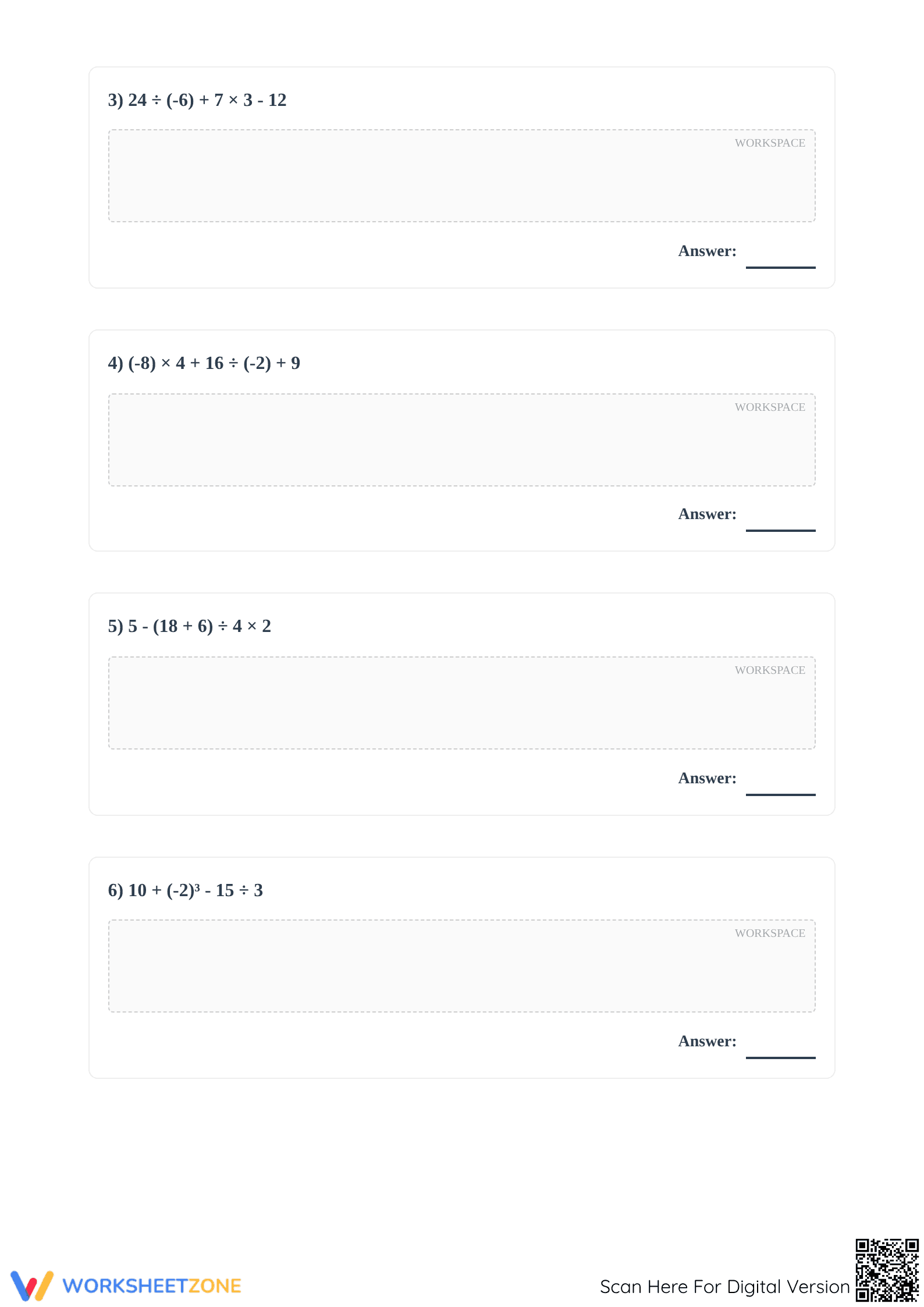
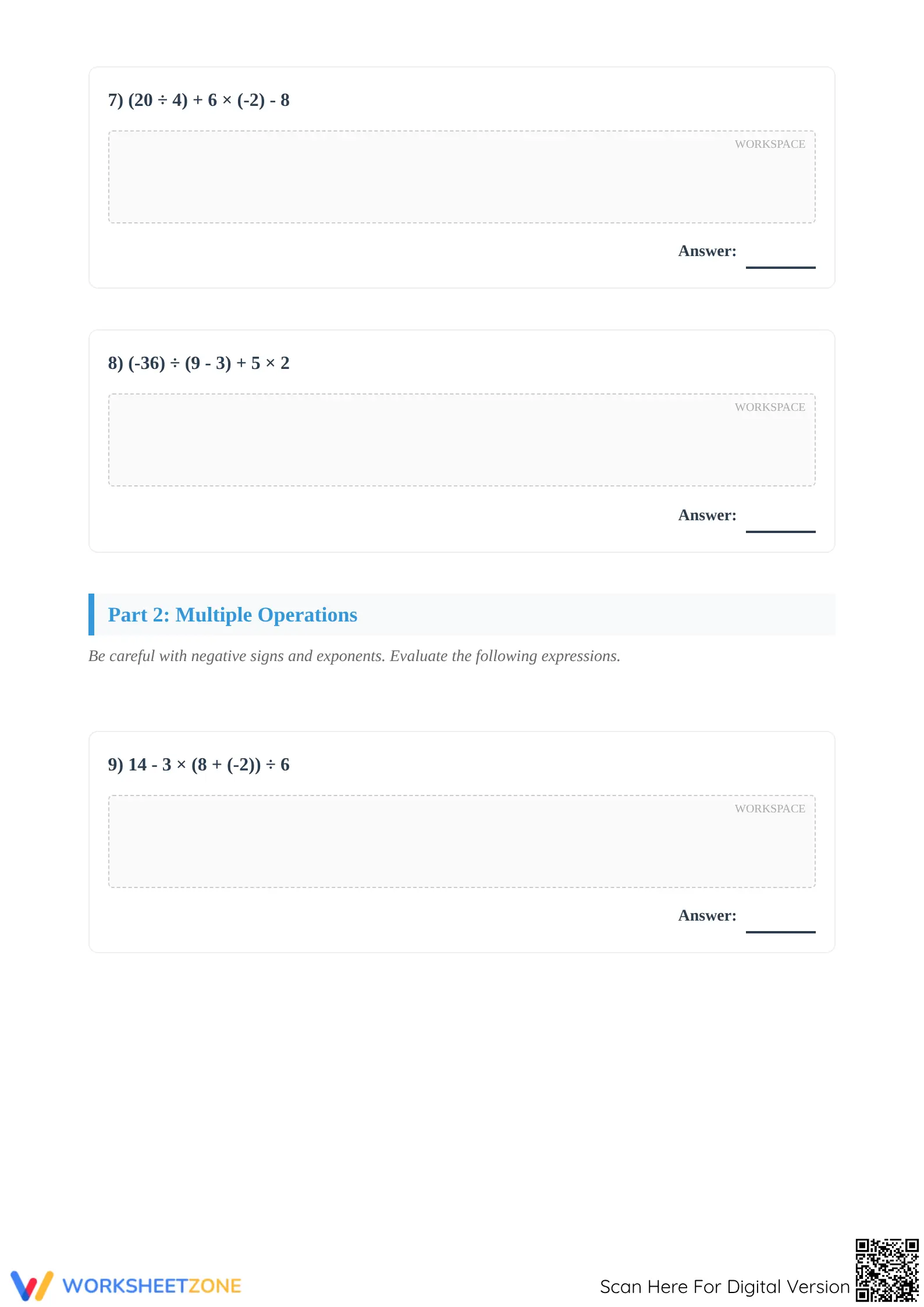
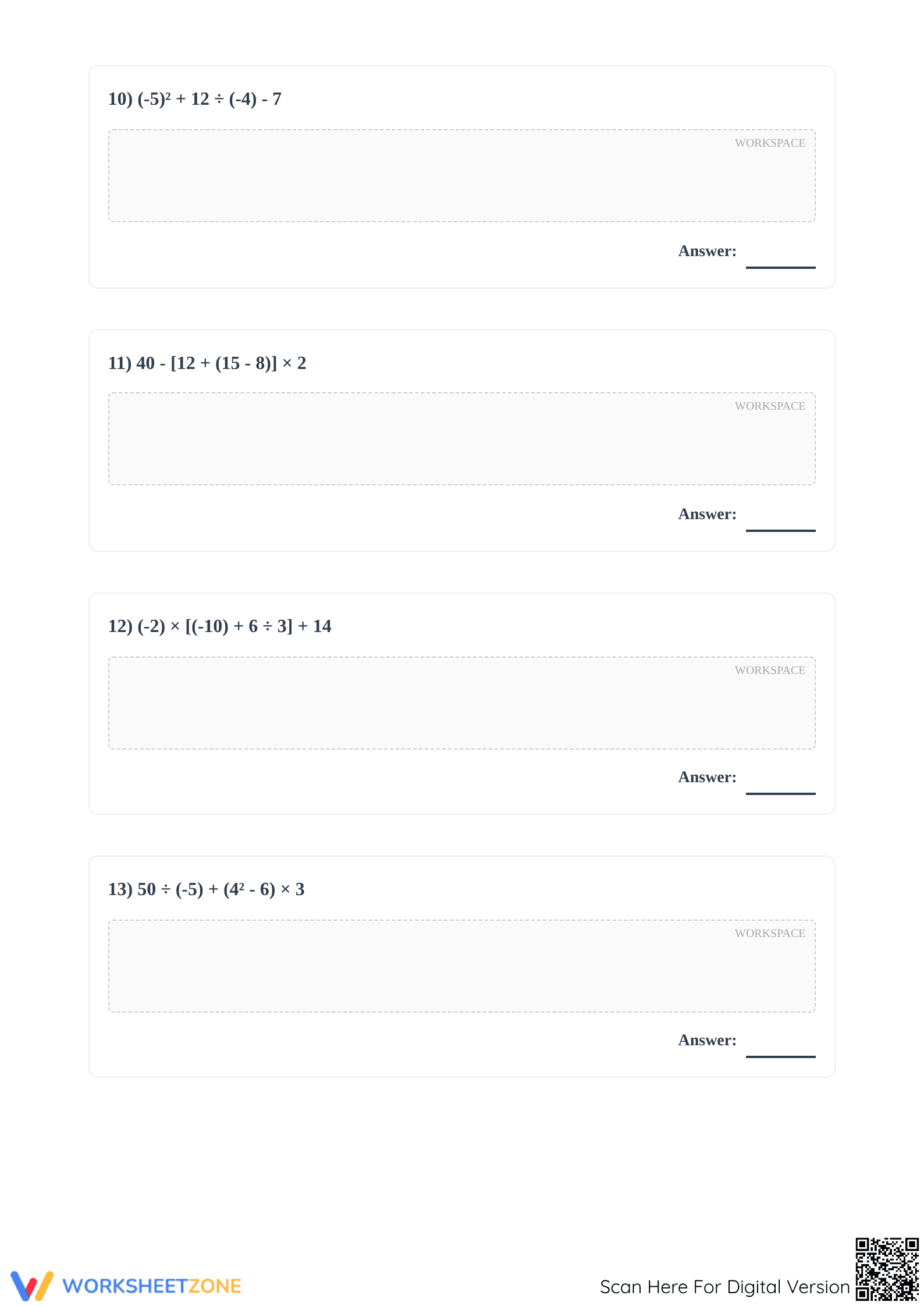
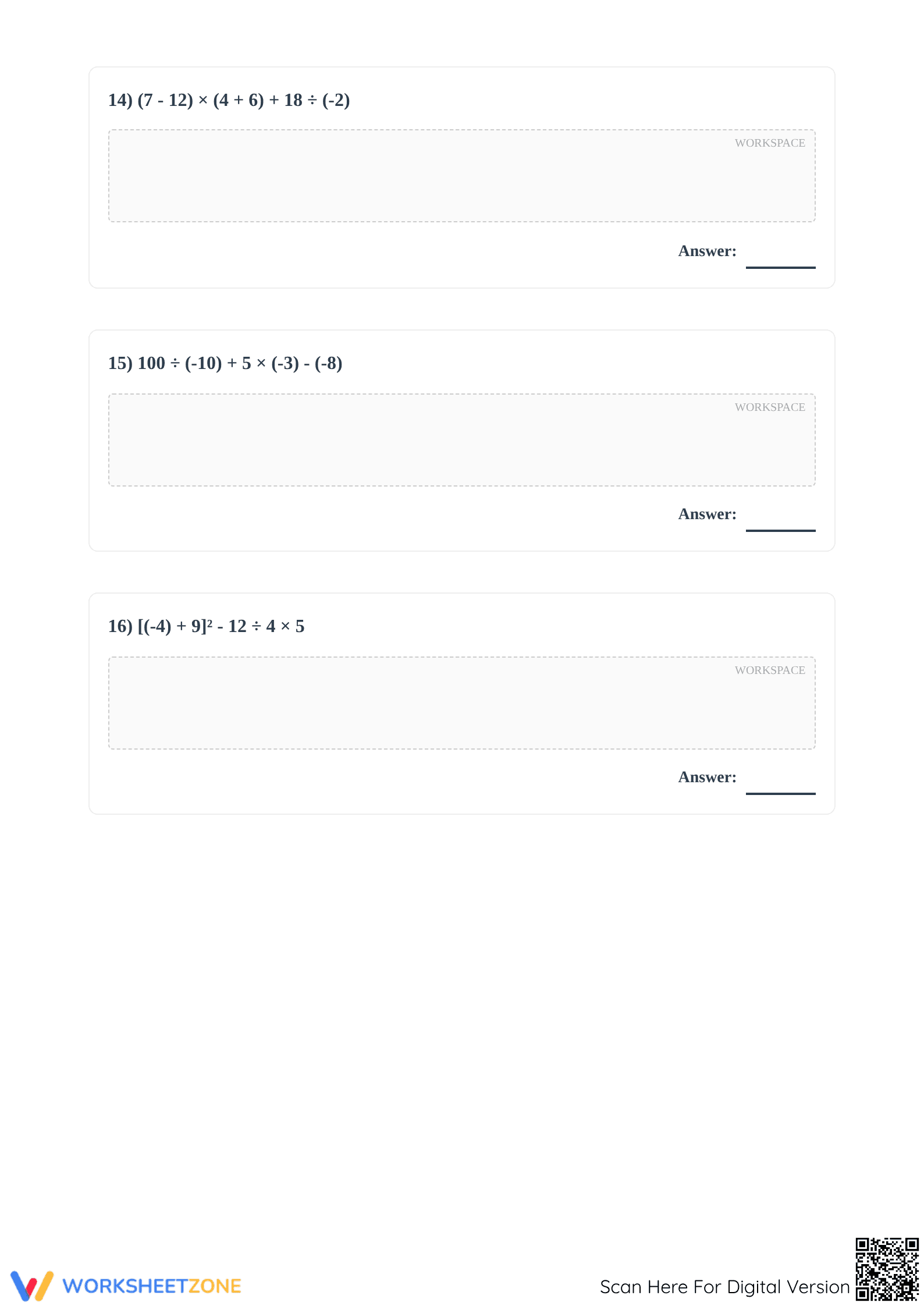
This five-page PDF resource contains sixteen rigorous problems designed to challenge seventh-grade learners. The worksheet is divided into two distinct parts: "Basic Mastery" and "Multiple Operations." Each problem features a dedicated "Workspace" box, encouraging students to show their step-by-step thinking—a vital habit for reducing calculation errors in multi-step arithmetic. A comprehensive answer key is included for rapid grading and student self-correction.
- Guided Practice: The initial problems introduce 5-step expressions with basic integer addition and subtraction to build confidence in the PEMDAS sequence.
- Supported Practice: Mid-range tasks incorporate exponents and division, requiring students to manage multiple layers of operations within a single expression.
- Independent Practice: The final section presents complex nested parentheses and negative bases, demanding total independence in applying mathematical properties.
This worksheet is directly aligned with `CCSS.MATH.CONTENT.7.NS.A.3`: "Solve real-world and mathematical problems involving the four operations with rational numbers." It specifically targets integer operation fluency and the application of exponents in multi-step equations. This standard code can be copied directly into lesson plans, IEP goals, or district curriculum mapping tools.
Assign this worksheet as a summative homework assignment following a direct instruction lesson on PEMDAS with negative numbers. During class, use it for "station rotations" where students work in small groups to peer-review their intermediate steps in the provided workspace. Monitor for common misconceptions, such as incorrectly applying the negative sign during exponentiation, to provide immediate formative feedback. Completion time typically ranges from 30 to 45 minutes.
This resource is optimized for seventh-grade students but serves as an excellent challenge for fifth and sixth graders or a remediation tool for eighth-grade algebra readiness. It pairs naturally with a number line anchor chart or a digital integer operation simulator to support visual learners and students requiring scaffolds.
According to the RAND AIRS 2024 report on mathematics instructional materials, the quality of practice problems significantly impacts student retention of procedural skills like the order of operations. This worksheet adheres to research-backed principles by providing ample workspace and high-quality, graduated problem sets that prevent cognitive overload. By isolating the 5-step integer operation skill, educators can target specific gaps in algebraic reasoning before students encounter variables. Research from Fisher & Frey (2014) highlights that the gradual release of responsibility, as mirrored in this worksheet's progression, is essential for transitioning students from guided instruction to independent mastery of rational number systems. The inclusion of exponents and negative integers reflects the rigorous demands of state assessments. Educators can rely on this vetted resource to provide the consistent, high-repetition practice required to anchor these essential middle school mathematical concepts for long-term academic success.


