


























Views
Downloads
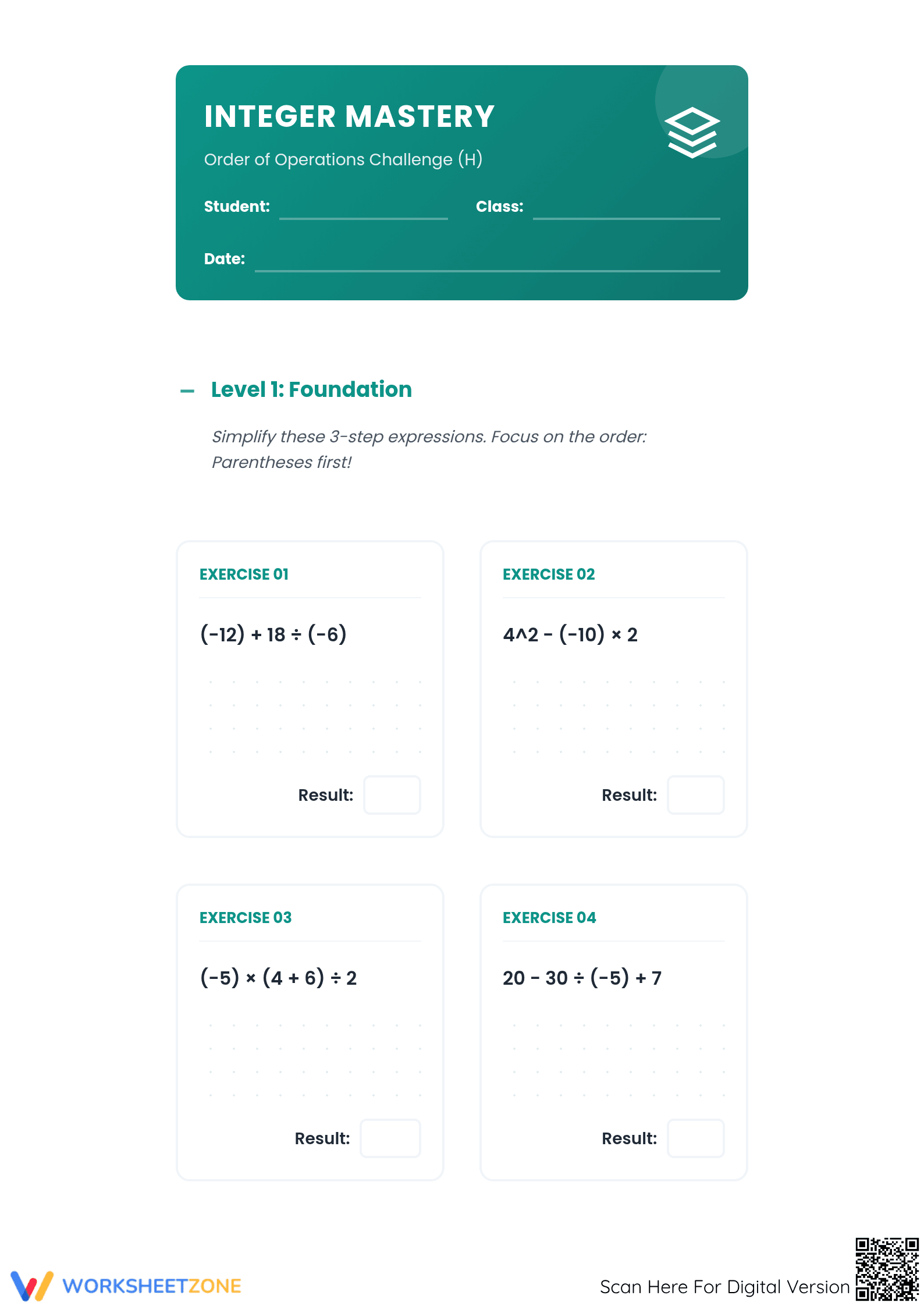
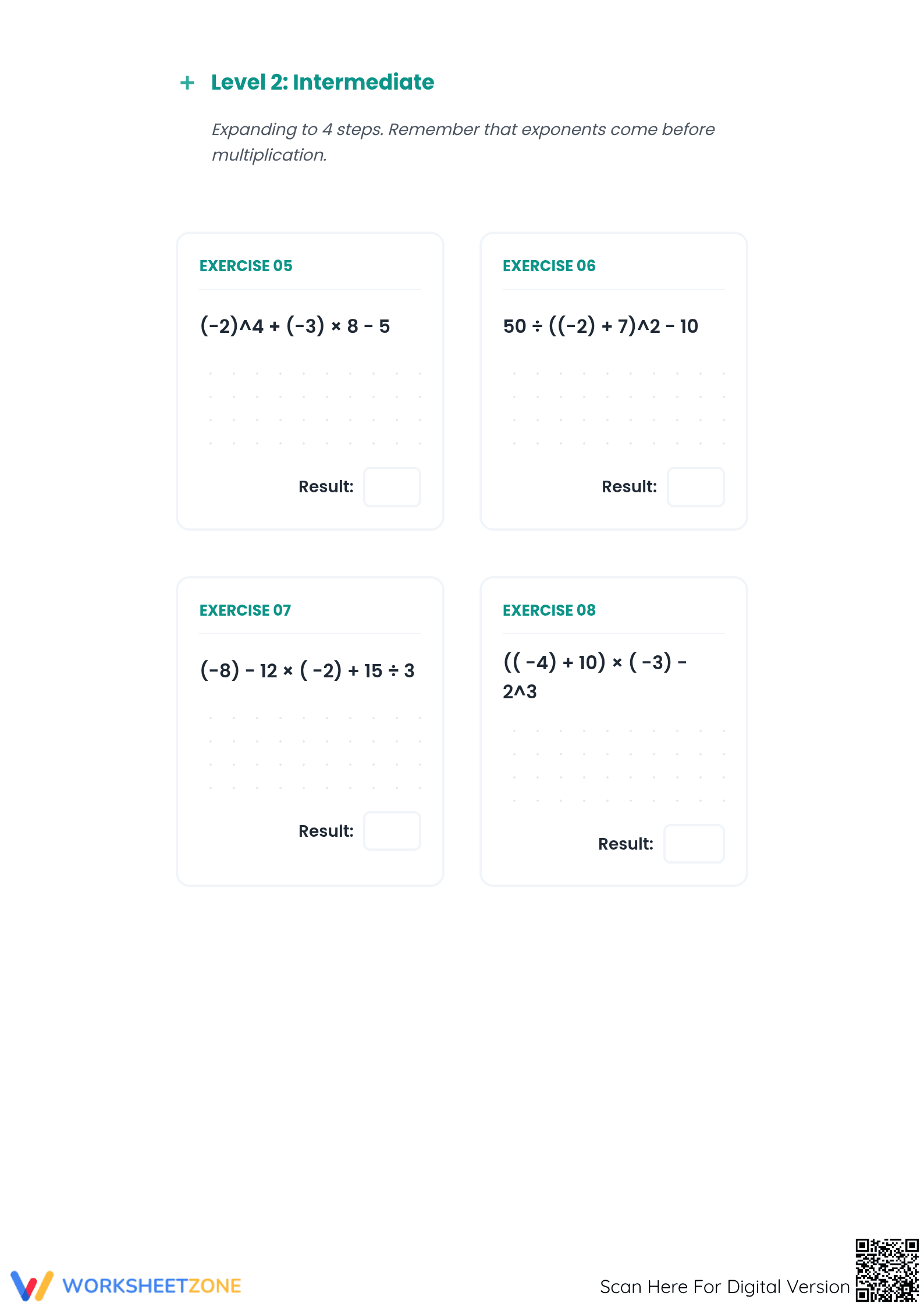
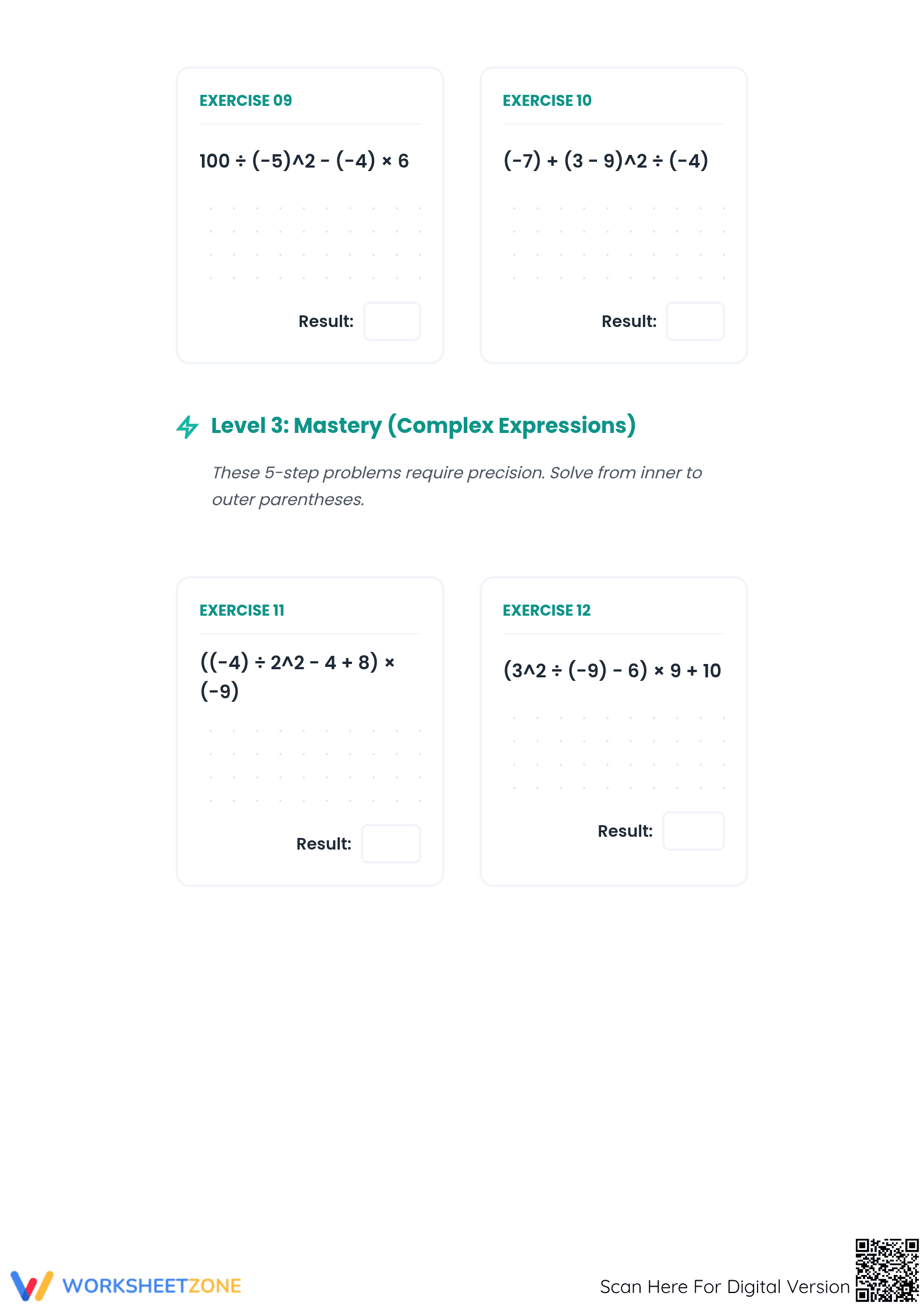
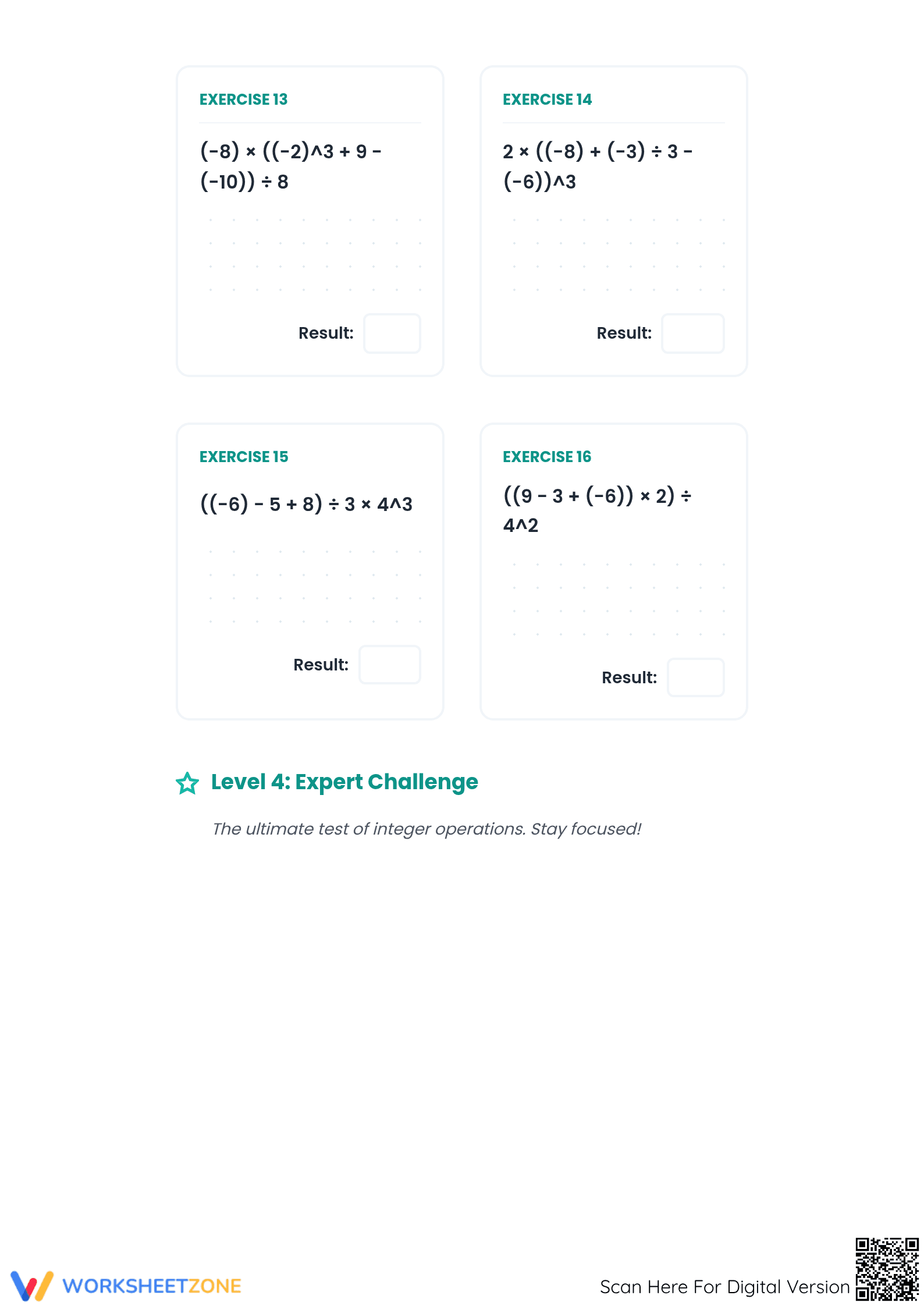


Order of Operations with Integers Worksheet | Essential Practice
Paste this activity's link or code into your existing LMS (Google Classroom, Canvas, Teams, Schoology, Moodle, etc.).
Students can open and work on the activity right away, with no student login required.
You'll still be able to track student progress and results from your teacher account.
Order of operations with integers is a foundational middle school math skill. This 5-page printable helps students master the hierarchy of PEMDAS using positive and negative numbers. By moving through four progressive levels of complexity, learners build the precision and stamina required for advanced algebraic thinking and multi-step problem solving.
At a Glance
- Grade: 6–8 · Subject: Math
- Standard:
CCSS.MATH.CONTENT.7.NS.A.3— Solve multi-step mathematical problems involving four operations with rational numbers- Skill Focus: Order of Operations (Integers)
- Format: 5 pages · 22 problems · Answer key included · PDF
- Best For: Independent practice and skill mastery
- Time: 45–60 minutes
This comprehensive 5-page set features 22 unique exercises organized into four distinct difficulty tiers. The layout provides ample workspace for students to show their step-by-step calculations. It includes simple 3-step expressions, intermediate 4-step problems with exponents, complex 5-step mastery tasks, and an expert challenge section. A complete teacher answer key ensures quick and efficient grading.
- Guided practice: The Foundation level uses 4 introductory 3-step problems to establish correct grouping habits with parentheses.
- Supported practice: Intermediate and Mastery sections introduce 12 multi-step problems that integrate exponents and nested parentheses.
- Independent practice: The Expert Challenge provides 6 high-stamina problems that require absolute precision with negative integers and complex hierarchies.
Students follow a gradual-release model, gaining confidence as the scaffolding decreases and operation counts increase per problem.
This resource is directly aligned with CCSS.MATH.CONTENT.7.NS.A.3, which requires students to solve multi-step mathematical problems posed with positive and negative rational numbers in any form. It also supports CCSS.MATH.CONTENT.6.EE.A.1 through the evaluation of numerical expressions involving whole-number exponents. Both standard codes can be copied directly into lesson plans, IEP goals, or district curriculum mapping tools.
Assign this worksheet during the "You Do" phase of a direct instruction lesson on integer operations. It serves as an excellent formative assessment tool; teachers can observe where students struggle—whether with sign rules or the PEMDAS hierarchy—by checking the work at each level change. Expect students to spend approximately 50 minutes to complete the full 5-page challenge.
This resource is designed for Grade 6–8 students mastering rational number arithmetic. It is particularly effective for learners who have mastered basic integer addition and subtraction but need structured practice with complex grouping. Pair this with a PEMDAS anchor chart or a short video tutorial on handling exponents with negative bases for maximum impact.
Order of operations with integers is a critical gatekeeper for high school algebra readiness. This worksheet addresses CCSS.MATH.CONTENT.7.NS.A.3 by providing 22 scaffolded problems that transition students from 3-step foundations to complex 5-step evaluations. Research from Fisher & Frey (2014) highlights that gradual-release structures, like the four levels utilized here, significantly improve student accuracy in multi-step procedural tasks. By isolating the integer sign rules within the PEMDAS framework, this resource ensures that students develop the computational fluency necessary for success in secondary mathematics. The inclusion of a full answer key and designated workspace aligns with evidence-based practices for effective mathematics instruction and formative assessment cycles. Educators can confidently integrate this standards-aligned tool into their daily curriculum to support diverse learner needs and track progress toward mastery of rational number operations and expression evaluation.


