


























Views
Downloads


Order of Operations Integer Worksheet | Grade 7 Essential
Paste this activity's link or code into your existing LMS (Google Classroom, Canvas, Teams, Schoology, Moodle, etc.).
Students can open and work on the activity right away, with no student login required.
You'll still be able to track student progress and results from your teacher account.
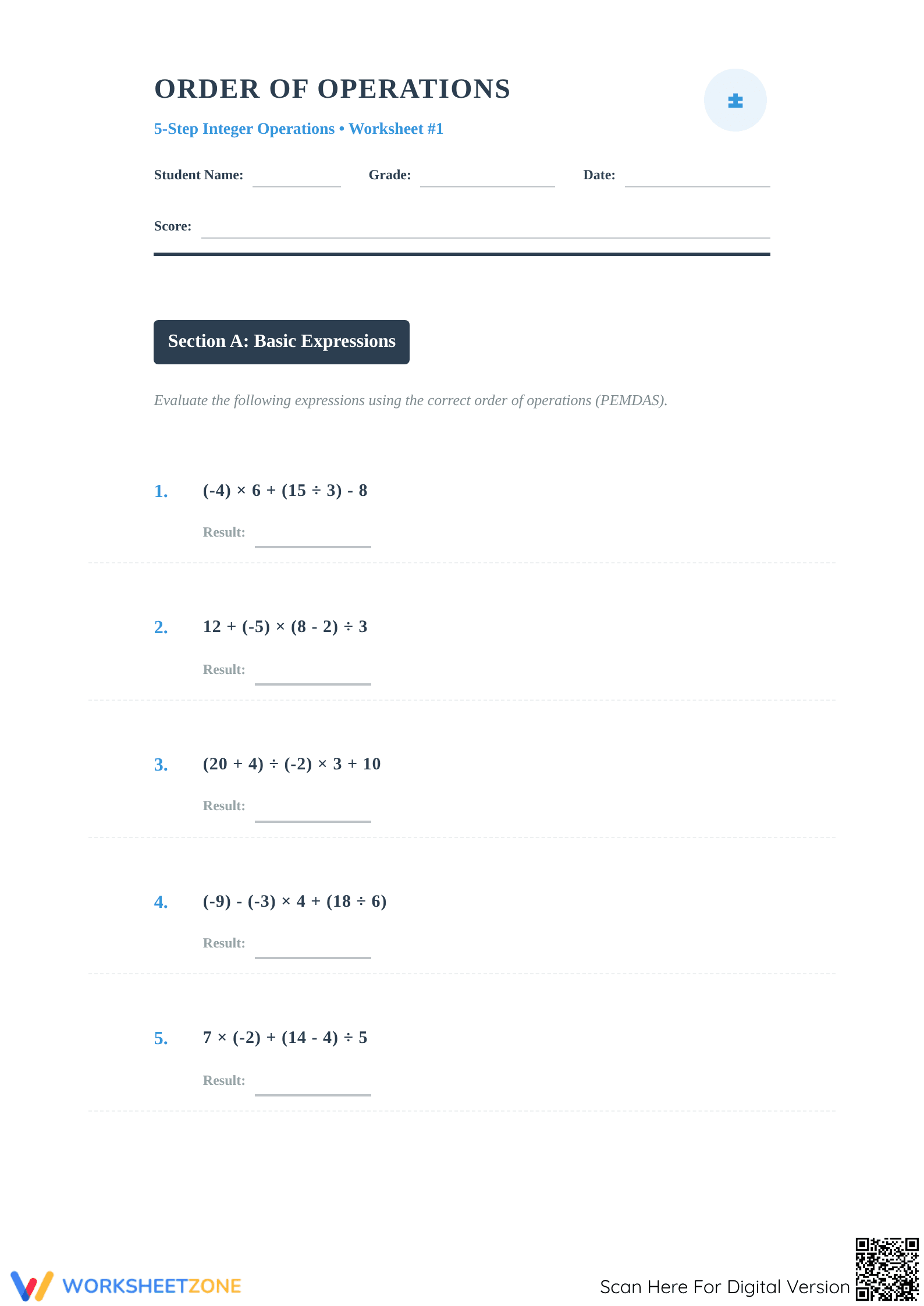
Mastering the order of operations with integers is a foundational skill for middle school mathematics. This comprehensive five-page worksheet provides students with a structured path to mastery, starting with basic expressions and culminating in master-level multi-step challenges. By working through 25 targeted problems, learners solidify their understanding of PEMDAS while navigating the complexities of positive and negative numbers.
At a Glance
- Grade: 7 · Subject: Math
- Standard:
7.NS.A.3— Solve multi-step mathematical problems involving rational numbers and multiple integer operations- Skill Focus: Order of Operations (PEMDAS) with Integers
- Format: 5 pages · 25 problems · Answer key included · PDF
- Best For: Middle school integer fluency and mastery
- Time: 45–60 minutes
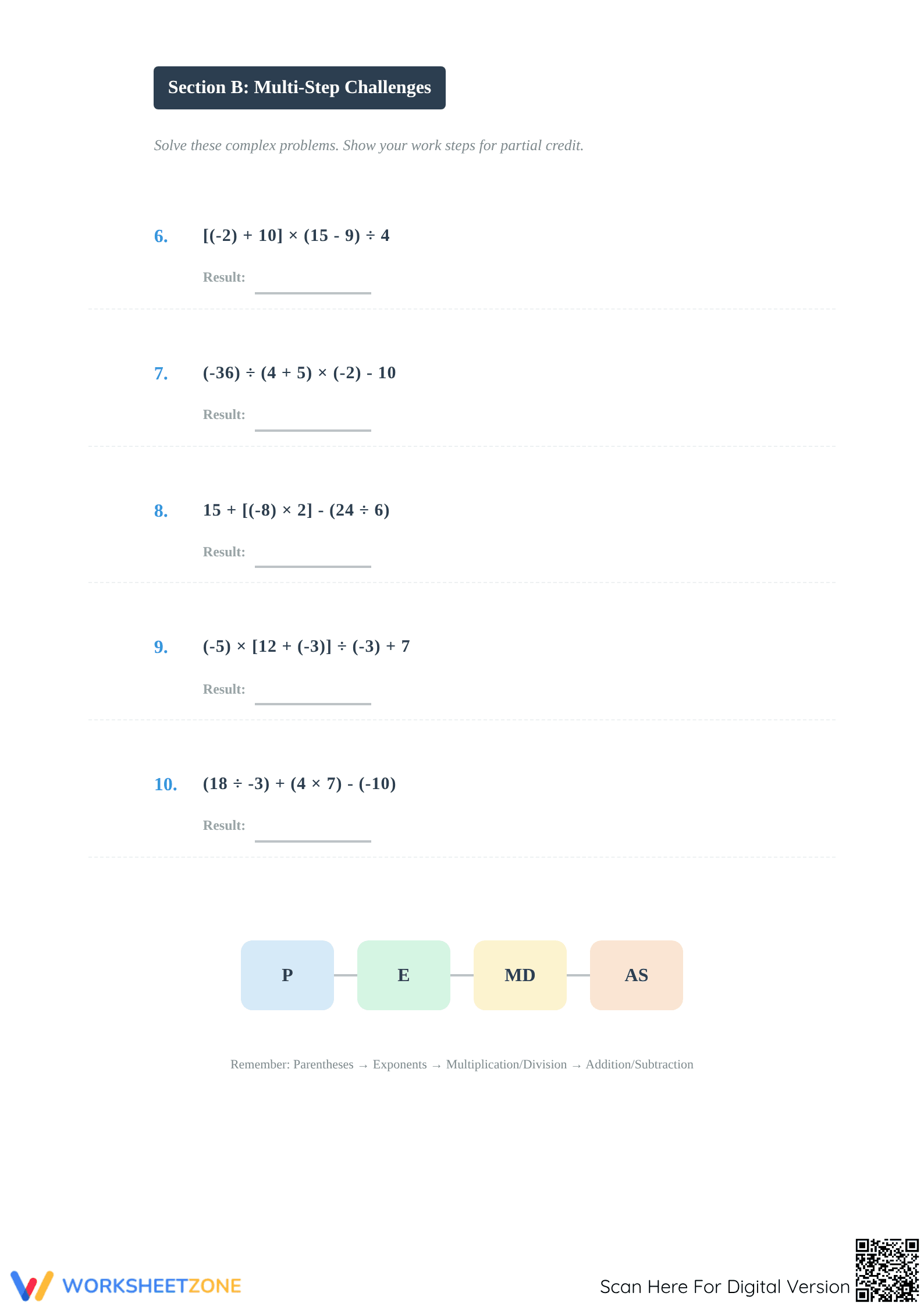
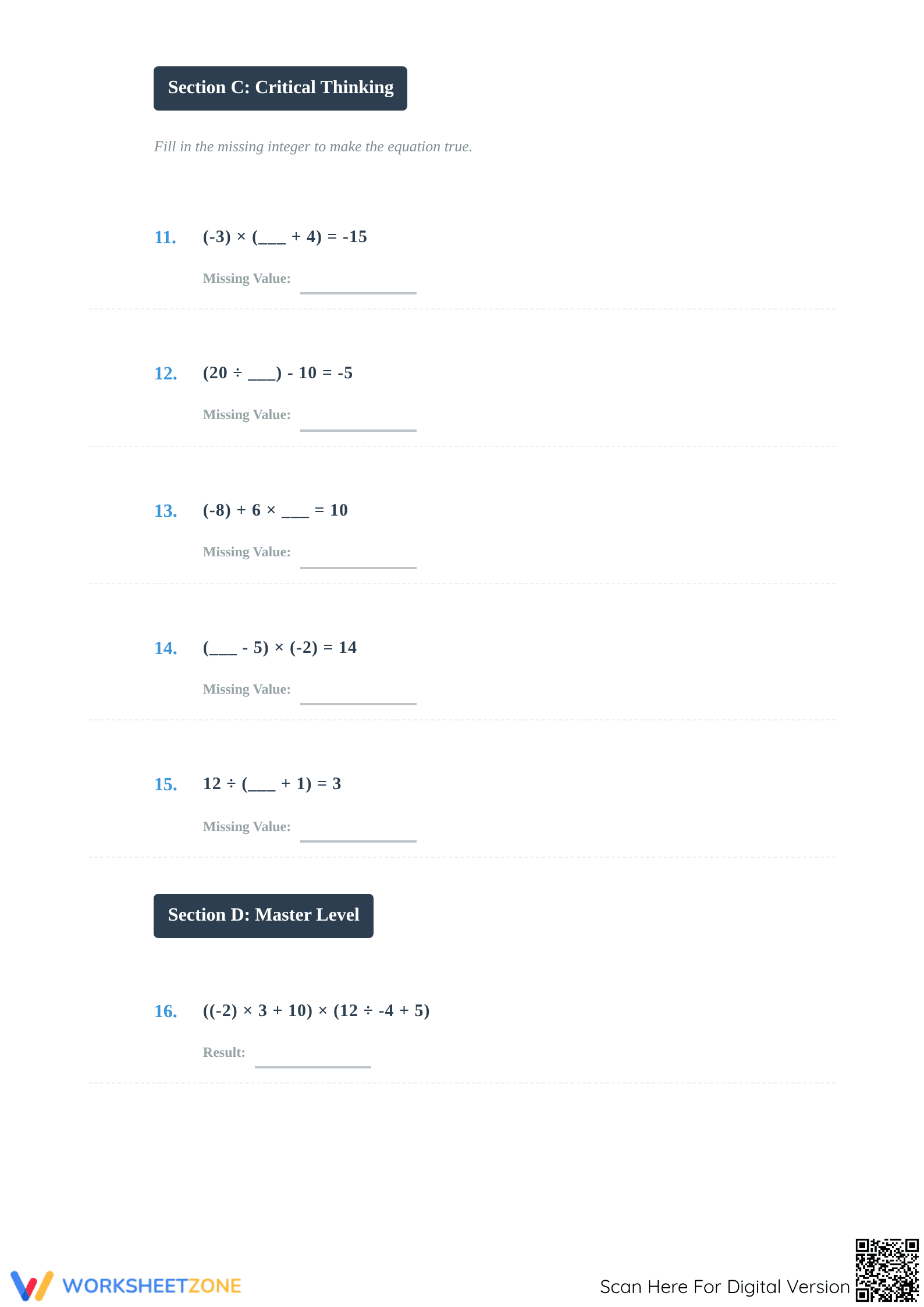
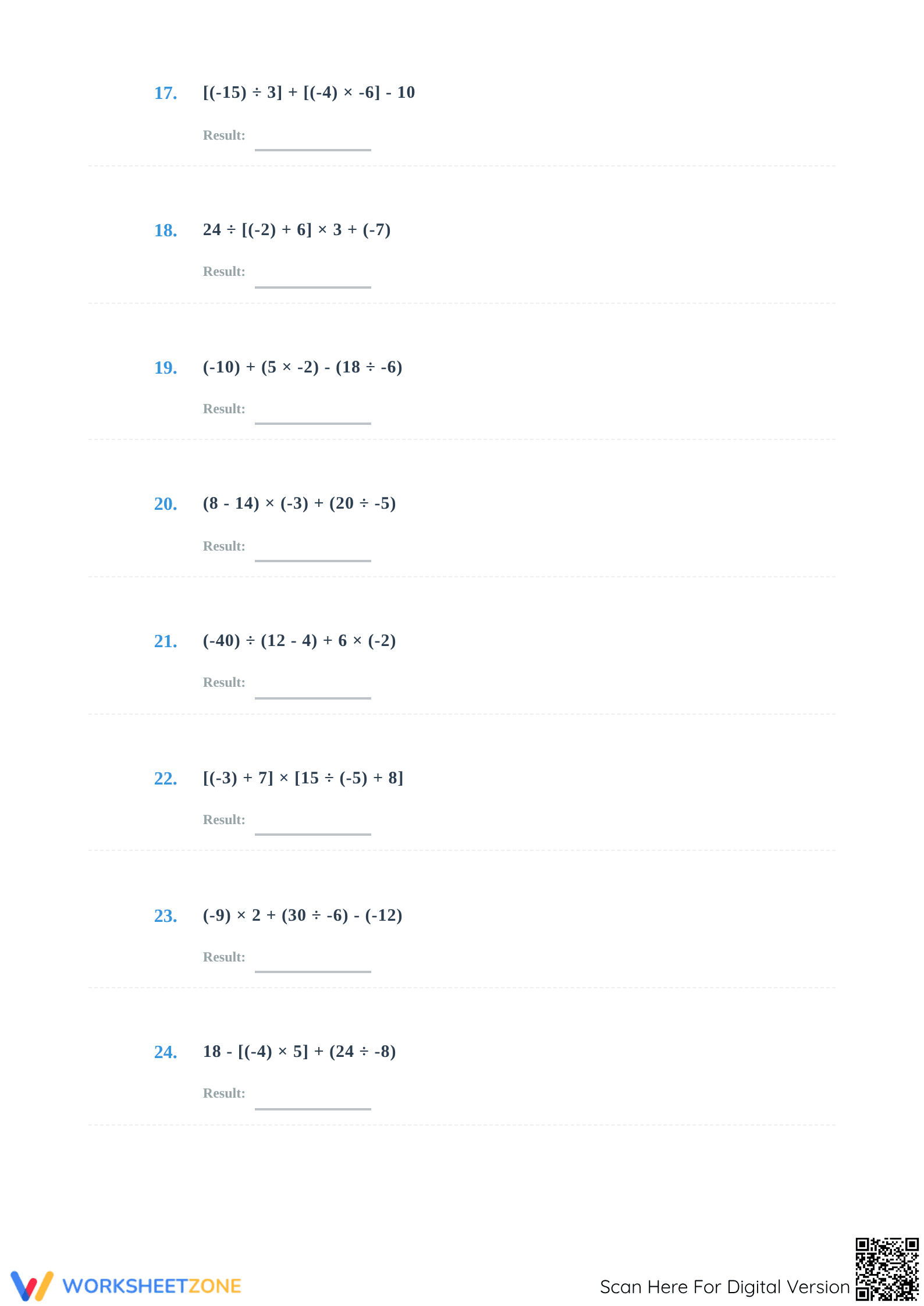
This resource features 25 problems across five pages, including a full answer key. The worksheet is organized into four distinct sections: Basic Expressions, Multi-Step Challenges, Critical Thinking, and Master Level. Each page includes helpful visual cues, such as the PEMDAS mnemonic, to support student independence and reduce cognitive load during complex calculations involving signed numbers.
The instructional design follows a clear three-step release of scaffolding:
- Guided Practice: The first five problems focus on two-step expressions, allowing students to establish a rhythm with basic integer rules and grouping symbols.
- Supported Practice: Problems 6 through 15 introduce brackets and inverse operations, requiring students to apply critical thinking to find missing integers in an equation.
- Independent Practice: The final ten problems consist of master-level expressions with five or more steps, ensuring students can independently handle the highest levels of complexity.
This sequence ensures that students build confidence before tackling more demanding mathematical tasks.
Standards Alignment
The primary standard addressed is `7.NS.A.3`: "Solve multi-step real-life and mathematical problems posed with positive and negative rational numbers in any form." The worksheet specifically targets the application of operations to integers, a critical component of algebraic readiness. This standard code can be copied into lesson plans, IEP goals, or district curriculum mapping tools.
How to Use It
Educators can utilize this worksheet during the independent practice phase of a lesson. For a formative assessment, assign Section C (Critical Thinking) to observe how students apply inverse operations to verify their logic. The expected completion time for the set is 45 to 60 minutes, making it ideal for a full class period or a comprehensive assessment.
Who It's For
This resource is tailored for seventh-grade students working toward mastery of integer operations, but it also serves as a challenge for sixth graders or a remediation tool for eighth graders. It pairs naturally with a number line anchor chart. Differentiation is built-in through tiered sections, allowing teachers to assign specific pages based on individual student needs.
The Grade 7 integer order of operations worksheet is designed to align with CCSS.MATH.CONTENT.7.NS.A.3, focusing on solving multi-step mathematical problems involving integers and multiple operations. Students must demonstrate proficiency in applying PEMDAS rules across four distinct sections of increasing complexity, ranging from basic expressions to critical thinking and master-level challenges. Research from Fisher & Frey (2014) emphasizes the importance of scaffolded practice in developing mathematical fluency, suggesting that gradual release of responsibility—moving from guided to independent practice—is essential for long-term retention of procedural knowledge. This worksheet provides 25 problems that facilitate this progression, allowing educators to monitor student mastery of signed number arithmetic and grouping symbols. By integrating algebraic thinking through missing-value problems, the resource prepares learners for higher-level mathematics. It serves as a comprehensive tool for formative assessment or independent reinforcement, ensuring students can accurately navigate complex numerical expressions within standard middle school curriculum frameworks.


