


























Views
Downloads

Order of Operations with Integers | Essential Grade 6 Math
Paste this activity's link or code into your existing LMS (Google Classroom, Canvas, Teams, Schoology, Moodle, etc.).
Students can open and work on the activity right away, with no student login required.
You'll still be able to track student progress and results from your teacher account.
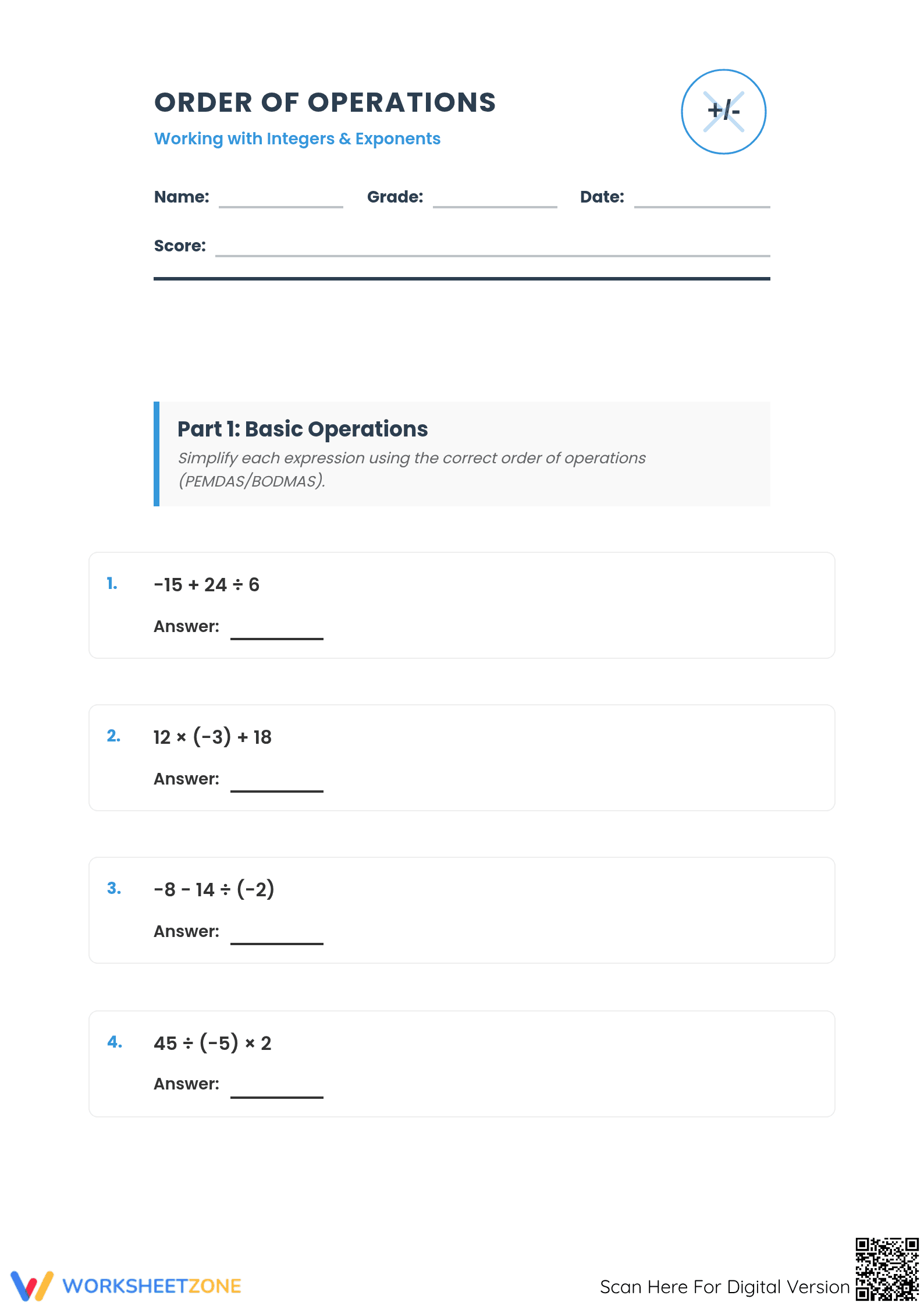
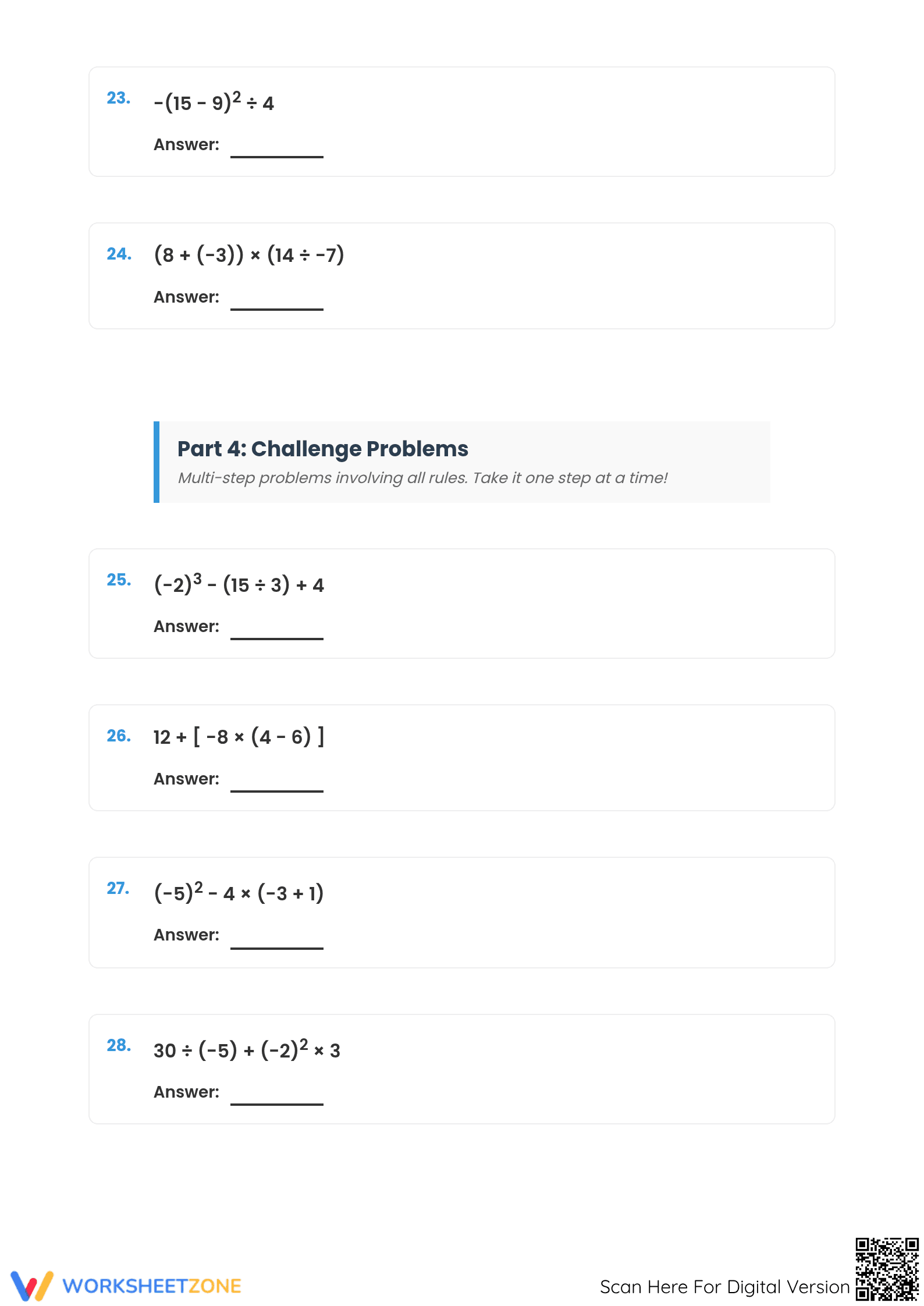
This comprehensive worksheet provides targeted practice for students mastering the order of operations with integers and exponents. By working through multi-step expressions, learners develop the procedural fluency needed to evaluate complex mathematical strings accurately. This resource ensures students understand the hierarchical nature of mathematical operations, ensuring mastery of evaluating powers within integer contexts.
At a Glance
- Grade: 6 · Subject: Math
- Standard:
CCSS.MATH.CONTENT.6.EE.A.1— Write and evaluate numerical expressions involving whole-number exponents and grouping symbols- Skill Focus: Multi-step Order of Operations (PEMDAS)
- Format: 5 pages · 28 problems · Answer key included · PDF
- Best For: Mid-unit practice or formative assessment
- Time: 40–50 minutes
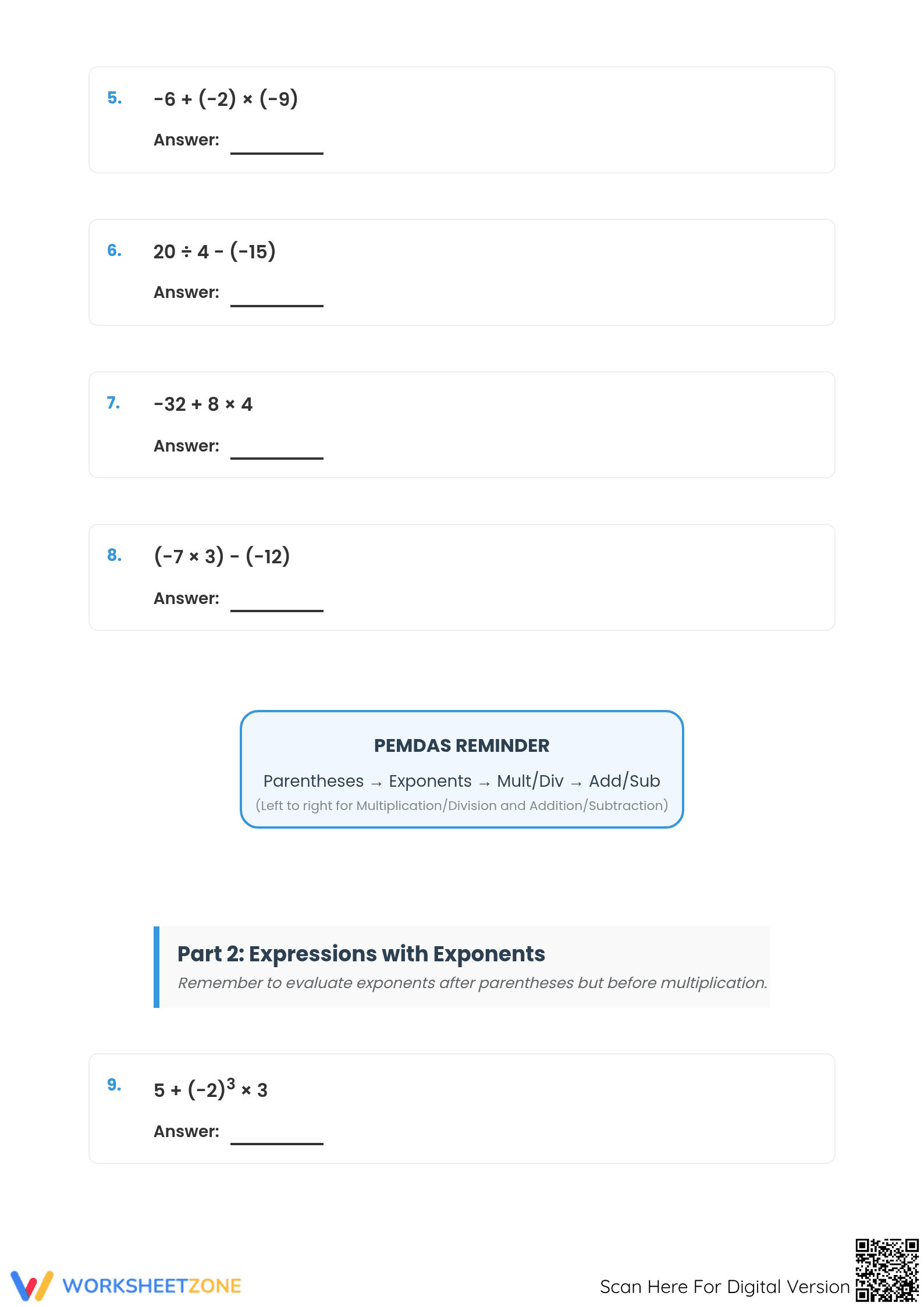
This five-page PDF package contains 28 unique problems divided into four progressive sections. It includes a dedicated PEMDAS Reminder anchor chart on page two to support independent work. The problems feature a mix of positive and negative integers, parentheses, brackets, and exponents. A complete answer key is provided for every page, allowing for rapid grading or student self-correction.
Skill Progression
- Guided Practice: Problems 1–8 focus on basic operations with integers, utilizing addition, subtraction, multiplication, and division to establish foundational sign-rule confidence.
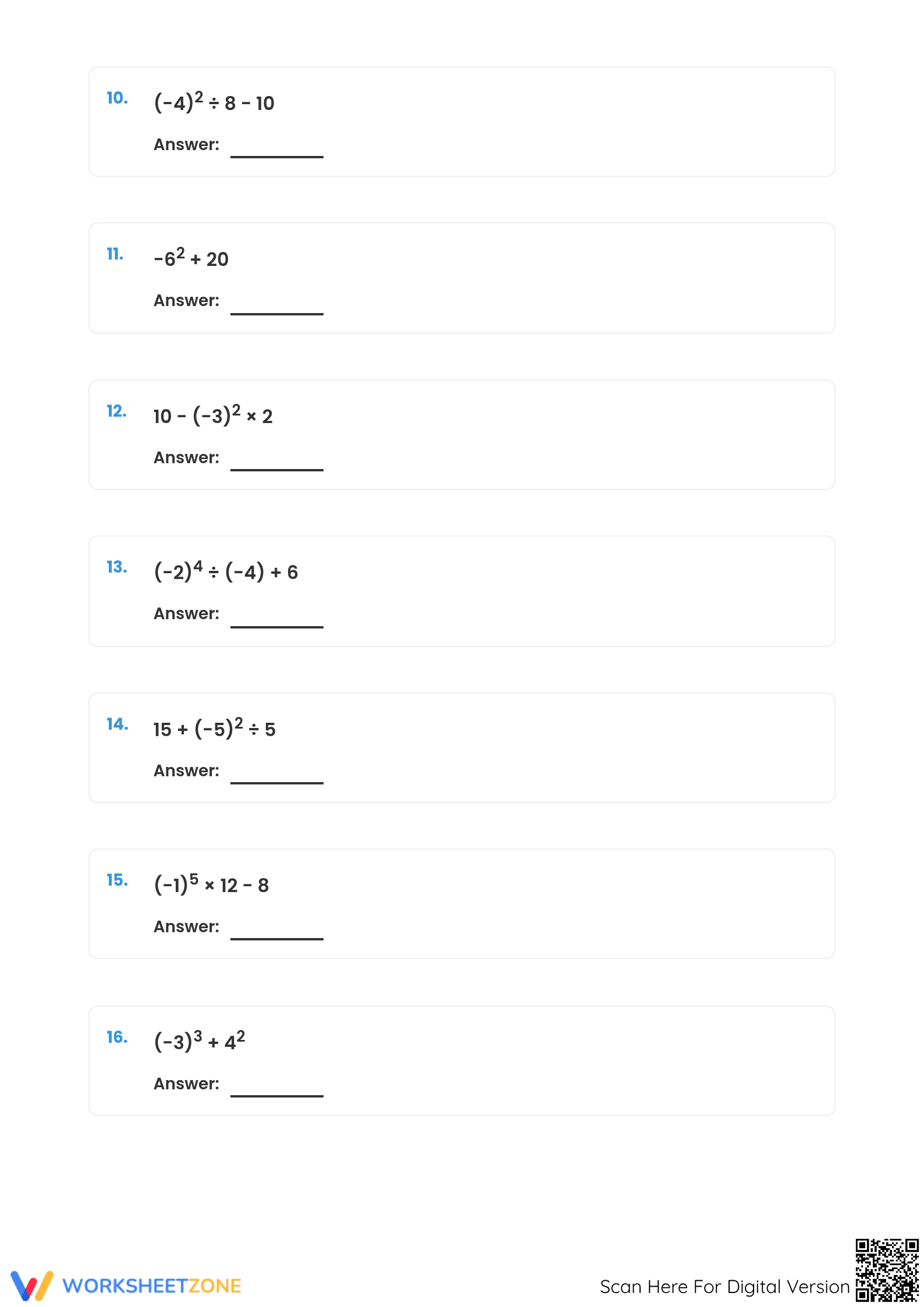
- Supported Practice: Problems 9–16 introduce exponents into the integer expressions, requiring students to carefully sequence powers before proceeding to basic arithmetic operations.
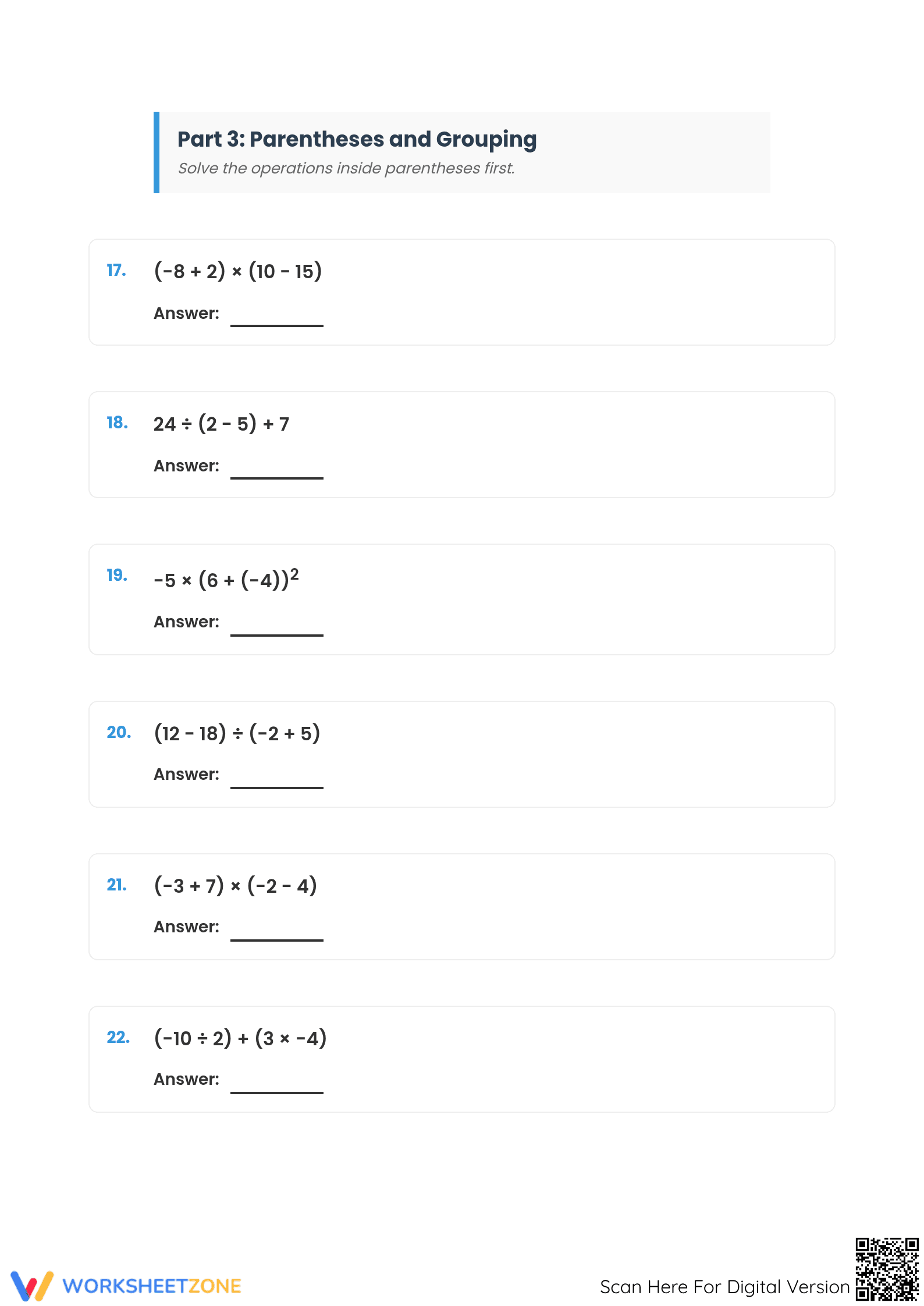
- Independent Mastery: The final two sections involve complex grouping symbols and multi-step challenge problems that require simultaneous application of all PEMDAS rules.
The primary focus is CCSS.MATH.CONTENT.6.EE.A.1. This resource also supports CCSS.MATH.CONTENT.7.NS.A.3 by applying operational rules to integers. Both standard codes can be copied directly into lesson plans, IEP goals, or district curriculum mapping tools.
How to Use It
Assign this worksheet as a summative task after direct instruction on integer operations and exponent rules. To use it for formative assessment, observe students during the transition from Part 2 to Part 3; this shift from exponents to nested parentheses often reveals specific misconceptions in operational hierarchy. Expected completion time for the full 28-problem set is approximately 45 minutes for typical learners.
Who It's For
This resource is designed for Grade 6–8 students who need intensive practice with operational sequencing. It serves as an excellent remediation tool for high school students struggling with algebraic evaluation. Pair this worksheet with a coordinate plane activity or a number line passage to help students visualize the movement of values during the multi-step simplification process.
According to the RAND AIRS 2024 report on mathematical literacy, procedural fluency in the order of operations is a critical predictor of success in early algebra and high-school-level calculus. This worksheet directly addresses this need by providing structured practice in CCSS.MATH.CONTENT.6.EE.A.1, requiring students to evaluate numerical expressions with exponents and integers. Research by Fisher & Frey (2014) emphasizes that the gradual release of responsibility—moving from simple operations to complex grouping—is essential for students to internalize hierarchical rules without cognitive overload. By isolating integer rules within the PEMDAS framework, this resource prevents common errors such as improper sign distribution or premature addition. Educators can utilize these 28 tasks to provide the high-dosage practice required for long-term retention of algebraic foundations. This systematic approach ensures that students can move beyond rote memorization of acronyms toward a functional understanding of mathematical structure and relationship evaluation.


