


























Views
Downloads
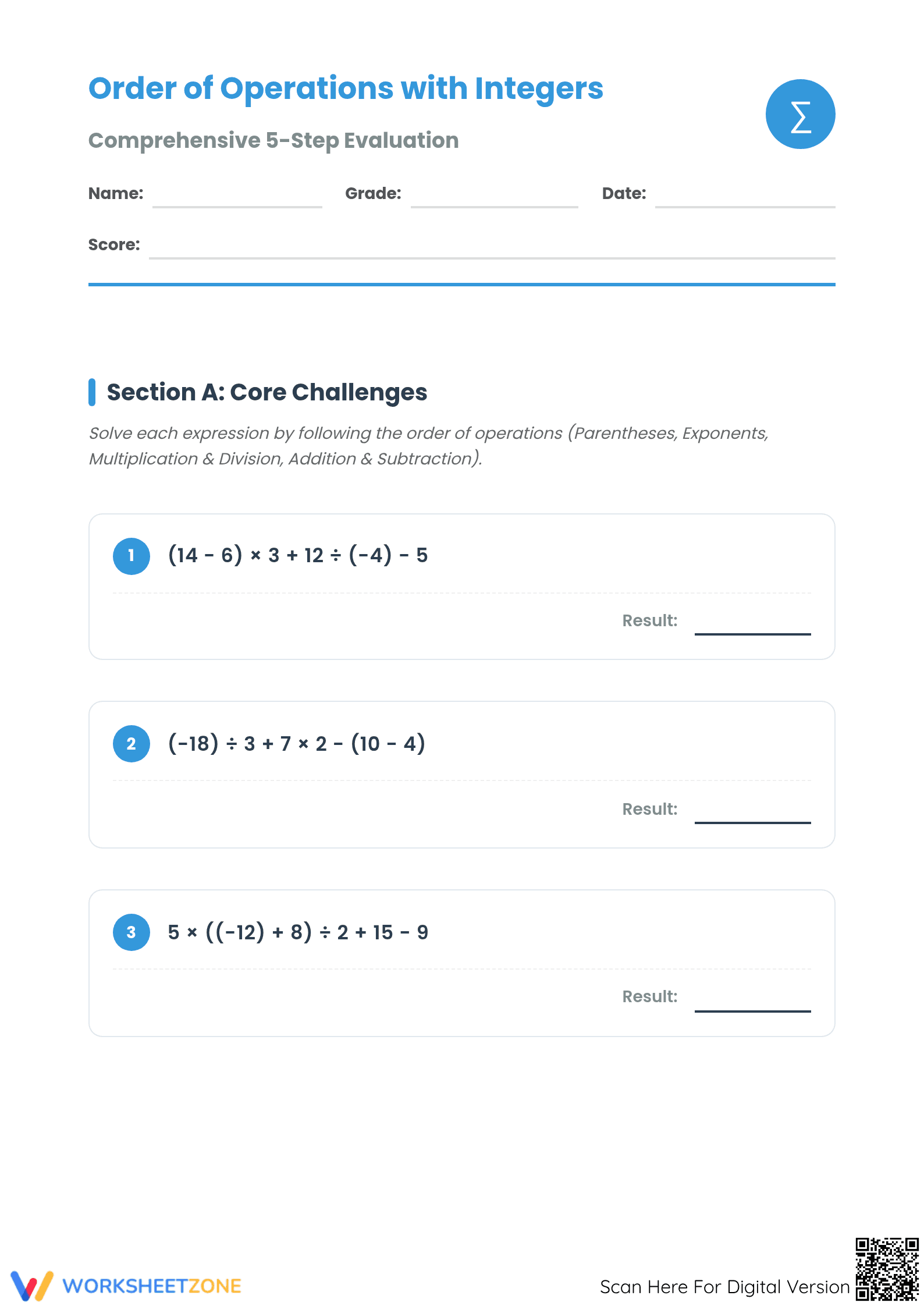
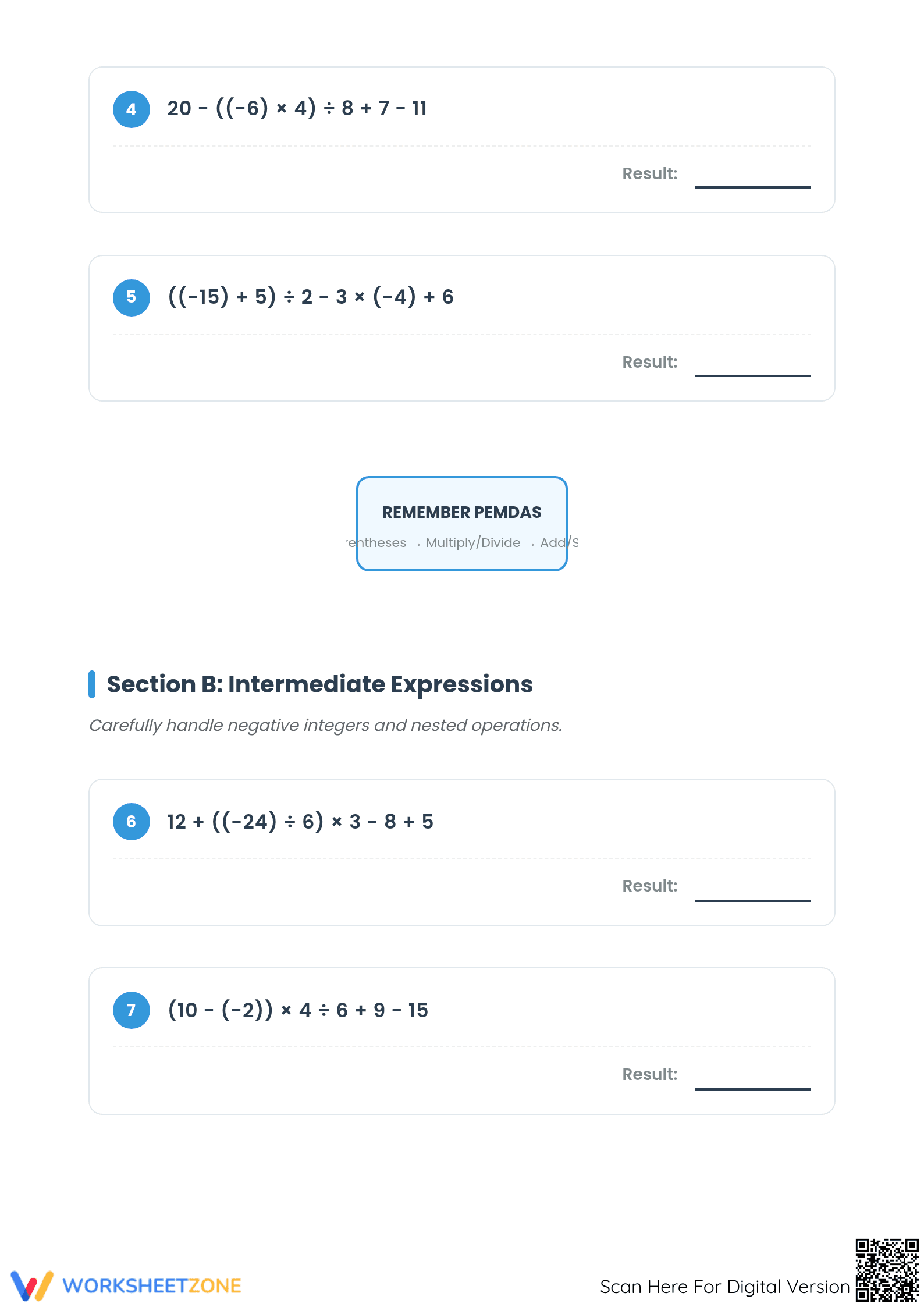
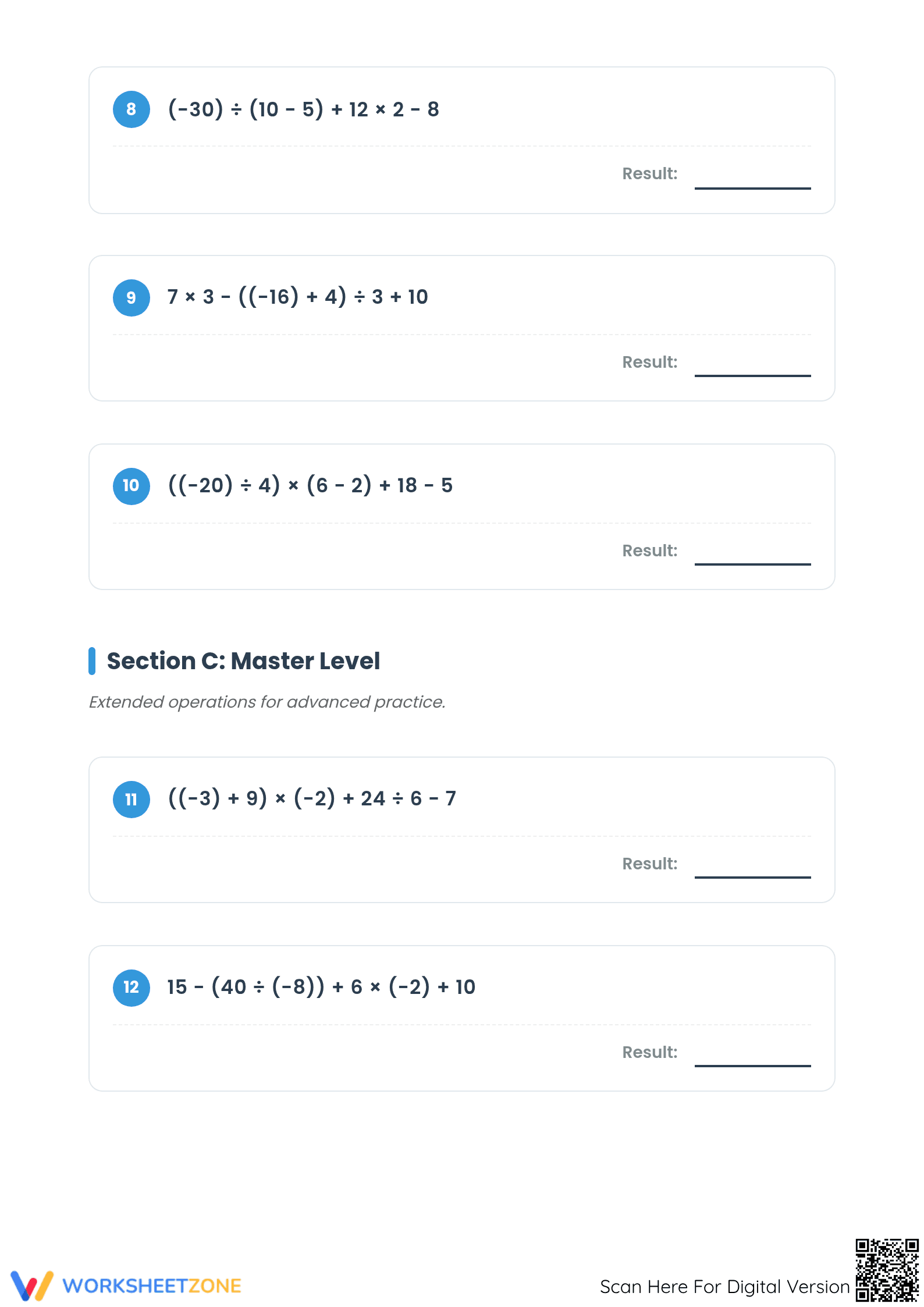
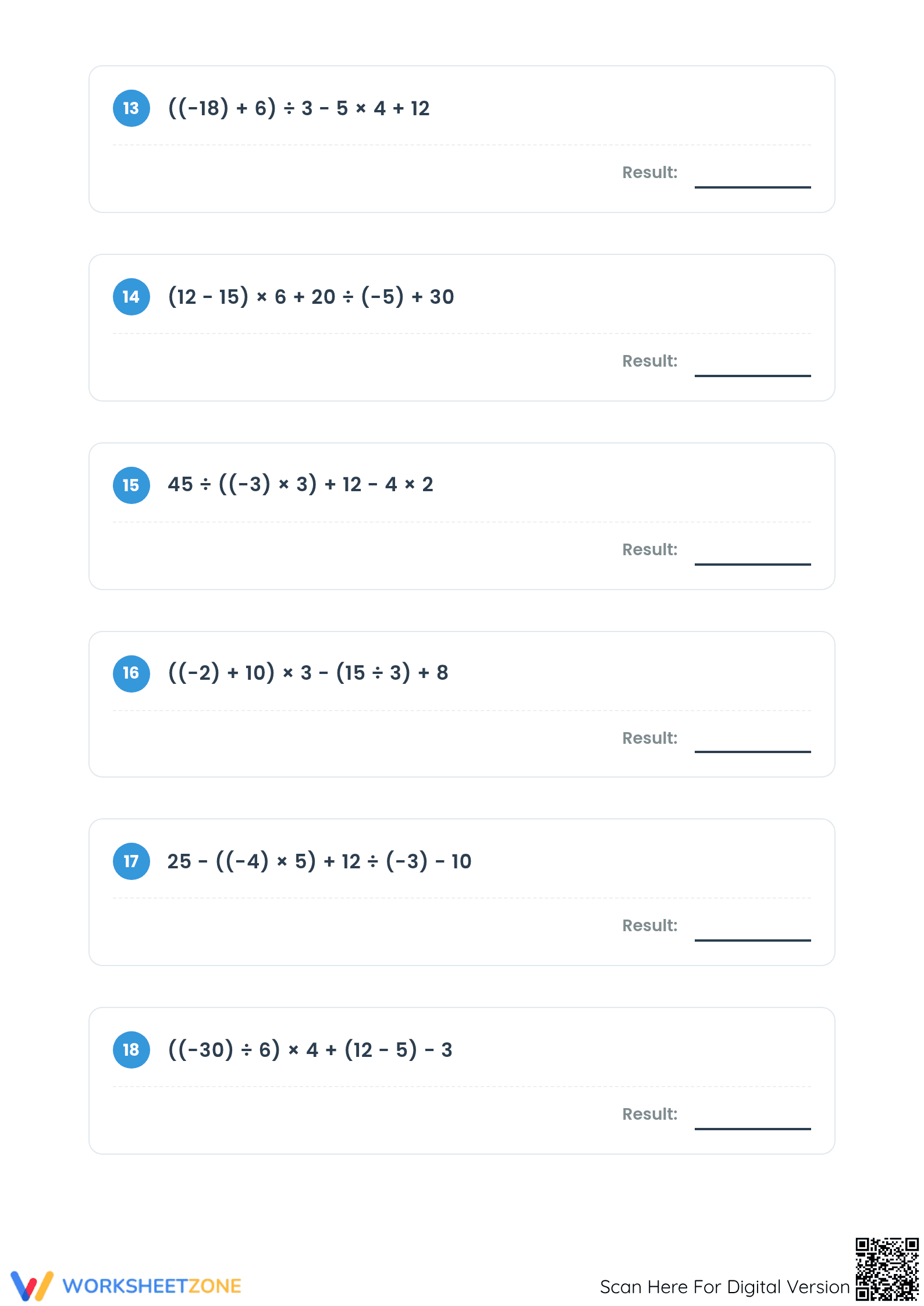

Essential Order of Operations with Integers Worksheet
Paste this activity's link or code into your existing LMS (Google Classroom, Canvas, Teams, Schoology, Moodle, etc.).
Students can open and work on the activity right away, with no student login required.
You'll still be able to track student progress and results from your teacher account.
This Grade 7 math worksheet provides a rigorous evaluation of the order of operations with integers, ensuring students master the application of PEMDAS across 23 increasingly complex problems. By integrating negative numbers into multi-step expressions, students develop the computational fluency required for advanced algebraic concepts and real-world mathematical problem-solving scenarios.
At a Glance
- Grade: 7 · Subject: Math
- Standard:
CCSS.MATH.CONTENT.7.NS.A.3— Solve multi-step mathematical problems involving addition, subtraction, multiplication, and division with rational numbers- Skill Focus: Order of Operations with Integers
- Format: 5 pages · 23 problems · Answer key included · PDF
- Best For: Independent practice and formative assessment
- Time: 30–45 minutes
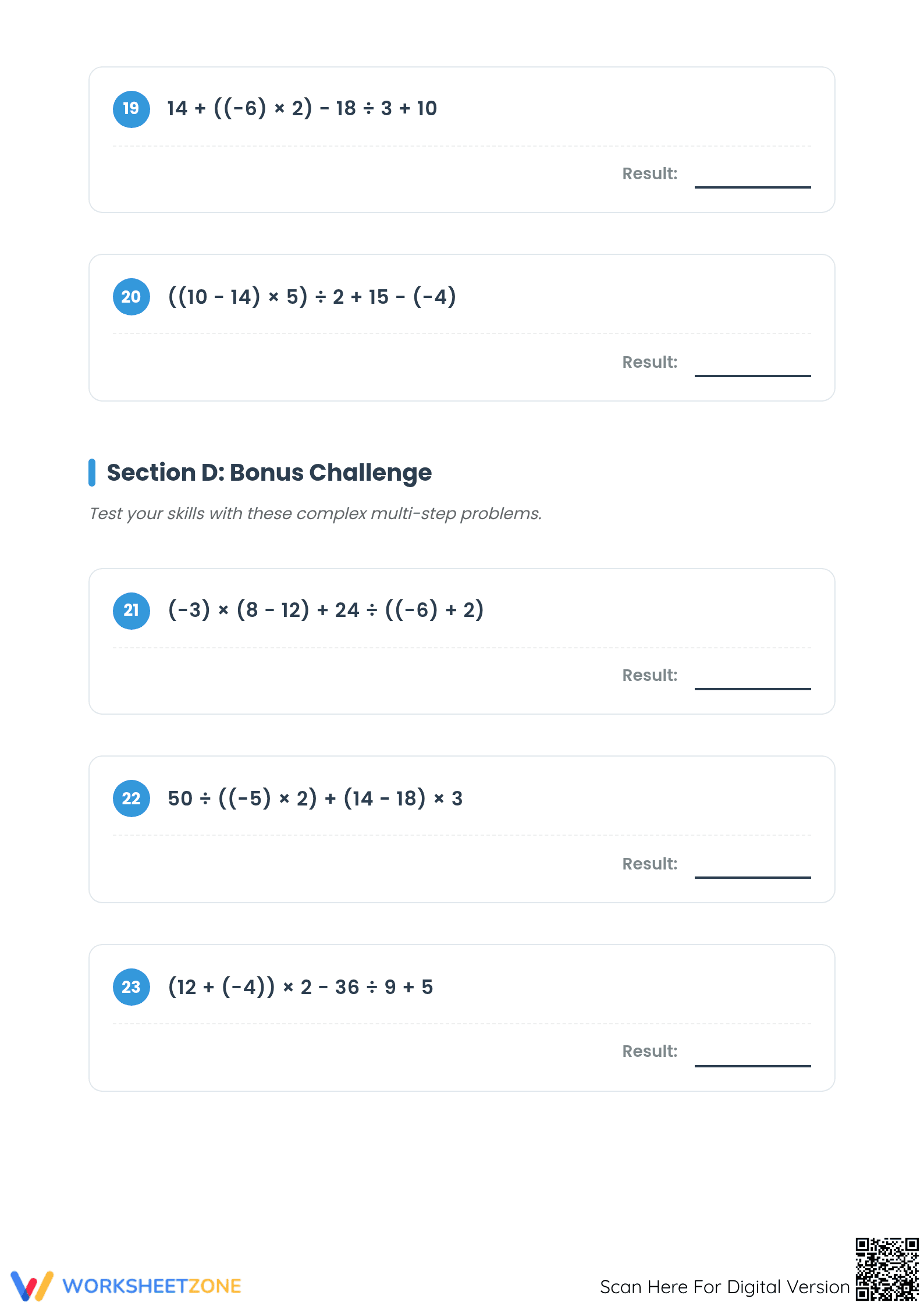
What's Inside: This 5-page comprehensive packet contains 23 structured problems divided into four distinct levels: Core Challenges, Intermediate Expressions, Master Level, and a Bonus Challenge. Each page features a clear, spacious layout for student work, a "Remember PEMDAS" reminder box, and dedicated result lines. A complete answer key is provided for rapid grading and student self-correction.
Skill Progression
- Guided Practice: Section A (Problems 1-5) focuses on basic 5-step evaluations with clear operational cues to build student confidence.
- Supported Practice: Section B (Problems 6-10) introduces nested operations and frequent sign changes with negative integers.
- Independent Practice: Sections C and D (Problems 11-23) present "Master" and "Bonus" challenges with maximum complexity and multi-level parentheses.
This sequence follows the gradual-release instructional framework to move students from basic procedural recall to complex mathematical mastery.
Standards Alignment
This worksheet aligns with CCSS.MATH.CONTENT.7.NS.A.3, which requires students to "Solve real-world and mathematical problems involving the four operations with rational numbers." The problems specifically target the synthesis of integer operations within the hierarchical structure of numerical expressions. This standard code can be copied directly into lesson plans, IEP goals, or district curriculum mapping tools.
How to Use It
Deploy this worksheet as a summative assessment after direct instruction on integer operations and PEMDAS. Teachers can observe students during Section B to identify common misconceptions regarding sign changes in nested operations. Alternatively, assign specific sections as differentiated homework based on previous formative checks to ensure appropriate challenge levels for every learner.
Who It's For
This resource is ideal for Grade 7 students building pre-algebraic skills, though it serves as excellent remediation for Grade 8 or enrichment for Grade 6 learners. It pairs naturally with an integer number line anchor chart or a direct instruction lesson on the distributive property within the context of operational order.
According to the RAND AIRS 2024 analysis, procedural fluency in multi-step integer operations is a significant predictor of success in secondary algebra. This worksheet targets the specific cognitive load associated with managing sign changes and operational hierarchy simultaneously, which is often a bottleneck for middle school learners. By providing a graduated release of difficulty across 23 problems, the resource allows students to consolidate their understanding of standard CCSS.MATH.CONTENT.7.NS.A.3 through repetitive, focused practice. This approach aligns with evidence-based instructional design that prioritizes the mastery of rational number operations as a foundation for higher-level mathematical reasoning. Educational researchers emphasize that the transition from whole numbers to integers requires deliberate scaffolding to prevent the fossilization of early arithmetic errors, making the structured evaluation provided in this document an essential tool for effective Grade 7 mathematics instruction and assessment.


