


























Views
Downloads
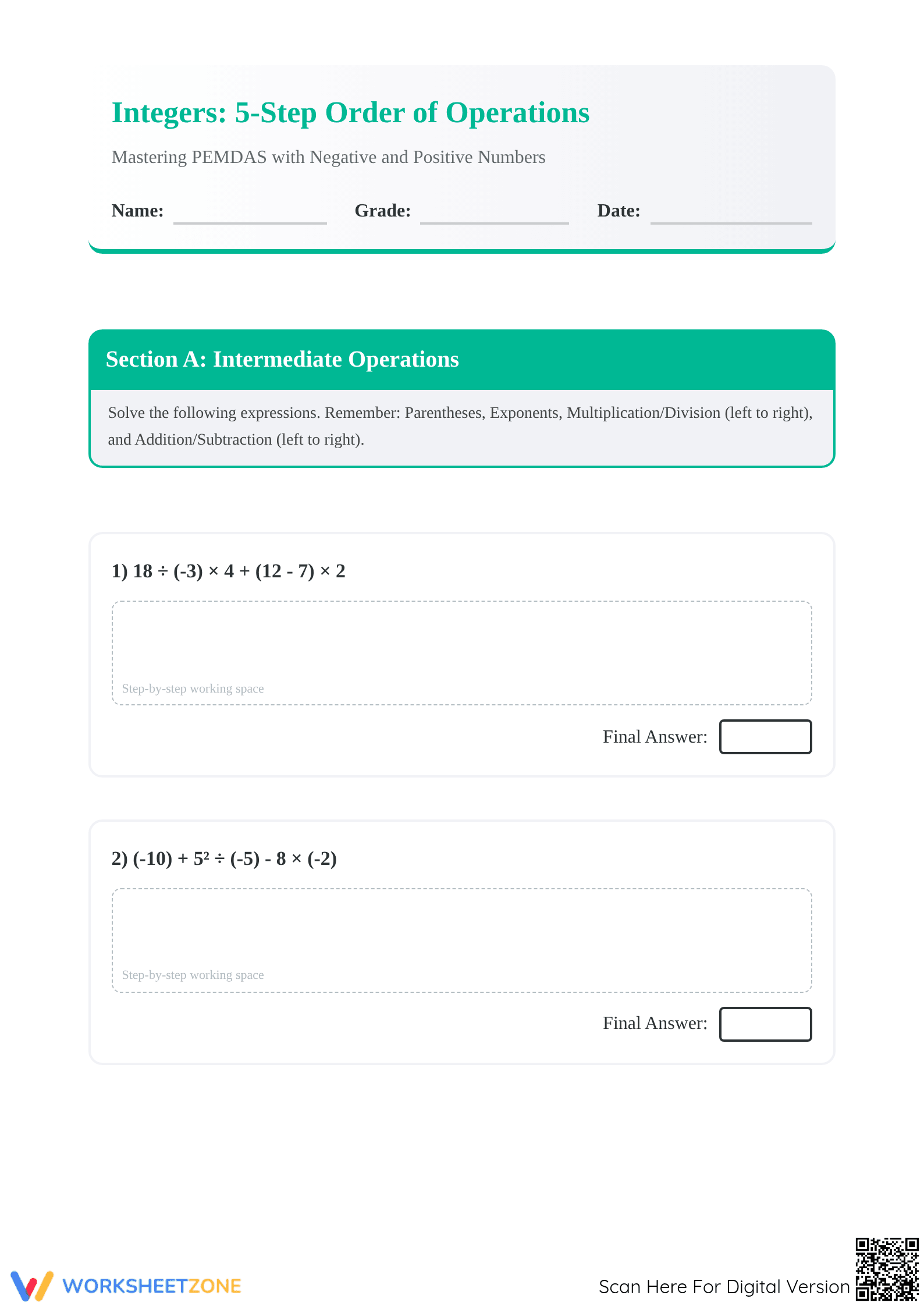
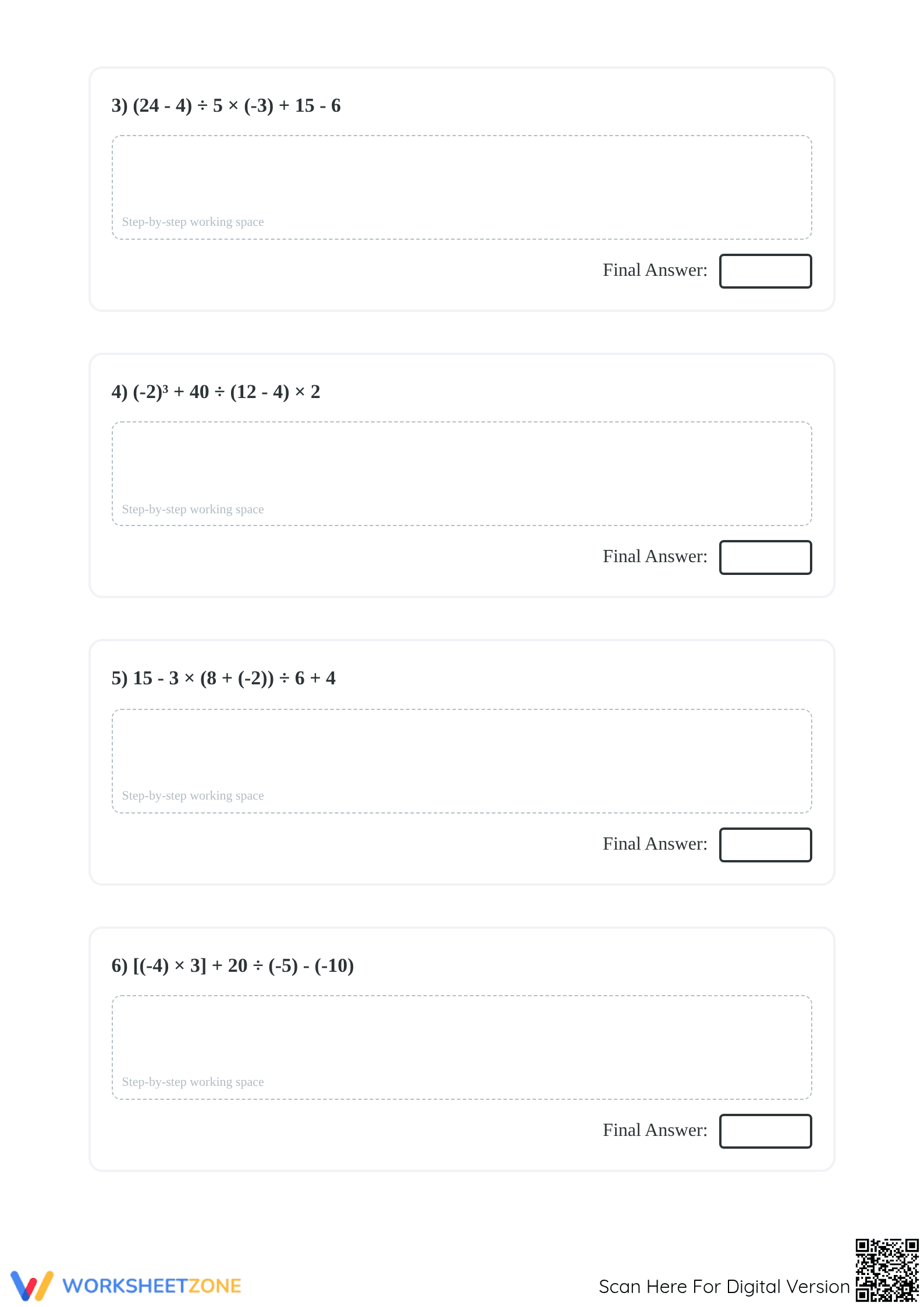
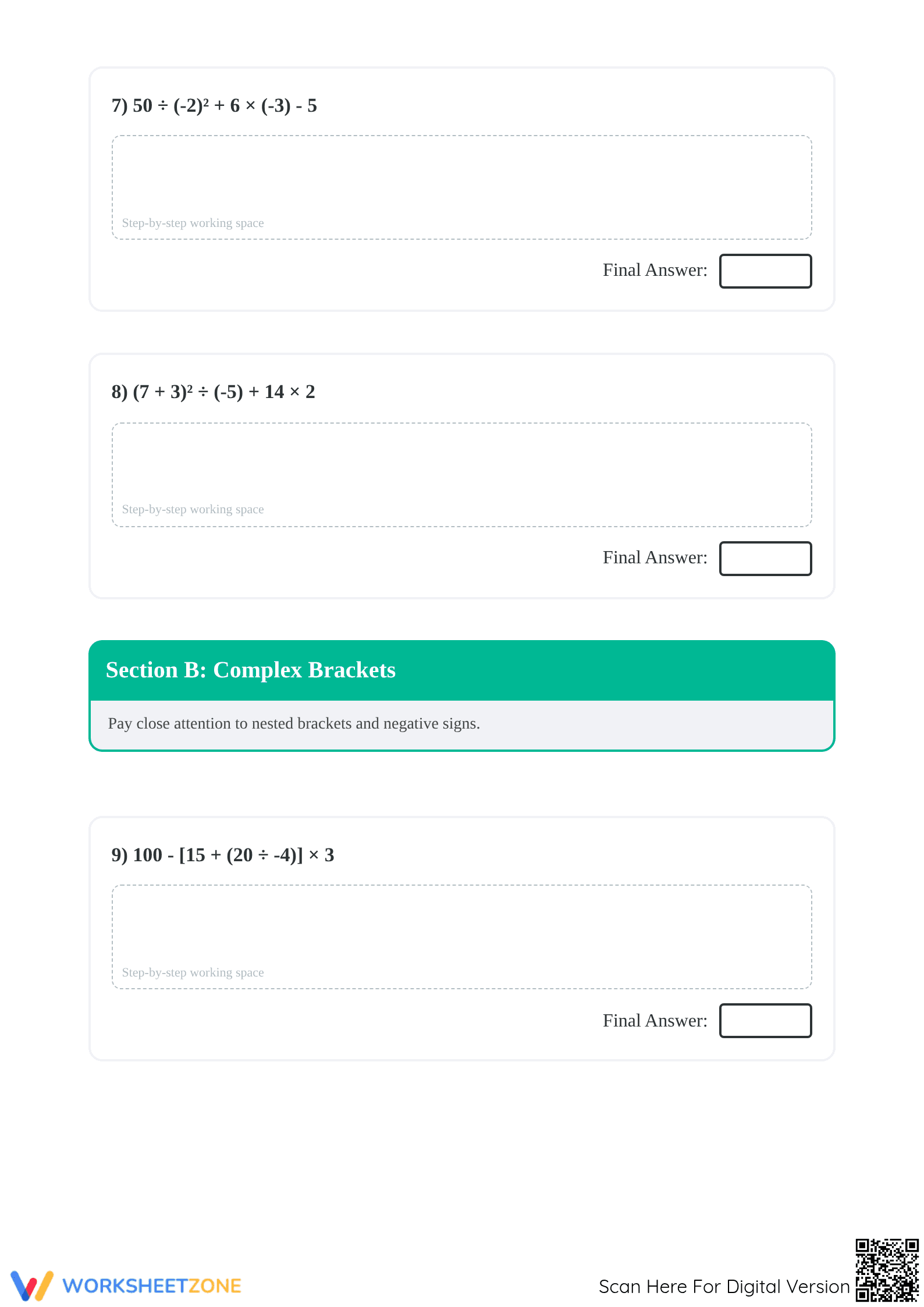
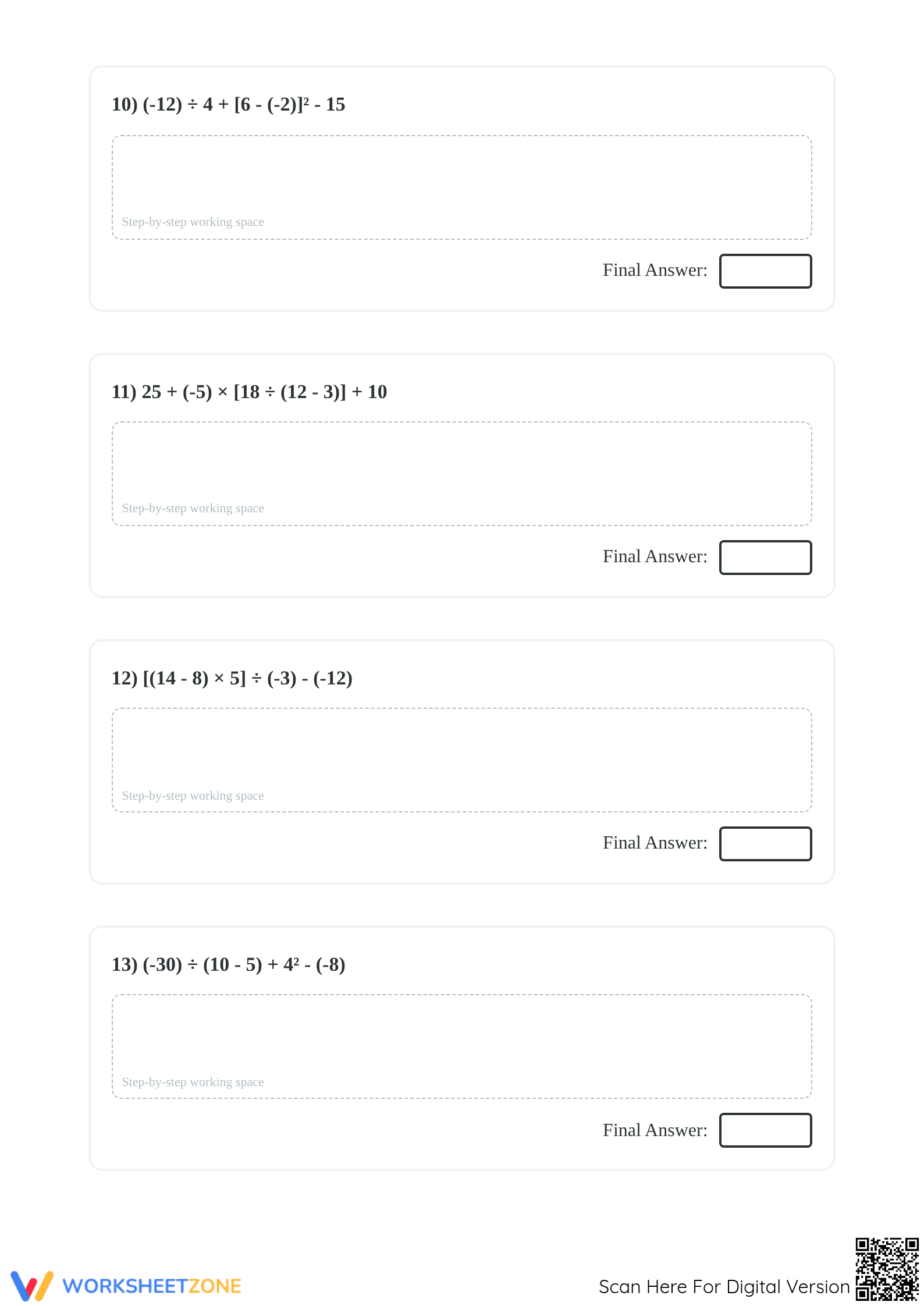

Printable Order of Operations with Integers | Grade 7 Math
Paste this activity's link or code into your existing LMS (Google Classroom, Canvas, Teams, Schoology, Moodle, etc.).
Students can open and work on the activity right away, with no student login required.
You'll still be able to track student progress and results from your teacher account.
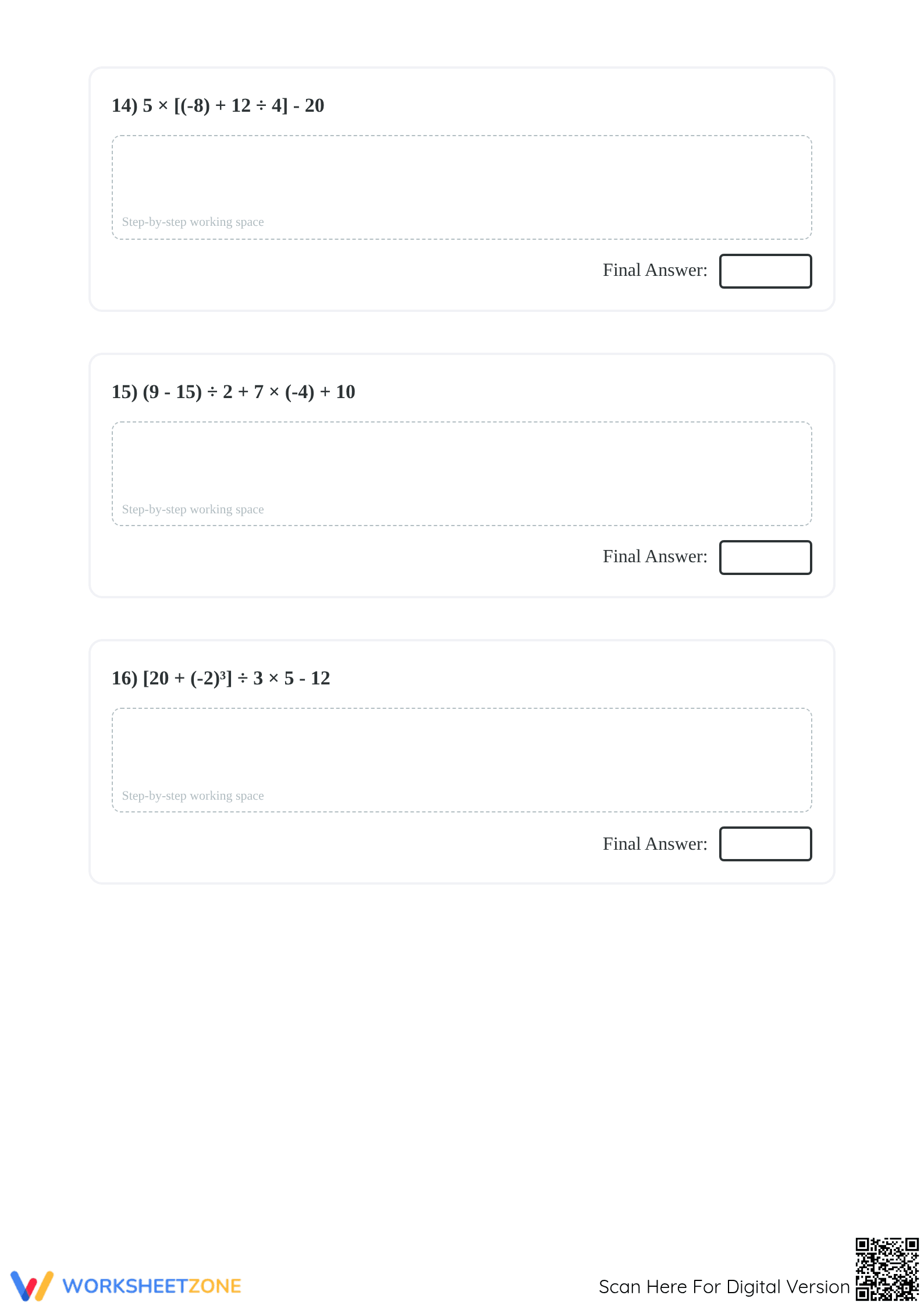
This Printable Order of Operations with Integers worksheet is designed to help students master complex mathematical expressions involving positive and negative numbers. By providing structured workspace for multi-step calculations, this resource ensures that learners build procedural fluency with PEMDAS, specifically focusing on the challenges of exponents and nested brackets in middle school mathematics.
At a Glance
- Grade: 7 · Subject: Math
- Standard:
CCSS.MATH.CONTENT.7.NS.A.3— Solve mathematical problems involving the four operations with rational numbers and integers- Skill Focus: Multi-step integer operations (PEMDAS)
- Format: 5 pages · 16 problems · Answer key included · PDF
- Best For: Middle school pre-algebra and integer mastery
- Time: 35–50 minutes
This comprehensive five-page set contains 16 unique multi-step problems, ranging from intermediate operations to complex expressions with nested brackets. Each page is formatted with dedicated "Step-by-step working space" boxes to encourage students to show their work and identify errors in their calculation path. The resource includes a full answer key with worked-out solutions for quick grading and self-correction.
Skill Progression and Scaffolding
- Guided practice: The first four problems focus on basic integer signs and parentheses, requiring three to four steps of logic to reach the final answer.
- Supported practice: Problems 5 through 8 introduce exponents and division, requiring students to carefully manage signs across five distinct operations within a single problem.
- Independent practice: The final eight problems feature complex nested brackets and higher-order exponents, challenging students to apply the full PEMDAS sequence autonomously.
This structure supports the gradual release of responsibility model, moving students from basic recall to complex application in a single session.
Standards Alignment
The primary focus is CCSS.MATH.CONTENT.7.NS.A.3, which requires students to solve mathematical problems involving the four operations with rational numbers. The inclusion of exponents also supports CCSS.MATH.CONTENT.6.EE.A.1. Both standard codes can be copied directly into lesson plans, IEP goals, or district curriculum mapping tools to ensure rigorous instructional alignment.
How to Use It
This resource is best utilized as a post-instruction practice set or a formative assessment tool. During independent work, teachers should circulate and observe the "Step-by-step working space" to identify if students are forgetting the left-to-right rule for multiplication and division. Expect students to take approximately 45 minutes to complete all five pages with high accuracy.
Who It's For
This worksheet is ideal for Grade 7 students learning pre-algebra concepts or Grade 8 students requiring intervention on integer operations. It pairs naturally with an integer number line or a PEMDAS anchor chart for students who require visual scaffolds during the calculation process.
Aligned with CCSS.MATH.CONTENT.7.NS.A.3, this worksheet targets the essential skill of solving multi-step integer problems using the order of operations. Research from Fisher & Frey (2014) emphasizes the importance of scaffolds like the "Step-by-step working space" included here, which help externalize student thinking and reduce cognitive load during complex arithmetic. By requiring students to manage negative signs, exponents, and nested brackets simultaneously, this resource builds the mathematical stamina needed for high school algebra. The 16 problems are calibrated to provide sufficient repetition for mastery without causing fatigue. This design reflects the NAEP findings that procedural fluency is most effectively developed when students are required to show the sequence of their operations rather than just the final product. Educators can use these structured tasks to bridge the gap between basic arithmetic and the abstract logic required in secondary mathematics.


