


























Views
Downloads

Essential Order of Operations with Integers | Grade 7
Paste this activity's link or code into your existing LMS (Google Classroom, Canvas, Teams, Schoology, Moodle, etc.).
Students can open and work on the activity right away, with no student login required.
You'll still be able to track student progress and results from your teacher account.
This comprehensive order of operations worksheet provides students with a rigorous pathway to mastering multi-step expressions involving integers and exponents. By following the PEMDAS hierarchy, learners tackle increasingly complex problems that build procedural fluency and conceptual depth. This resource ensures students can confidently manage negative numbers and nested grouping symbols in advanced mathematical contexts.
At a Glance
- Grade: 7 · Subject: Math
- Standard:
CCSS.MATH.CONTENT.7.NS.A.3— Solve multi-step mathematical problems involving the four operations with integers and exponents- Skill Focus: Order of Operations (PEMDAS) with Integers
- Format: 5 pages · 13 problems · Answer key included · PDF
- Best For: Middle school pre-algebra and integer mastery
- Time: 35–50 minutes
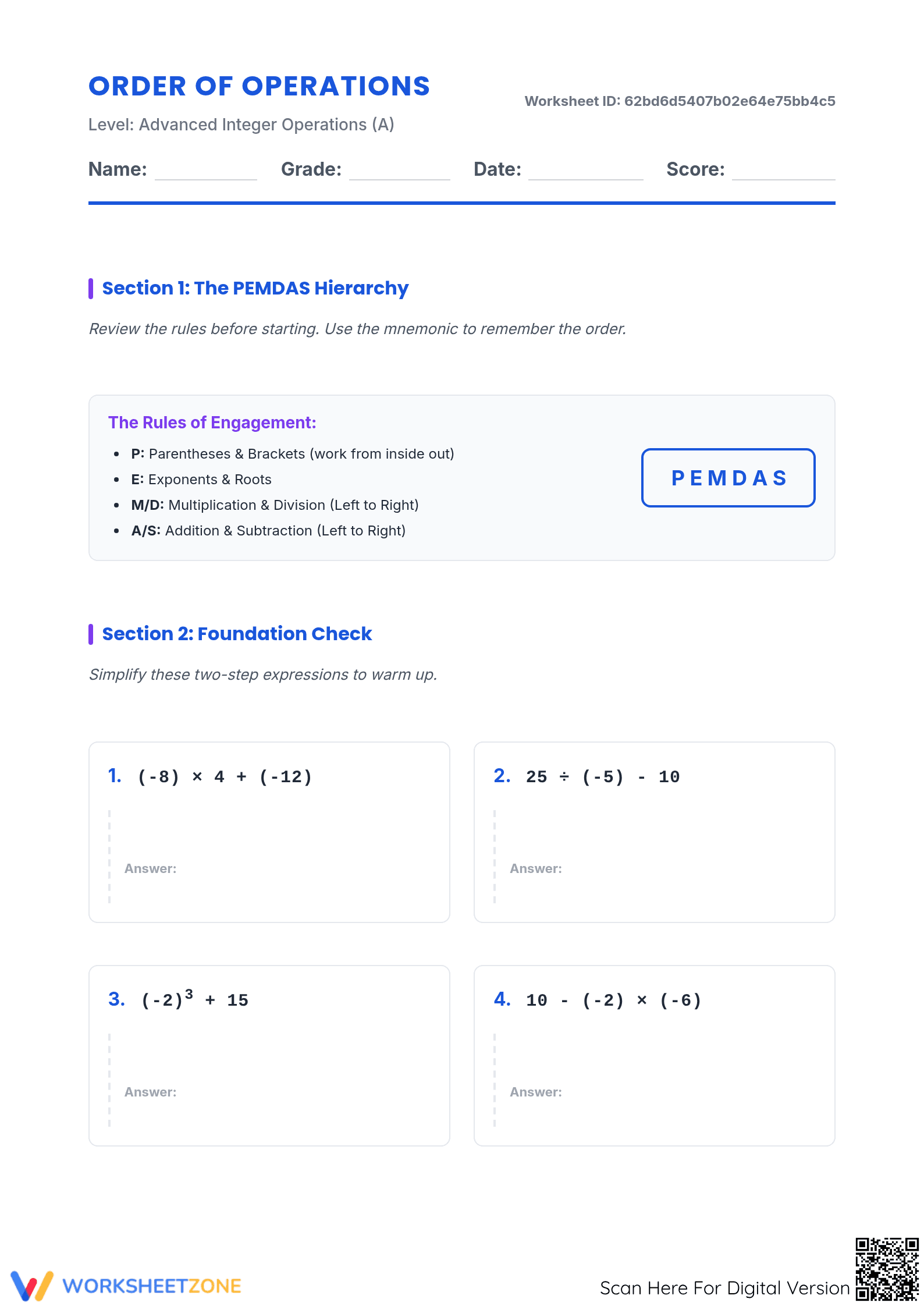
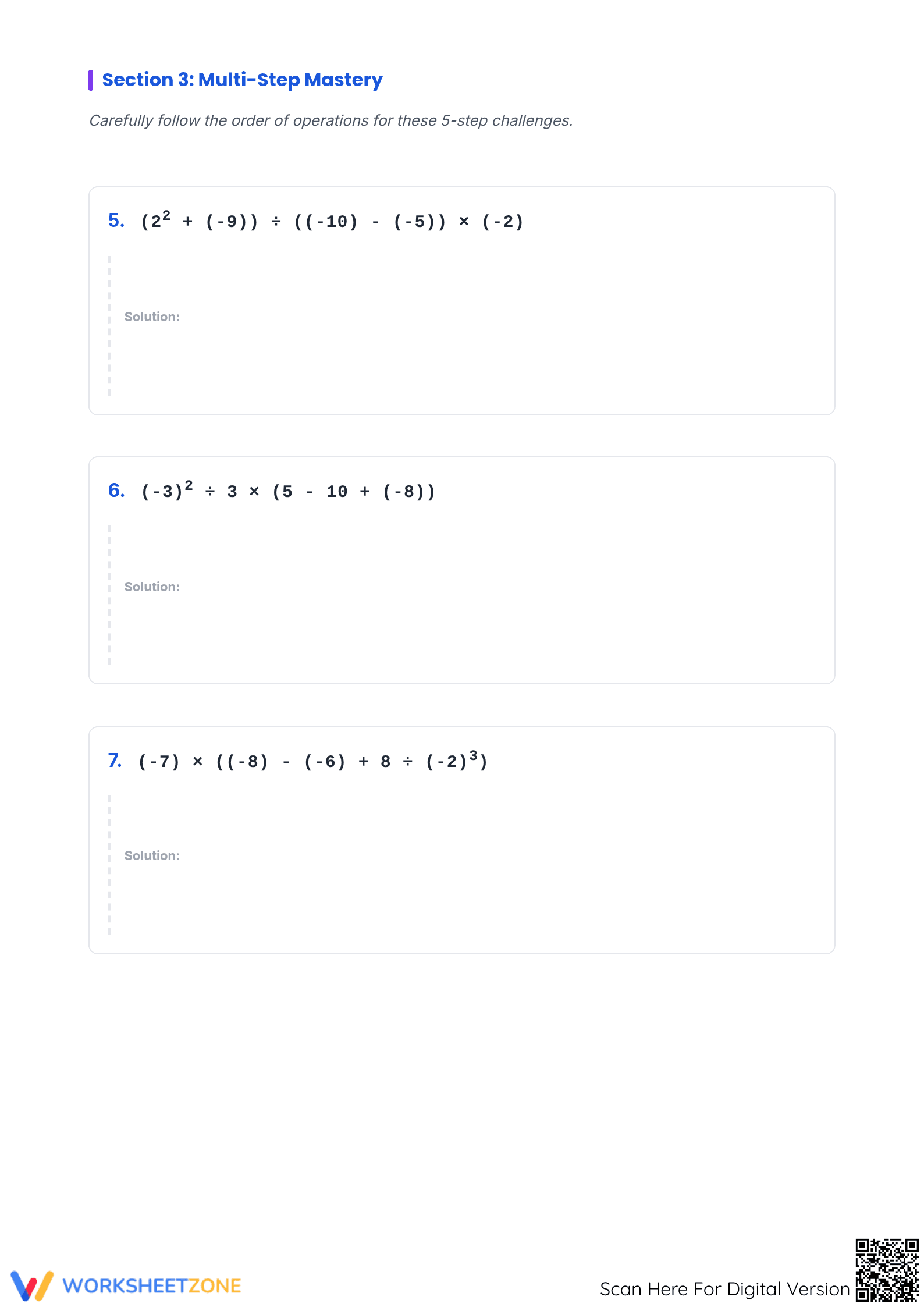
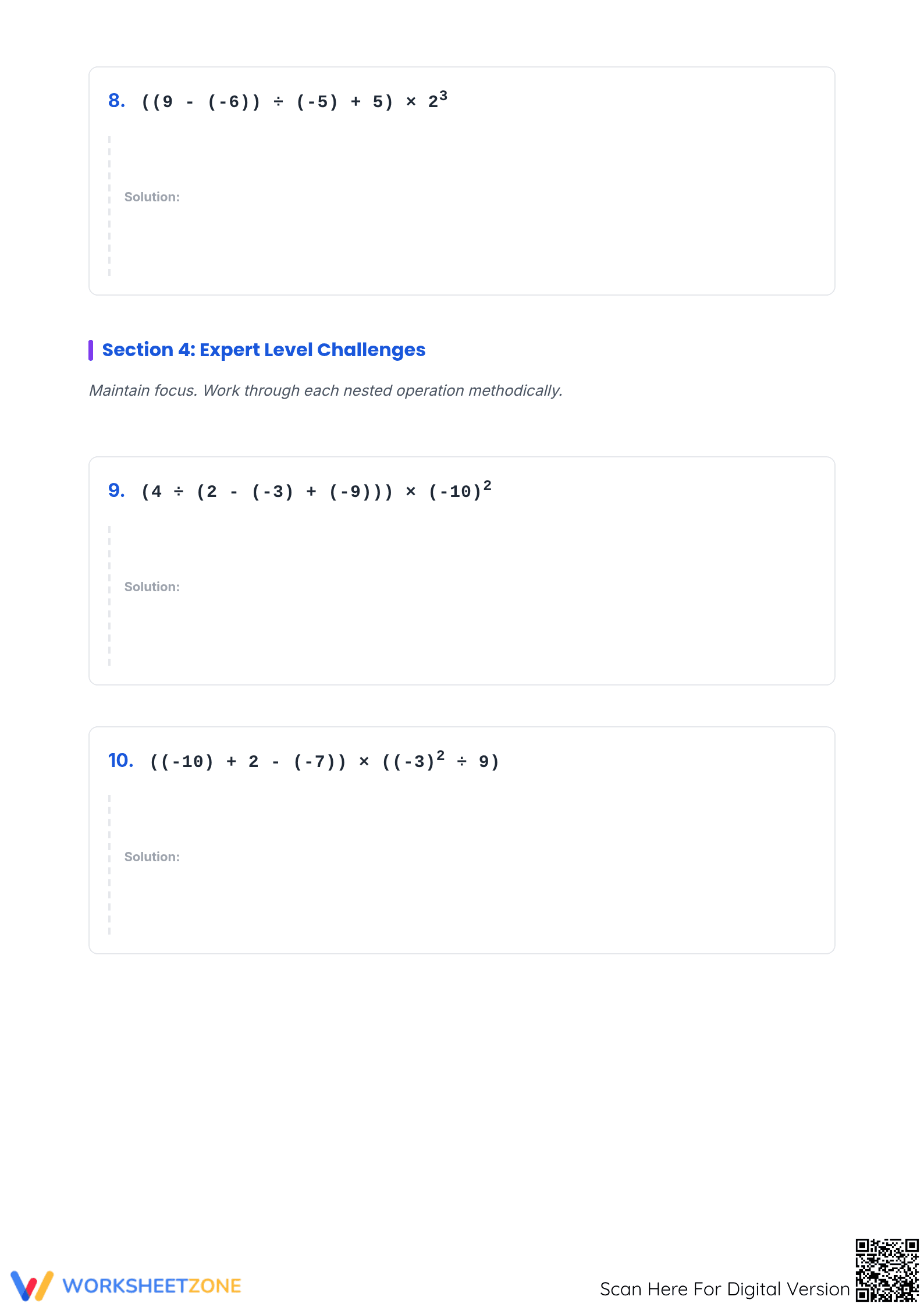
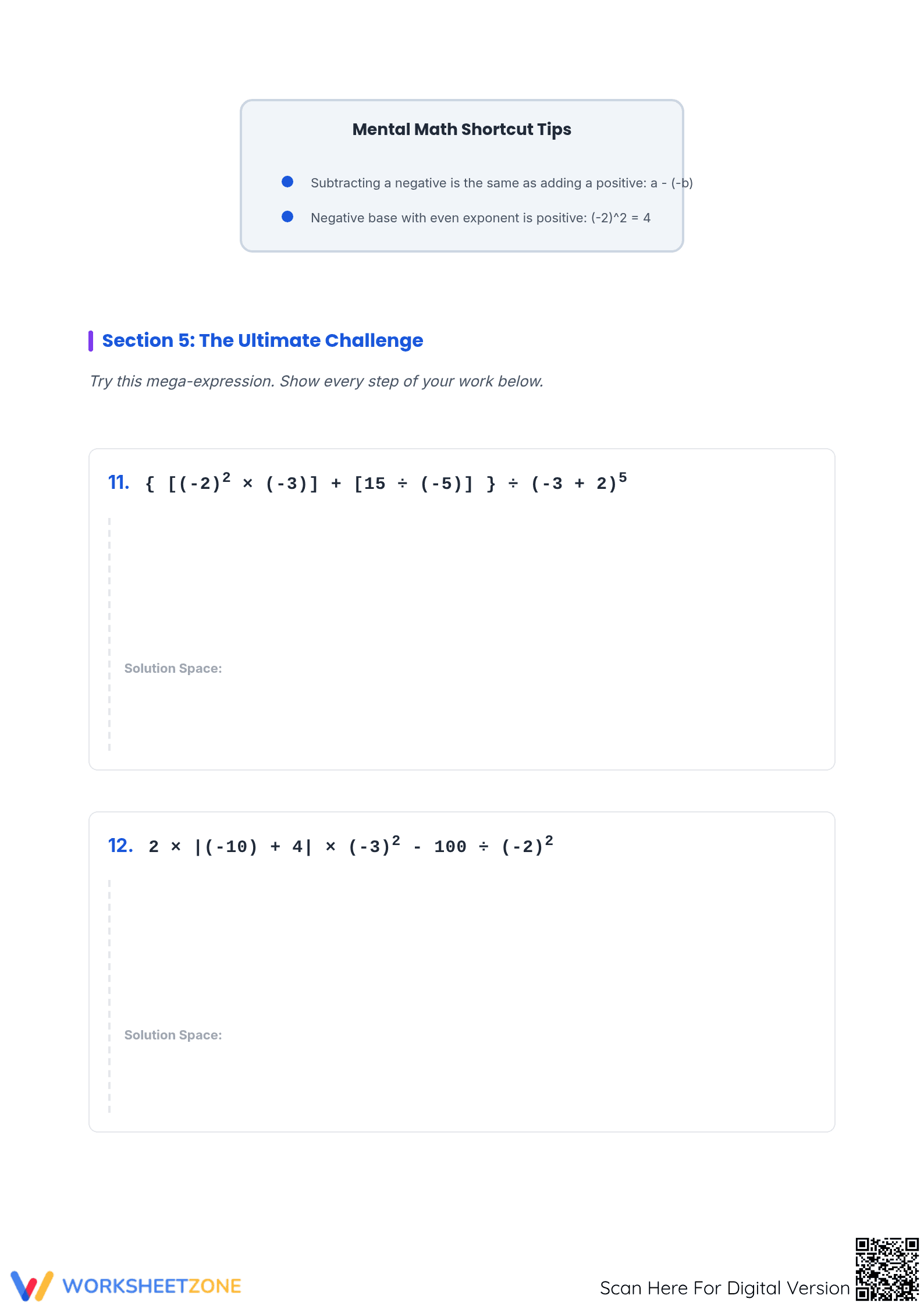
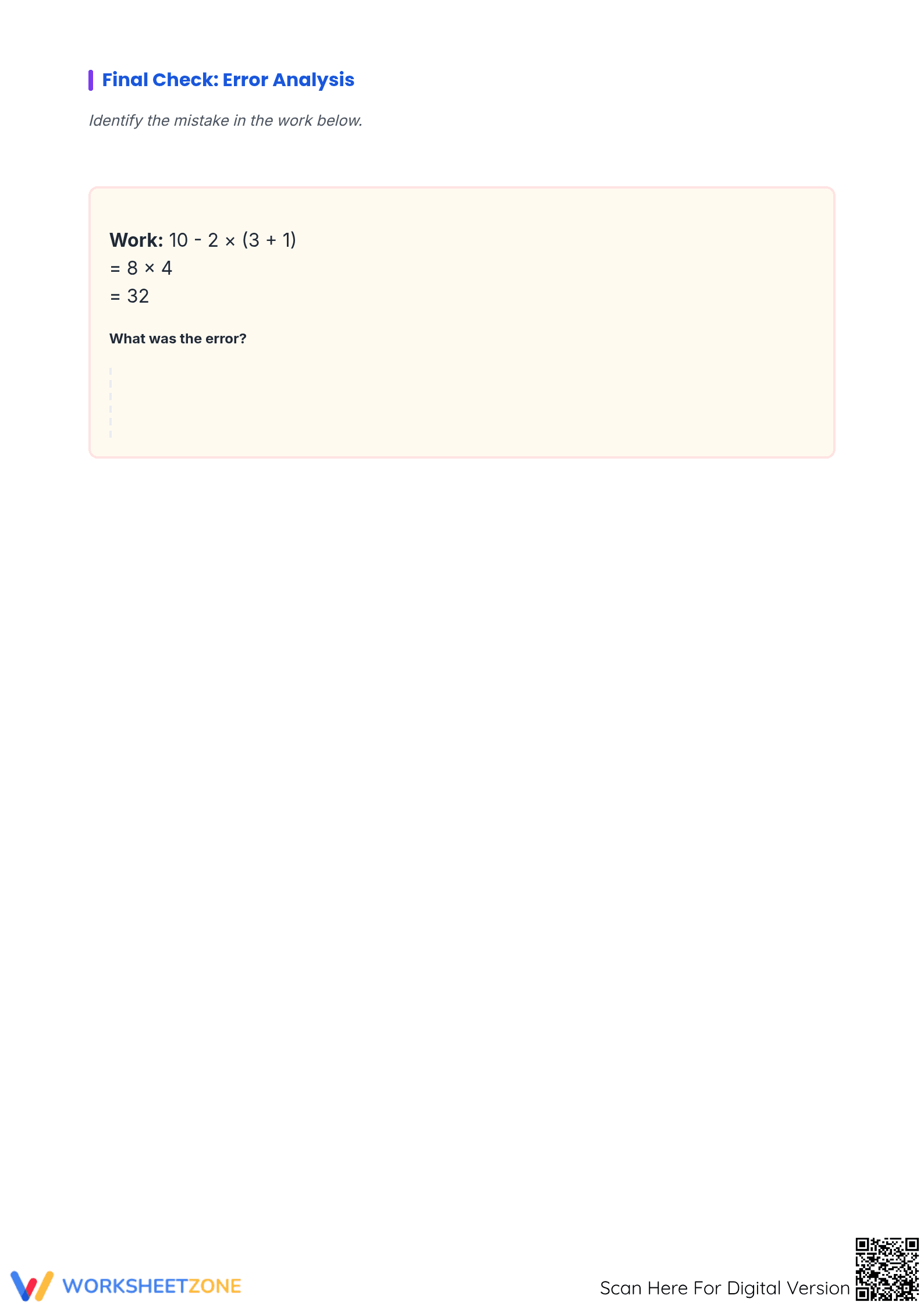
This 5-page PDF contains a structured progression of tasks, starting with a review of the PEMDAS hierarchy and a "Foundation Check" of four warm-up problems. The set expands into "Multi-Step Mastery" and "Expert Level Challenges" featuring nested parentheses and exponents. A dedicated "Ultimate Challenge" page presents complex mega-expressions, followed by an error analysis task to strengthen meta-cognitive skills. A full answer key is provided for immediate feedback.
Skill Progression
- Guided Practice: The worksheet begins with a visual mnemonic for the PEMDAS rules and 4 warm-up tasks to anchor foundational skills.
- Supported Practice: Students progress to 6 multi-step and expert challenges where they must methodically apply the order of operations to expressions with nested symbols.
- Independent Practice: The final sections require learners to solve 2 "Ultimate Challenge" mega-expressions and perform a detailed error analysis on a solved problem set.
This structure facilitates the gradual release of responsibility model, moving from rule review to independent problem-solving.
Standards Alignment
This resource is primarily aligned to CCSS.MATH.CONTENT.7.NS.A.3: "Solve real-world and mathematical problems involving the four operations with rational numbers." It also supports CCSS.MATH.CONTENT.6.EE.A.1 by incorporating exponents. Both standard codes can be copied directly into lesson plans, IEP goals, or district curriculum mapping tools.
How to Use It
Assign this worksheet during the "You Do" phase of a lesson on integer operations to assess student mastery of complex PEMDAS applications. For formative assessment, observe students during Section 4 to see if they maintain the correct order when working with nested brackets. It is also an excellent tool for test preparation or as an intensive sub plan.
Who It's For
This resource is designed for Grade 7 and 8 students who are ready to transition from basic arithmetic to pre-algebraic expressions. It is ideal for general education classrooms, accelerated Grade 6 learners, or high school students requiring remedial support with negative number operations and exponents.
Research by Fisher & Frey (2014) emphasizes the importance of the gradual release of responsibility model in mathematics instruction, particularly when students encounter complex multi-step procedures like the order of operations. This worksheet embodies that framework by scaffolding the learning process from a simple mnemonic review to high-complexity "Ultimate Challenges" and critical error analysis tasks. By requiring students to identify mistakes in the final section, the resource leverages meta-cognitive strategies shown to improve long-term retention of algebraic rules. Aligned with CCSS.MATH.CONTENT.7.NS.A.3, these 13 tasks ensure that students develop the procedural fluency necessary for higher-level algebra. The inclusion of mental math shortcut tips further supports the development of number sense, a critical predictor of success in secondary mathematics according to NAEP performance data. Educators can utilize these findings to justify the integration of structured practice in rigorous middle school curricula.


