


























Views
Downloads




Writing Algebraic Expressions | Essential Grade 6-8 Math
Paste this activity's link or code into your existing LMS (Google Classroom, Canvas, Teams, Schoology, Moodle, etc.).
Students can open and work on the activity right away, with no student login required.
You'll still be able to track student progress and results from your teacher account.
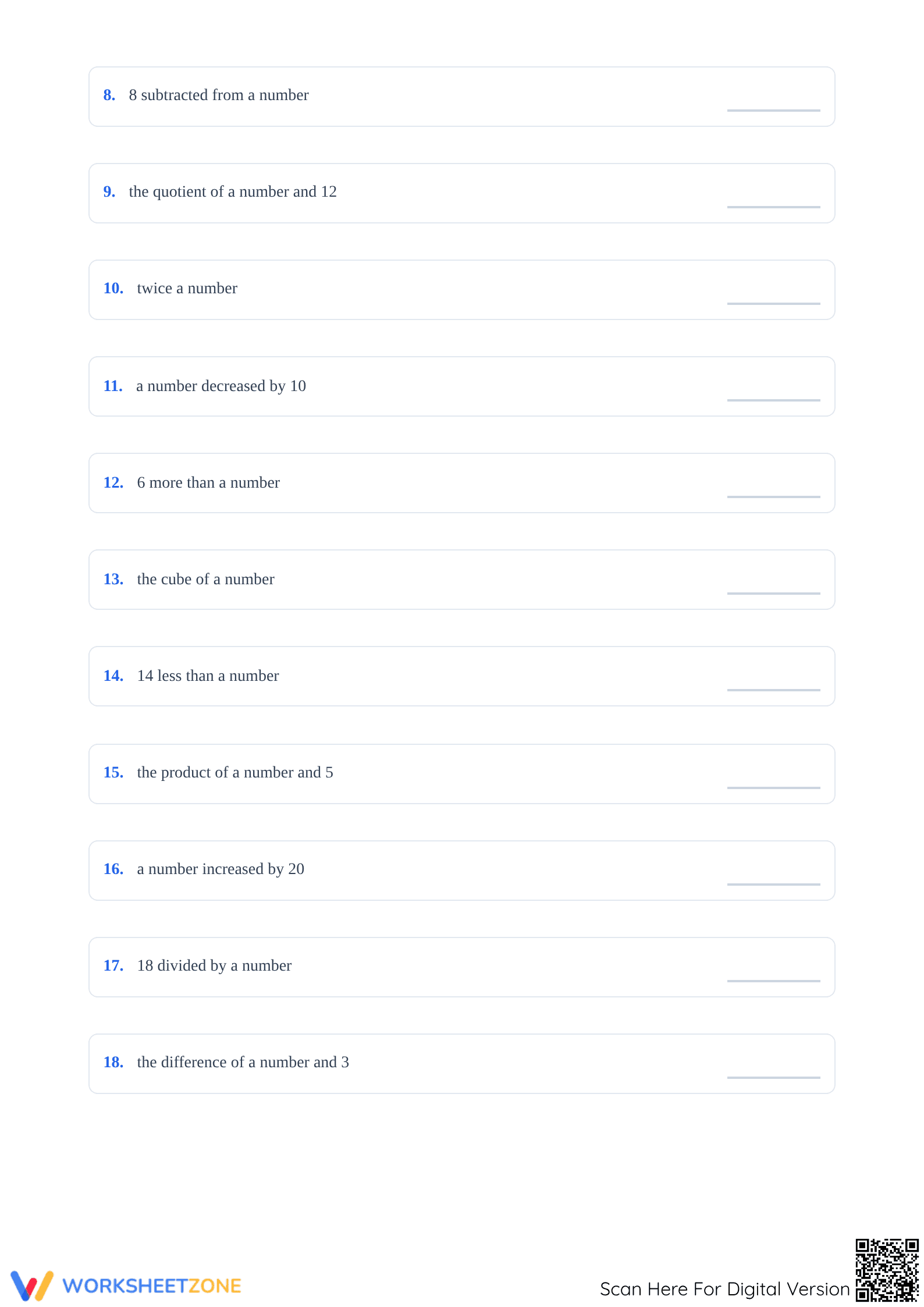
This comprehensive Grade 6-8 math worksheet empowers students to master the language of algebra by translating between verbal phrases and mathematical symbols. By practicing with 36 diverse problems, learners develop the fluency needed to represent real-world scenarios as algebraic expressions, ensuring a solid foundation for solving complex equations and functions.
At a Glance
- Grade: 6-8 · Subject: Math
- Standard:
6.EE.A.2.A— Write expressions that record operations with numbers and letters standing for numbers- Skill Focus: Algebraic Translation
- Format: 4 pages · 36 problems · Answer key included · PDF
- Best For: Independent practice and formative assessment
- Time: 30–45 minutes
This 4-page PDF contains two distinct sections designed for bidirectional mastery. Part I features 24 problems requiring students to convert verbal phrases into symbolic expressions using variables. Part II provides 12 symbolic expressions for students to translate back into written words. The layout includes ample white space for student work and a complete answer key for rapid grading.
Skill Progression
- Guided practice: Initial problems focus on single-operation phrases like "increased by" or "product of" to build basic vocabulary and confidence.
- Supported practice: Mid-range tasks introduce exponents and multi-step operations, such as "the sum of a number and 15," requiring careful reading.
- Independent practice: Final challenges require translating complex phrases involving parentheses and multiple variables, like "10 times the sum of a number and 4."
This sequence follows a gradual-release model, moving from simple identification to complex synthesis of mathematical language.
Standards Alignment
The primary focus is `CCSS.MATH.CONTENT.6.EE.A.2.A`, which requires students to write expressions that record operations with numbers and with letters standing for numbers. It also supports `CCSS.MATH.CONTENT.7.EE.B.4` by preparing students to use variables to represent quantities in real-world or mathematical problems. Both standard codes can be copied directly into lesson plans, IEP goals, or district curriculum mapping tools.
How to Use It
Use this resource during the "You Do" phase of a lesson on algebraic foundations to gauge individual student understanding. It also serves as an excellent formative assessment tool; observe students during Part II to see if they can accurately verbalize mathematical operations. Expect students to complete the full set in 30 to 45 minutes depending on their prior exposure to algebraic vocabulary.
Who It's For
This worksheet is ideal for middle school students in Grades 6 through 8, including those needing extra support with mathematical literacy. It pairs naturally with an anchor chart detailing "math action words" (e.g., quotient, difference, product) to scaffold the translation process for English Language Learners or students with IEPs who benefit from explicit vocabulary instruction.
According to the RAND AIRS 2024 report, the ability to translate between natural language and mathematical notation is a critical predictor of success in high school algebra. This worksheet targets 6.EE.A.2.A by providing 36 structured opportunities for students to practice this specific skill. Research by Fisher & Frey (2014) emphasizes that bidirectional translation—moving from words to symbols and symbols to words—deepens conceptual understanding more effectively than unidirectional practice alone. By engaging with both Part I and Part II, students reinforce their grasp of mathematical syntax and variable usage. This resource provides the high-repetition, low-stakes environment necessary for students to internalize the vocabulary of operations, ensuring they can accurately model quantitative relationships in more advanced coursework.


