


























Views
Downloads
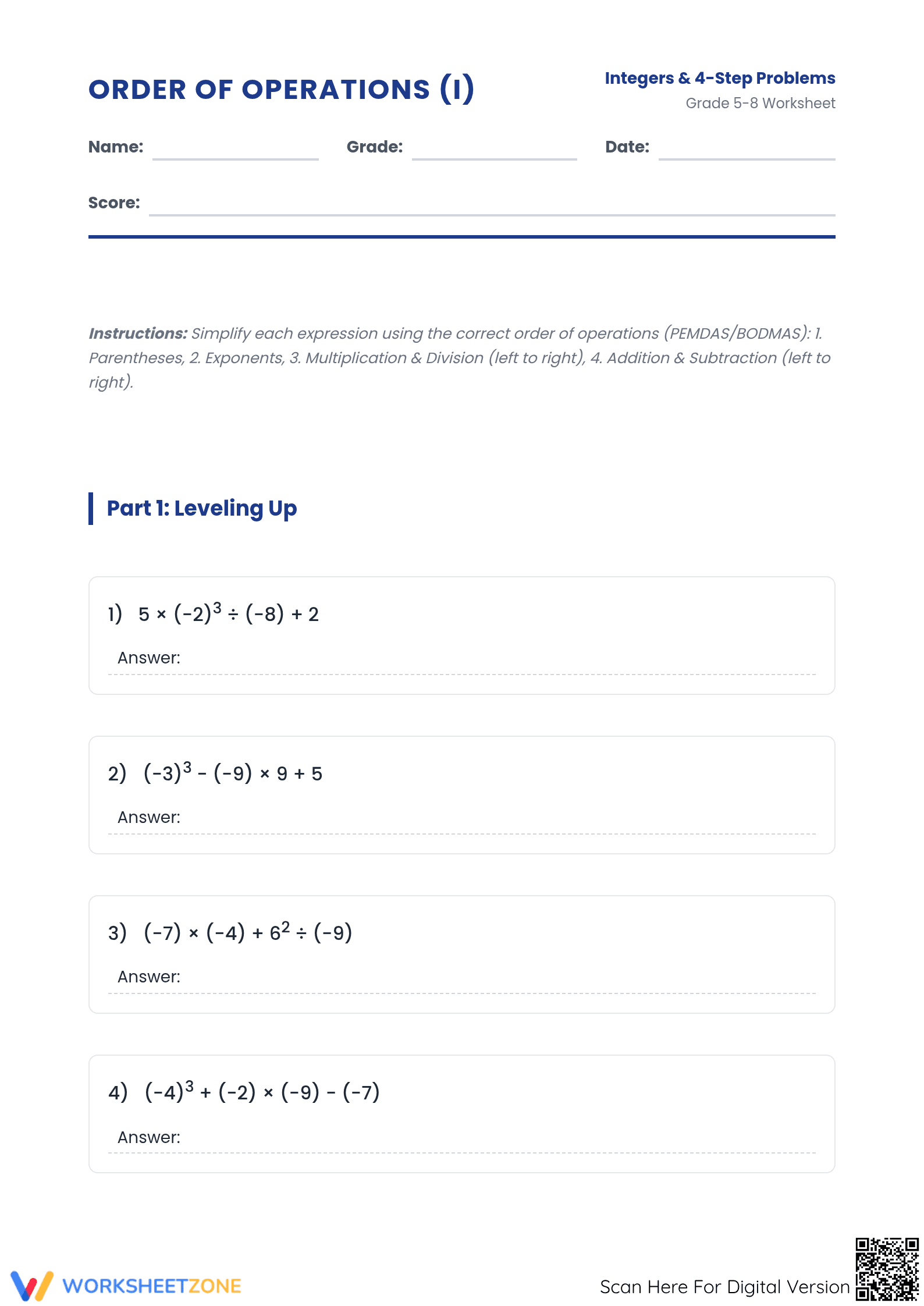
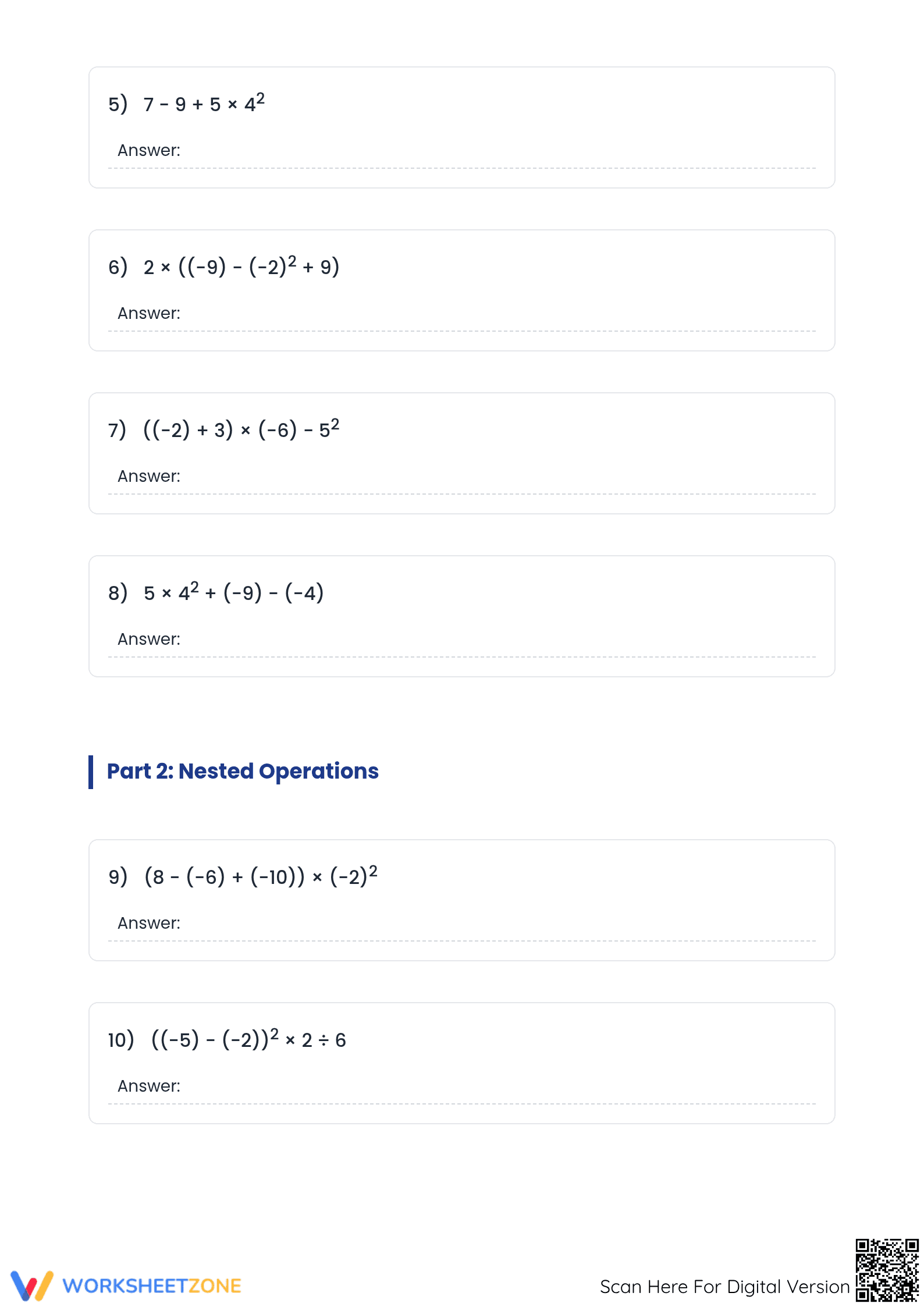
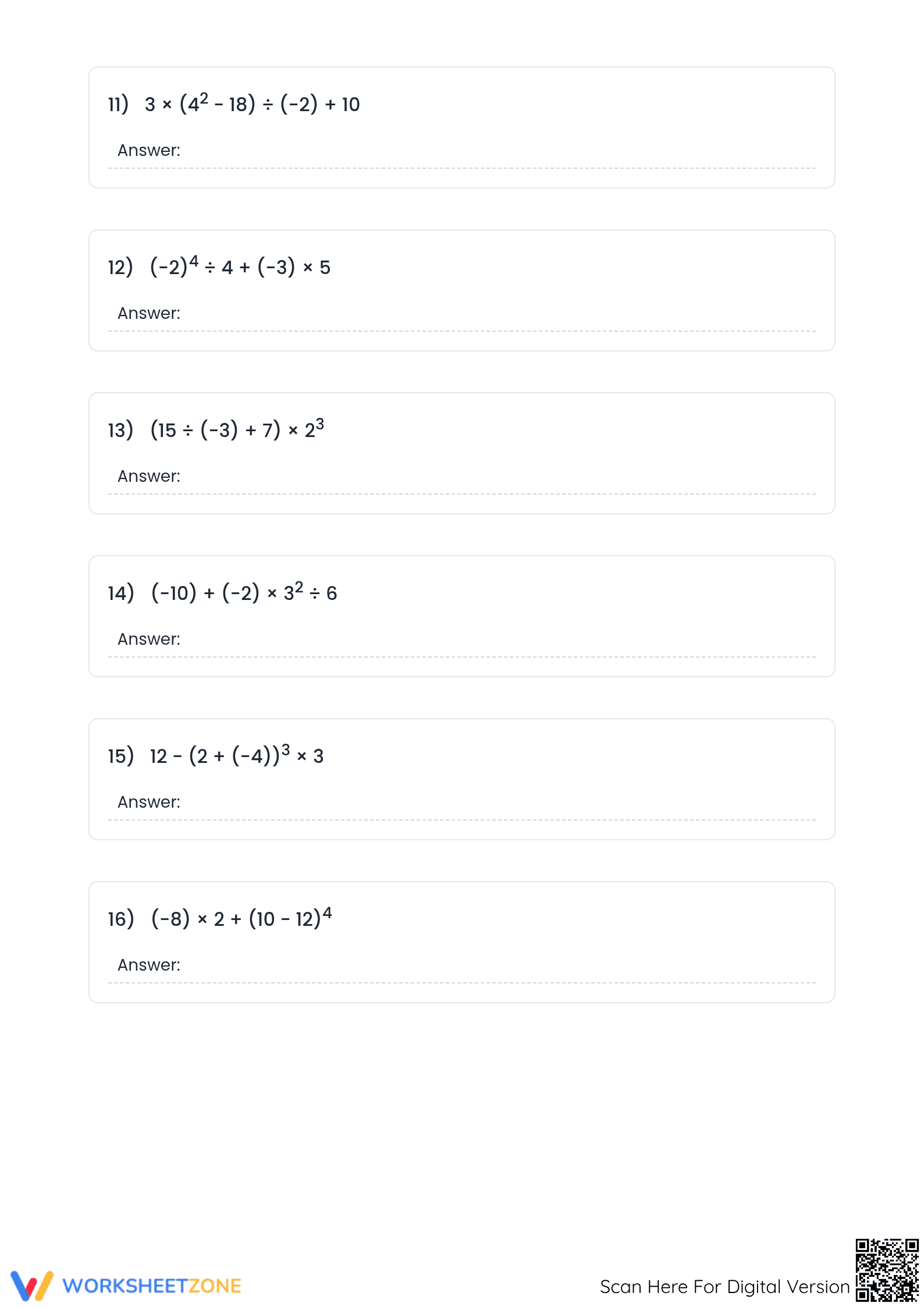
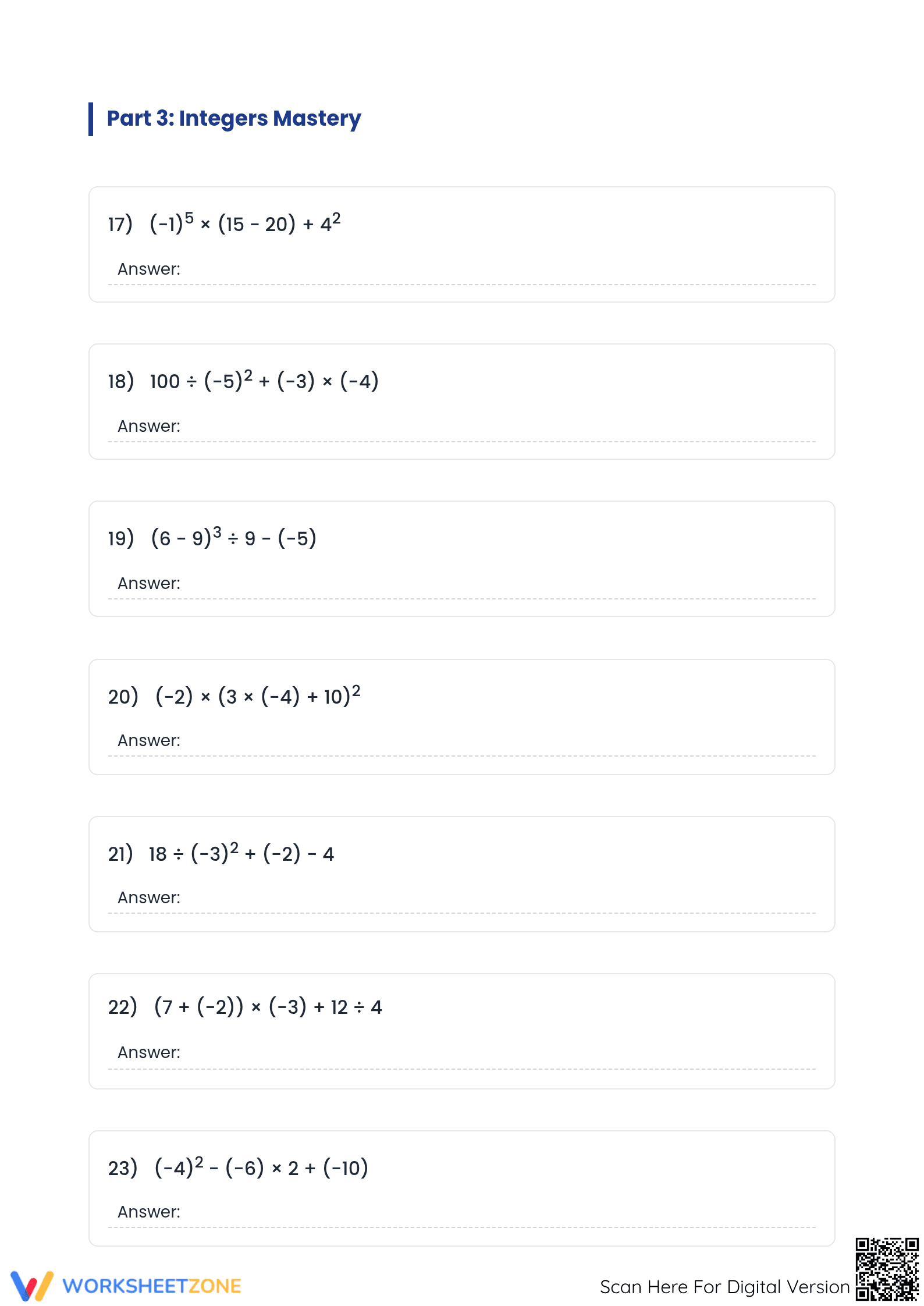

Printable Order of Operations Integer Worksheet | Grades 5-8
Paste this activity's link or code into your existing LMS (Google Classroom, Canvas, Teams, Schoology, Moodle, etc.).
Students can open and work on the activity right away, with no student login required.
You'll still be able to track student progress and results from your teacher account.
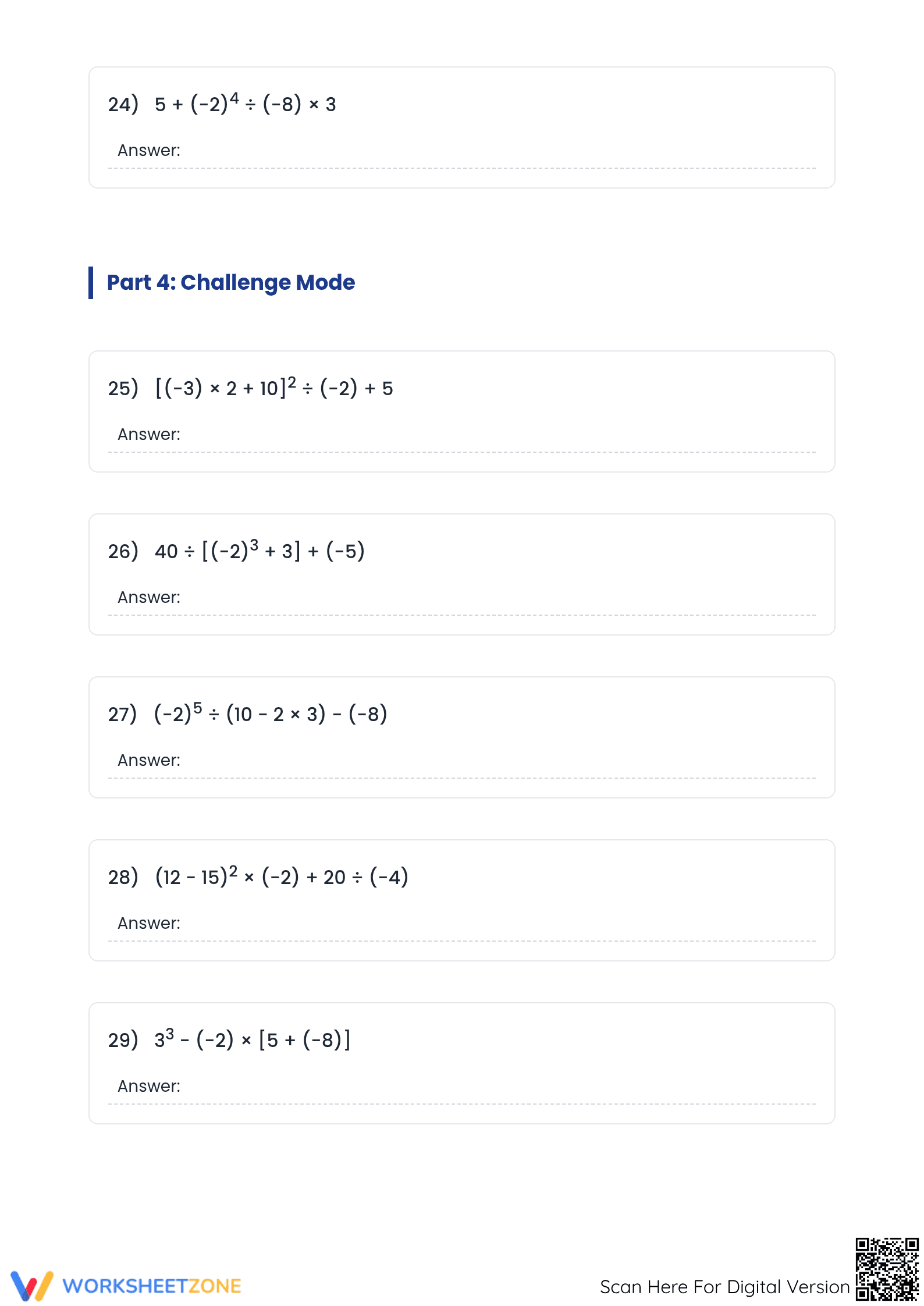
Equip your middle school students with the essential skills to master the order of operations using this comprehensive integers worksheet. This 5-page resource provides a structured progression through 29 problems, challenging students to evaluate complex expressions involving parentheses, exponents, and negative numbers. Students will achieve procedural fluency while building a solid foundation for algebra.
At a Glance
- Grade: 5–8 · Subject: Math
- Standard:
CCSS.MATH.CONTENT.6.EE.A.1— Write and evaluate numerical expressions involving whole-number exponents and operations- Skill Focus: 4-Step Order of Operations (Integers)
- Format: 5 pages · 29 problems · Answer key included · PDF
- Best For: Independent practice and skills mastery
- Time: 30–45 minutes
Inside this 5-page PDF are 29 unique problems divided into four logical sections. The worksheet features 4-step expressions incorporating all four operations and exponents. It includes PEMDAS/BODMAS instructions, spacious answer fields, and a complete answer key. Structural supports like nested parentheses and varied integer combinations help students visualize the hierarchy of operations effectively during independent work.
Skill Progression
- Guided Practice: The "Leveling Up" section introduces foundational 4-step problems with consistent structures to build initial confidence.
- Supported Practice: "Nested Operations" and "Integers Mastery" increase complexity with inner parentheses and multiple exponents, requiring careful sequencing.
- Independent Practice: "Challenge Mode" offers problems requiring students to synthesize all operational rules without external cues or scaffolds.
This gradual release of responsibility model ensures students master each operational layer before tackling high-difficulty nested structures.
Standards Alignment
This resource is primarily aligned with CCSS.MATH.CONTENT.6.EE.A.1, which requires students to write and evaluate numerical expressions involving whole-number exponents. It also supports CCSS.MATH.CONTENT.7.NS.A.3 by requiring the application of operational properties to solve mathematical problems with rational numbers. Both standard codes can be copied directly into lesson plans, IEP goals, or district curriculum mapping tools.
How to Use It
This worksheet is ideal for independent practice or a comprehensive homework assignment. Use the 'Challenge Mode' as a formative assessment to observe how students handle nested grouping symbols. Expected completion time ranges from 30 to 45 minutes. Teachers can use it for sub plans or as a skills-based review before unit tests to identify specific procedural gaps.
Who It's For
This material is designed for Grade 5 through Grade 8 students refining their understanding of integer operations. It is effective for students requiring scaffolding in PEMDAS or as an extension for advanced learners. Pair this worksheet with a PEMDAS anchor chart to support students struggling with operational sequencing during independent work sessions in a general or special education setting.
Aligned to standard CCSS.MATH.CONTENT.6.EE.A.1, this comprehensive worksheet facilitates student mastery of the order of operations involving integers and exponents. By navigating four distinct stages of complexity—Leveling Up, Nested Operations, Integers Mastery, and Challenge Mode—learners develop the procedural fluency necessary for algebraic success. According to the RAND AIRS (2024) report, structured practice that incorporates varying levels of cognitive demand significantly improves retention of mathematical conventions like PEMDAS. This resource provides 29 meticulously designed tasks that transition students from basic 4-step expressions to complex nested structures, ensuring a robust understanding of how negative numbers interact within mathematical hierarchies. Such deliberate scaffolding aligns with best practices in middle school mathematics instruction, allowing teachers to identify specific misconceptions in integer arithmetic or operational sequencing early in the learning cycle. The inclusion of a full answer key supports immediate feedback and self-correction, which are critical components of the gradual release of responsibility model.


