


























Views
Downloads
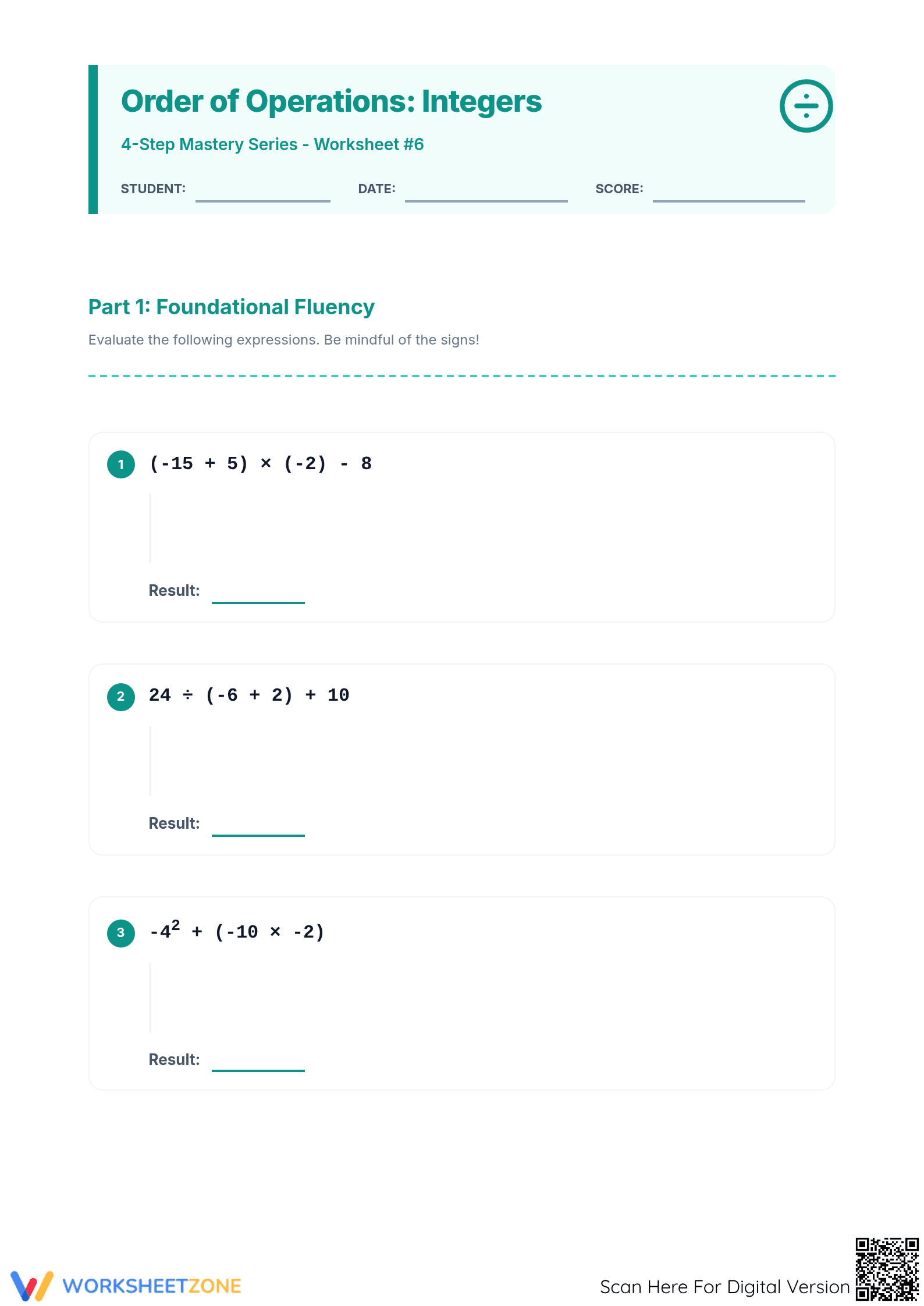
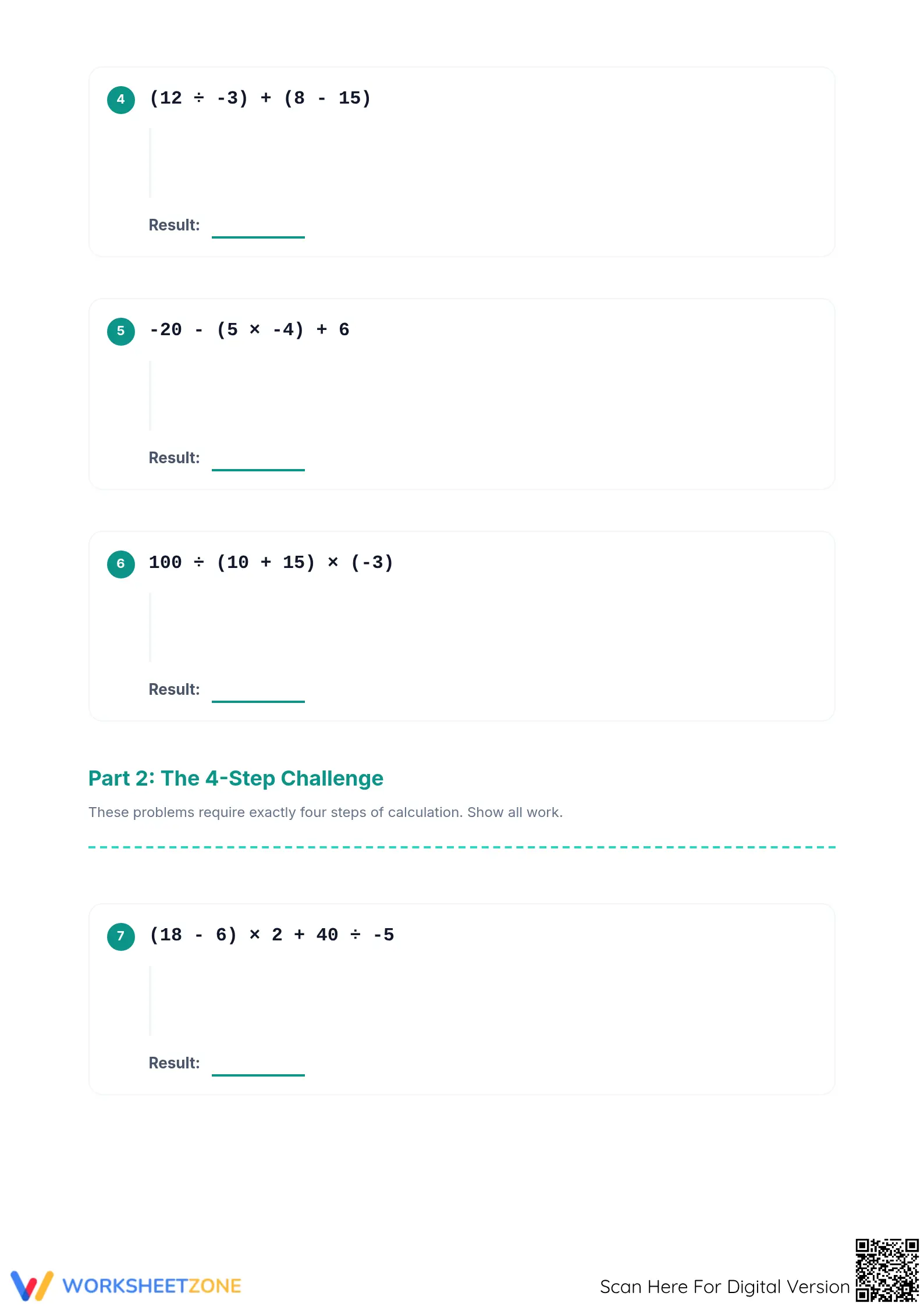
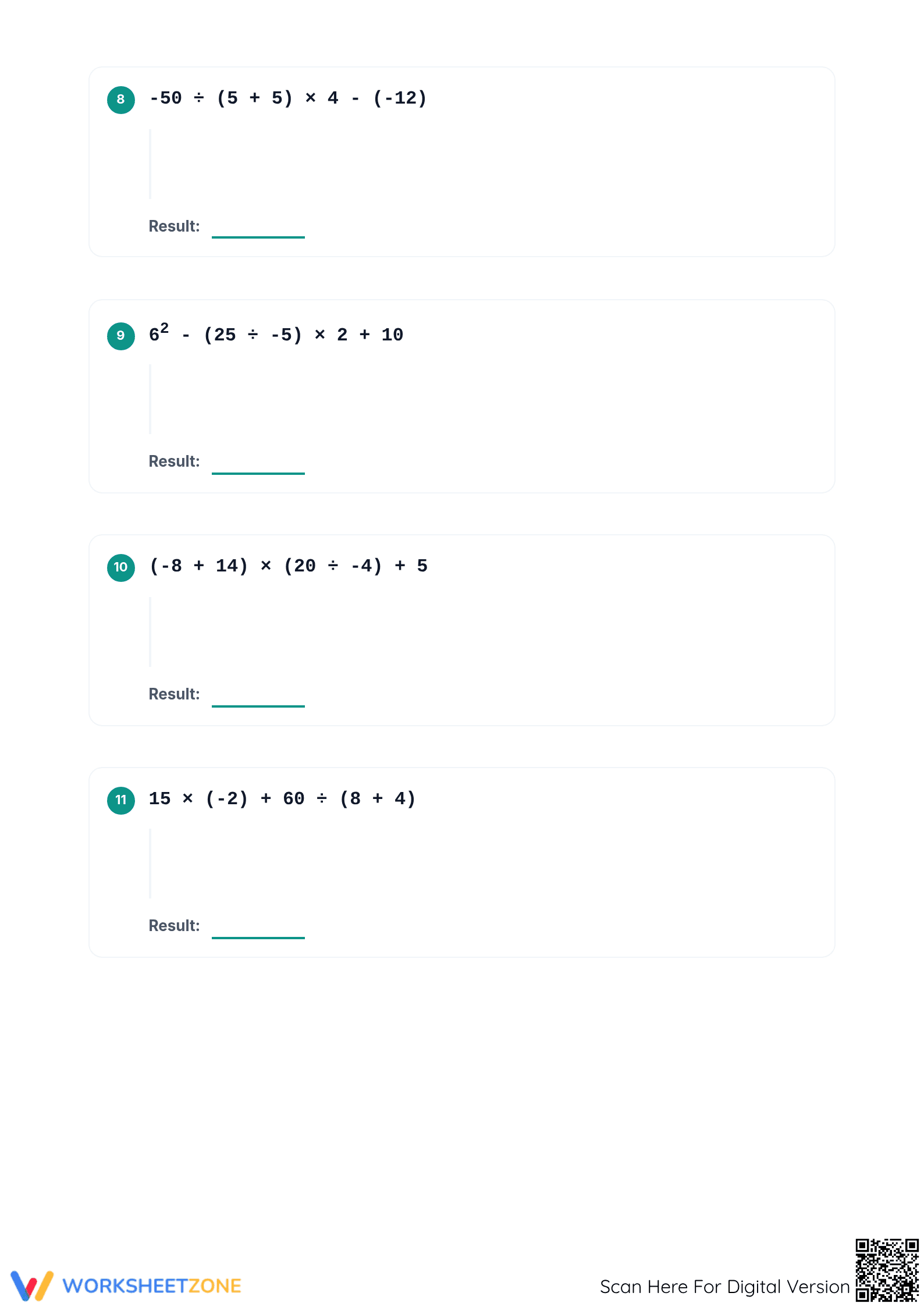
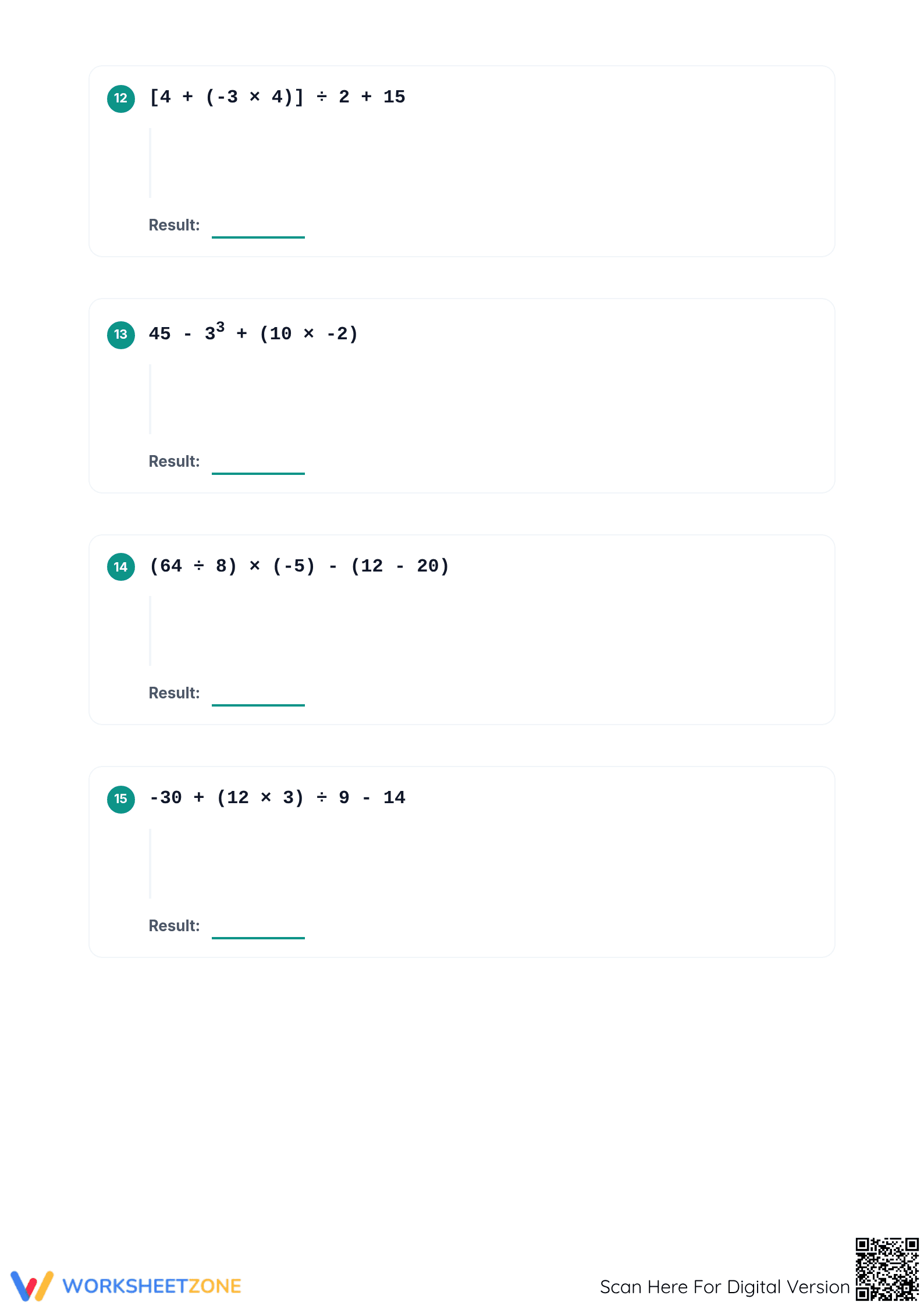

Printable 4-Step Order of Operations Integers Mastery
Paste this activity's link or code into your existing LMS (Google Classroom, Canvas, Teams, Schoology, Moodle, etc.).
Students can open and work on the activity right away, with no student login required.
You'll still be able to track student progress and results from your teacher account.
Master the complexities of integer calculations with this comprehensive order of operations worksheet. Designed for Grade 7 students, this resource focuses on evaluating expressions with positive and negative numbers using PEMDAS. Students will build computational fluency and confidence as they work through increasingly difficult multi-step problems featuring parentheses, exponents, and brackets.
At a Glance
- Grade: 7 · Subject: Math
- Standard:
7.NS.A.3— Solve multi-step mathematical problems involving the four operations with rational numbers- Skill Focus: Order of Operations with Integers
- Format: 5 pages · 19 problems · Answer key included · PDF
- Best For: Independent practice and mastery assessment
- Time: 30–45 minutes
This five-page instructional packet contains 19 meticulously crafted problems that guide students through the rules of integer arithmetic. The worksheet is organized into three distinct parts, ensuring a gradual release of responsibility. It includes a clear header for student tracking and a full answer key for efficient grading or self-check moments during class.
Skill Progression
- Foundational Fluency: The first 6 problems focus on two-step expressions, allowing students to practice basic integer rules and parentheses.
- The 4-Step Challenge: Problems 7 through 15 introduce additional operations, requiring students to carefully track negative signs across four distinct calculation steps.
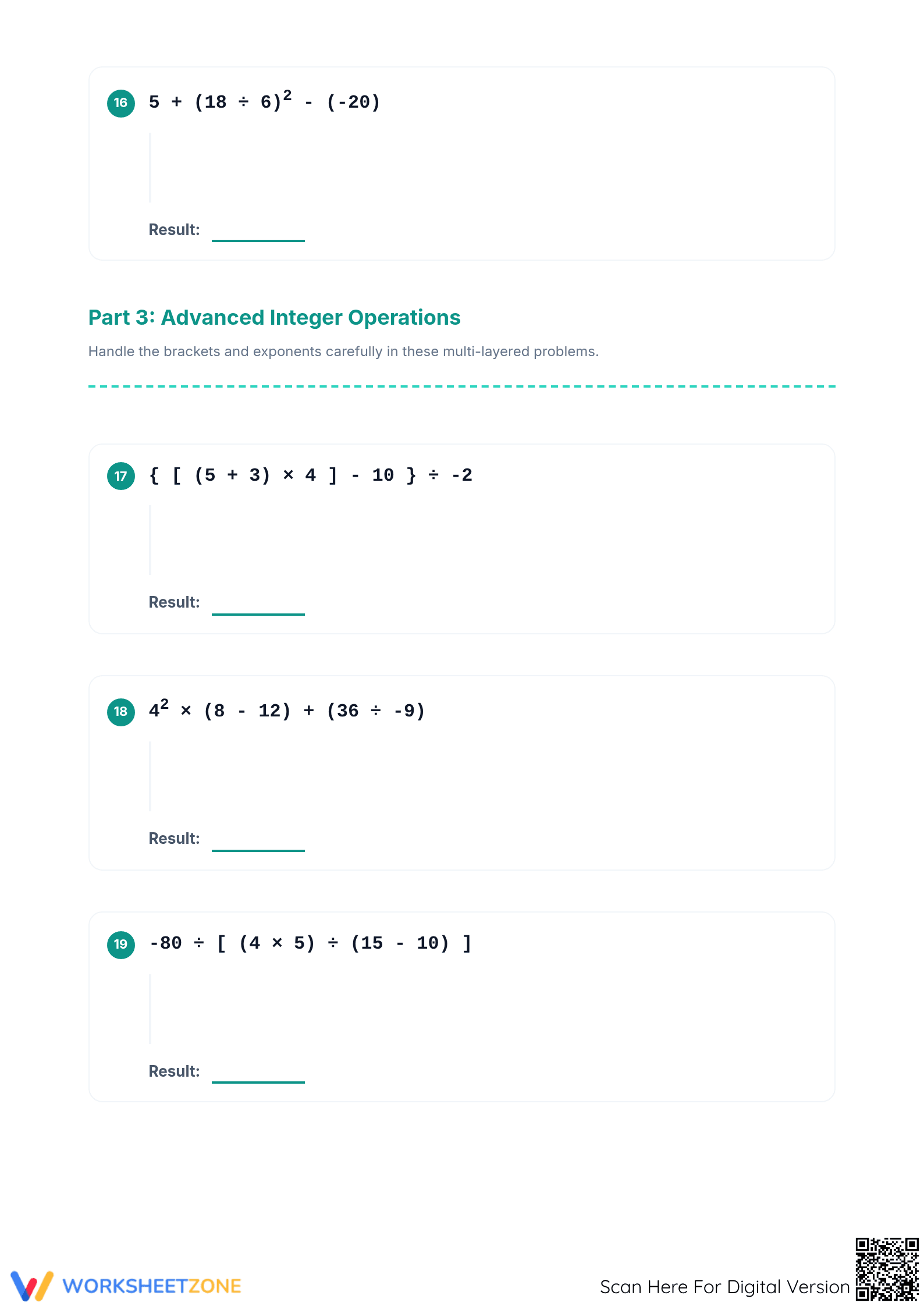
- Advanced Operations: The final 3 problems incorporate exponents and nested brackets, pushing students toward full mastery of complex numerical expressions.
Each section builds upon the previous one, following a gradual-release model that moves students from basic recall to complex application.
Standards Alignment
This resource is strictly aligned to CCSS.MATH.CONTENT.7.NS.A.3, which requires students to solve mathematical problems involving the four operations with rational numbers. It also supports CCSS.MATH.CONTENT.6.EE.A.1 by introducing numerical expressions involving exponents. Both standard codes can be copied directly into lesson plans, IEP goals, or district curriculum mapping tools.
How to Use It
Use this worksheet as a summative assessment following a unit on integer operations to gauge individual student progress. Alternatively, assign specific sections as differentiated homework based on current student performance levels. During instruction, observe how students handle the "4-Step Challenge" to identify common misconceptions regarding sign changes. Expect completion within 30 to 45 minutes.
Who It's For
This resource is ideal for Grade 7 math students, but also serves as a robust review for Grade 8 learners or an extension for advanced Grade 6 classes. Pair this worksheet with a visual anchor chart for PEMDAS or a guided lesson on integer multiplication rules for maximum instructional impact.
The 7.NS.A.3 standard emphasizes the necessity of computational fluency with integers as a prerequisite for algebraic success. According to EdReports 2024, high-quality instructional materials must provide sufficient opportunities for students to apply mathematical rules in varied contexts to ensure long-term retention. This worksheet facilitates that application by providing 19 problems that transition from foundational fluency to advanced multi-layered operations. Research from Fisher & Frey (2014) indicates that a gradual release of responsibility—moving from guided to independent practice—is essential for students to internalize the logic of order of operations. By isolating integer operations within the PEMDAS framework, this resource allows teachers to identify specific breakdown points in student reasoning. This systematic approach ensures that students are not merely memorizing steps but are developing a deep, conceptual understanding of how numbers interact within complex expressions.


