


























Views
Downloads

Integer Order of Operations Worksheet | Grade 6 Essential
Paste this activity's link or code into your existing LMS (Google Classroom, Canvas, Teams, Schoology, Moodle, etc.).
Students can open and work on the activity right away, with no student login required.
You'll still be able to track student progress and results from your teacher account.
Mastering the order of operations with integers is a foundational requirement for success in middle school algebra. This comprehensive worksheet provides students with targeted practice in simplifying complex numerical expressions using PEMDAS rules. By integrating negative numbers and exponents, learners develop the precision needed for advanced mathematical computation and multi-step problem-solving.
At a Glance
- Grade: 6 · Subject: Math
- Standard:
CCSS.MATH.CONTENT.6.EE.A.1— Write and evaluate numerical expressions involving whole-number exponents and multiple operations- Skill Focus: Integer PEMDAS and Nested Parentheses
- Format: 5 pages · 25 problems · Answer key included · PDF
- Best For: Middle school math skill reinforcement
- Time: 45–60 minutes
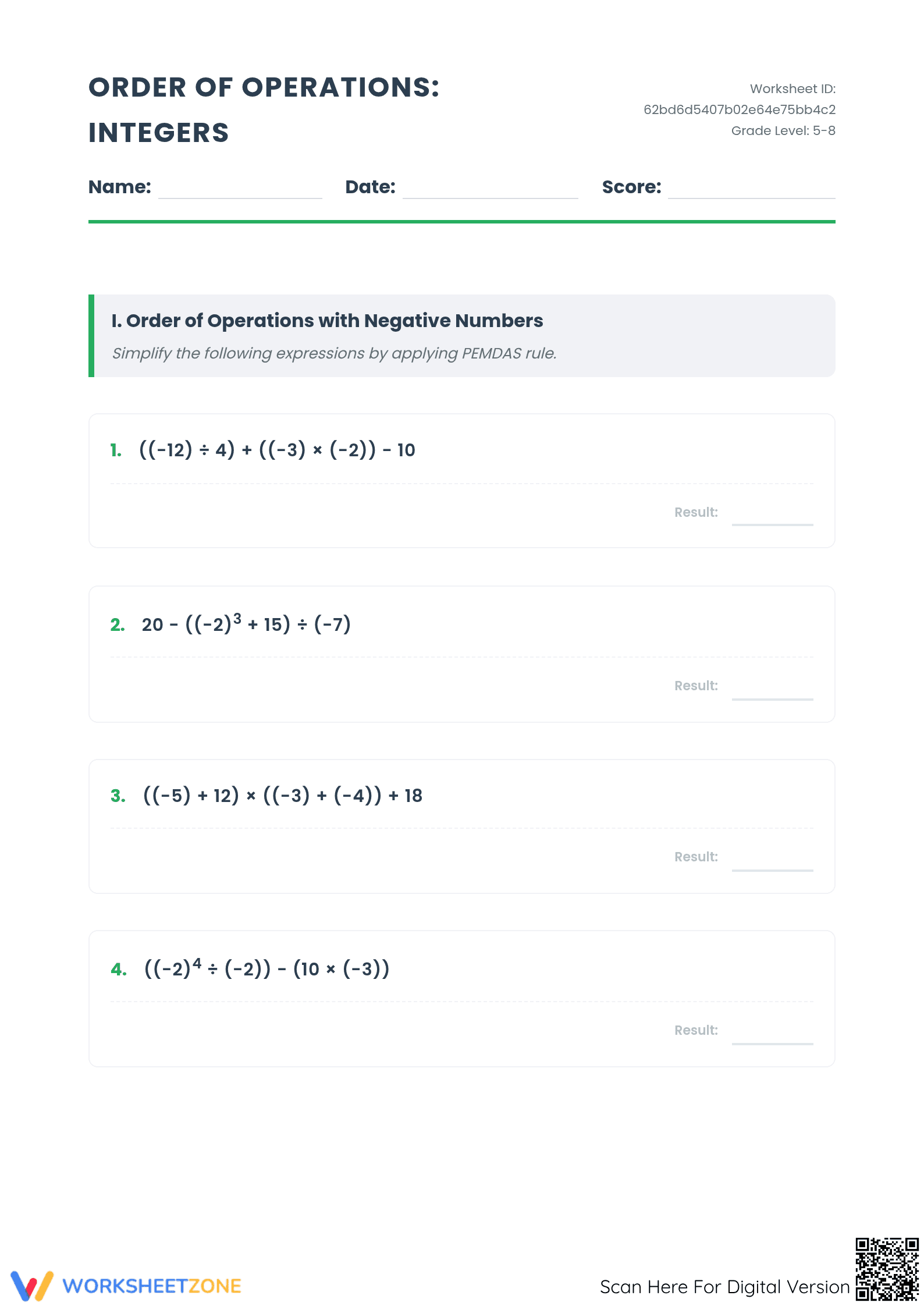
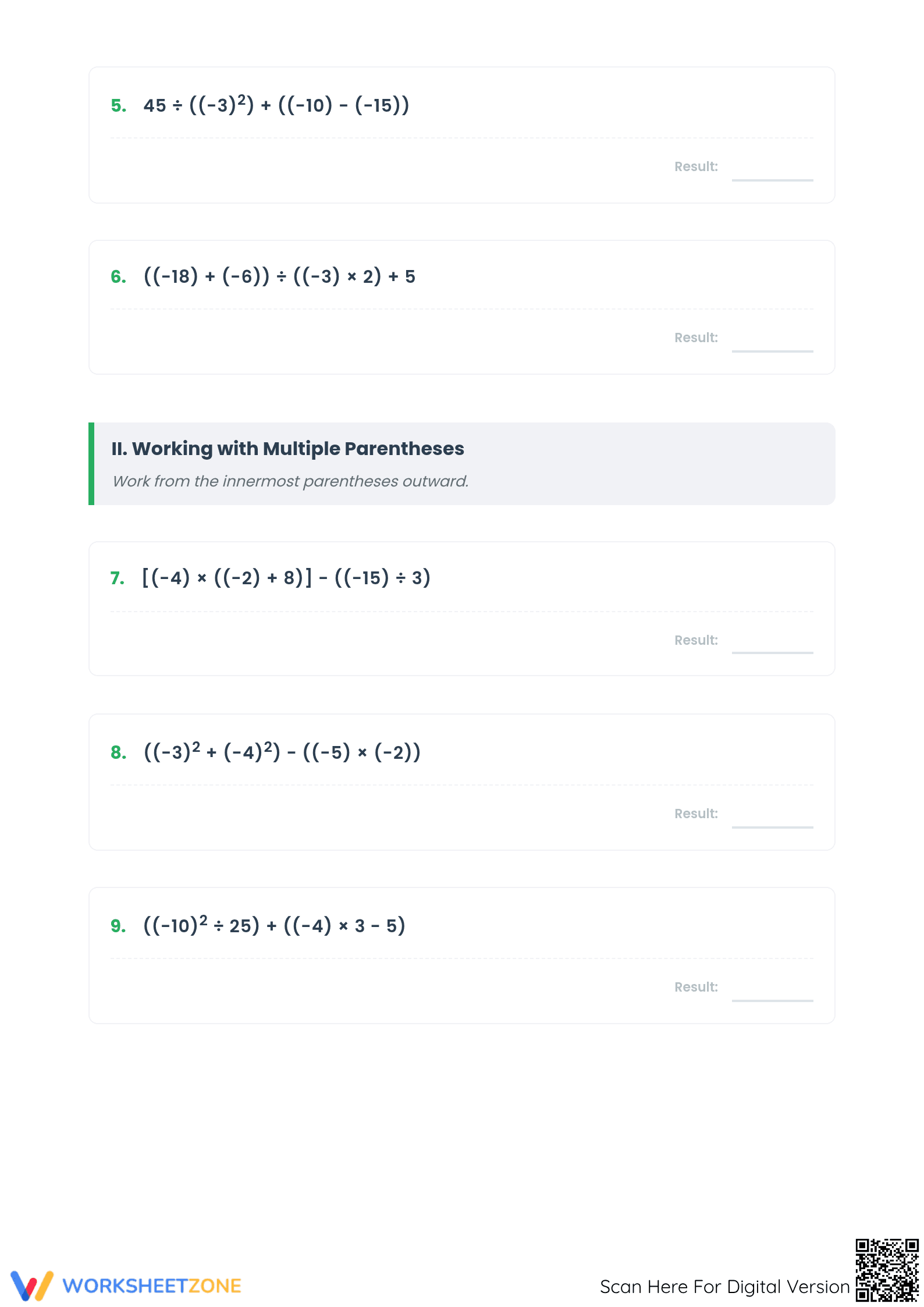
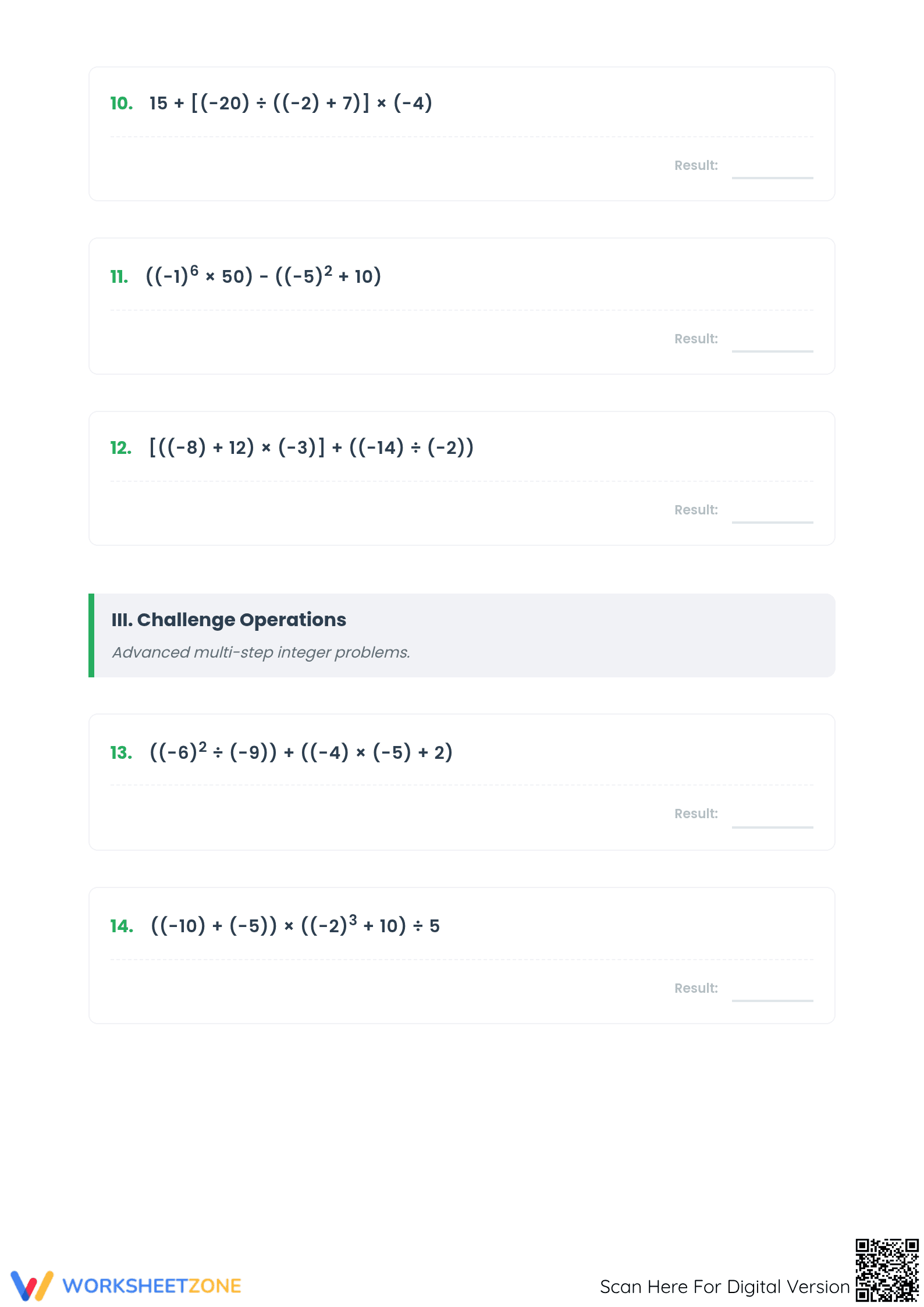
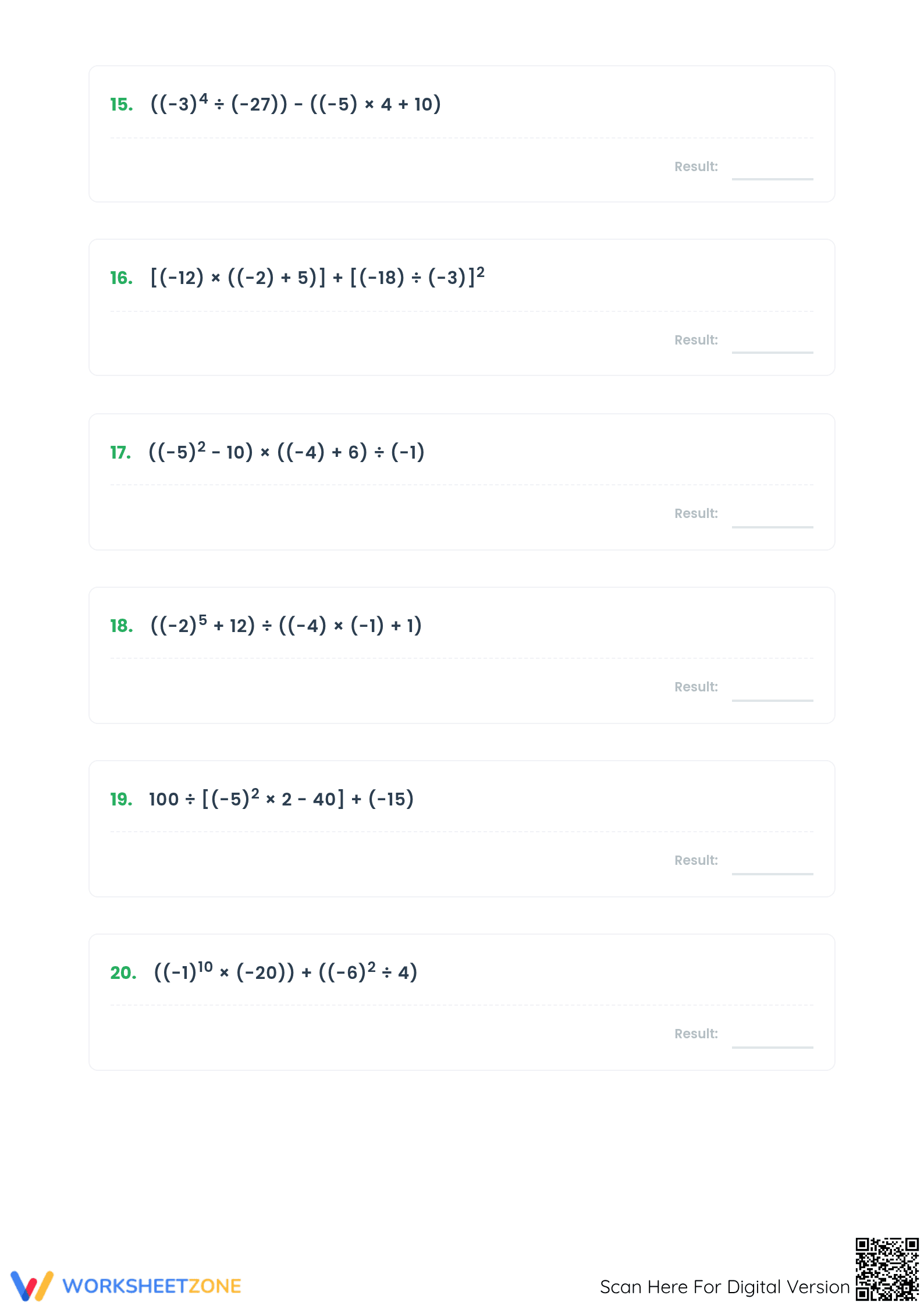
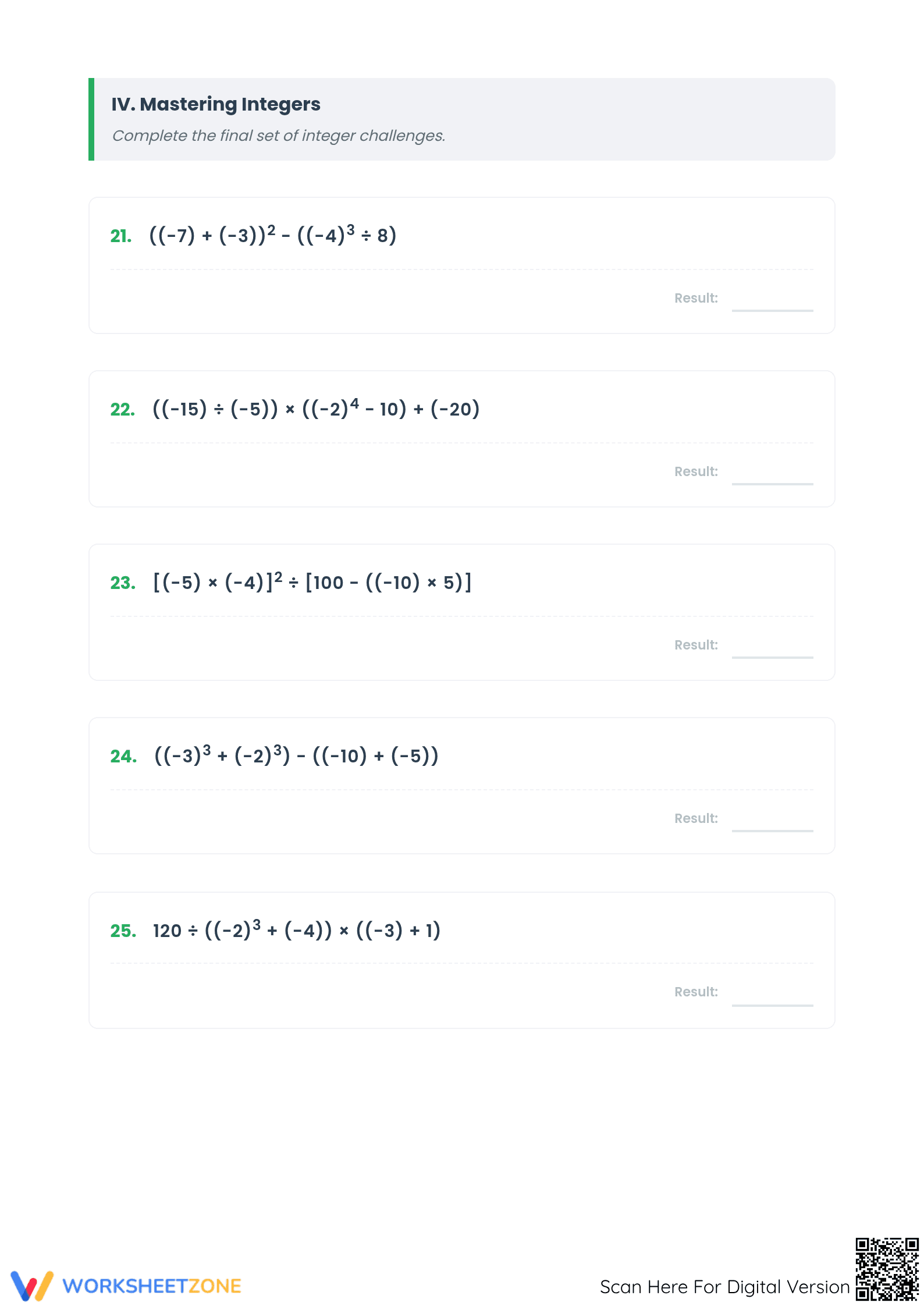
This 5-page PDF features 25 problems divided into four instructional sections. Each page increases complexity, starting with basic negative numbers and progressing to nested brackets and exponents. The layout provides workspace for students to show step-by-step thinking, and a complete answer key is provided for rapid grading or self-correction during independent study sessions.
Skill Progression
- Guided Practice: The first 6 problems focus on fundamental PEMDAS application with basic integer operations to build initial confidence and fluency.
- Supported Practice: Problems 7 through 12 introduce multiple parentheses and exponents, requiring students to manage operational priority and negative signs within complex expressions.
- Independent Practice: The final 13 problems present "Challenge" scenarios where students synthesize all rules to evaluate multi-step expressions without structural hints.
This gradual release of responsibility ensures that students internalize the procedural flow of complex integer arithmetic while building stamina for longer calculations.
Standards Alignment
The primary alignment for this resource is CCSS.MATH.CONTENT.6.EE.A.1: Write and evaluate numerical expressions involving whole-number exponents. Additionally, it supports CCSS.MATH.CONTENT.7.NS.A.2 by requiring students to apply operations to rational numbers. Both standard codes can be copied directly into lesson plans, IEP goals, or district curriculum mapping tools.
How to Use It
Deploy this worksheet after a direct instruction lesson on PEMDAS to provide rigorous independent practice. It serves as an excellent formative assessment tool; teachers should observe if students are correctly distributing negative signs within nested parentheses. The 25-problem set can be split across multiple days or assigned as a comprehensive review packet before a unit test. Expected completion time ranges from 45 to 60 minutes.
Who It's For
This resource is designed for 6th and 7th-grade math students, but it is also highly effective for 8th-grade remediation or Algebra 1 prep. The clear section headings allow for easy differentiation, as teachers can assign specific pages based on individual student readiness. Pair this with a digital integer calculator or number line anchor chart for additional scaffolding where needed.
Research from NAEP indicates that fluency in order of operations is a significant predictor of student success in high school mathematics. According to Fisher & Frey (2014), a structured approach to multi-step problem solving—moving from guided to independent practice—is essential for internalizing mathematical procedures. This worksheet addresses the specific cognitive load challenges associated with integer operations by breaking the process into four logical phases. By providing 25 rigorous tasks aligned to CCSS.MATH.CONTENT.6.EE.A.1, it ensures students develop the procedural precision required for evaluating numerical expressions with exponents and nested grouping symbols. The inclusion of challenge-level problems aligns with current best practices for mathematical rigor, encouraging students to apply their knowledge to non-routine tasks. Educators can use these data-driven tasks to identify specific misconceptions regarding negative numbers or the hierarchy of operations before transitioning to algebraic variables.


