


























Views
Downloads
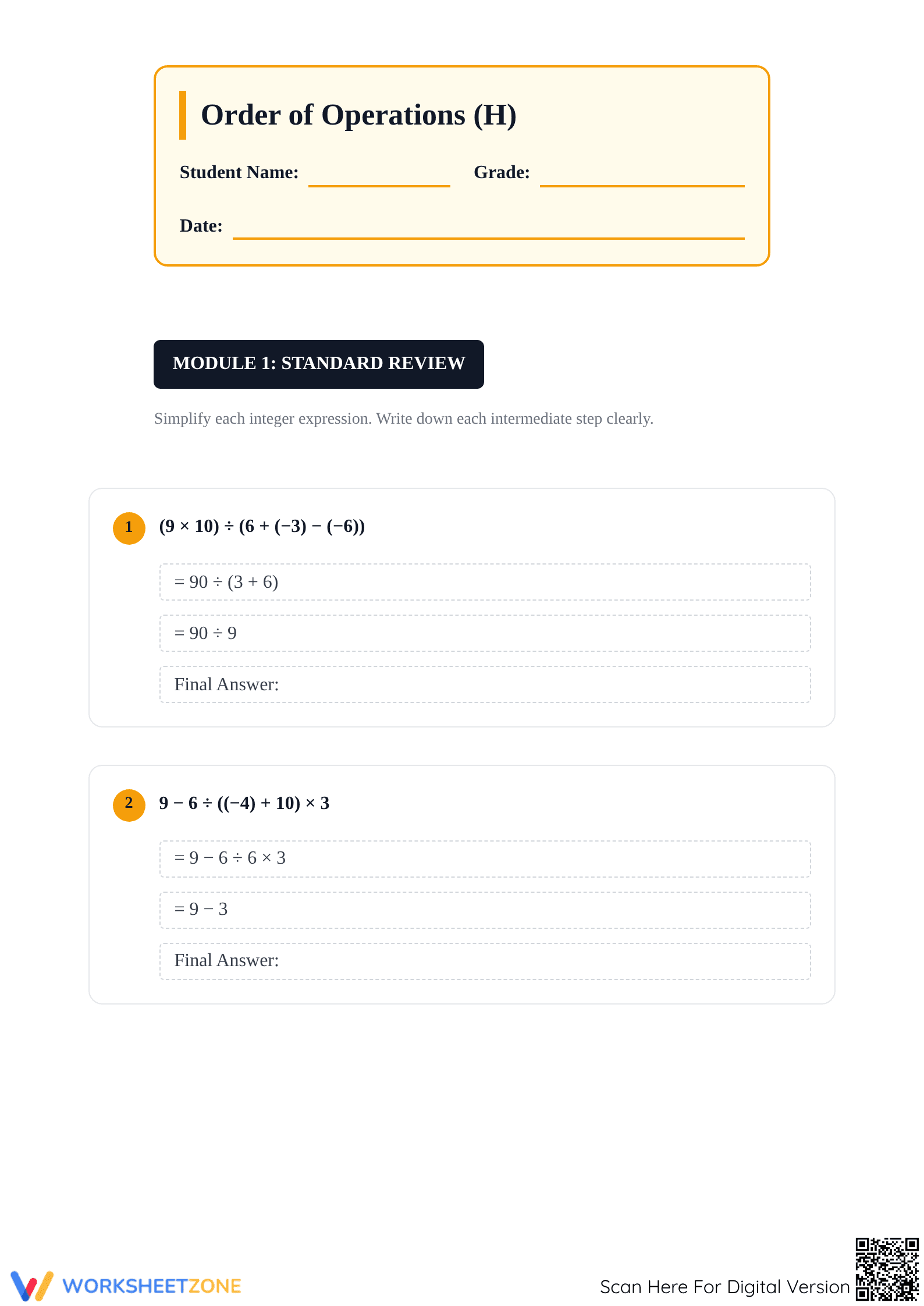
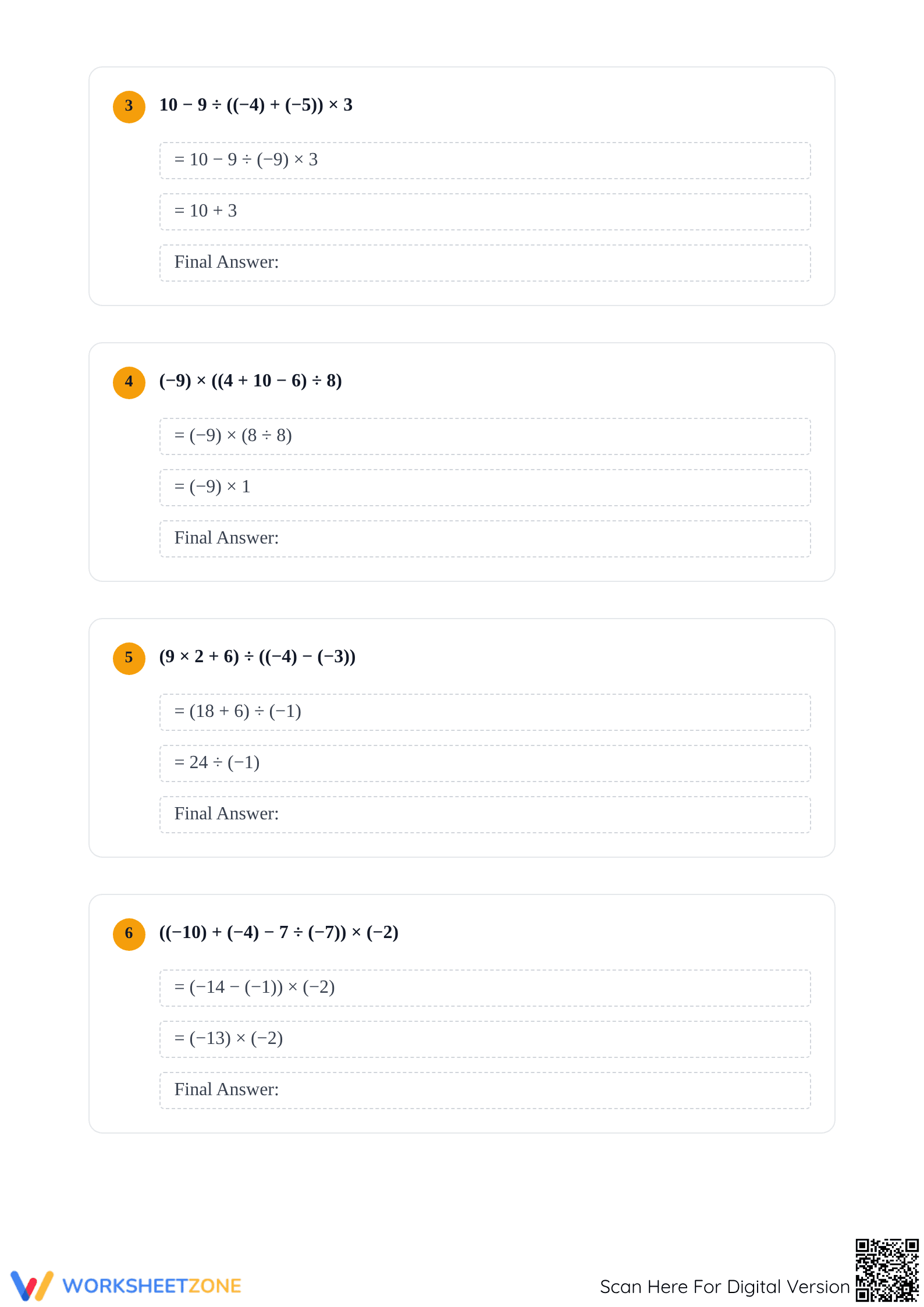
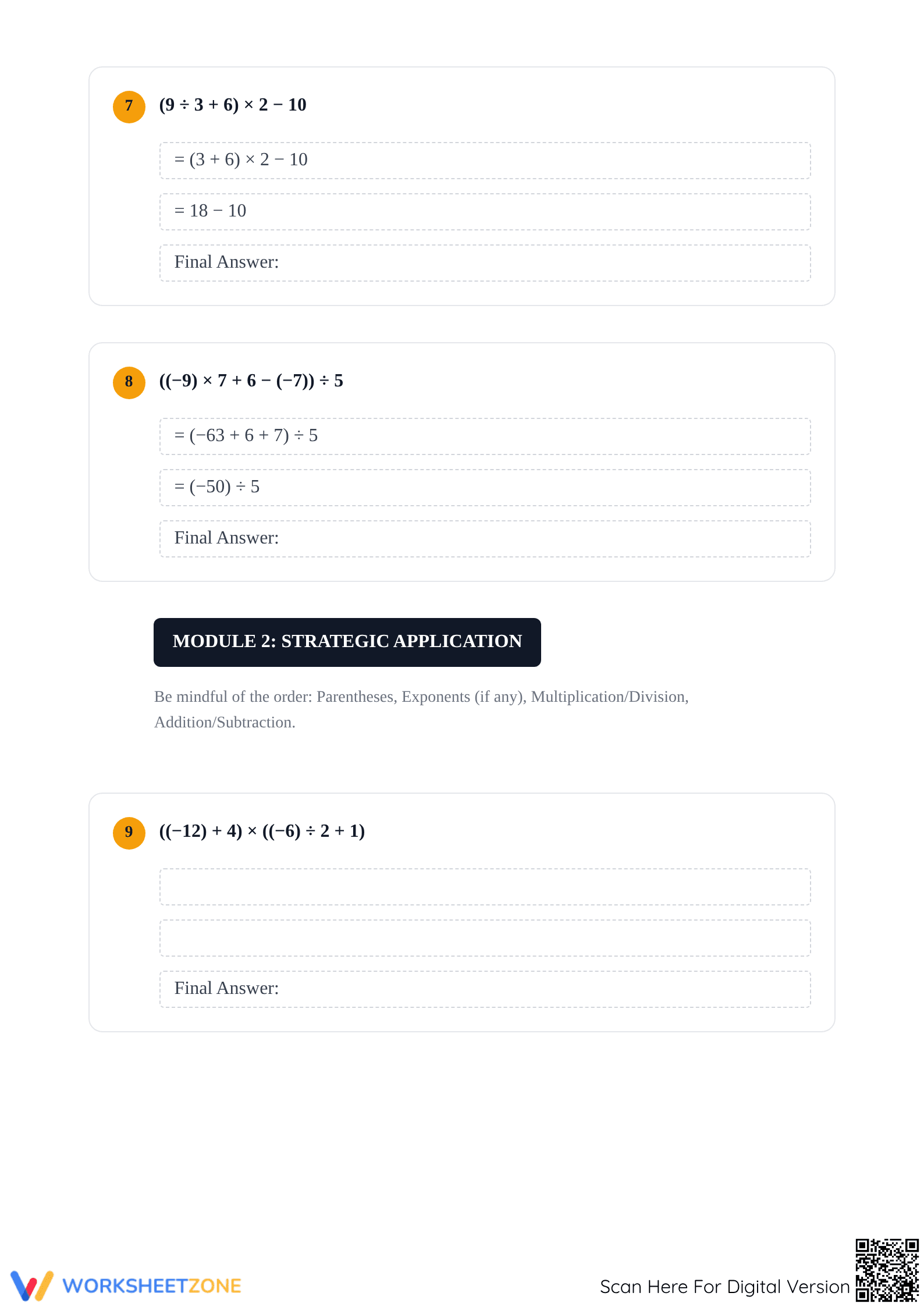
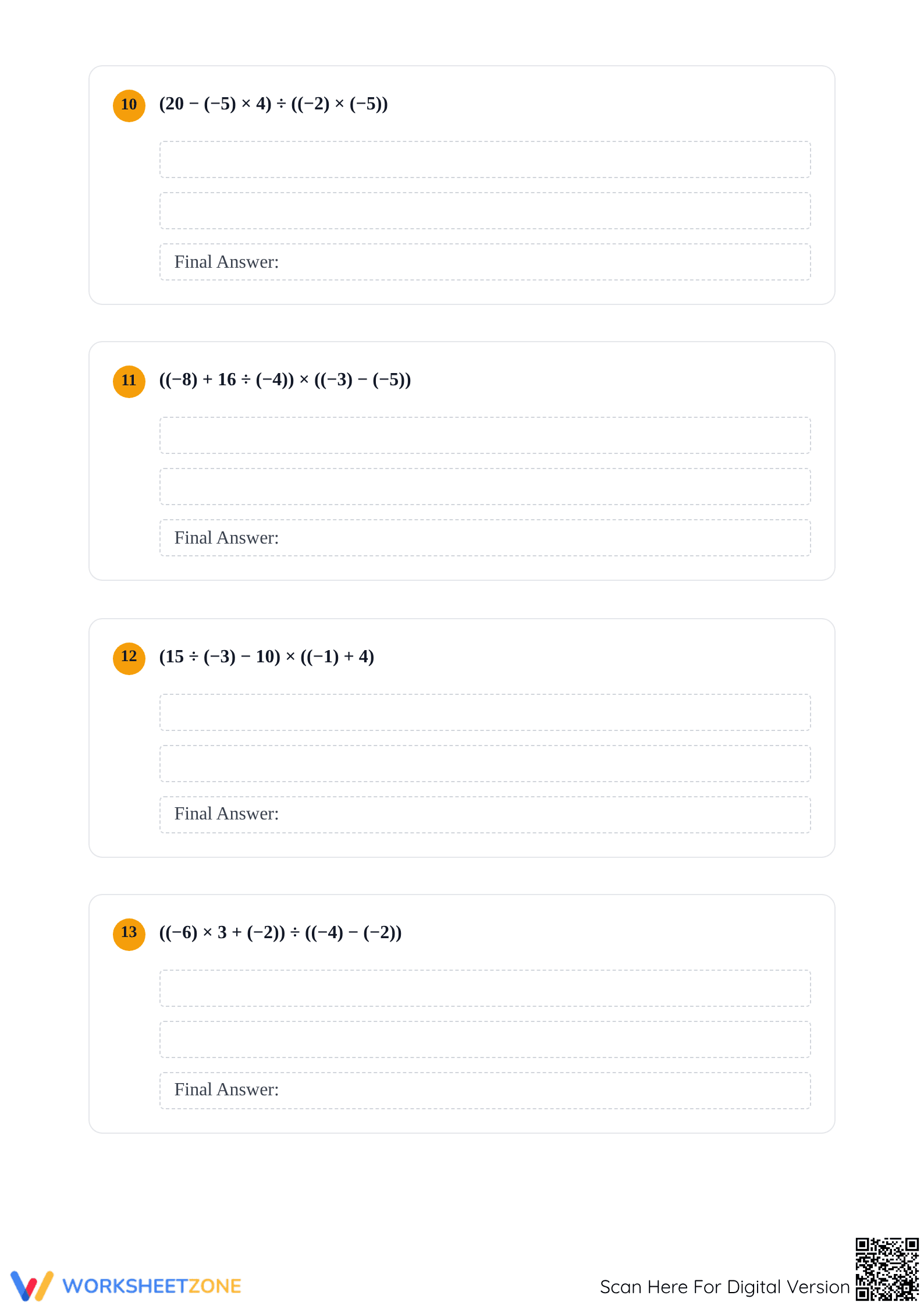

Essential Order of Operations with Integers | Grade 7 Math
Paste this activity's link or code into your existing LMS (Google Classroom, Canvas, Teams, Schoology, Moodle, etc.).
Students can open and work on the activity right away, with no student login required.
You'll still be able to track student progress and results from your teacher account.
Master complex mathematical expressions with this focused Order of Operations worksheet. Designed for middle school students, this resource provides targeted practice in evaluating 4-step expressions involving positive and negative integers. By following the standard hierarchy of operations, students develop the computational fluency and precision needed for higher-level algebra and long-term academic success.
At a Glance
- Grade: 7 · Subject: Math
- Standard:
7.NS.A.3— Solve mathematical problems involving the four operations with rational numbers- Skill Focus: Order of Operations (PEMDAS/BODMAS) with Integers
- Format: 5 pages · 16 problems · Answer key included · PDF
- Best For: Middle school math review or intervention
- Time: 30–45 minutes
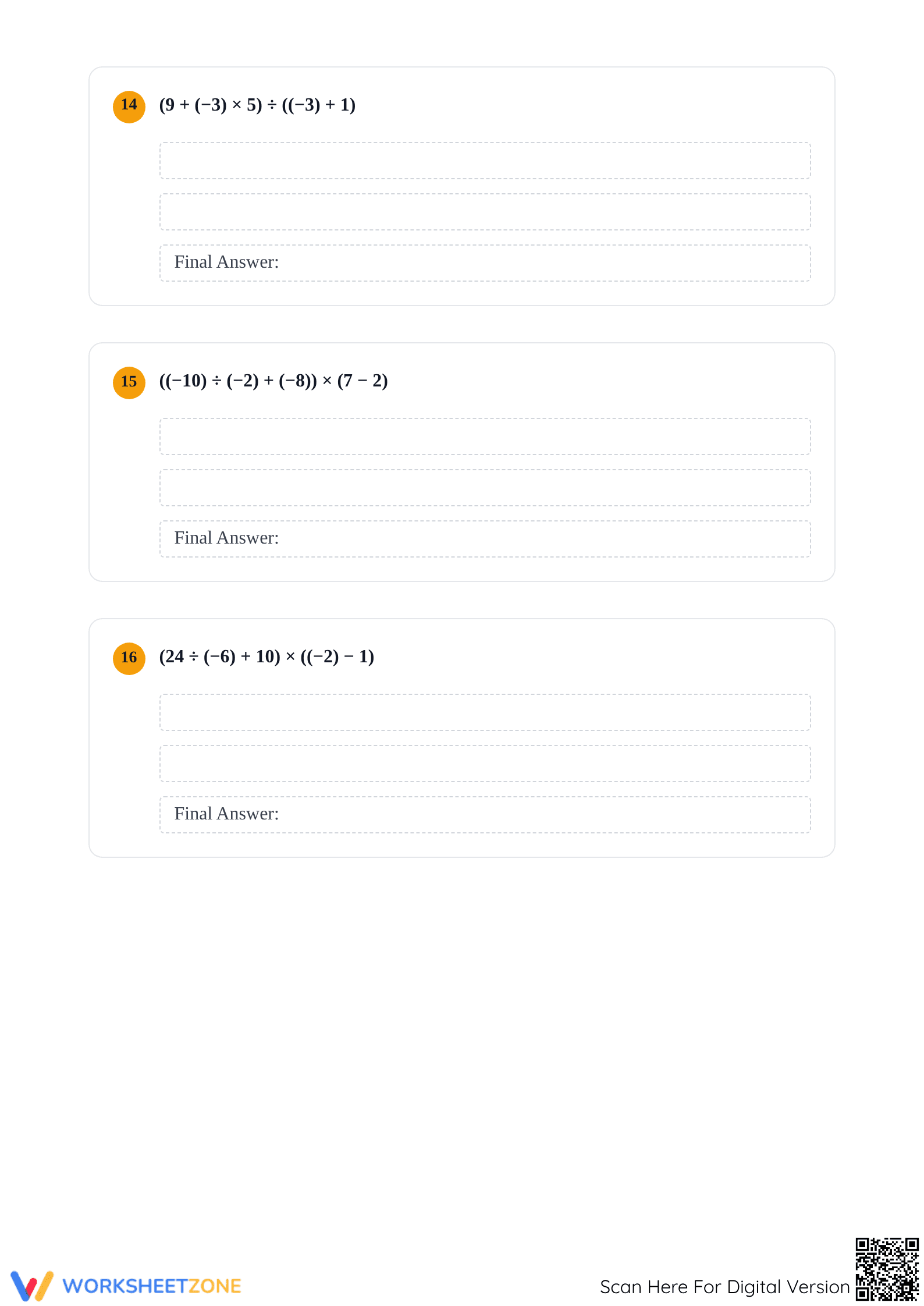
This comprehensive 5-page PDF features 16 structured mathematical problems spread across two distinct instructional modules. Module 1 focuses on standard review with worked scaffolding, while Module 2 challenges students with strategic applications. Each problem includes dedicated workspace for recording intermediate steps, ensuring that students visualize the sequential reduction of expressions while managing multiple negative values.
- Guided practice: The initial problems in Module 1 include explicit intermediate boxes to guide students through the first simplification steps, reinforcing the priority of parentheses and multiplication over addition.
- Supported practice: Problems 5 through 8 transition to a format that requires students to identify and execute the correct sequence with less visual prompting, though workspace remains provided.
- Independent practice: The Strategic Application module removes step-by-step scaffolding, requiring students to independently apply PEMDAS rules to complex multi-operator integer expressions.
This gradual release model ensures students build confidence before tackling rigorous challenges independently.
This worksheet is strictly aligned to CCSS.MATH.CONTENT.7.NS.A.3, which requires students to solve mathematical problems involving the four operations with rational numbers. It specifically addresses the computational precision required to handle negative values within multi-step parentheses. Both standard codes can be copied directly into lesson plans, IEP goals, or district curriculum mapping tools.
Deploy this resource as a primary practice tool during a unit on integer operations or as a robust review before assessments. Use it during the "You Do" phase of a gradual release lesson. Teachers should observe students at problem 9 to ensure they are correctly distributing negative signs. Most students will complete the 16 included tasks within 40 minutes.
This worksheet is ideal for 7th-grade math students mastering rational number operations and 8th-grade students requiring a refresher on algebraic foundations. It serves as an excellent resource for Title I intervention groups or as a no-prep sub plan. Pair this worksheet with an anchor chart detailing the PEMDAS acronym to support visual learners during independent work.
Effective instruction in the order of operations requires a structured approach to cognitive load management, as outlined in the NAEP (2024) mathematics framework. This worksheet leverages the "worked example effect" by providing intermediate steps in early problems, which helps reduce extraneous processing and allows students to focus on the procedural logic of integer arithmetic. Research by Fisher & Frey (2014) emphasizes that such guided scaffolding is essential for students to transition from procedural knowledge to conceptual mastery in middle school mathematics. By isolating the 4-step order of operations within a clearly defined workspace, this resource addresses the specific challenges students face when managing sign changes and operator priority simultaneously. This alignment with evidence-based instructional design ensures that the 16 included tasks drive measurable growth in computational fluency and mathematical reasoning across various learner profiles.


