


























Views
Downloads


Order of Operations Integers Worksheet | Grade 6 Essential
Paste this activity's link or code into your existing LMS (Google Classroom, Canvas, Teams, Schoology, Moodle, etc.).
Students can open and work on the activity right away, with no student login required.
You'll still be able to track student progress and results from your teacher account.
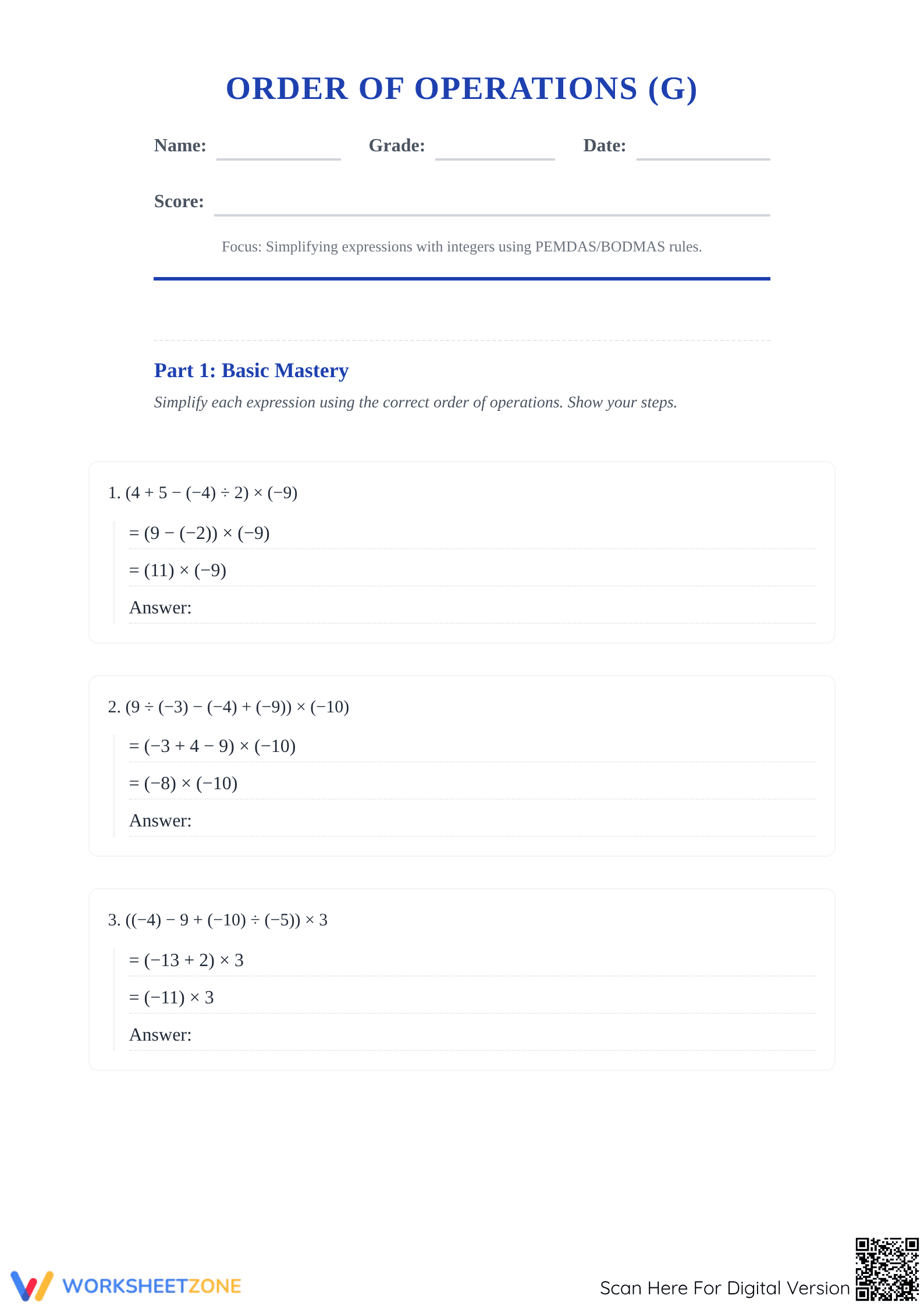
Mastering the order of operations with integers is a foundational requirement for middle school algebra. This comprehensive worksheet guides students through 21 carefully scaffolded problems using PEMDAS or BODMAS rules. Students will transition from basic expression simplification to complex multi-step integer calculations, ensuring they develop the procedural fluency needed for higher-level mathematics.
At a Glance
At a Glance
- Grade: 6 · Subject: Math
- Standard:
CCSS.MATH.CONTENT.6.EE.A.2.C— Evaluate expressions at specific values of their variables including whole-number exponents- Skill Focus: Order of Operations with Integers
- Format: 5 pages · 21 problems · Answer key included · PDF
- Best For: Independent practice and procedural mastery
- Time: 30–45 minutes
What's Inside
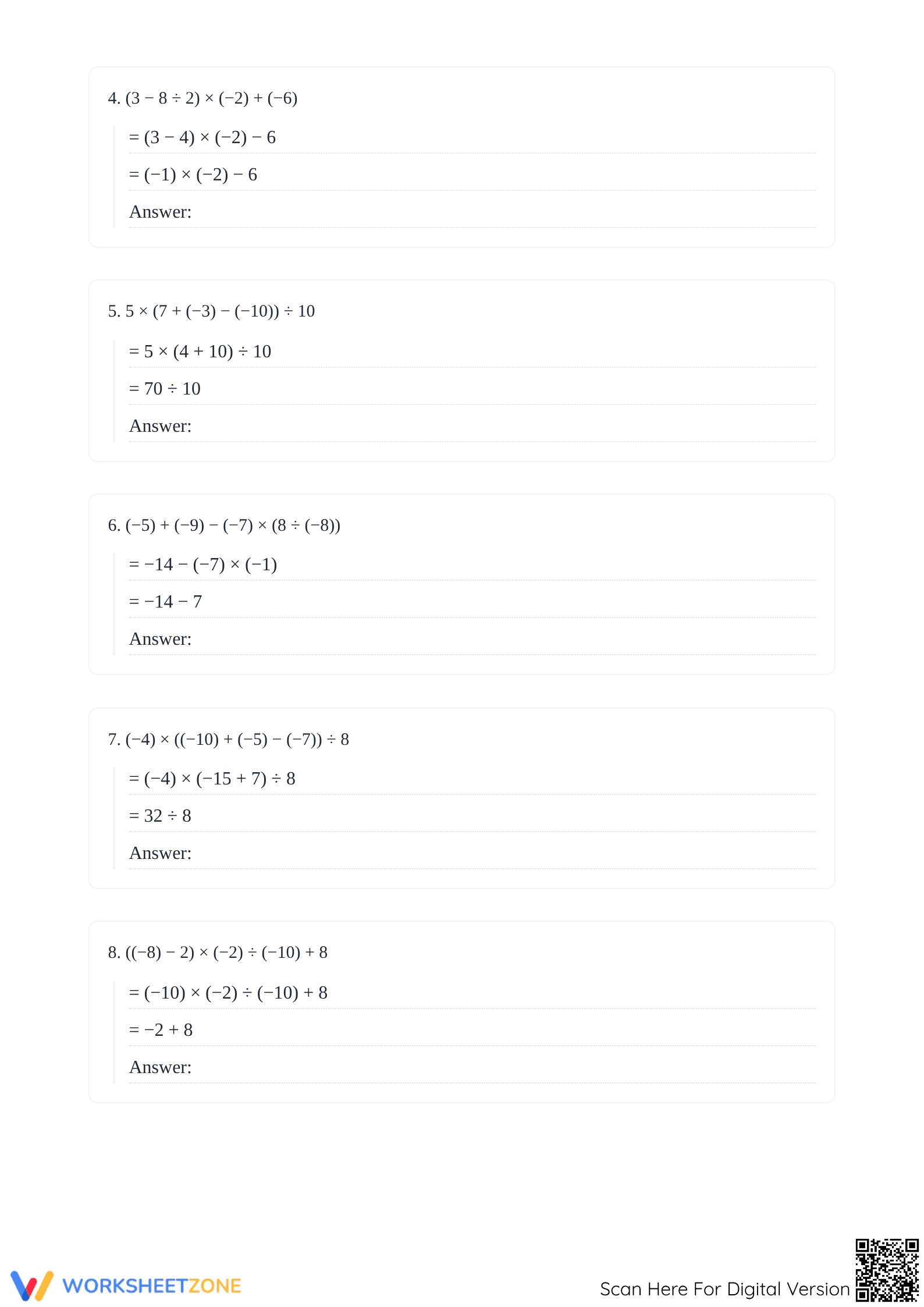
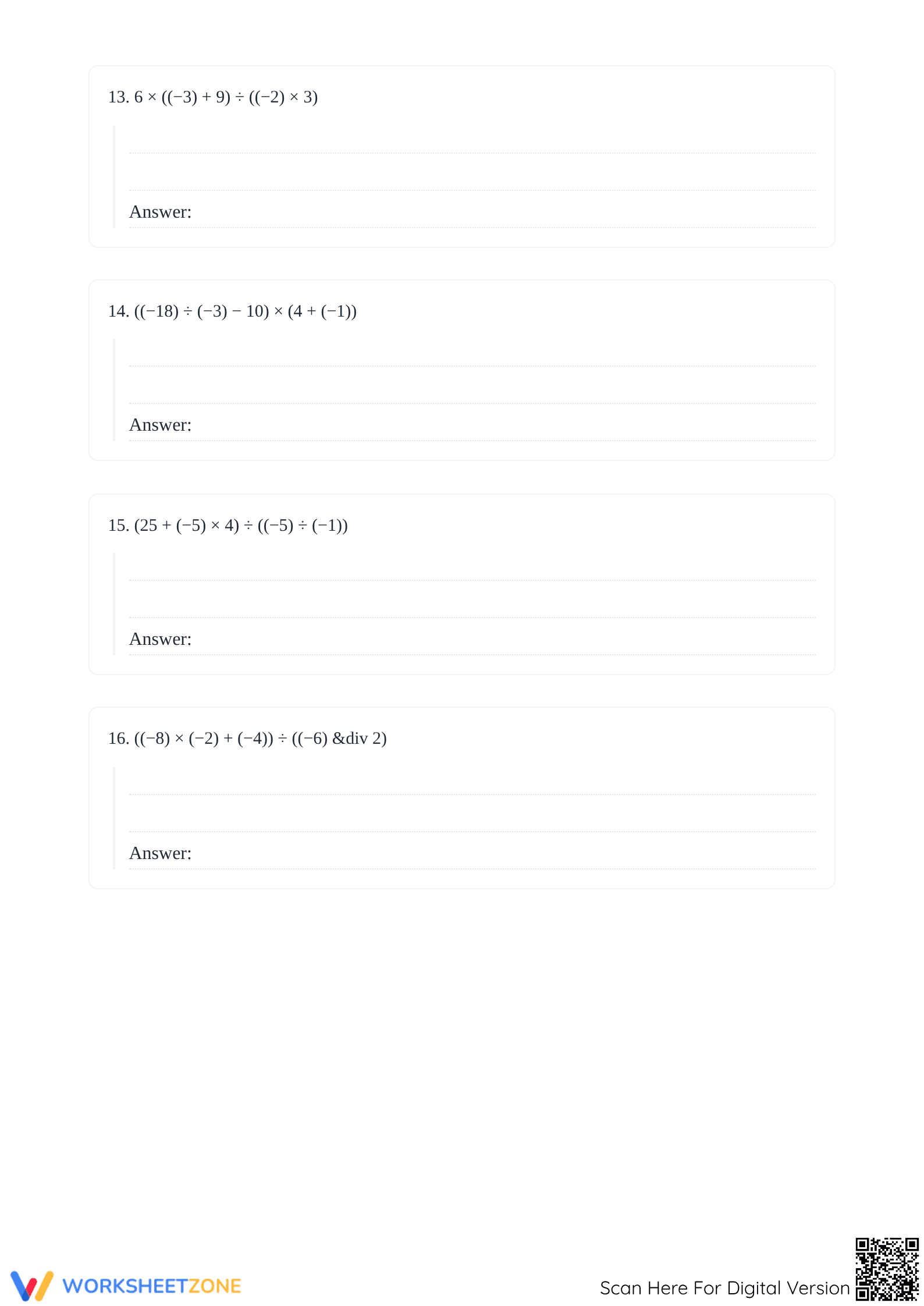
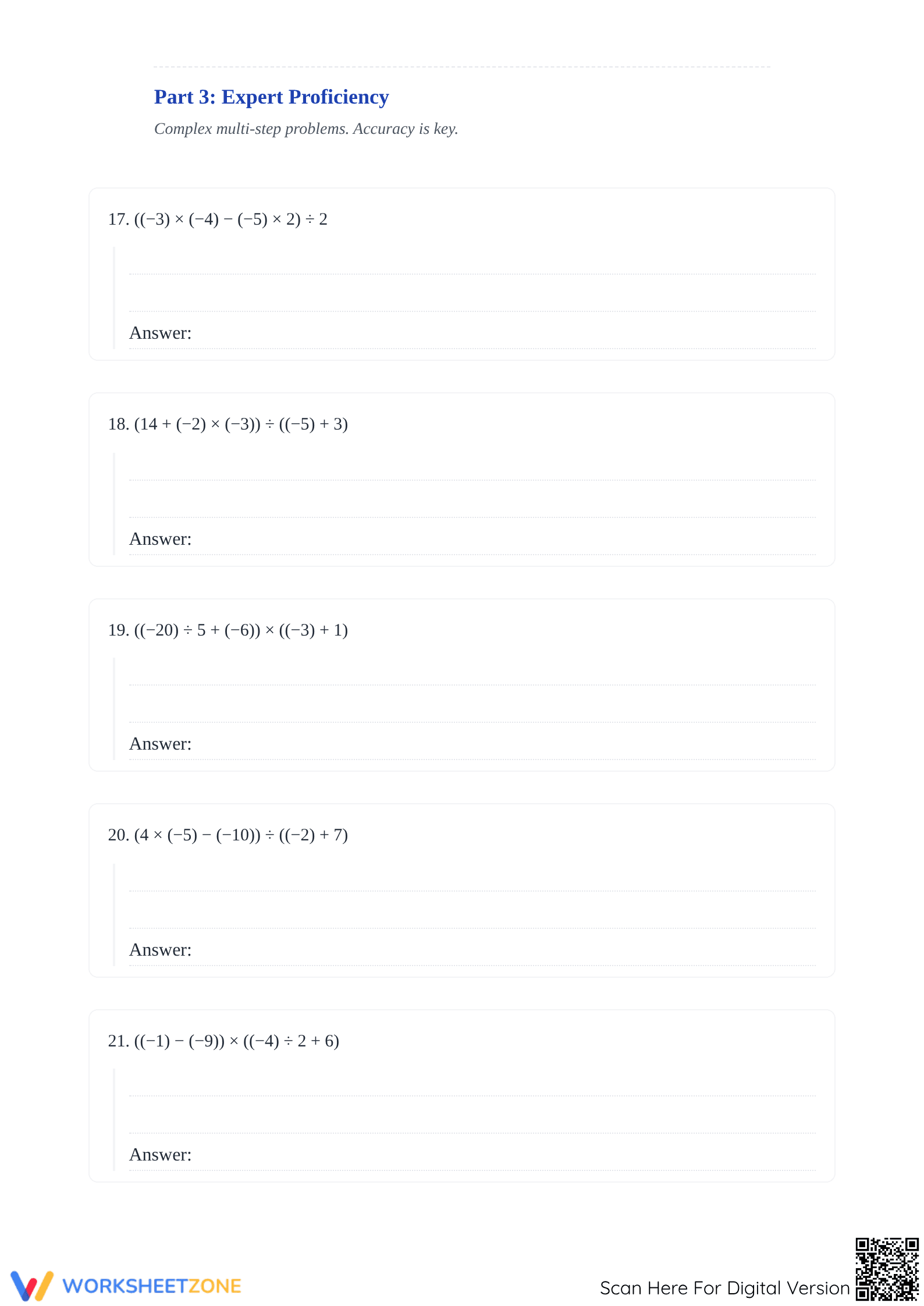
This five-page PDF resource contains three distinct parts designed to build student confidence. Part 1 features worked examples to model the correct steps for basic mastery. Part 2 introduces intermediate challenges involving double negatives and nested parentheses. Part 3 provides expert proficiency tasks that require precision. A full answer key is included for all 21 problems.
Skill Progression
- Guided Practice: The first three problems serve as instructional anchors with partially completed steps, modeling how to isolate operations within brackets and handle division before addition.
- Supported Practice: Problems 4 through 16 provide ample space for students to show their work as they navigate increasing complexity, specifically focusing on the interaction between negative signs and multiplication.
- Independent Practice: The final five problems remove all scaffolds, challenging students to apply the full hierarchy of operations to long-form expressions where precision and accuracy are paramount.
This approach follows the gradual release of responsibility model.
Standards Alignment
The worksheet is primarily aligned to `CCSS.MATH.CONTENT.6.EE.A.2.C`, which requires students to evaluate expressions using the order of operations. It also supports `CCSS.MATH.CONTENT.7.NS.A.3` by applying these properties to rational number operations. Both standard codes can be copied directly into lesson plans, IEP goals, or district curriculum mapping tools.
How to Use It
Distribute this worksheet during the practice phase of a direct instruction lesson on integer operations to reinforce the hierarchy of PEMDAS. For a formative assessment, have students complete Part 2 and check their work against the provided answer key to identify common misconceptions regarding negative integers. Expect most Grade 6 students to finish within 40 minutes.
Who It's For
This resource is ideal for Grade 6 and Grade 7 students who are bridging the gap between whole number arithmetic and algebraic expressions. It serves as an excellent remediation tool for Grade 8 students or as an enrichment activity for advanced 5th graders. Pair it with an integer number line anchor chart for maximum support.
Research from Fisher & Frey (2014) emphasizes that the gradual release of responsibility is critical for internalizing complex procedural skills like the order of operations. By providing worked examples followed by tiered challenges, this resource minimizes cognitive load while maximizing the opportunity for student success. A 2024 analysis by ScienceDirect on curriculum materials highlights that structured practice with integers significantly reduces error rates in later algebraic manipulation tasks. Specifically, the inclusion of 21 tasks allows for the repetition necessary to move from conscious calculation to automaticity. This worksheet aligns with the NAEP framework for mathematical complexity by requiring students to perform multi-step procedures with negative numbers, a known hurdle for middle-school learners. Educators can rely on this standard-aligned tool to provide high-quality, research-backed instruction that directly supports the development of mathematical fluency and algebraic readiness across various classroom settings.


