


























Views
Downloads

Essential Integer Order of Operations Worksheet | Grade 7
Paste this activity's link or code into your existing LMS (Google Classroom, Canvas, Teams, Schoology, Moodle, etc.).
Students can open and work on the activity right away, with no student login required.
You'll still be able to track student progress and results from your teacher account.
Mastery of integer operations requires precision and a firm grasp of procedural hierarchy. This worksheet provides a comprehensive laboratory for students to practice the order of operations—PEMDAS—with positive and negative numbers. By moving from basic three-step expressions to complex equations with nested brackets and exponents, learners build the computational fluency needed for algebraic success.
At a Glance
- Grade: 7 · Subject: Math
- Standard:
7.NS.A.3— Solve mathematical problems involving the four operations with rational numbers- Skill Focus: Order of Operations with Integers
- Format: 5 pages · 32 problems · Answer key included · PDF
- Best For: Intensive skill practice and summative assessment
- Time: 45–60 minutes
What's Inside
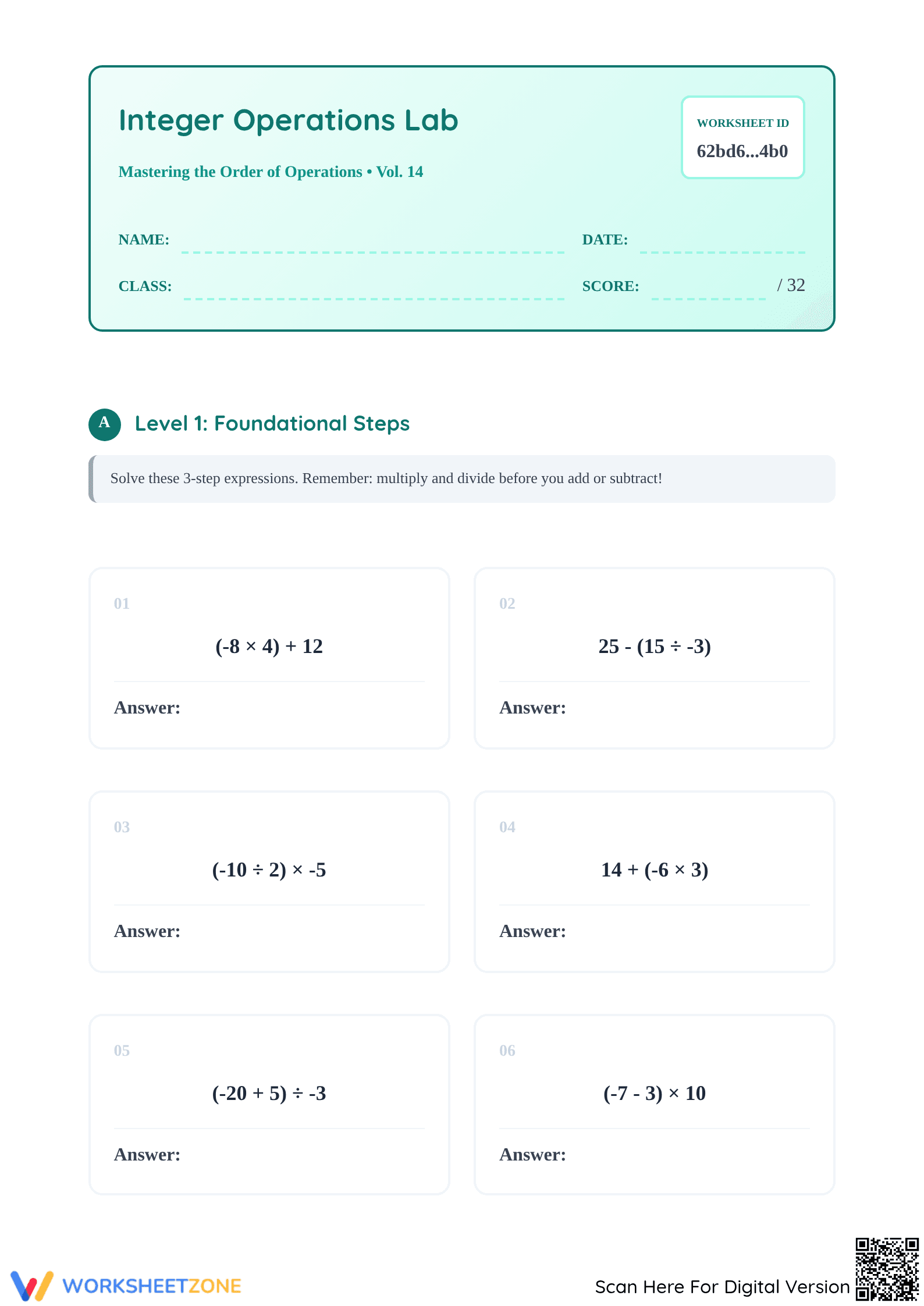
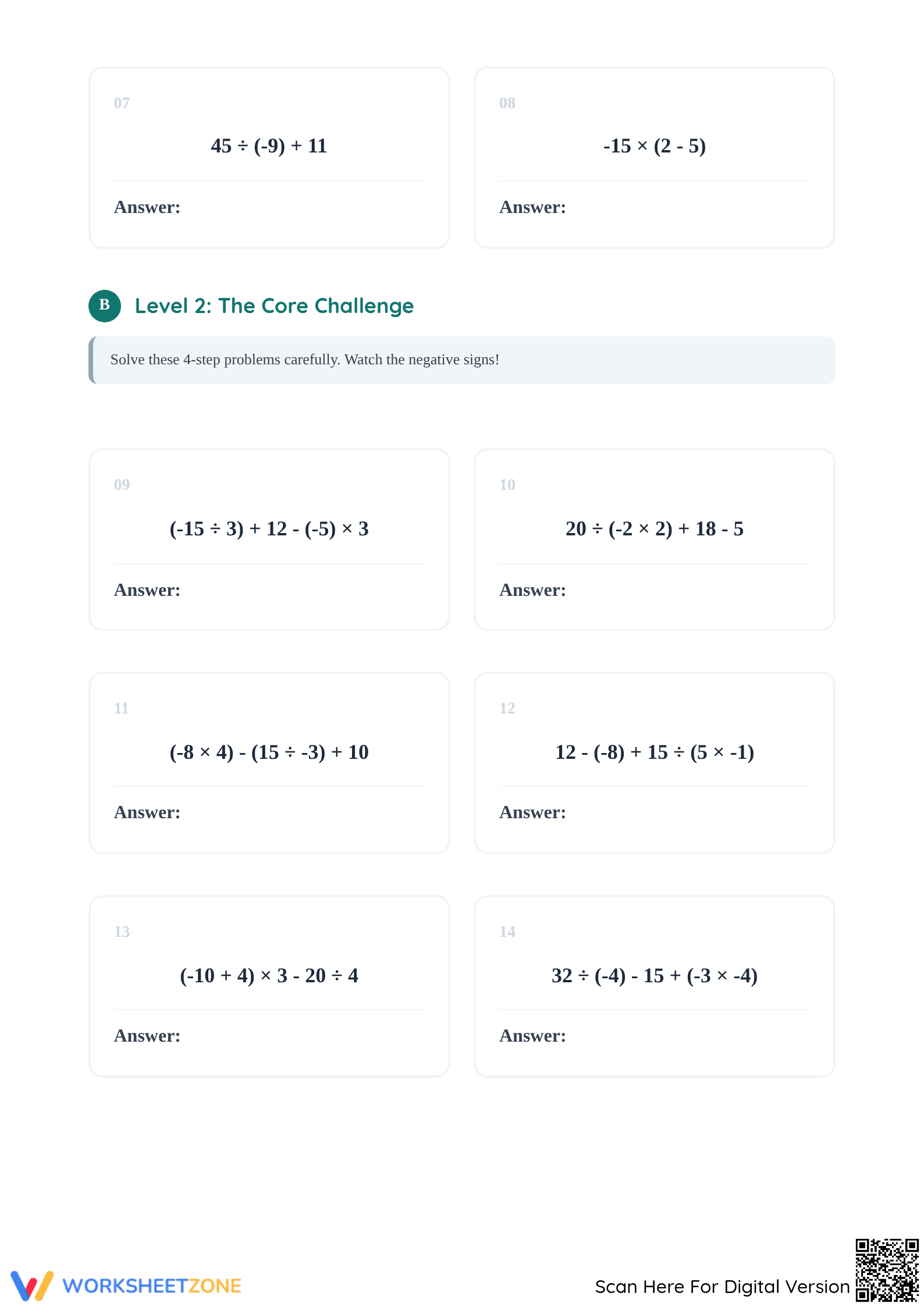
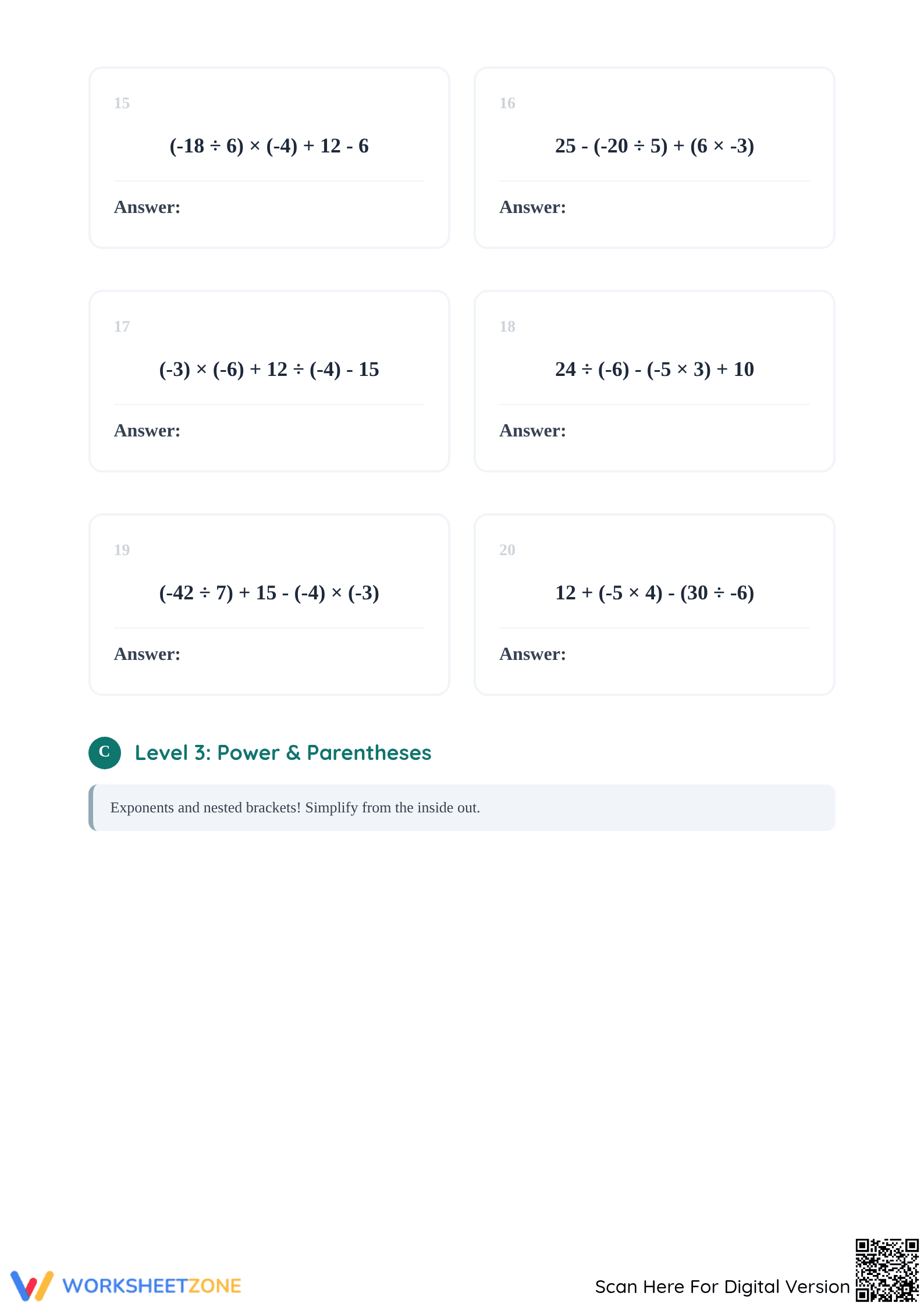
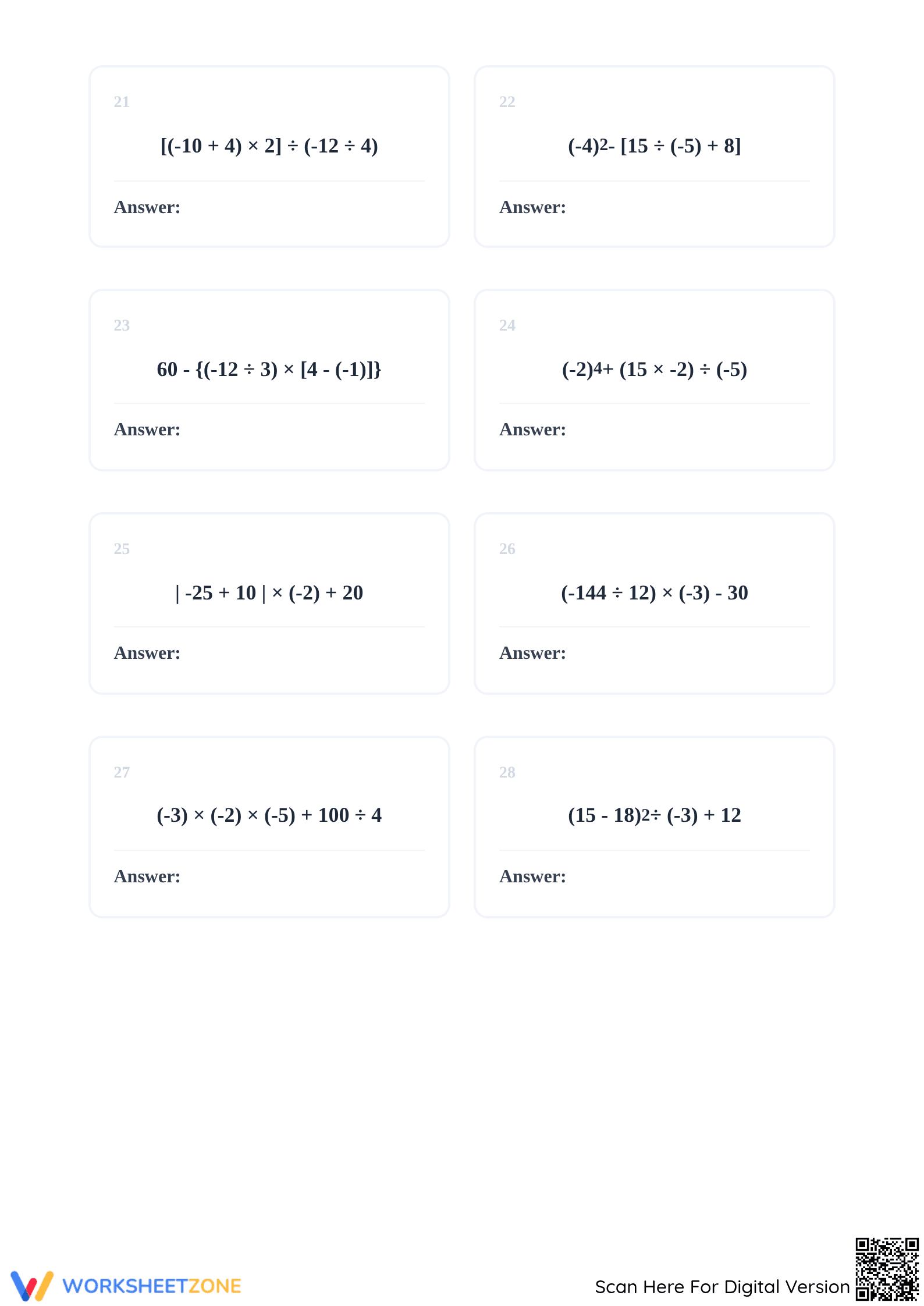
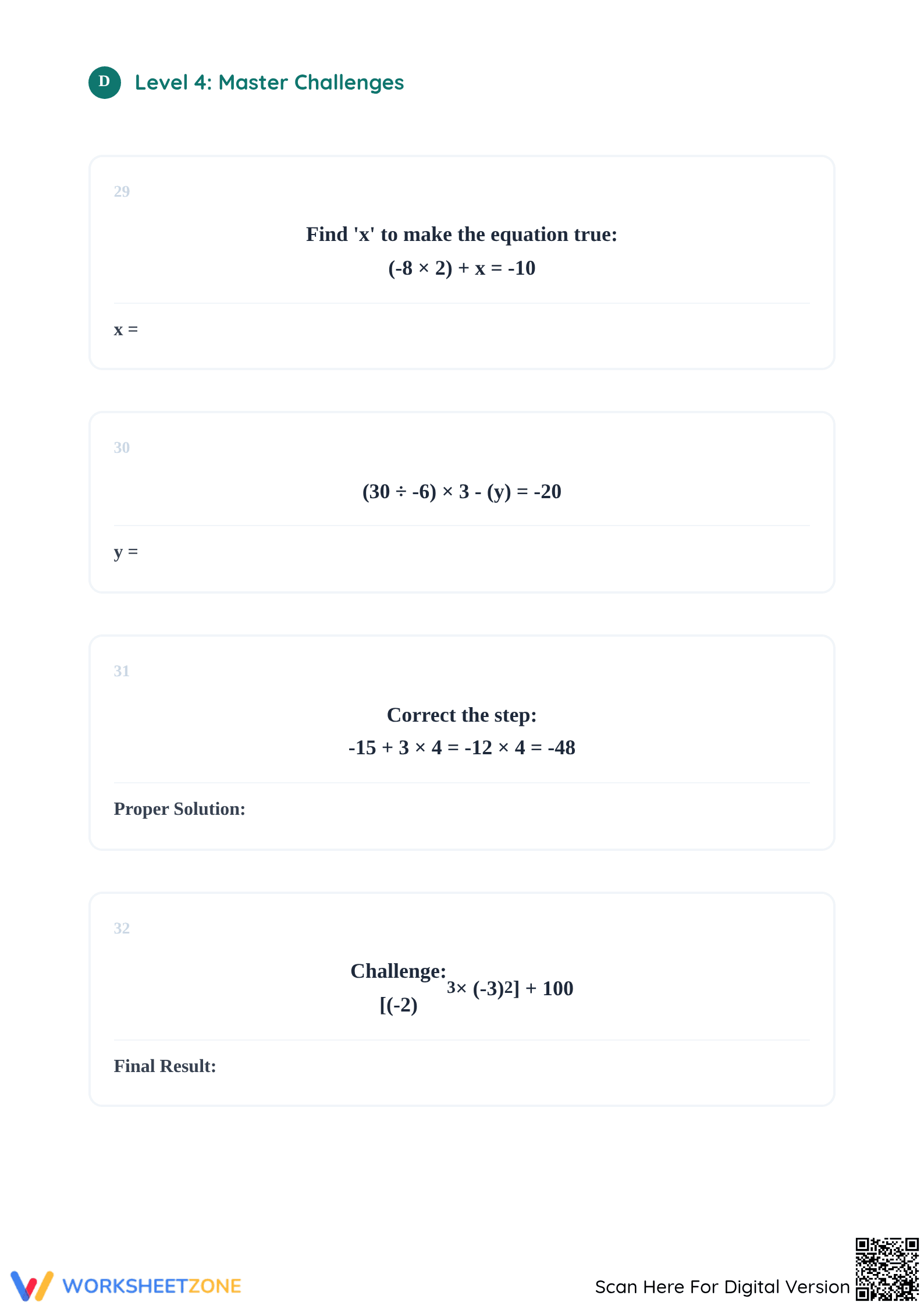
This five-page "Integer Operations Lab" packet contains a curated sequence of 32 mathematical expressions. The layout is clean and professional, featuring dedicated answer spaces for every problem. The packet includes a full answer key, enabling immediate feedback. Structural supports include clear level headings that signal increasing complexity, helping students self-monitor their progress through foundational, core, and master challenges.
Skill Progression
- Guided Practice (Foundational): problems 1 through 8 focus on 3-step expressions, reinforcing the priority of multiplication and division over addition and subtraction within an integer context.
- Supported Practice (Intermediate): tasks 9 through 28 introduce 4-step problems and the integration of exponents and nested brackets, requiring students to simplify from the inside out.
- Independent Practice (Advanced): the final problems present master challenges, including solving for unknown variables and identifying errors in multi-step solutions to demonstrate deep conceptual understanding.
This gradual release of responsibility ensures students master basic mechanics before tackling high-rigor algebraic reasoning.
Standards Alignment
The primary standard addressed is 7.NS.A.3, which requires students to solve mathematical problems involving the four operations with rational numbers. This worksheet specifically targets the application of these operations to integers while adhering to the standard order of operations. Both standard codes can be copied directly into lesson plans, IEP goals, or district curriculum mapping tools.
How to Use It
Use this resource as a summative assessment at the end of a unit on rational numbers to gauge individual mastery of PEMDAS. Alternatively, assign specific levels as tiered homework to match student readiness during the instructional cycle. During completion, observe whether students are performing horizontal or vertical simplification; those struggling with negative sign carryover may benefit from using colored highlighters to track operators.
Who It's For
This resource is designed for Grade 7 students but is highly effective for Grade 8 review or Grade 6 accelerated learners. It is an ideal pairing for an anchor chart on integer rules or a direct instruction lesson on evaluating complex expressions.
Academic success in middle school mathematics hinges on the transition from arithmetic to algebraic thinking. According to a ScienceDirect TpT Analysis (2024), structured practice that incorporates increasing levels of cognitive demand improves retention of procedural hierarchies like the order of operations. This worksheet aligns with those findings by offering 32 problems that target standard 7.NS.A.3. By isolating the skill of integer operations within the PEMDAS framework, the resource ensures students develop the precision required for higher-order math. The inclusion of challenge tasks requiring error analysis further supports mathematical reasoning and self-regulation. Educators can utilize this comprehensive five-page packet to provide evidence-based intervention or as a core component of their rational number curriculum, ensuring that every learner achieves computational fluency with positive and negative numbers in complex scenarios.


